Jules and Ringo on the Week in College Football

October 19, 2014

(Guest Post by Matthew Ladner)

C’mon Yolanda- what is Fonzie like?!?

Cool?

Correcto-mundo! And that’s what we’re gonna be, we’re gonna be cool. Now Ringo, I’m gonna count to three, and when I do, I want you to let go of your gun, lay your palms flat on the table, and then tell me what happened in college football this weekend. But when you do it, do it cool. Ready?

What?

Say what again! I dare you! I spent the weekend detailing a car with a toothbrush, I missed all the college football games and I am NOT IN THE MOOD. One, two, THREE!!!

Alright mate (puts gun down)

Good- now tell me what happened.

So…it breaks down like this- Florida State beat Notre Dame on a controversial late call, but it probably doesn’t matter ’cause the selection committee is going to recognize the fact that the Irish outplayed the Seminoles on their home field. So if the Irish win out, I think they will still make the playoff. IF they do, they might get the chance to play FSU on a neutral field.

I would like to see that! Go on….

Oklahoma got beat by Kansas State, so that’s their second loss and they are out unless things go 2007 levels of weird. Baylor also had their first loss at West Virginia, and they looked bloody sloppy doing it.

Would you say that they are eliminated Ringo?

No I would not say they are eliminated, but they had better get their act figured out quick because TCU and Kansas State will be competing with them for a Big 12 birth, if there is going to be a Big 12 birth. TCU looked really strong beating up on Oklahoma State.

Too bad they blew that huge lead last week. What about the Big 10?

Michigan State, Nebraska and Ohio State all beat middling conference opponents, but that will all sort itself out eventually. They all have lost a game already so no guarantees.

How about the West?

Oregon, Utah and Arizona State are still in the running after victories this weekend. Arizona was off this week but also has only one loss.

What else happened this weekend? Anyone send a message? I mean besides Florida State?

Alabama sent one loud and clear by beating Texas A&M 59-0.

59 to nothing? Just a couple of years ago they were selling t-shirts claiming that A&M was like the moon ’cause they ‘control the Tide.’ Well well well- a’int nobody gonna shepherd them through the valley of SEC West darkness!

They’ve been blown out three weeks in a row…

THREE.WEEKS.IN.A.ROW! That is just inspiring. Now…reach in the bag and hand me my wallet.

How will I know which one it is?

You’ll know it when you see it.

(Finds wallet)


Now this is the situation. Normally both of you would be dead as fried chicken. But you happened to pull this while I’m in a transitional period. I don’t wanna kill ya, I want to help ya.  What’s in my wallet Ringo?

Don’t you mean ‘what’s in your wallet’ mate?

Don’t get cute Ringo- open the wallet!

(Opens wallet)

Two tickets to the college football national championship game in ATT stadium?!?

Correct. Put them in your pocket Ringo-they are yours. Now with the rest of them wallets and the register, that makes this a pretty successful little score. I ain’t just givin’ it to you. I’m buyin’ somethin’ with those tickets. Wanna know what I’m buyin’ Ringo?

What?

I TOLD you NOT to say that!!!!

Sorry!

Your life Ringo. I’m givin’ you those tickets so I don’t have to kill you. You read the Bible?

Not regularly.

There’s a passage I got memorized….nevermind, it’s not a real verse anyway. Take the tickets and get out of here before I change my mind. I’m almost certain that the Tide will be rolling into Jerry-world so you’d best get out of here before I snap out of it.


The Trouble with Baking Achievement Gap Measures into State Accountability Systems

October 17, 2014

(Guest Post by Matthew Ladner)

On March 9, 1974 Yoshimi Taniguchi, a Japanese book merchant and former Major in the Japanese Imperial Army, traveled to the Philippines in order to order a former subordinate, Second Lieutenant Hiroo Onoda to stand down from combat operations. Lieutenant Onoda had received news of Japan’s surrender in World War II, but had concluded that it was mere enemy propaganda. Firm in this misapplied conviction, Onoda carried on a long since concluded war for almost 30 years.

Onoda may have misspent three decades in an island jungle, but on a positive note he at least inspired an episode of Gilligan’s Island (Ginger in fact defeated his doppelganger in a judo battle).  More disturbingly, he may have also passed his die-hard spirit on to NCLB’s last stalwart defenders of achievement gap mania and the dream of mandated perfection.

I should begin by saying that I do believe that achievement gaps are very important. I went back to review a post I wrote a blog post three years ago called In Defense of Achievement Gap Mania and found nothing that I had changed my mind about on this subject.  Getting low-performing American students on a faster academic pace is of the utmost importance.

I am however mystified by the Onoda-style defense of NCLB’s unworkable division of schools into multiple subgroups with targets for narrowing and ultimately closing all achievement gaps on the equivalent of a train schedule. That would have all been enormously beneficial if it had worked, but let’s just say that the trains weren’t showing much sign of arriving on time, sometimes at all. We could discuss various ways states found to escape from the NCLB subgroup noose at length (hello n-size manipulation!) but there are deeper problems to discuss.

Today we find NCLB diehards sprinkled throughout the K-12 reform conversation archipelago. In this recent post on Eduwonk, Anne Hyslop  goes Banzai! corrects factual problems in a recent New York Times story focusing on the flaws of NCLB. My own take on this is that Hyslop is probably completely correct in her assertions. I however believe that they are largely irrelevant to the bigger picture.  When I read a paragraph explaining how technical mumbo jumbo safe harbor confidence intervals actually mean that the mandated 100% proficiency mandate doesn’t actually arrive until 2016 instead of in 2014, it makes me chuckle. Do we imagine that when educators read the fine print they will rush to embrace NCLB’s machine of mandated universal proficiency with open arms? Or would it be more accurate to say that many educators never took AMO schedules seriously in the first place, confident that they would be dropped (they were- through the waiver process).

Ed Trust released a report recently critical of NCLB waivers. I personally don’t like NCLB waivers either given the Secretary’s lack of obvious authority to grant conditional waivers, but that is not what has Ed Trust excited. They think that the Secretary ought to have used his non-existent conditional waiver authority to mandate gap closing measures into state accountability systems.

Stand down Lt. Po…that’s an ORDER!

Ed Trust is careful towards the end of their study to say that they are NOT calling for a return to NCLB’s multiple pathways to failure based on myriad subgroups in pursuit of mandated improvement on a schedule. Hey its 2014 and they aren’t that crazy, you see, they just seem to want Secretary Duncan to work something out with these states that will be the functional equivalent of NCLB’s multiple pathways to failure based on myriad subgroups in pursuit of dramatic improvement by mandate on a schedule. That would do just fine.

Ed Trust (and others) seems sufficiently wedded to NCLB-era mechanics that they dislike an elegant improvement-the super subgroup. Florida policymakers grade schools half on proficiency (the % passing state exams) and half on student progress over time. They double-weighted the importance of the progress of the lowest performing 25% of students from the last year’s test. The students falling behind thus constitute the “super subgroup” and they became the most important students in the building for determining a school’s grade. They count against all three of the main three components of a school grade: overall proficiency, overall growth and the growth of the students who have fallen behind.

The super subgroup doesn’t ask whether you are White, Black, Asian, American Indian, economically disadvantaged, an English Language Learner or a child with a disability, blue-eyed or left-handed. It simply identifies the lowest performing children in the school and puts a special emphasis on their academic gains over time.  It doesn’t create a perverse incentive to ignore an academically struggling child because he or she happens to be White, or because his or her parents make a little more money than this year’s Free and Reduced Lunch standard or because you’ve been reclassified out of SPED. Done properly, super subgroup creates a powerful incentive to identify struggling students regardless of their appearance and/or circumstances and get them making progress.

Oh, and the Ed Trust’s own previous research would lead one to the conclusion that it can help reduce achievement gaps. Not eliminate achievement gaps on a train schedule, mind you, but to make substantial progress on them by creating an incentive for schools to get struggling students to catch up. Who are the kids struggling? Why it is the kids on the short end of the achievement gaps as a matter of fact.  Florida kept A-F school grading up over a good period of time and you see gaps narrow in the best way possible- bottom scoring kids making greater progress than the still progressing top scoring kids.

The Ed Trust report tut-tuts things like Black students in A graded Florida schools scoring lower than White students in C graded schools as evidence that we ought to be including gap closure in state accountability systems.

Should we work ourselves into a froth about this? I personally don’t think so. Ed Trust’s own research has documented Florida’s overall progress in narrowing achievement gaps, but it’s not like they have eliminated achievement gaps. Would anyone be shocked to learn that ELL students at A graded schools score lower than non-ELL students at C schools? What about children with disabilities? Low-income children?  Ed Trust focused only on three states, but you could find similar results in any state.

The super-subgroup mechanism creates an incentive to get all students who have fallen behind to make academic progress. A moment of reflection regarding grading schools based upon various achievement gaps would give any thoughtful person pause. Do we really want to bake perverse incentives to stall the progress of high performing students into state accountability systems? Under the super sub-group, schools have any incentive to get any child that has fallen behind back on track. If states began rating them based on trends in achievement gaps, they could create perverse incentives to ignore their plight if they happened not to have a disability, or if they were a native English speaker, if their family made too much money for a free or reduced lunch, or if they were White.

Against this backdrop, the Ed Trust report seems strategically vague- not in favor the NCLB AYP system, but vaguely in favor of including achievement gaps in state grading systems. The fuzzy nature of these recommendations deftly avoids discussion of how to avoid creating cringe-inducing perverse incentives.

We live in a nation where Black and Hispanic students score closer on PISA to students in Mexico to those in South Korea or their own Anglo classmates. Mexico, btw, has far greater poverty and far lower public school spending than the United States. This is sickening, but we should exercise good judgment in addressing it. Previous Ed Trust research and the NAEP both show that it has achieved commendable gains in narrowing achievement gaps in Florida. In the country as a whole, not so much.

Thinking more broadly, we should recognize the NCLB era as a decentralized learning process. While NCLB created a general accountability rubric, many states had already created accountability systems of their own, creating the opportunity to learn from variations in policy approaches. Florida paid far more attention to school grades than to NCLB’s AYP and achieved greater than average gains among traditionally disadvantaged student groups.  I’m not a fan of conditional waivers, but we need to study and learn from the successes and failures of the diversity of approaches as best we can as well. It is understandable that there are many with a deep investment in NCLB, but we should not allow that attachment to blind us to something more effective at achieving its aims. The importance of achievement gaps should lead us to adopt the most effective methods for reducing them rather than pining for the ones we had hoped would eliminate them in short order.




Thibaut Scholasch and Sébastien Payen for the Al

October 16, 2014

(Guest Post by Matthew Ladner)

So Scholasch and Payen are Frenchmen who are well on their way to revolutionizing the art of making wine, and perhaps agriculture more broadly. They however have faced years of reactionary opposition and general inertia in the wine making community. No good deed goes unpunished in this wicked world, but I for one hope that these two guys become incredibly wealthy and give their skeptics something to cry about through the best sort of revenge- living well.

Wired profiled Scholasch and Payen in 2012 in an article titled the Vine Nerds. Scholasch and Payen are French ex-pats who met in California. Scholasch had worked in vineyards in Napa, France and Chile and came to feel like a scientist trapped in a profession of artists. Scholasch had an unusual desire to improve the process of making wine, which apparently verges on the blasphemous in some circles. Techniques developed in 12th Century France represent the apex of agricultural technology you see, and anyone trying to update them is something of a public menace. A mutual friend introduced Scholasch to Payen, another French ex-pat. Payen holds a Ph.D. in Mechanical Engineering from UC Berkeley. As a graduate student Payen designed a novel micro-biosensor. They teamed up to form the Fruition Sciences company, which installs sap sensors to provide real-time data on crops, in this case grapes. The technology allows wine makers to give their vines just the right amount of water precisely when needed- a substantial improvement over tasting dirt, spitting it out, and irrigating fields early and (too) often.

You can read their bios here and how the process works here. Basically their process allows wine makers to make better wine while using only a fraction of the water typically employed.

Some wine makers gave Scholasch and Payen a shot, and became believers. From the Vine Nerds:

Austin Peterson, is one of Fruition’s most vocal supporters and attests to changes the sensor arrays can produce. ‘Before, irrigation management was basically done by our vineyard foreman looking at next week’s weather forecast and at leaves that were starting to fold or tendrils that were drying,’ Peterson says. ‘But visual cues can be misleading. As we started to see the data, it started to explain some things.’

Before becoming a convert, Peterson needed to see proof. In 2007 he divided Ovid’s 15-acre property in half, using the visual method on one side, sensors on the other. Following traditional visual cues led to a regimen of shallow irrigations, which required more water and resulted in unintended side effects, like shriveled grapes and elevated alcohol levels. It also may have helped slow the ripening process and delay the harvest, which is always risky in Northern California, where early autumn rains can destroy a crop in a matter of days. Meanwhile, data gathered from the sensors dictated a near-opposite approach: fewer, deeper irrigations, primarily later in the season. After two years, the result was substantial water savings and earlier harvests. For Peterson, the experiment shed light on how profoundly irrigation affects fruit quality as well as a wine’s flavors and bouquet. ‘It was like going from having an undergraduate degree in something to a PhD, where you have a deep understanding of why vines behave the way they do’ Peterson says. ‘As a winemaker, you understand different flavors. But now you start to understand why the differences exist.’

So it turns out that wine makers have been over-irrigating their vineyards in Napa for decades and producing lower rated wine as a result. One client interviewed by Wired stated that they had dropped their water use from 36-64 gallons per vine to 0-10 gallons. They reckoned this would save them 5.8 million gallons of water and produce better wine in the process. Project that out across California, and it gets to something like a potential savings of 9.1 billion gallons of water per growing season.

Did I mention that the Southwest United States is experiencing a huge drought? It looks something like this (color = bad, dark = worse):

Agricultural technologies that help you get by with less water might come in handy about now, especially in California. So you make much better use of an increasingly scarce resource to produce a better product. Better still, this technology is branching out beyond wine to increase the productivity of other sectors of agriculture. Scholasch and Payen are just two of the most recent entrepreneurs in a long line that have repeatedly thwarted Malthusians and neo-Malthusians through the driving force of voluntary exchange.

The process of updating agriculture sounds almost as frustrating as education reform. After an enthusiastic embrace of the technology by an expert in rice cultivation, Wired noted Scholasch’s reaction:

Scholasch lowers his eyes and shakes his head. ‘The first sap-flow sensors were tested in the ’80s. What we have in place was usable in the early ’90s—and look, it’s taken 20 years to start using it,’ he says, then gives a quick smile, betraying a glimmer of hope. ‘But it’s very rewarding to get recognition from peers you respect. It’s an accreditation.’

Hang in there guys- and remember the motto of the Economist “to take part in a severe contest between intelligence, which presses forward, and an unworthy, timid ignorance obstructing our progress.” No one ever said it would be easy, but the difficulty of your struggle will only make your eventual triumph all the more flavorful- like your wine, it will get better with age.


Why is the man with the goatee smiling?

October 16, 2014

It might have something to do with this new report from MDRC showing a 9.4% increase in graduation rates in NYC in the “small high-schools” initiative. Students attending small high schools attended college at an 8.4% higher rate as well.

So just to review, Gates FF had a winning strategy on their hands- it had a plausible theory but not much empirical support. Sadly they dropped this strategy before waiting for empirical evaluations, which continue to pile up and have strongly positive results. The siren call of central planning lured them into an endless quagmire that also lacks empirical support (see Hanushek and Loveless) and also lacks a plausible theory of change. Small schools now lacks neither of these things.

There’s one obvious solution to all of this- he’s tan, rested and ready and he’s bringing back socks and sandals! Or perhaps it would be more accurate to say that he is bringing in socks and sandals for the first time. Regardless- bring back Tom Vander Ark!


The Play’s the Thing

October 15, 2014

T2 audience

Our study of what students learn from seeing live theater is now available at Education Next.

We randomly assigned school groups to see live performances of Hamlet and A Christmas Carol. We found large increases in knowledge about the plots and vocabulary of those plays — much larger than students experienced from being assigned to read or watch movie versions of those works. We also observed increases in tolerance and the ability to read the emotions of others among students assigned by lottery to see the plays.

Here is a snippet from the article:

If teachers want students to learn plays, it is much better for them to take students to a live theater performance than to have them read the material or watch a movie. Plays are taught best by seeing them performed live.

and the conclusion:

Culturally enriching field trips matter. They produce significant benefits for students on a variety of educational outcomes that schools and communities care about. This experiment on the effects of field trips to see live theater demonstrates that seeing plays is an effective way to teach academic content; increases student tolerance by providing exposure to a broader, more diverse world; and improves the ability of students to recognize what other people are thinking or feeling. These are significant benefits for students on specific educational outcomes that schools pursue and communities respect. Especially when considered alongside our previous experiment on field trips to art museums, this research shows that schools can draw upon the cultural institutions in their communities to assist in producing important educational outcomes. Not all learning occurs most effectively within the walls of a school building. Going on enriching field trips to cultural institutions makes effective use of all of a community’s resources for teaching children.

Finally, this research helps demonstrate that schools produce important educational outcomes other than those captured by math and reading test scores, and that it is possible for researchers to collect measures of those other outcomes. If what’s measured is what matters, then we need to measure more outcomes to expand the definition of what matters in education.


Live Theater and Reading the Emotions of Others

October 14, 2014

RMET

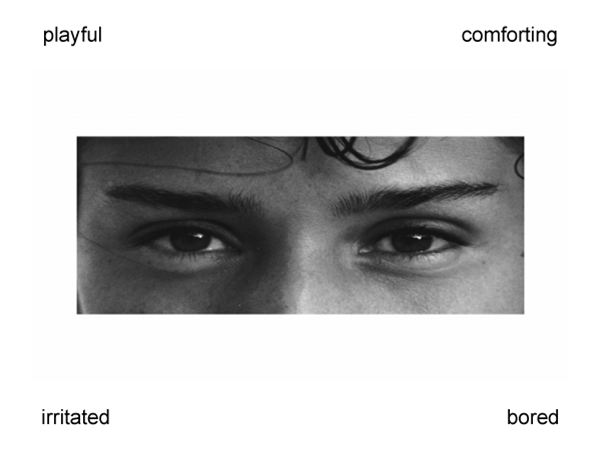
Tomorrow Education Next will be publishing our new random-assignment experiment on what students learn from seeing live theater.  One outcome we examined is whether students assigned by lottery to seeing live performances of Hamlet or A Christmas Carol developed a stronger ability to read the emotions of others.

To test this we used the adolescent version of the Reading the Mind in the Eyes Test (RMET), which was developed by British psychologist, Simon Baron-Cohen, and his colleagues. RMET consists of photos, like the one pictured above, cropped so that just a person’s eyes are showing.  Subjects are then asked to choose from a set of four possible answers to identify what the pictured person is thinking or feeling. Baron-Cohen (who is actually Sacha’s cousin) originally developed this measure to study people with autism, who tend to have a harder time reading the emotions of others.  More recently research published in the journal, Science, found that people who were assigned by lottery to read literary fiction performed better on the RMET.  Literature appears to strengthen our Theory of Mind, as it is called.  Theory of Mind is an incredibly important social skill (as any parent of someone with autism could tell you), and is an important precursor to other useful outcomes, like empathy and effective use of language.

We suspected that seeing live theater might have an effect on RMET similar to reading literature.  We also looked at whether seeing live theater altered student tolerance as well as improved their knowledge of plots and vocabulary more than if they read or watched movies of works.  And we looked at whether seeing live theater altered student desire to attend or participate in theater in the future.

Go to Education Next tomorrow to see our results.


What do Students Learn from Seeing Live Theater?

October 13, 2014

Hamlet

Along with Collin Hitt, Anne Kraybill, and Cari Bogulski, I have a new study coming out Wednesday in Education Next on what students learn from seeing live theater.  We randomly assigned school groups to receive free tickets to see performances of Hamlet or A Christmas Carol at TheatreSquared, an award-winning professional theater.  We then collected measures on a variety of outcomes from students several weeks later in their classrooms.

We also compare what students learn from seeing live theater to what they learn from being assigned to read or watch movies of those same works.  Do students learn the same things from reading or watching a movie of Hamlet that they get out of seeing it performed live?

This is the first randomized experiment of what students learn from seeing live theater, so check it out when it is released on Wednesday.


What did we learn in this week’s episode of College Football Denny?

October 12, 2014

(Guest Post by Matthew Ladner)

So Denny what did you make of college football this week?

Arkansas and Texas are the guys in the PG movie that everyone is reallllly hoping it will happen for. They need to be the guy in the rated R movie.

You are right Denny. Baylor after all has claws and teeth, and they killed the bunny in the 4th quarter when they really needed it.

**puff puff**

What else?

The Egg Bowl is looking like an elimination round for the playoff. Whoda thunk it? Even if it isn’t both of those teams deserve a medal for punking the Aggies. Have I ever mentioned how loathsome those….

Many times Denny- but don’t forget there is another elimination round coming next week….

Ah yes Notre Dame travels to Tallahassee to take on Florida State.

What do you make of that game Denny?

Hmpphf, the Seminoles should be distracted, but the Irish have to change planes in Atlanta. I’ll take the Seminoles.

I’m looking for a little Irish magic in that one Denny. You of course remember the 1993 game…

Absolutely…and also what Boston College did to them the following week!

Now Denny- what have I told you about hating on the Domers?

**puff puff**

I don’t hate the Domers, I just don’t like a team having their own network.

Yes Denny well then what about the Longhorn Network?

Well now see here, that, that’s different….

And the blatant CBS SEC homer-ism? Yesterday they claimed that 7 SEC teams controlled their own destiny for the playoff, but that the winner of the Baylor-TCU game would “need help.”

@@sip@@

And some of those teams were from the lowly SEC EAST….

Outrageous! You are right-there has never been media bias to match that. Fill me up would you?

Certainly. I haven’t been able to muster any interest in the Big 10 lately, but what about out West Denny?

Don’t sleep on Michigan State and the Buckeyes. Out west, Oregon is not dead yet…UCLA is getting close…Arizona finally lost despite a rally to USC.

See you next week Denny?

**puff** @sip@ **puff**

Count on it.


Nominated for the Al Copeland Award: Thomas J. Barratt

October 9, 2014

Advertising is the bogeyman of the Left.  It makes you desire things you never wanted.  It confuses wants and needs.  It brainwashes you to make you believe things that you otherwise would not.  In short, advertising, in this view, turns you into a slave.  By hijacking your preferences, advertising turns you into the instrument of other people’s interests.

But this negative view of advertising is mistaken in two ways.  First, it denies that you are ultimately responsible for your own thoughts and actions.  No advertising can convince you to believe or do something unless you choose to believe or do that.  You are free to ignore or disbelieve advertising, so advertising can never turn you into a slave.

Second, all communication — whether it is called advertising or not — is attempting to convince you to believe or do something.  Even warning you that advertising is trying to brainwash you is itself an effort to convince you of something.  How is that message any more pure than dirty advertising?  In fact, what would innocent, non-coercive communication look like?  Even art is a form of communication that is attempting to convince its audience of something.  So if advertising is evil I have no idea what good would be.

I love advertising.  I love it because it is a form of communication that is more self-conscious of its efforts to convince others and therefore tends to be more accountable for its success or failure in doing so.  That accountability tends to make it more engaging, meaningful, and beautiful.  If advertising isn’t these things, it fails in its effort to be persuasive.

Let’s take for example the McDonalds ad at the top of this post.  That ad manages to tell an entire story in just 30 seconds.  And it’s a really good story.  It captures the anxiety of a first kiss as beautifully as the Odyssey captures the longing to return home.  The moment when the boy realizes that her request for “no onions” on the burger means that she wants him to kiss her is as universal and essential to the human experience as anything I have seen in a museum.

Yes, I understand that McDonalds is just trying to get me to buy its products.  Everyone understands that.  But they are also providing me with useful information.  They are telling me that McDonalds is a cheap and easy place to stop on a date in case you are hungry.  And most importantly, they are telling me that McDonalds will make my burger to order so that I can enjoy their product and still kiss without onion-breath.  So, the ad provides me with useful information.  But because it seeks to be persuasive, the ad is also compelling in its story-telling, engages its audience in a meaningful way, and is beautiful to watch.

Because I think advertising is wrongly disparaged, I am nominating Thomas J. Barratt for the Al Copeland Award.  Barratt is known as the father of modern advertising.  He married into the  A&F Pears’ soap company in 1865.  As Wikipedia describes it:

Under his leadership the company instituted a systematic method of advertising its distinctive soap, in which slogans and memorable images were combined. His slogan “Good morning. Have you used Pears’ soap?” was famous in its day. It continued to be a well known catch phrase well into the twentieth century.

Barratt was keen to equate Pears with quality and high culture through his campaign methods. He acquired works of art to use in the advertisements, most famously John Everett Millais’ painting Bubbles, which he turned into an advertisement by adding a bar of Pears soap in the foreground. Millais was said to be unhappy about the alteration, but could do nothing since Barratt had acquired the copyright. Barratt followed this with a series of adverts inspired by Millais’ painting, portraying cute children in idealised middle-class homes, associating Pears with social aspiration and domestic comfort….

Barratt was not a systematic theorist of marketing, but introduced a number of ideas that were widely circulated. He was keen to define a strong brand image for Pears while also emphasising his products ubiquity with saturation campaigns. He was also aware of the need for constant reinvention, stating in 1907 that “tastes change, fashions change and the advertiser has to change with them. An idea that was effective a generation ago would fall flat, stale, and unprofitable if presented to the public today. Not that the idea of today is always better than the older idea, but it is different – it hits the present taste.”

Barratt was not only a genius and innovator because he was the first to develop advertising practices that are common today, but because he recognized the connection between art and advertising.  They are both engaging, meaningful, and beautiful forms of communication.  Both are trying to convince you to believe or do something.  And one does not sully the other.  If Andy Warhol can turn a can of soup into art, I can’t see why Barratt couldn’t turn a work of art, like the painting “Bubbles“, into an advertisement.  Unlike Warhol, Barratt actually owned the rights for the image he used.

So, whenever you hear someone rant about the evils of advertising, just think about how much free entertainment, useful information, and beautiful images you get to experience from advertising.  Think about how much the human condition is improved by plentiful and free advertising that everyone gets to enjoy.  And rest assured that advertising is no more an effort to brainwash you than an Andy Warhol painting or the blowhard ranting about advertising.

I know Al Copeland recognized the art of advertising.  That’s why he had New Orleans jazz/blues legend Dr. John sing in his early commercials.  And that’s why Thomas J. Barratt is worthy of The Al.


Nominations Solicited for the 2014 Al Copeland Humanitarian Award

October 8, 2014

It is time once again for us to solicit nominations for the Al Copeland Humanitarian Award.  The criteria of the Al Copeland Humanitarian Award can be summarized by quoting our original blog post in which we sang the praises of Al Copeland and all that he did for humanity:

Al Copeland may not have done the most to benefit humanity, but he certainly did more than many people who receive such awards.  Chicago gave Bill Ayers their Citizen of the Year award in 1997.  And the Nobel Peace Prize has too often gone to a motley crew including unrepentant terrorist, Yassir Arafat, and fictional autobiography writer, Rigoberta Menchu.   Local humanitarian awards tend to go to hack politicians or community activists.  From all these award recipients you might think that a humanitarian was someone who stopped throwing bombs… or who you hoped would picket, tax, regulate, or imprison someone else.

Al Copeland never threatened to bomb, picket, tax, regulate, or imprison anyone.  By that standard alone he would be much more of a humanitarian.  But Al Copeland did even more — he gave us spicy chicken.

Last year’s winner of “The Al” was Weird Al Yankovic.  Weird Al won over an impressive set of nominees, including Penn and Teller, Kickstarter, and Bill Knudsen. In selecting Weird Al as the winner I explained:

Like Al Copeland, Weird Al may not have changed the world, but he has certainly improved the human condition.  He’s done so by making us laugh at the the absurdity of many who think highly of themselves.

In the previous year the winner of “The Al” was George P. Mitchell, a pioneer in the use of fracking to obtain more, cheap and clean natural gas. Mitchell won over a group of other worthy nominees:  Banksy, Ransom E. Olds, Stan Honey, and Alfred Fielding and Marc Chavannes.

In 2011 “The Al” went to Earle Haas, the inventor of the modern tampon.  Thanks to Anna for nominating him and recognizing that advances in equal opportunity for women had as much or more to do with entrepreneurs than government mandates.  Haas beat his fellow nominees:  Charles Montesquieu, the political philosopher, David Einhorn, the short-seller, and Steve Wynn, the casino mogul.

The 2010  winner of  “The Al” was Wim Nottroth, the man who resisted Rotterdam police efforts to destroy a mural that read “Thou Shall Not Kill” following the murder of Theo van Gogh by an Islamic extremist.  He beat out  The Most Interesting Man in the World, the fictional spokesman for Dos Equis and model of masculine virtue, Stan Honey, the inventor of the yellow first down line in TV football broadcasts, Herbert Dow, the founder of Dow Chemical and subverter of a German chemicals cartel, and Marion Donovan and Victor Mills, the developers of the disposable diaper.

And the 2009 winner of “The Al” was  Debrilla M. Ratchford, who significantly improved the human condition by inventing the rollerbag.  She beat out Steve Henson, who gave us ranch dressing,  Fasi Zaka, who ridiculed the Taliban,  Ralph Teetor, who invented cruise control, and Mary Quant, who popularized the miniskirt.

Nominations can be submitted by emailing a draft of a blog post advocating for your nominee.  If I like it, I will post it with your name attached.  Remember that the basic criteria is that we are looking for someone who significantly improved the human condition even if they made a profit in doing so.  Helping yourself does not nullify helping others.  And, like Al Copeland, nominees need not be perfect or widely recognized people.