(Guest Post by Matthew Ladner)
The Illinois Policy Institute interviews Howard Fuller on vouchers and voucher critics:
Priceless…
(Guest Post by Matthew Ladner)
The Illinois Policy Institute interviews Howard Fuller on vouchers and voucher critics:
Priceless…
 2 Comments |
  vouchers | Tagged: Howard Fuller, Illinois Policy Institute, School Vouchers |
  Permalink
 Posted by matthewladner
(Guest Post by Matthew Ladner)
Bad news from Texas– bipartisan super-majority of the House votes to prohibit vouchers in the House budget plan. It remains to be seen whether the state adding 80,000 new public school students per year and which has 17% of Hispanic and 15% of Black 8th graders reading proficiently will allow 10 new charters to be added to the state’s cap per year or not.
2 Comments | vouchers | Tagged: School Vouchers, Texas school vouchers | Permalink
Posted by matthewladner
 (Guest Post by Matthew Ladner)
Some of you will recall Greg Anrig’s Washington Monthly article combining a teacher union talking point reading of the evidence on school choice with some grousing in the school choice ranks to declare school vouchers as “An Idea Whose Time Has Gone.”
Having trouble remembering? Fortunately the Century Foundation. Mr. Anrig’s employer, has quite helpfully preserved a record on youtube. You can be the 125th or so person to watch the video:
Hmmm….”grinding to a halt…” But wait, there is more-part deux!
There’s even more video on youtube, but these two constitute plenty of rope. I’ve never met Anrig, but I’d be willing to bet that he’s a decent chap who loves his mother, his country and his alma mater. He isn’t the first person nor will he be the last to make a bold but utterly mistaken prediction. I almost feel bad about writing this post.
Almost but not quite…
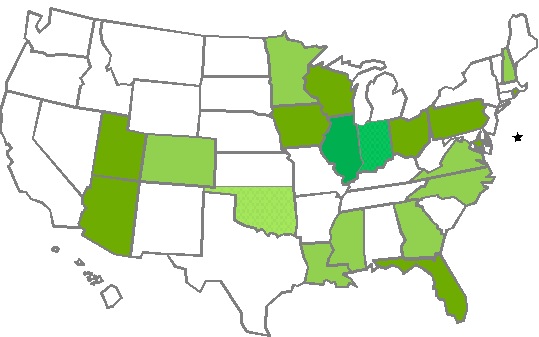
After all, Andrew Rotherham sagely predicted at the time that Anrig would regret writing the article. So here is a map of the states with private choice programs on the date of Anrig’s Washington Monthly piece:

After the win in New Hampshire yesterday, the map looks something like the one below. Mind you, this underestimates the progress of the parental choice movement, as several states created multiple programs.
4 Comments | tax-credit scholarships, vouchers | Tagged: Century Foundation, Greg Anrig, school choice, School Vouchers, tuition tax credits | Permalink
Posted by matthewladner

(Guest Post by Matthew Ladner)
Last month Sean Cavanaugh interviewed Michelle Rhee about vouchers over at Ed Week. Overall I’m happy to have Rhee and other “Cool Kids” support parental choice, even if it is on a limited basis. I hope they think deeper on the subject however, as many Cool Kids are far more misguided on vouchers than Rhee. It is easy however to detect shoot-from-the-hip attitudes in the interview. Rhee told Cavanaugh:
“When people talk about universal vouchers, first of all, I’ve never seen an economic model that actually made sense and laid that out in way that’s sustainable,” Rhee said. I haven’t seen any kind of model that makes economic sense. … My support for vouchers is around a specific group of kids.”
“There are a lot of people out there who sort of believe, the free market, let the free market reign, the market will correct itself—give every kid a backpack with their money in it and let them choose wherever they want to go,” she added. “I don’t believe in that model at all.”
I’m still waiting for the day when supporters of means-tested vouchers come out and explain why they don’t support means testing public schools. Bill Gates could move to Milwaukee right now and enroll his children in public schools that cost taxpayers $13,000 per year. No one blinks. If he were to move to Milwaukee and get $6,400 vouchers however some of us want are inclined to view it as a grave injustice. I’ve yet to hear anyone propose that we should have economic cleansing of charter schools either-out with you middle and high-income children and don’t come back!
Don’t get me wrong- I have fought for a number of means-tested programs and continue to support them. I also strongly support an advantage for the poor, but not means-testing. Rhee is discussing the ideal however, and as an ideal, limited programs have some unresolvable problems.
Rhee also seems to be influenced by straw-man arguments. Very few people advocate a complete free market in education, and those that do don’t support vouchers. From Milton Friedman’s original formulation of the voucher concept he argued for public financing of K-12 education rather than financing and provision. Friedman also recognized the need for some level of regulation. The appropriate level of course remains an issue for debate.
As an aside, Rhee goes on to specifically distance herself from Florida governor Rick Scott’s proposal for universal education savings accounts during his transition, on which Rhee served. National Review Online rightly described this as “the most significant, transformative idea ever advanced by an actual elected official with any real power.” Sadly Scott’s proposal activated the hyperbolic anti-choice antibodies of Florida’s newspapers, and Governor Scott stopped pushing the proposal. Testing new ideas with pilot programs can be a agonizingly slow process, but that process has begun in Arizona. Florida’s private choice program continues to expand incrementally through the Step Up for Students program. I remain hopeful that something between Governor Scott’s initial ambition and the current slow pace of bringing funded private choice eligibility to Florida children will be enacted. Zero to sixty to two seconds sometimes wraps a Ferrari around a telephone pole, the price of being aggressive, but it isn’t an argument in favor of indefinite gradualism.
But I digress. Rhee went on:
“It has to be a heavily regulated industry,” she said. “I believe in accountability across the board. If you’re going to be having a publicly funded voucher program, then kids have to be taking standardized tests. We have to be measuring whether kids are academically better off in this private school with this voucher than they would be going to their failing neighborhood school. If they’re not, they shouldn’t get the voucher. … I’m about choice only if it results in better outcomes and opportunities for kids.”
Rhee’s faith in regulation is odd. The public school system is super-heavily regulated with laws and policies streaming down from the federal, state and local levels. Despite all of that, much of the system performs at a tragically poor level. That of course is not to say that vouchers should have no regulation, but the right level of regulation is not “heavy.”
Rhee also places far too much weight on the results of standardized test and gives far too little deference to the judgment of parents. Parents make decisions about schools for a large variety of reasons- including things like school safety, peer groups and the availability of specialized programs. In addition to missing the whole point about school choices being multifaceted with parents best able to judge all the factors, individual test scores bounce around from year to year, they often take a temporary hit when a child transfers and adjusts to a new school.
The notion of having program administrators looking at the math and reading tests and deciding to cast children back to their ‘failing neighborhood school’ is very problematic. Pity the poor voucher program apparatchiks who have to drag children back to a public school where they had been continually bullied because they had the flu on testing day. Pity the children more. The subject of what to do about poorly performing private schools in a choice system is a complex topic and opinions vary widely. Rhee’s proposed solution however does not begin to capture this complexity.
Rhee wraps up:
The ideal public school system, Rhee argued, will include high-quality traditional public schools and a charter sector, as well as some vouchers.
“But the vast majority of kids are going to be in a high-performing public school environment,” she said, adding: “I’m a believer in public schools. I’m a public school parent. I ran a public school district.”
Public schools will continue to serve as the primary conduits for education regardless of what we do on the choice side of things.We are a long, long way from having high-quality public schools for all children, and choice can play a role in moving us in that direction. Choice improves public schools and we can hardly will the ends without the means.
If however we embrace only tiny choice programs targeted at limited student populations, that positive role will likewise remain limited. In the end, catastrophically under-performing schools do so because they can get away with it. I’m all for efforts to improve the laughably ineffectual quality of our regulation in an effort to curtail this, but choice is the only decentralized system of accountability that allow parents to hold schools accountable for individual results.
We need as much parental choice as we can get.
(Edited for typos and clarity)
13 Comments | Education Savings Accounts, vouchers | Tagged: Education Savings Accounts, Michelle Rhee, School Vouchers | Permalink
Posted by matthewladner
 (Guest Post by Matthew Ladner)
Arizona Governor Jan Brewer signed the first new private choice program of 2012 into law today. The new law will create a new individual tax credit the same size as the current one ($500 for an individual and $1000 per couple) that will operate under the rules of Arizona’s corporate tax credit (i.e. means tested and aimed at students transferring from public schools). Individual taxpayers will be able to make donations under both credits each year. Arizona lawmakers are also considering an expansion of eligibility of the Education Savings Account program to students attending low rated schools.
Governor Jindal is gearing up for what sounds like a broad choice program. Florida lawmakers are considering an increase in their tax credit program, Virginia has a chance to join the ranks of choice states.
After the 2011 blowout, perhaps Greg’s original bet with Jay Mathews would make for a high but obtainable bar for a good year for private choice in 2012. Greg’s bet is to legislative monitoring what the NCAA tournament is the college basketball.
1 Comment | tax-credit scholarships | Tagged: Arizona Tax Credits, Education Savings Accounts, School Vouchers, tuition tax credits | Permalink
Posted by matthewladner

(Guest Post by Matthew Ladner)
Philadelphia Archbishop Charles Chaput released the following statement last Friday and published in today’s Philadelphia Archdiocesan publications, including every parish bulletin being distributed at Mass and published online.
Monday, January 29, begins Catholic Schools Week. It’s a time to honor the unique value of Catholic education. Here in the Archdiocese of Philadelphia, we have a long record of dedicated service by the women and men who teach in our classrooms and run the “business” of Catholic schools. That record includes the legacy of thousands of women and men religious and diocesan clergy. In the single academic year of 1963-64, more than 4,100 religious and 1,600 laypersons taught more than 263,000 students enrolled in our schools. Today, scores of our pastors make extraordinary commitments of parish funds to keep our schools open and excellent.
Unfortunately, schools run on resources, not simply good will and heroic service. Our schools can no longer count on unlimited Church support. The resources simply don’t exist. Many of our parishes are financially strained. The archdiocese itself faces serious financial and organizational challenges that have been developing for many years and cannot be ignored.
So where does that leave us? We can honor Catholic Schools Week this year by actually doing something about the fiscal problems hurting our schools. We need to press our lawmakers, respectfully but vigorously, to pass school choice.
First, we need some clarity: School vouchers do not mean “government support for religious schools.” That argument is flatly false. No vouchers go to any school, religious or otherwise. Vouchers do, however, return the power of educational choice to parents, where it belongs. In doing so, vouchers make all schools more accountable for the quality of education they deliver. Parents get the voucher. Parents choose the school. This makes perfect sense. And if a school offers a poor education for young people, parents will rightly vote with their feet — and their vouchers. Of course, most Catholic schools do the opposite: They offer a strong education, in a safe environment, with a focus on developing good moral character. That’s why parents are so upset when they close.
Some people argue that school choice legislation only helps families in poor areas. Helping the poor is obviously vital, and vouchers would accomplish that. But vouchers would also assist many more families than the poor. If vouchers are approved, they will free up what’s known as EITC funds — Educational Improvement Tax Credit funds — along with other grant and scholarship monies for many thousands of other school families. In effect, the positive impact of vouchers translates to millions of dollars of additional educational resources potentially available to a wide range of school families each year — including Catholic school families.
Now here’s an unhappy fact: In 2011, the bishops of Pennsylvania made the passage of vouchers one of their priority legislative issues. People like Bob O’Hara in our statewide Catholic bishops’ conference and Jason Budd in our archdiocesan Office of Catholic Education worked hard to mobilize Catholic support. Their efforts failed — and not because they didn’t try, but because too few people in the pews listened. Very few Catholics called or wrote their state senators and representatives. Even fewer visited their offices to lobby as citizens. Despite this, vouchers passed in the state senate, before stalling in the house. One non-Catholic school choice activist — who has poured years of his time and millions of dollars of his own resources into fighting for vouchers as a social justice issue — was baffled at the inability of Catholics to mobilize around an issue so obviously vital to the public interest and so clearly helpful to the survival of their own schools.
In the coming week I’ll be writing every state senator and representative in the territory of the Archdiocese of Philadelphia to press them to support school vouchers. And I’ll continue doing it until vouchers pass. I hope my brother bishops and pastors across the state will do the same. More importantly: Our Catholic people need to do the same. Elected officials do listen, and they act when the noise gets loud enough. If nothing else, the crisis of Philadelphia’s Catholic schools is an unpleasant but finally very healthy wake up call. The bill for our failure to pass school choice over the past decade has come due. Now we’re paying for it.
When vouchers stalled, yet again, in the Pennsylvania house last fall, a frustrated Catholic school teacher friend of mine said “Catholics are suckers.” I don’t believe that. But then, I’m new in town. If we Philadelphia Catholics love our Catholic schools, and we obviously do, then the time to get active and focused is now. We need to begin pressing our state lawmakers to pass the school choice legislation — including vouchers and expanded EITC credits — that’s currently pending in Harrisburg. And we need to do it this week, today, right now. I plan to do that. I hope you’ll join me.
For more information on school choice, and to contact your legislator, please visit: http://tinyurl.com/PASchoolChoice
4 Comments | tax-credit scholarships, vouchers | Tagged: Archbishop Charles Chaput, Pennsylvania Catholic schools, Pennsylvania school choice, School Vouchers, tuition tax credits | Permalink
Posted by matthewladner

(Guest Post by Matthew Ladner)
In 1916, legendary Georgia Tech coach John Heisman had a score to settle with Cumberland College. His engineers led 126-0 at halftime, inspiring Heisman to tell his players “We’re ahead, but you just can’t tell what those Cumberland players have up their sleeves. They may spring a surprise. Be alert, men.”
The final score: Georgia Tech 222, Cumberland College 0. The Atlanta Journal reported, “As a general rule, the only thing necessary for a touchdown was to give a Tech back the ball and holler, ‘Here he comes’ and ‘There he goes.’ ”
Greg has followed Heisman’s example by scoring 4 more times in the Mathews bet. Ohio dramatically expanded their Ed Choice voucher program, their Cleveland program, and upgraded their autism voucher bill to a full fledged special needs voucher. In addition, North Carolina became the first state to enact a tuition tax credit for special needs children.
Let’s see if I can recall them all:
Utah (1) Carson Smith expansion
Arizona (1) Education Savings Accounts
Colorado (1) New voucher program
DC (1) Opportunity Scholarships reenacted, expanded
Florida (2) McKay Scholarship expansion, Step Up for Students Tax Credit Expansion
Georgia (1) Tax credit expansion
Oklahoma (1) New tax credit, (major fix of special need voucher)
Indiana (3) New statewide voucher, expansion of tax credit, new tax deduction
Louisiana (1) Tax deduction expansion
Wisconsin (2) Milwaukee Expansion, New Racine Program
Iowa (1) Tax credit expansion
North Carolina (1) New special needs tax credit
Ohio (3) Cleveland expansion, Ed Choice expansion, Autism to Special needs expansion
Most legislative sessions are winding down this year, but we could see some additions to the list. There are too many great stories to cover here, from the heroic struggle to save the DC Opportunity Scholarship Program, to Colorado’s turning a court defeat based upon “local control” on its head, and Wisconsin emerging from years of toil and struggle to enact an amazing expansion, to Arizona lawmakers embarking on an experiment in liberty to give parents control down of the education of their child down to the last penny.
Lots of important reforms outside of private choice as well- major tenure reforms, charter caps lifted, some pathbreaking expansions of digital learning. It will take time for the smoke to clear just to see what actually passed, much more before we will have any clue about results.
A few states have taken what I would describe as deep reform dives-embracing a broad set of reforms making truly historic changes. Florida of course has long been in the lead here, and Florida had a fantastic education reform session this year, reforming tenure, expanding digital learning and passing a truly amazing law to expand high quality charter schools.
Indiana however may be the pupil that has exceeded the master.
Indiana adopted critical Florida reforms, like grading schools A-F and social promotion curtailment, last session. During this session, Indiana’s reformers went far beyond enacting the most far reaching choice programs. Go and read the transcript from Governor Daniels speech at AEI. After detailing Indiana’s far reaching collective bargaining, teacher quality and parental choice reforms, Daniels sort of casually mentions:
And here’s another little calendar quirk that we just moved the school board elections from the spring to the fall. So test from the fall to the spring, elections from the spring to the fall, what’s up with that, you want to know? Well, spring is when we have primaries, nobody votes. It’s a lot easier to dominate, for a small or for an interest group to dominate the outcome and elect a friendly school board in the sparsely attended primary elections. And so now they will have more of the public at least eligible or at least on hand to take part in those elections, we’ll see if it makes a difference.
Now this, ladies and gentlemen, is comprehensive education reform: grading schools A-F based on student proficiency and gains, curtailing social promotion, tenure reform including the mandated use of student performance as a part of formula, throwing out the 900 page collective bargaining agreements, and what will be the nation’s largest system of parental choice. Oh, and by the way, we are going to take a shot at massively increasing democratic participation in school districts while we are at it, just for fun.
Govenor Daniels described these reforms as “mutually reinforcing” in his AEI speech. When I heard that line, I literally gasped and thought to myself: he really gets it!
Indiana lawmakers have not however suspended the law of unintended consequences. Many challenges known and unknown attend such profound change, and the hardest work lies ahead. Among the known challenges: Indiana has term limits, and these far reaching reforms come in the twighlight rather than the dawn of the Daniels terms of office. Seeing this business through will be an enormous challenge for the next crop of Indiana policymakers, if they choose to accept it.
Ok, enough of the grim warrior business. If you can’t pause to celebrate victory, you won’t last the season. This has easily been the best year for K-12 reform, and the best is yet to come.

15 Comments | instructional reform, tax-credit scholarships, vouchers | Tagged: Indiana education reform, Mitch Daniels, School Vouchers | Permalink
Posted by matthewladner

(Guest Post by Matthew Ladner)
The Tennessee Senate passed a school voucher program for low-income children in the three largest counties by a vote of 20-10. Congratulations to Sen. Brian Kelsey- on to the House!
P.S.
2 Comments | vouchers | Tagged: School Vouchers, Senator Brian Kelsey, Tennessee school vouchers | Permalink
Posted by matthewladner

INDIANAPOLIS, IN — The Indiana Senate today passed legislation that would create the nation’s broadest school voucher program, allowing low- and middle-income families to use taxpayer funds to send their children to the private school of their choice.
House Bill 1003, which was approved by the Senate in a 28-22 vote, would create a new scholarship program enabling families to send their children to the private school of their choice. Scholarship amounts are determined on a sliding scale based on income, with families receiving up to 90 percent of state support.
The Indiana House of Representatives previously approved a similar version of the bill by a vote of 56-42. The Senate version, which adds a $1,000 tax deduction for families that pay out of pocket for private or homeschool expenses, will now go back to the House. If the House agrees to the changes made in the Senate, the bill will proceed to Governor Daniels, who is expected to sign the bill into law.
“This is exciting news,” said Robert Enlow, President and CEO of the Foundation for Educational Choice. “We applaud those legislators who stood tall for kids, and we hope the House will concur as soon as possible so that Indiana families who desperately need educational options do not have to wait any longer.”
If enacted, the voucher would be available to far more students than other programs in the country, where vouchers are limited to low-income households, students in failing schools, or special-needs students. Under HB 1003, a family of four earning up to $61,000 per year would be eligible.
Additionally, the $1,000 tax deduction for private and homeschool expenses has universal eligibility. The bill also improves Indiana’s scholarship tax credit program by increasing the program cap to $5 million, making $10 million in scholarships available to Hoosier families.
2 Comments | vouchers | Tagged: Foundation for Educational Choice, Governor Mitch Daniels, Indiana Vouchers, School Vouchers | Permalink
Posted by matthewladner
(Guest Post by Matthew Ladner)
BAEO took out a full page ad in the NYT to blast President Obama for the gap between his rhetoric and his administration’s participation in the pillow smothering of the DC Opportunity Scholarship Program.

Leave a Comment » | politics, vouchers | Tagged: Black Alliance for Educational Options, D.C. vouchers, Kevin Chavous, School Vouchers, Washington Opportunity Scholarship Program | Permalink
Posted by matthewladner

 Jay P. Greene's Blog