American Legislative Exchange Council releases Report Card on American Education

September 1, 2010

(Guest Post by Matthew Ladner)

The American Legislative Exchange Council released the Report Card on American Education: Ranking State K-12 Performance, Progress and Reform today coauthored by yours truly, Andy LeFevre and Dan Lips. Follow the link and check out our rankings of state NAEP performance based on the overall math and reading scores and gains of general education low-income children, and our “poll of polls” grades for K-12 policy in each state.

Former Florida Governor Jeb Bush penned the foreward. After losing a bet Stanford Political Scientist Terry Moe gave the book a very kind endorsement:

Everyone interested in education reform should read this book. Using a method that—by focusing on the achievement of low-income children—allows for apples-to-apples comparisons across the states, the authors present a treasure trove of eye-opening performance data and arrive at a ranking of state performance that reveals both surprising success and shocking failure. The book is well worth reading for the data alone. But it also offers a good deal more, from research summaries to methodological clarifications to model legislation—and concludes with an insightful discussion of the high-powered reforms that have helped some states out-perform others, and that offer the nation a path to improvement. I should add, finally—and with genuine admiration—that the book is beautifully written and a pleasure to read: something I can rarely say about a data analysis.

JPGB readers will of course realize that this is quite a tribute to Andy and Dan, given your painfully intimate knowledge of my garbled writing. Thanks also to Jeff Reed and Dave Myslinski from ALEC (Jeff is now rocking and rolling at the Foundation for Educational Choice), Jay and my Goldwater Institute comrades.

Check it out and let me know what you think. Be nice though: today is my birthday, which makes me even more emotionally volatile than usual.

UPDATE: Here is a link to the PDF.


Sneak Preview: Report Card on American Education

August 30, 2010

(Guest Post by Matthew Ladner)

Later this week the American Legislative Exchange Council will release Report Card on American Education: Ranking State K-12 Performance, Progress and Reform written by yours truly, Dan Lips and Andy LeFevre.

As suggested by the title, we grade each state by their academic performance, their academic gains and their K-12 reform policies. On the later, we use a “poll of polls” technique and average the grades assigned for particular policy areas on academic standards, teacher quality, charter school laws, private choice, digital education etc.

Sneak peak: a B+ was the highest grade.

On the performance and progress, we utilize NAEP with an eye to maximizing comparability  between states. After all, no one can be shocked that Connecticut has higher NAEP scores than Mississippi, given the huge disparities in income between the two states.

We therefore judge each state based on the scores of free and reduced lunch eligible general education students on all four main NAEP exams: 4th grade reading and math, 8th grade reading and math. We use the period for which all 50 states and the District of Columbia have participated in NAEP (2003-2009). Using free or reduced lunch eligibility keeps the income range of students under a known limit, whereas non-free and reduced lunch kids can vary in income from still relatively hardscrabble to billionaires.

We made no effort to control for race or ethnicity despite the well-known existence of racial achievement gaps. This is because we believe that such gaps can in fact be closed. We believe that the gaps exist due to policy and cultural factors, all of which can be changed. Schools in particular are in the business (or should be) of promoting a strong academic culture focused on learning-aka controlling the culture of the school.

You’ve never heard of a racial combat effectiveness gap in the United States Marines Corps because it doesn’t exist. The fact that the Marines are a well-led organization with a strong culture has a great deal to do with that, as does the fact that every Marine is a part of the Corps by choice.

In any case, we do not claim that our NAEP rankings provide perfect comparability  just enormously better comparability  than looking at raw NAEP scores.

So you are dying to know whether your state rocked or sucked wind in the rankings. Calm down- pace yourself!

All will be revealed later in the week.


Even More Bloat!

August 23, 2010

(Guest Post by Matthew Ladner)

Yours truly weighs in on the bloat fest!


Burke and Ladner Sing the real “Empire State of Mind” Duet on NRO

June 9, 2010

Now you’re in New York FLOR-I-DA!  Our minority children outscore your WHOLE STATE! There’s nothing we can’t do! 

(Guest Post by Matthew Ladner)

The Heritage Foundation’s Lindsey Burke and I hit National Review Online on Florida’s K-12 success in raising minority academic achievement.

In California, Meg Whitman won the Republican nomination for governor in overwhelming fashion on Tuesday. As you can see on her campaign site, Whitman wants to bring Florida reforms to California, which desperately needs them. California is a gigantic state that scores like an urban school district on NAEP. Without large improvements in California, it is unlikely that we will see the United States even begin to close the academic gap with European and Asian nations.


Public Education and its Enemies

October 29, 2009

(Guest Post by Matthew Ladner)

In the final scene of Shakespeare’s Henry V, the French sue for peace after Henry’s triumph at Agincourt. While the French king is away negotiating the final terms, Henry uses the opportunity to woo the King’s daughter Katherine to become his Queen.

Katherine is cool to this idea, but slowly warms to the notion under the glare of Henry’s charm. Finally, she asks “May it be possible zat I should love zee enemy of France?”

Henry replies:

“No Kate, it is not possible. For in loving me, you shall love the friend of France. For I love France so much that I will not part with a village of it.”

I think of this line often when K-12 reactionaries try to play the “well, I support public education” card. This you see, is supposed to put a reformer on a defensive and get them to scramble to say that they support public education too!!!

Nice try, but for my part, I have this to say: don’t tell me how much you love public schools unless you are willing to do what it takes to make them work for kids.

Yesterday Marcus Winters released a study showing that charter schools in NYC improve public school performance, especially for disadvantaged children. The effect sizes were modest, but what more can you expect given that the state still has a cap for the number of charters? The cap should be removed, and private choice options created.

Research has firmly established that ineffective teachers severely harm the education of children. Who is the enemy of public education- those who want to preserve tenure at all costs, or those who want to remove ineffective teachers from the classroom?

Last year, I was at a conference in Arizona. A philanthropist spoke movingly about the need to raise Arizona academic standards to internationally competitive levels. An assistant Superintendent of a tony school district said “We can’t meet the standards we have now, the last thing we should do is raise them.”

Who is the enemy of public education- the philanthropist or the administrator?

Later in that same meeting, I made a presentation about Florida’s success in improving public education, including the curtailment of social promotion to compel literacy training. One of the educators in the audience replied “I don’t want to see 9 year olds rolling on the ground crying because they don’t get to advance with their grade.”

That, you see, would be inconveint to her. It would be much less messy to simply pass the child along illiterate until he or she drops out in the 8th grade.

Who is the enemy of public education- me or her?

The reactionaries cleverly try to equate pouring more money on this broken system as compassionate. Balderdash. It is the goals of public education that people should be committed to, not any particular delivery mechanism, nor the employment interests of the adults working in the all-to-often dysfunctional system. We’ve tried the pour money method for improving public schools, and it failed miserably.

Show me don’t tell me how much you love public schools, apologists. As your critics multiply across ideological lines, the time has come to put up or shut up. I love public schools so much that I am willing to put in the right incentives and policies to make them work for a far larger number of children.

How about you?


The Price of Things to Come: Free

September 24, 2009

(Guest Post by Matthew Ladner)

I am half way through Chris Andersen’s new book Free: The Future of a Radical Price and I can already recommend the book.

Andersen’s treatment of disruptive technologies and firms is simply fascinating. Craig’s List, for example, has from one perspective “destroyed” far more profits for newspapers than it creates for itself. The entire firm runs on a few dozen employees, but has played a large role in reducing a huge revenue stream for the entire American newspaper industry.

Craig’s List actually hasn’t destroyed profits, but in fact has redistributed them to the general public. Craig’s List provides a superior service to a want ad, and it is almost always free.

Likewise, Britannica and others used to make large profits going door to door selling $1,000 encyclopedia sets. Then Microsoft came out with a $99 dvd encyclopedia, and profits withered. Then Wikipedia came along and Microsoft abandoned their dvd project, and Britannica and company will be required to reinvent themselves if they are to survive.

Technology is driving all of these changes-exponential increases in computing power, storage capacity, are driving changes that are fundamentally disrupting several industries: music, newspapers, and perhaps banking.

The question I have half way through this book: who will become the Google of higher education?

Google has a core business of showing you online ads that is very, very profitable. Most of what they do, however, is throwing out products for free. Google has over 100 free software applications online- maps, Earth, documents, etc. and develops new ones all the time.

Highly successful American universities seem to have a core mission of educating students. This however is questionable at best. Some of these universities have endowments so large that if they simply followed the rules for non-profits and spent 5% of their endowment per year, they could eliminate tuition for their students entirely.

What these universities are really about, of course, is getting research grants and adding to their endowments. What if, however, one or more of them were to go down the road of truly seeking to educate the world by putting up entire degree programs online for free.

A Harvard, Princeton or Notre Dame is likely to always have more applicants than spaces, and in any case, these places could survive without students, not that they will ever need to do so. Why not put up entire rigorous degree programs online, and invite anyone and everyone in the world to complete them for free?

Concerned that it would lessen a regular degree? Pshaw-distinguish it from a regular degree, and require an exit exam, say the GRE, that indicates the student knows quite a bit. Random half-baked idea alert, but if a score on the GRE high enough to admit the student in the upper half of graduate programs were required, we’d know far more about the online student than the traditional ones.

Worried about quality? You should be, but don’t forget the recent U.S. Department of Education study showing that technology based learning is substantially more effective than the old fashioned way.

Imagine if students in Bangladesh could earn a Princeton math degree, or a theology degree from Notre Dame for free, or more accurately for the time, computer and internet cost. The marginal players of the American academy would squeal as they are forced to reinvent themselves from making buggy whips, but this is a small price to pay for bringing opportunity to the world.

The only question in my mind is how long it will be until an elite player has the necessary vision to defect from the comfortable cartel. Several universities have the means to do this, and could receive philanthropic help to do so. Attention Oxford and Cambridge: it wouldn’t require an American university to pull this off. A British university could put out a low-cost version of this, and unlike their American counterparts, they aren’t swimming in resources.


Mourning Constitutional- OK kids score even worse than AZ

September 17, 2009

(Guest Post by Matthew Ladner)

Regular JPGB readers will recall that the Goldwater Institute gave a version of the United States Citizenship Test to Arizona high school students, only to learn that they were profoundly ignorant regarding American government, history and geography. Only 3.5% of Arizona public school students got six or more questions correct, the passing threshold for immigrants.

The Oklahoma Council of Public Affairs wanted to know how Oklahoma high school students would fare on the exam- so we surveyed them and gave them precisely the same set of questions we asked Arizona students.

Perhaps I ought not to have been so hard on Arizona students. After all, they passed at a rate that was 25% higher than their peers in Oklahoma!

That’s right: the passing rate for Oklahoma high school students was 2.8%. They somehow underperformed Arizona’s already abysmally pathetic performance.

My favorite part of writing this paper was poking around in the Oklahoma state standards for civics. Here’s a quote:

Oklahoma schools teach social studies in Kindergarten through Grade 12. … However it is presented, social studies as a field of study incorporates many disciplines in an integrated fashion, and is designed to promote civic competence. Civic competence is the knowledge, skills, and attitudes required of students to be able to assume ‘the office of citizen,’ as Thomas Jefferson called it.

A social studies education encourages and enables each student to acquire a core of basic knowledge, an arsenal of useful skills, and a way of thinking drawn from many academic disciplines. Thus equipped, students are prepared to become informed, contributing, and participating citizens in this democratic republic, the United States of America.

That all sounds swell, except for the part where despite being taught social studies from K-12, Oklahoma high school students come out knowing about as much about American history and government as they know about Quantum Physics or ancient Sanskrit.

These kids wouldn’t do much worse if the pollster asked them questions in Sanskrit instead of English. The pollster would say “I am going to ask you some questions about American civics in Sanskrit. Answer as best you can.  Question 1: संस्कृता वाक् संस्कृता वाक् संस्कृता वाक् संस्कृता वाक् ?”

There is some small chance they would answer “George Washington” after all.

I have an empty metal coffee pot in my office marked “Sweden Civics Survey Fund.” Please drop by a give what you can afford. Once it gets to a couple of thousand bucks, I’ll retain the pollster to give this exact same survey on AMERICAN civics to high school students in Sweden.

They couldn’t do much worse than the kids in Arizona and Oklahoma. Sadly, I suspect they would do much better.

(Edited for Clarity)


Texas has nothing to learn from California except…

July 10, 2009

2809LD1(Guest Post by Matthew Ladner)

Interesting article from the Economist on California vs. Texas: America’s future.

I’ve been an Economist reader for 20 years now, and their work is usually outstanding. They do however occassionally fall prey to an easy stereotype, and this article contains such a folly.

Read the article for yourself, but keep in mind that Texas has among the highest NAEP scores for Hispanic students in the nation (now edged out by Florida on 4th grade reading) and spends over $10,000 per child per year.

The only thing Texas has to learn from California is what not to do.

P.S.

This has been a settled question on the only true field of battle for some time now.


Freedom from Responsibility Preview part Deux

June 25, 2009

 (Guest Post by Matthew Ladner)

In the end more than they wanted freedom, they wanted security. When the Athenians finally wanted not to give to society but for society to give to them, when the freedom they wished was freedom from responsibility, then Athens ceased to be free.

Edward Gibbon

Last week we had our first sneak peak at Freedom from Responsibility.

Today, more details about the results. The Goldwater Institute randomly drew 10 questions from the United States citzenship exam item bank. We hired a survey firm to interview a sample of both Arizona public and private school high school students.

The questions for neither the citizenship test nor our survey were multiple choice. When you are asked “Who was the first President?” you must answer “Washington” in order to receive credit. Applicants for citizenship must get six out of the ten questions correct to pass. A recent trial of a slightly reformatted exam found that 92.4% of citizenship applicants passed the test on the first try.

Charles N. Quigley, writing for the Progressive Policy Institute, explained the critical nature of civic knowledge:

From this nation’s earliest days, leaders such as Thomas Jefferson, James Madison, and John Adams recognized that even the well-designed institutions are not sufficient to maintain a free society. Ultimately, a vibrant democracy must rely on the knowledge, skill, and virtues of its citizens and their elected officials. Education that imparts that knowledge and skill and fosters those virtues is essential to the preservation andimprovement of American constitutional democracy and civic life.

Paul D. Houston, the executive director of the American Association of School Administrators, also put the issue in focus:

If you look back in history, you will find the core mission of public education in America was to create places of civic virtue for our children and for our society. As education undergoes the rigors of re-examination and the need for reinvention, it is crucial to remember that the key role of public schools is to preserve democracy and, that as battered as we might be, our mission is central to the future of this country.

Here are the 10 questions randomly selected, and their answers:

1.What is the supreme law of the land?Answer: The Constitution

2. What do we call the first 10 amendments to the Constitution?

Answer: the Bill of Rights

3. What are the two parts of the U.S. Congress?

Answer: Senate and House

4. How many Justices are on the Supreme Court?

Answer: Nine

5. Who wrote the Declaration of Independence?

Answer: Jefferson

6. What ocean is on the East Coast of the United States?

Answer: Atlantic

7. What are the two major political parties in the United States?

Answer: Democratic and Republican

8. We elect a U.S. Senator for how many years?Answer: Six

9 . Who was the first President of the United States?Answer: Washington

10. Who is in charge of the Executive Branch?Answer: The President

 
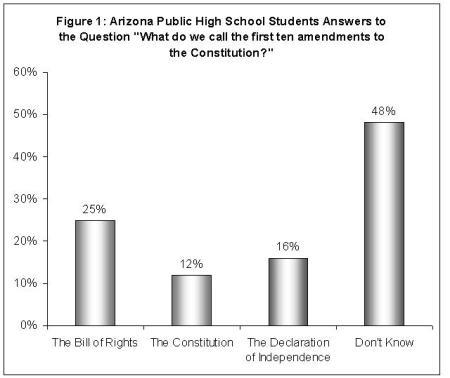
A majority of Arizona public high school students got only one of these questions correct, with 58% correctly identifying the Atlantic Ocean as being off the east coast of the United States, with 42% unable to do so. It was all downhill from there. 29.5% of students identified the Constitution as the supreme law of the land, 25% of students identified the Bill or Rights as the first 10 amendments to the Constitution (12% said they were called “The Constitution” and 16% “The Declaration of Independence.”)

Twenty three percent of Arizona public high schoolers identified the House and Senate as the chambers of Congress. Nine point four percent that the Supreme Court has nine justices. Only 25% of students correctly identified Thomas Jefferson as the author of the Declaration of Independence. An almost majority of 49.6 percent identified the two major political parties, only 14.5% answered that Senators are elected for six year terms. Finally, only 26.5% of students correctly identified George Washington was the first President. Other guesses included John F. Kennedy, Ronald Reagan, George Bush and Barack Obama.

Only 26% could identify the President as being in charge of the Executive Branch. All in all, only 3.5% of public school students passed the test by getting six or more items correct. That’s 40 students out of a sample of 1,134 district students.

There were no major differences in performance based on grade (Seniors did approximately as poorly as Freshmen) nor by ethnicity. Profound ignorance is quite equally distributed in large measure across students in the public school system.

Two obvious questions to ask: is it fair to give this test? In order to answer, I examined the Arizona state standards for 8th grade social studies, which all or nearly all of these students will have taken. These standards are included as an Appendix in the study. What they show is that students are supposed to have learned about John Locke, the Mayflower Compact, the Articles of Confederation, the Constitution, Checks and Balances, Seperation of Powers, etc. etc. etc.

Everything they ought to have needed, in other words, to have passed this test. If, that is, they had actually learned any of that material in practice, which they obviously did not.

Second, I gave the test to my own 1st and 2nd grade sons. They both got 3 answers correct. We’ll be working on that. In so doing, they outscored about 40% of the Arizona high school sample, and tied or exceeded about 60 percent.

Charter school kids performed far better but still terribly- with a passing rate about twice as high as the public school kids. Private school students passed at a rate four times higher, which ultimately is both much better and still pathetic.

I had a very difficult time writing a conclusion to this study. More on that for the next post, but you tell me: if you were an Arizona lawmaker what would you do about this?


Teasing Out Freedom from Responsibility

June 19, 2009

(Guest Post by Matthew Ladner)

I have a new study coming out from the Goldwater Institute called Freedom from Responsibility: A Survey of Civic Knowledge Among Arizona High School Students. You dear reader get a special sneak-peak!

This study employs a straightforward methodology: we designed a telephone survey instrument to test civic knowledge based upon the United States Citizenship and Immigration Services (USCIS) exam items. The USCIS administers a test to all immigrants applying for citizenship and makes the questions public.

USCIS officials choose 10 questions out of the item bank of 100 questions and give them as a citizenship exam. In order to pass, the applicant for citizenship must answer six out of the 10 questions correctly. The questions are not multiple choice, instead requiring applicants to supply an answer. When they ask “Who wrote the Declaration of Independence” the applicant has to answer “Thomas Jefferson” in order to get the question correct. 

Recently, the USCIS had 6,000 citizenship applicants pilot a newer version of this test. The agency reported a 92.4 percent passing rate for the test among citizenship applicants on the first try. I did not expect Arizona high school students to do that well of course, given that those seeking citizenship have had the opportunity to prepare for the test. On the other hand, Arizona high school students have some advantages of their own: multiple courses in American history and social studies, hopefully exposure to American history outside of school, etc.

I randomly selected 10 of the USCIS questions and included them in a survey, curious to see how many high school students would pass the test required of immigrants.

civics1Here’s your free sample: One of the questions was “What do we call the first ten amendments to the Constitution?” How many high school students attending public schools answered correctly?

“I don’t know” beat “the Bill of Rights” by almost a two to one margin, and 75% of students got the question wrong.

Notice also that 12% of Arizona students thought that the first ten amendments to the Constitution were called “The Constitution.”

Phoenix, we have a problem…