Burke and Ladner respond to the Think Tank Review Project

December 6, 2010

(Guest Post by Matthew Ladner)

Lindsey Burke and I respond to a critique of our work by the Think Tank Review project. Perhaps my favorite part is where the reviewer chides us for failing to do a literature review but failed to notice that Dan Lips and I had refuted her main contention over a year ago in Education Next. The main point of the review is an attempt to cry foul over Florida’s 4th Grade NAEP scores due to the 3rd grade retention policy.

I’ve changed my mind, this is my favorite part:
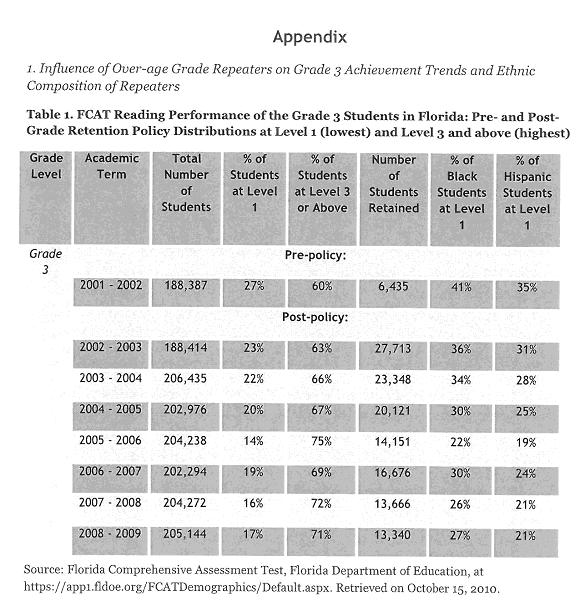


This page comes directly from the review. Notice that by the information gathered by the reviewer herself, the percentage of Florida students scoring FCAT 1 (the lowest possible score and the score making a student eligible for retention) in 3rd grade fell from 27% in 2001-02 to 17% in 2008-09. That’s almost a 38% decline.

Likewise, the percentage of African-American students scoring FCAT 1 fell from 41% to 27%, and the Hispanic rate fell from 35% to 21%. Notice that the African-American rate of scoring FCAT 1 now matches the overall rate in 2001-02 had been.

This is called “radical success.”

Notice also that the number of students actually being retained drops by more than half between the first year of the policy and 2008-09. Despite that fact, Florida’s 4th grade NAEP scores continued to climb. If Florida’s NAEP improvement were driven by retention, scores ought to have peaked early in the decade, and then fallen off. Instead, they continued to rise throughout the decade, even as retention declined.

Oh, and Florida’s reading scores improved by almost a grade level before the retention policy even passed. I could go on, point out the practice of mid-year promotions further weakens the “it was all retentions” theory, and/or blather at some length about the regression discontinuity analysis that Jay performed, which strongly points to something other than aging going on with this policy. Click the link if you want to read about it.

The bottom line: these policies worked. The percentage of Florida students scoring below basic on 4th grade reading dropped from 47% to 27% between 1998 and 2009. No one knows exactly how much of which policy moved the needle, but there is a simple solution to this: do all of the policies at the same time.

If Florida lawmakers had mandated in 1999 that students stood off the side of their desks to do jumping jacks to start each school day, and childhood illiteracy dropped like a rock off a cliff, I would be advocating for other states to do the same. At least until such time that someone established that it didn’t add any value.

In some offline conversations I have had with the Think Tank Review people, they seem to think that other states should be “cautious” until we know exactly how much improvement there has been after hair-splitting, and what causes what.

I disagree. In my view, that’s like getting into an argument about whether to use the sprinkler system, the firehose or the buckets of water when kids are running around with their hair on fire. Florida used all the approaches at once, and got great improvement.

Governor-elect Scott seems to busily readying Florida Reform Version 2.0. Somehow I doubt he will be much persuaded by an attempt to muddy the water on Version 1.0.

All is not lost, however.

I will be adding the above table from their study to my Powerpoint, given how well it makes the case for Florida’s reforms.


Would You Want These People Making Ed Policy?

September 19, 2010


New Heritage Brief on the Racial Achievement Gap

September 18, 2010


(Guest Post by Matthew Ladner)

Back in 1997, Professor Lawrence Stedman wrote:

Twelfth-grade black students are performing at the level of middle school white students. These students are about to graduate, yet they lag four or more years behind in every area including math, science, writing, history, and geography. Latino seniors do somewhat better than 8th-grade white students in math and writing but, in other areas, are also four years behind white 12th graders…. Schools and society remains divided into two different worlds, one black, one white, separate and unequal.

Thirteen years later, sadly not much has changed with the national numbers, but some states have proven that far-reaching policy changes can reduce achievement gaps.

Lindsey Burke and I sing a new duet celebrating Florida’s reduction of the racial achievement gap  in a new Heritage brief.  Let’s just say the evidence from Florida is fairly compelling:

From the brief:

If trends since 1998 were to hold nationally, it would be about 33 years before we could expect Hispanics to close the gap with their white peers. In Florida, however, black students could catch up in half that time, and Hispanics could exceed the national average for white students as early as 2011.

This is just the sort of progress that the “Broader-Bolder” crowd would like us to believe is not possible without a vast expansion of the welfare state.

OOOOOOOOPS! Do you think we’re stupid Hans? It is accountability with teeth, real transparency and expanded parental choice that is making this happen. Cue the slo-mo fall scene-and please try not to make too big of a mess on the sidewalk.


Burke: Why Florida Was the “Smart” Choice for LeBron

July 10, 2010

(Guest Post by Matthew Ladner)

Lindsey Burke of the Heritage Foundation explains why LeBron made the right decision in moving to Miami.

BOOOOOOOOOM!


Burke and Ladner Sing the real “Empire State of Mind” Duet on NRO

June 9, 2010

Now you’re in New York FLOR-I-DA!  Our minority children outscore your WHOLE STATE! There’s nothing we can’t do! 

(Guest Post by Matthew Ladner)

The Heritage Foundation’s Lindsey Burke and I hit National Review Online on Florida’s K-12 success in raising minority academic achievement.

In California, Meg Whitman won the Republican nomination for governor in overwhelming fashion on Tuesday. As you can see on her campaign site, Whitman wants to bring Florida reforms to California, which desperately needs them. California is a gigantic state that scores like an urban school district on NAEP. Without large improvements in California, it is unlikely that we will see the United States even begin to close the academic gap with European and Asian nations.


“Voluntary” Standards

June 4, 2010

I am shocked – shocked! – to discover that political manipulation of education is going on in here!

Your NCLB and RTTT grants for supporting national standards, monsieur.

(Guest post by Greg Forster)

Over on NRO, Heritage’s Lindsey Burke and Jennifer Marshall warn that the Obama administration is finding even more ways to use federal influence to push “voluntary” national standards on the states.

So much for Checker’s apparently serious assertion that the standards “emerged not from the federal government but from a voluntary coming together of (most) states, and the states’ decision whether or not to adopt them will remain voluntary.” Bwa ha ha!


Dan Lips and Lindsey Burke = Will Muschamp

April 22, 2009

(Guest Post by Matthew Ladner)

So the University of Texas has a defensive coordinator named Will Muschamp. Muschamp is known as “Coach Boom” because a clip of him reacting to a big hit went viral on youtube. Going nuts after one of his players delivered a bone crunching hit, Muschamp ran out on to the field happily screaming “BOOM!!!!!!!!!!!!” in a voice louder than I would have ever expected humanly possible, with the possible exception of the Ladner children
 
Texas fans now happily yell “BOOM!” from the stands when they see a big hit.
 
This is the reaction I had when I read Dan Lips and Lindsey Burke in the NRO today. The lines from President Obama’s open letter to his daughters is priceless. I take that back. They are beyond priceless:

“In the end, girls, that’s why I ran for President: because of what I want for you and for every child in this nation. I want all our children to go to schools worthy of their potential – schools that challenge them, inspire them, and instill in them a sense of wonder about the world around them. I want them to have the chance to go to college – even if their parents aren’t rich.”

BOOM!!!!!!!!!!!!!!!!!!


Heritage and WaPo Bring the Pain

April 20, 2009

(Guest Post by Matthew Ladner)

Lindsey Burke of the Heritage Foundation published the results of the latest survey of where members of Congress sent/send their own children to school. The survey finds:

 • 44 percent of Senators and 36 percent of Representatives had ever sent their children to private schools. Among the general public, only 11 percent of American students attend private school.

• While members of the 111th Congress practice school choice for their own families, they should also support school choice policies for all of America’s families. A failed amendment offered by Senator John Ensign (R–NV) on behalf of the popular and successful D.C. Opportunity Scholarship Program would have passed if Members of Congress who exercised school choice for theirown children had voted in favor of the amendment. The future of the D.C. voucher program is now uncertain.Approximately 20 percent of Members of the 111th Congress attended private high school themselves—nearly twice the rate of the American public.

The Washington Post editorialized on the study this morning:

The gap between what Congress practices and what it preaches was best illustrated by the Heritage Foundation’s analysis of a recent vote to preserve the program. The measure was defeated by the Senate 58 to 39; it would have passed if senators who exercised school choice for their own children had voted in favor. Alas, the survey doesn’t name names, save for singling out Sen. Richard J. Durbin (D-Ill.), architect of the language that threatens the program, for sending his children to private school and attending private school himself…

Mr. Duncan, in a recent interview, spoke eloquently of his family’s choice of Arlington as a place to live because of what he called the “determining factor” of schools. He told Science magazine: “My family has given up so much so that I could have the opportunity to serve; I didn’t want to try to save the country’s children and our educational system and jeopardize my own children’s education.” We don’t think it’s too much to expect our leaders to treat their constituents with the same fairness and regard they demand for their own families.

Next year, I’d love to see Heritage go in to even greater depth. Let’s see how many Congressmen sent their children to Anacostia High, etc. Let’s put the over/under at one.

I’ll take the under.