Twin Editorials on Milwaukee Vouchers

June 4, 2009

Weasley Twins

(Guest post by Greg Forster)

This morning the Wall Street Journal and National Review Online both take on the covert effort to destroy Milwaukee vouchers by political subterfuge.

From the Journal:

Because the 20-year-old program polls above 60% with voters, and even higher among minorities, killing it outright would be unpopular. Instead, Democratic Governor Jim Doyle wants to reduce funding and pass “reforms” designed to regulate the program to death. The goal is to discourage private schools from enrolling voucher students and thus force kids to return to unionized public schools.

From NRO:

Last week, the legislature’s Joint Finance Committee approved a series of auditing, accrediting, and instructional requirements that will force successful voucher schools to shift resources away from classrooms and into administration. Several schools will have to comply with new bilingual-education mandates, even though many immigrant parents choose those schools precisely because they emphasize the rapid acquisition of English instead of native-language maintenance.

Both editorials also mention looming cuts in funding for vouchers, even though the program saves huge taxpayer dollars and the bloated government schools are getting increases in funding. Both editorials cite Robert Costrell’s calculation that the difference between private school efficiency and public school bloat has saved taxpayers $180 million – though only NRO mentions Costrell by name.

And NRO also gets a gold star for this:

Researchers say that the program is beginning to show systemic effects. In other words, it doesn’t merely help its participants. It also gives a lift to non-voucher students because the pressure of competition has forced public schools to improve.

C’mon, Wall Street Journal, get on the ball!


Was He Stupid or Lying? Durbin-Blagojevich Edition

June 3, 2009

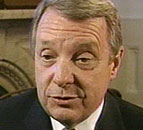
Durbin

(Guest post by Greg Forster)

A while back, noting Sen. Dick Durbin’s flagrantly false statements about the DC voucher study – he said the study didn’t show voucher students outperformed the control group, which is entirely true except for the fact that it did show voucher students outperforming the control group – Jay asked “is he stupid or lying?”

“Of course,” he added, “when it comes to an Illinois pol, one doesn’t have to choose. He could be both.”

Not long ago, when Sen. Durbin made similarly misleading (though now more carefully weaseled) statements in USA Today, Jay remarked, “I’m beginning to lean toward the lying end.”

The first sign of a good scientist is that he adjusts his theory in response to new data!

Well here’s another new datum to factor into our “stupid or lying” calculus. The AP reports that Durbin offered to help Rod Blagojevich make a deal for Barack Obama’s Senate seat. Take it away, AP (emphasis added):

CHICAGO (AP) – Just two weeks before his arrest on corruption charges, then-Gov. Rod Blagojevich floated a plan to nominate to the U.S. Senate the daughter of his biggest political rival in return for concessions on his pet projects, people familiar with the plan told The Associated Press.
 
Blagojevich told fellow Democratic Sen. Dick Durbin he was thinking of naming Illinois Attorney General Lisa Madigan to the seat vacated when Barack Obama won the presidential election, according to two Durbin aides who spoke on condition of anonymity…
 
The aides said the concessions Blagojevich wanted in return were progress on capital spending projects and a health care bill that were stalled in the Legislature…
 
According to the Senate aides, Durbin was delighted to hear that Blagojevich was thinking of naming Madigan to the seat. He believed she would be a popular figure in Illinois and stood perhaps the best chance of holding the seat against a Republican.
 
Durbin volunteered to call the attorney general or the speaker to get the ball rolling and possibly broker an agreement, the aides said.

When the AP came calling about the story, Durbin’s office offered no comment.

Moe Lane of Red State comments: “This would only be a bombshell if it had been unexpected…Senator Dick Durbin has had since November some very significant corroborating evidence that Governor Rod Blagojevich really was corruptly auctioning off a Senate seat.  This is information that would have been very helpful when it came to the timing of Blagojevich’s impeachment, seating Burris, and/or fixing the entire problem with a special election.  And yet, Durbin did or said nothing. I don’t wonder why.  Then again, I know enough about this story to know that the Senator hadn’t realized that his talks with Blagojevich were being recorded.”

Lane highlights the implication that Durbin knew about Blago’s corruption all along, and kept vital information under his hat during the crisis. And Illinois-based politicians betraying the public trust by keeping vital information out of public circulation during a crisis does seem to be emerging as a meme in the DC voucher story.

But doesn’t it seem more important that AP is reporting Durbin offered to help broker the deal?

Yes, what Durbin offered to help arrange was not a bribe to be paid directly to Blago. It was conessions on Blago’s pet projects, including “capital spending projects.” Yet that’s bad enough, isn’t it? I’m aware that people take alliances and rivalries into account when they make these kinds of appointments. But isn’t it something else entirely to arrange a quid-pro-quo transaction of legislative votes for nominations?

And if you insist that there must be a personal bribe involved before we can say it’s wrong, let me ask you: given what we know about Blago, what kind of odds would you give that he wasn’t going to wet his beak on any of those “capital spending projects”? And doesn’t that make Durbin complicit? Or just how dumb are you willing to say Durbin is?

HT Moe Lane, via Jim Geraghty


PJM on Free to Teach

June 1, 2009

Free to Teach cover

(Guest post by Greg Forster)

Today Pajamas Media runs my column on why the government school monopoly is bad for teachers:

Everyone knows a monopoly is bad for the people who rely on its services. But monopolies are also bad for the people who work for them. Just like the monopoly’s clients, its employees have few alternatives. If they’re not treated well at work, they can’t go work for a competing employer. That means the monopoly doesn’t have to worry about keeping them happy.

And the education monopoly also locks out parental pressure for better teaching, which is probably a factor in improving working conditions for teachers in private schools. Public schools are government-owned and government-run, so the main pressure on them is political imperatives. The main pressure on private schools is keeping parents happy. Given that parents primarily want better teaching, which of those two options do you think is better for teachers?

A certain recent study is mentioned in the column.


Pass the Popcorn: Things Are Looking Up – Or Are They?

May 29, 2009

UP 1

(Guest post by Greg Forster)

Well, I’m going to owe a lot of people their money back on this post. Bowled over by the new Star Trek film (which you should really go see if you haven’t already) I overconfidently predicted that it would be the best movie of the year, and offered a refund on the price of the blog post to anyone who felt differently at year’s end. My reasoning at the time – as I explained in the comment thread – was as follows: “Take a look at what else is on the docket for this year. See anything that’s likely to be better?”

Guess what I had completely and totally forgotten about?

When I realized that a Pixar movie was coming out this summer, here’s what I felt like:

UP 2

But who knows? Pixar has been less than stellar in the past – remember A Bug’s Life and Monsters Inc.? Both are better than the average family movie, but to say that is damning with faint praise.

And UP comes to us from a relatively untested creative team. It was written by Bob Peterson and co-directed by Peterson and Pete Docter. Both have accumulated some secondary credits at Pixar – Peterson got secondary writing credits on Finding Nemo and Ratatouille; Docter got “story” credits on both Toy Story movies, Monsters Inc. and Wall-E; both have worked on Pixar shorts, direct-to-video projects, videogames, etc. (Peterson was also the voice of Ray the science teacher in Nemo and Roz the bureaucrat-cum-deus-ex-machina in Monsters.) Neither seems to have done much outside Pixar.

Between the two of them, there’s only one topline credit before UP. Guess what it is?

Docter directed Monsters Inc.

Let’s see how far back we have to go before we find a Pixar movie with a similarly untested creative team:

Wall-E: Written and directed by Andrew Stanton of Finding Nemo

Ratatouille: Written and directed by Brad Bird of The Incredibles and The Iron Giant (a masterpiece you really must see if you haven’t yet)

Cars: Written and directed by John Lasseter of Toy Story & Toy Story 2

The Incredibles: Written and directed by Brad Bird of The Iron Giant

Finding Nemo: Written and directed by Andrew Stanton of . . .

. . . well, OK, I guess the last time we had an untested creator at the helm, we did pretty well, didn’t we?

But guess when the last time before that was? Monsters Inc. Directed by Pete Docter.

I suppose I’m being overly pessimistic. It’s partly because I don’t want to have to shell out all that money on my ill-advised guarantee.

But I have another reason to suspect UP will be no good – I loved the teaser trailer.

No, seriously. Up until now, I have hated every teaser trailer I’ve seen from Pixar. I hated the teaser for Finding Nemo. I hated the teaser for The Incredibles. I really hated the teaser for Cars. I don’t remember seeing the teaser for Ratatouille but I didn’t go in with high expectations so I can’t have liked it if I did see it. And I was, I guess, nonplussed by the teaser for Wall-E – by that time I had learned that hating the teaser was actually a good sign, so that changed my whole outlook on them.

So up until now the teasers have been awful and the movies have been great. What does it say that the teaser for UP made the movie look really good?

This is the second of what I guess will be an annual series of Pass the Popcorn entries on Pixar. I don’t think I can top what I said in the first edition, so I’ll stop here.

Except I will note that the plot synopsis for Toy Story 3 has changed pretty radically since I first expressed such trepidation about it. Before, there was a whole paragraph, which I don’t remember in detail but it was about Woody and Buzz getting thrown away after Andy grows up. Now it’s just one sentence, and Woody and Buzz are ending up in a day care. That sounds much more promising.


Briefing on School Choice Research Misscheduled

May 27, 2009

nixon

(Guest post by Greg Forster)

BAEO, the Urban League and ASC are holding a briefing on What the Research Says about School Choice tomorrow afternoon, 2:00, at the National Press Club. It’s open to the public “by RSVP only,” so contact Ashley Ehrenreich at aehrenreich@allianceforschoolchoice.org or 202-280-1986 if you want to attend.

The good news is, you can hear Jay P. Greene’s Blog’s own Jay P. Greene along with an all-star lineup of school choice researchers discussing what the research says about school choice.

The bad news is, due to a horrible scheduling mixup, the sponsors failed to obey the new city ordinance that says all public release of information regarding vouchers within the boundaries of the District must take place late on Friday afternoon. If even the Obama administration couldn’t get itself exempted, why did these guys think they could?


The Last Word on Unions and Reform

May 26, 2009

building_unions

(Guest post by Greg Forster)

In the great Flypaper debate over whether unions are an obstacle to reform, Robert Costrell has what can only be considered the last word on the subject. Little Ramona started the argument by asserting that Massachusetts has strong unions and yet it accomplished some reforms, therefore unions are not an obstacle to reform, QED. (I paraphrase, but not by much.)

Costrell offers a very striking post on his real-world experience in Massachusetts. Excerpt:

It is indisputable that the Massachusetts Teachers Association (MTA) was the largest obstacle to implementing key elements of the reforms, most notably the MCAS exit exams, which were the main driver of Massachusetts’ success. Diane seems to minimize “the current effort to show that teachers’ unions were no help to education reform in Massachusetts,” as if this were some sort of recent revisionist history. But the “current” effort simply reiterates the well-documented history that was established at the time.  The fight against MCAS featured lawsuits, boycotts, demonstrations, and, most famously, the MTA’s $600,000 fear-mongering ad campaign (the ads showed a ticking clock with nervous students, despite the fact that the exams were untimed).

Here’s the game changer:

My own contribution to this history was solicited by Diane for her last annual Brookings conference….At the time, Diane thought my piece was “great.” So I was surprised to read that the lesson Diane now draws from Massachusetts is that “unions do not block academic improvement.” Well, it was certainly not for lack of trying.

Back in the early 1990s, we videogamers used to call that a “finishing move.”

In other news, sock puppet and Sith apprentice Leo Casey continues to offer his insights. Question for Leo: How deep do you intend to let the hole get before you stop digging?


Free to Teach: What America’s Teachers Say about Teaching in Public and Private Schools

May 20, 2009

Free to Teach cover

(Guest post by Greg Forster)

Today the Friedman Foundation releases Free to Teach: What America’s Teachers Say about Teaching in Public and Private Schools, a study I co-authored with my Friedman colleague Christian D’Andrea.

It’s a simple study with a powerful finding. We used the teacher data from the Schools and Staffing Survey, a very large, nationally representative, confidential survey of school employees conducted by the U.S. Department of Education. We just separated public school teachers from private school teachers and compared their answers on questions covering their working conditions.

We found that the government school system is not providing the best environment for teaching. Public school teachers fare worse than private school teachers on virtually every measurement – sometimes by large margins. They have less autonomy in the classroom, less influence over school policy, less ability to keep order, less support from administrators and peers, and less safety. So it’s not surprising that they also have less job satisfaction on a variety of measures. About the only thing they have more of is burnout. (The measures of teacher burnout were some of the more eye-popping numbers we found in the federal data set.)

Free to Teach box scores

The Schools and Staffing Survey is observational, so we can’t run causal statistical analyses. But it’s really not hard to figure out why private schools provide a better teaching environment. The government school system responds mainly to political imperatives, because anything owned and run by government is inherently political and always will be. Meanwhile, the biggest pressure on private schools is from parents, because if the schools don’t please the parents, the parents can take their children elsewhere.

Which of the two sources of influence – politics or parents – do you think is more focused on demanding that schools provide better teaching?

That’s why private schools deliver a better education even when they serve the same students and families as public schools, and public schools improve when parents can choose their schools.

Parents and teachers are traditionally thought of as antagonists. And no wonder – under the current system, parents have no effective control over their children’s education other than what they can extract from their teachers by pestering and nagging them. The status quo is designed to force parents and teachers into an antagonistic relationship.

But in the big picture, parents are the best friends teachers have. Ultimately, it’s parents who provide the pressure for better teaching, and – if what we’re seeing in the Schools and Staffing Survey is any indication – that pressure for better teaching provides better working conditions for teachers.

Here’s the executive summary:

Many people claim to speak on behalf of America’s teachers, but we rarely get the opportunity to find out what teachers actually have to say about their work – especially when people are debating government control of schooling.

This study presents data from a major national survey of teachers conducted by the U.S. Department of Education; the Schools & Staffing Survey. We break down these observational data for public and private school teachers, in order to compare what teachers have to say about their work in each of the two school sectors.

These are eye-opening data for the teaching profession. They show that public school teachers are currently working in a school system that doesn’t provide the best environment for teaching. Teachers are victims of the dysfunctional government school system right alongside their students. Much of the reason government schools produce mediocre results for their students is because the teachers in those schools are hindered from doing their jobs as well as they could and as well as they want to. By listening to teachers in public and private schools, we discover numerous ways in which their working conditions differ—differences that certainly help explain the gap in educational outcomes between public and private schools. Exposing schools to competition, as is the case in the private school sector, is good for learning partly because it’s good for teaching.

Key findings include:

• Private school teachers are much more likely to say they will continue teaching as long as they are able (62 percent v. 44 percent), while public school teachers are much more likely to say they’ll leave teaching as soon as they are eligible for retirement (33 percent v. 12 percent) and that they would immediately leave teaching if a higher paying job were available (20 percent v. 12 percent).

• Private school teachers are much more likely to have a great deal of control over selection of textbooks and instructional materials (53 percent v. 32 percent) and content, topics, and skills to be taught (60 percent v. 36 percent).

• Private school teachers are much more likely to have a great deal of influence on performance standards for students (40 percent v. 18 percent), curriculum (47 percent v. 22 percent), and discipline policy (25 percent v. 13 percent).

• Public school teachers are much more likely to report that student misbehavior (37 percent v. 21 percent) or tardiness and class cutting (33 percent v. 17 percent) disrupt their classes, and are four times more likely to say student violence is a problem on at least a monthly basis (48 percent v. 12 percent).

• Private school teachers are much more likely to strongly agree that they have all the textbooks and supplies they need (67 percent v. 41 percent).

• Private school teachers are more likely to agree that they get all the support they need to teach special needs students (72 percent v. 64 percent).

• Seven out of ten private school teachers report that student racial tension never happens at their schools, compared to fewer than half of public school teachers (72 percent v. 43 percent).

• Although salaries are higher in public schools, private school teachers are more likely to be satisfied with their salaries (51 percent v. 46 percent).

• Measurements of teacher workload (class sizes, hours worked, and hours teaching) are similar in public and private schools.

• Private school teachers are more likely to teach in urban environments (39 percent v. 29 percent) while public school teachers are more likely to teach in rural environments (22 percent versus 11 percent).

• Public school teachers are twice as likely as private school teachers to agree that the stress and disappointments they experience at their schools are so great that teaching there isn’t really worth it (13 percent v. 6 percent).

• Public school teachers are almost twice as likely to agree that they sometimes feel it is a waste of time to try to do their best as a teacher (17 percent v. 9 percent).

• Nearly one in five public school teachers has been physically threatened by a student, compared to only one in twenty private school teachers (18 percent v. 5 percent). Nearly one in ten public school teachers has been physically attacked by a student, three times the rate in private schools (9 percent v. 3 percent).

• One in eight public school teachers reports that physical conflicts among students occur everyday; only one in 50 private school teachers says the same (12 percent v. 2 percent).


A Different Kind of WaPo Gold

May 14, 2009

Billy-Bragg-Talking-With-The-Taxman

(Guest post by Greg Forster)

In other Washington Post news, those who have been following our coverage of the resurgence of socialism will not want to miss George Will’s column today:

The administration’s central activity — the political allocation of wealth and opportunity — is not merely susceptible to corruption, it is corruption.

HT Jim Geraghty


Mike Petrilli Buys into Hope and Change

May 13, 2009

Pollyanna

(Guest post by Greg Forster)

Yesterday, Mike Petrilli posted that he has “hope” some good will come from the giant geyser of money that the federal government is blindly spewing into the government school system under the “stimulus” bill.

I would let it slide, but I owe Mike a good ribbing for this. So . . .

Mr. Sulu, you have the bridge. Mr. Spock, Mr. Checkov, you’re with me. Set phasers to snark.

Mike’s “hope” comes from the fact that he attended a meeting with some state-based reform leaders and heard some stories about how states are going to do great things in order to qualify for some of the relatively tiny portion of stimulus funding that has been set aside to reward good behavior (the so-called “race to the top” funds).

He actually calls these tales “bona fide stories of state legislatures contemplating” reform. Amazing – they’re contemplating reform!

To substantiate his point, he says that because Arne Duncan said he “may” withhold some of the tiny race-to-the-top portion of stimulus funds from states that limit charter schools, Maine is “considering” enacting a charter law. What kind of charter law we might expect to get under such conditions is a question Mike doesn’t raise. Plenty of states have charter laws that effectively block the creation of any charters that might actually produce change. The purpose of the law is for state legislators to be able to claim they have a charter law. Such laws do much more harm than good, since they siphon off political capital for reform and create a few phony, lousy charters which can then be held up and pilloried to discredit further reform efforts. You think that might happen in Maine?

“Mr. Spock, is all this . . . what I think it is?”

“Tricorder readings confirm we are witnessing the phenomenon known as ‘kabuki,’ Jim. Judging by the crudity of the performance, I would estimate that this particular specimen is at a very low stage of development.”

I’ll agree with Mike on one thing, though. The stories he heard are ceratinly “bona fide stories.” That is, they clearly are stories. What kind of stories is a question worth pondering.

Ironically, Mike wrote his post in response to an earlier post yesterday from Fordham’s Andy Smarick, which adduces with devastating clarity just some of the many reasons why we have no right to even hope for good results from the edu-stimulus:

First, although the application requires the governor to sign assurances promising to make progress in four areas, remarkably, it requires neither a plan for accomplishing those goals nor details on how these billions of dollars will be spent.  The states that have applied so far have obliged, including none of this relevant information in their packages.

Second, the Department sent a letter to states on April 1 saying that states don’t have to demonstrate progress on the assurances to get the second batch (~$16 billion) of stabilization funds.  They only have to have systems in place to collect data.

Third, governors lack the power to require districts to use these funds wisely.  From the guidance released in April:

III-D-14.  May a Governor or State education agency (SEA) limit how an LEA uses its Education Stabilization funds?

No.  Because the amount of Education Stabilization funding that an LEA receives is determined strictly on the basis of formulae and the ARRA gives LEAs considerable flexibility over the use of these funds, neither the Governor nor the SEA may mandate how an LEA will or will not use the funds. 

Finally, the only leverage the Department seems to have is threatening to make states ineligible for Race to the Top funds if this money isn’t wisely spent.  But states, not districts, are the only eligible applicants for the Race to the Top funds, and, as the guidance makes clear, states can’t force districts to behave.  So the threat is misdirected.

Game, set, match – Andy.

Looks like we’re done here. Mr. Scott, three to beam up.


USA Today Notices Cracks in the Dam

May 13, 2009

(Guest post by Greg Forster)

USA Today, the newspaper of American business travelers, has noticed the cracks in the Democratic dam.

You know what I’ve noticed? The blob isn’t just losing more Dems. It’s losing the MSM.