Burke and Ladner Sing the real “Empire State of Mind” Duet on NRO

June 9, 2010

Now you’re in New York FLOR-I-DA!  Our minority children outscore your WHOLE STATE! There’s nothing we can’t do! 

(Guest Post by Matthew Ladner)

The Heritage Foundation’s Lindsey Burke and I hit National Review Online on Florida’s K-12 success in raising minority academic achievement.

In California, Meg Whitman won the Republican nomination for governor in overwhelming fashion on Tuesday. As you can see on her campaign site, Whitman wants to bring Florida reforms to California, which desperately needs them. California is a gigantic state that scores like an urban school district on NAEP. Without large improvements in California, it is unlikely that we will see the United States even begin to close the academic gap with European and Asian nations.


No one else will do it, but…Goldwater is Hiring!

February 9, 2010


(Guest Post by Matthew Ladner)

We are looking to fill five openings at the Goldwater Institute: a vice president of finance and administration, a director of development, an administrative assistant, a development assistant and a staff attorney. We are seeking mid- to senior-level applicants and have some flexibility in responsibilities and salaries depending on the qualifications of the candidates. Information on the positions and how to apply are on our website at: http://www.goldwaterinstitute.org/jobopportunities

Or contact Berry Nelson at bnelson@goldwaterinstitute.org.


Federal Judge Strikes Down Campaign Matching Funds in AZ

January 21, 2010


(Guest Post by Matthew Ladner)

A federal judge has overturned Arizona’s misguided “Clean Elections” system, once touted as a national model, on First Amendment grounds.

The system was a terrible idea from the start.

Clean Elections gathered involuntary contributions from sources such as surcharges on parking tickets, and created a funding source for political campaigns. A candidate could run “clean” by gathering a proscribed number of $5 donations, and then would receive state funding.

Worse still, when facing an opponent raising funds the old fashioned way, the “clean” candidate would receive matching funds from Clean Elections. It is this matching provision which has been found unconstitutional in case brought by the Goldwater Institute.

So what was so bad about “Clean Elections” after all? Plenty. For starters, it represents involves compelled political speech. Second, it is subject to all sorts of gaming, some of which we have seen unfold, and some of which has yet to come.  The Phoenix New Times did a great job of laying out the gaming going on, including Republicans apparently recruiting Green Party candidates for legislative races that the real Green Party people had never met.

Greg Patterson, a former state lawmaker and Republican Arizona blogger, has delighted in noting that although Clean Elections was a project of Progressives, that one of the main results have been a more conservative state legislature. The centrist O’Connor House Project sums it up nicely:

Kill Clean Elections: Voters approved this system of publicly financed campaigns in 1998, hoping to reduce the influence of private donors and give less-wealthy candidates a better shot. Over the ensuing decade, though, Clean Elections has proved adept at helping extremists of both parties get elected. In a traditional campaign setting, the political views of these folks would prevent them from raising enough money to mount a legitimate campaign. But with Clean Elections, they need only collect a minimum number of $5 contributions to qualify for public funding. Talk of dissolving the system may be the nearest to bipartisan consensus of any of the government reforms being discussed.

Finally, the system works as an incumbency protection racket. If you are an incumbent with strong name recognition, you can run “clean” and the battlefield tilts decidedly in your favor and against any relatively unknown challengers. An unknown often needs the opportunity to purchase their name recognition, but the paltry base amounts provided by Clean Elections don’t allow for this. A traditionally financed candidate faces the disadvantage of having matching funds provided to their opponent, begging the question as to why anyone would make a donation to their campaign simply to watch it get matched by Clean Elections.

There are more problems still, more than I have time to write about.

The Goldwater Institute has received some grumbling about why it is we don’t like a system that helped produce a more conservative legislature. Note however that that same system ensured Janet Napolitano’s initial election as Governor (she ran clean, a Republican Congressman ran traditional, JNap won by 12,000 votes) and, oh yeah, IT’S JUST WRONG.  Political free speech ought to be protected as a sacred right. Speaking only for myself (GI hasn’t developed a position on this) the only requirement I believe is appropriate for campaign contributions is transparency- campaigns should take money from whomever they want, with the proviso that they report everything they take in a timely fashion.

Congratulations to GI’s Nick Dranias and the entire litigation team for a job well done.


States to Protect Health Care Freedom?

November 19, 2009

(Guest Post by Matthew Ladner)

George Will wrote a column today about an effort to protect Arizonans from being forced to buy health insurance or to ban the right to privately purchase medical care by Obamacare.

If Obamacare passes, the people of Arizona may give it the proverbial single finger salute. Other states may as well.

The proposed initiative reads:

No law shall be passed that restricts a person’s freedom of choice of private health care systems or private plans of any type. No law shall interfere with a person’s or entity’s right to pay directly for lawful medical services, nor shall any law impose a penalty or fine, of any type, for choosing to obtain or decline health care coverage or for participation in any particular health care system or plan.

Clint Bolick notes that the federal protection of individual rights have always served as a floor, not a ceiling. If both Obamacare and this language passed, an interesting legal battle would ensue. Money quote from the column:

The court says the constitutional privacy right protects personal “autonomy” regarding “the most intimate and personal choices.” The right was enunciated largely at the behest of liberals eager to establish abortion rights. Liberals may think, but the court has never held, that the privacy right protects only doctor-patient transactions pertaining to abortion. David Rivkin and Lee Casey, Justice Department officials under the Reagan and first Bush administrations, ask: If government cannot proscribe or even “unduly burden” — the court’s formulation — access to abortion, how can government limit other important medical choices?

How indeed? This would all be much better if judges simply rediscovered an ability to read the 9th and 10th Amendments to the Constitution, but if you can’t “unduly burden” abortion how are you supposed to “unduly burden” an individual’s right to pay a heart surgeon or have an appendix removed?

Hopefully the Senate will kill Obamacare, but if not, the fight can be carried on by other means. If some states passed such amendments and other did not, get ready for the second great doctor migration. I had a Canadian doctor growing up in southeast Texas in the 1970s. Any guesses why?


Private Schools and the Public Interest

September 9, 2009

I may not agree with what you say, but I will defend to the death your right to say it. Just not in my neighborhood. While you are at it, drop by and beg for permission to run for office.

(Guest Post by Matthew Ladner)

Regular JPGB readers will recall the survey that the Goldwater Institute sponsored showing an appalling lack of civic knowledge among Arizona high school students, both public and private. Sneak preview: a special Oklahoma remix is on the way.

Well, guess what, we also asked a series of questions about political tolerance, volunteerism and satisfaction in the same survey.

Yesterday the Goldwater Institute released two studies: Tough Crowd: Arizona High School Students Evaluate Their Schools and Better Citizens, Lower Cost: Comparing Scholarship Tax Credit Students to Public School Students.

Let’s start with the latter study, which focuses on political tolerance and volunteerism. I could fish up absurd quotes from people about how only public schools can teach proper civic values, and how scary private schools under a choice system are certain to indoctrinate children into all sorts of dangerous anti-democratic ideologies. You being a discriminating consumer of education blogs, however, makes the task unnecessary.


So what happens when you ask a standard set of political tolerance questions to samples of public and private school students in Arizona? Try this:

Tolerance 1


Mmkay, maybe public schools aren’t doing much better at teaching tolerance than they are in teaching reading. Next we asked:

Tolerance 2


So a high percentage of kids, especially in public schools, like the idea of a personalized language police. Disturbing. Next:

Tolerance 3


Hello ideological segregation! Next:

Tolerance 4


Mmm-hmm, we’ll just have all the candidates drop by your house and ask for permission to run. Be sure to wear your ring so that the candidates can kiss it.

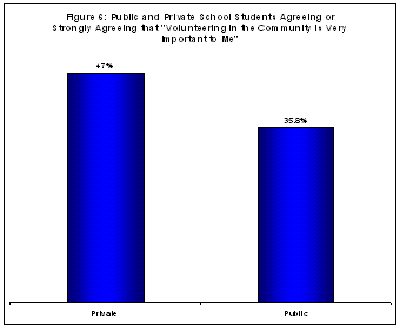
Ah well, tolerance isn’t the only civic virtue- volunteerism counts as well. Next we asked:

Tolerance 5


and while we were at it:


Tolerance 6


There were no meaningful differences between private school students attending with the assistance of a tax credit scholarship, and those who did not receive a scholarship. A minimum of 41% of tax credit scholarships are given out by groups that employ a means-test, so it is not the case that the private school kids are all wealthy and attending Dead Poet Society Schools, which are few and far between here in Arizona in any case.

Of course not all, and perhaps even none of the observed differences can be attributed to the actions of the schools. This however seems very unlikely. This was a survey of high-school students. I know I didn’t have a clue about my family income when I was in high-school, and thus wouldn’t believe the numbers we might get from asking about it, so we didn’t ask.

These results however strongly debunk the notion that private schools function as intolerance boot camps. In fact, it is much easier to build that sort of a case against public schools with the available data, though more research ought to be done.

Arizona’s $2,000 tax credit scholarships are looking like quite the bargain compared to $9,700 Arizona public schools. If you care about tolerance and volunteerism, that is.

More soon on how Arizona high school students view their schools.


USA Today on Freedom from Responsibility

July 2, 2009

6a00d83451b46269e2011570a731b4970c(Guest Post by Matthew Ladner)

USA Today has an editorial piece on Victor and Miguel Mendoza, two American servicemen in Iraq who become United States citizens on July 4th.

The Mendozas represent the best of what the nation is celebrating this Independence Day weekend — liberty, freedom and the sacrifice it takes to keep them strong. They symbolize what’s right with America, a nation of immigrants that was built by opening its doors. And they speak to what could be so much better. At a time when anti-immigrant sentiment has swept through great swaths of the nation, much of it focused on those from Mexico, it’s worth recalling that more than 65,000 immigrants serve in the armed forces, about one-third of them legal residents but not yet citizens. Military service can shorten the usual five-year wait.

We should all be joyful and proud to welcome the Mendozas to our nation. USA Today notes that this contrasts starkly with the performance of Arizona high school students:

Immigrants seeking to become U.S. citizens have to pass a test, and the Mendoza brothers aced theirs this week in Baghdad. That’s more than you can say for a group of Arizona high school students who were surveyed recently on their knowledge of U.S. history and civics.

Just in time for Independence Day, the Goldwater Institute, a non-profit research organization in Phoenix, found that just 3.5% of surveyed students could answer enough questions correctly to pass the citizenship test. Just 25%, for example, correctly identified Thomas Jefferson as the author of the Declaration of Independence.

I mentioned in an earlier post that we drew the title of this study from an Edward Gibbon quote:

In the end more than they wanted freedom, they wanted security. When the Athenians finally wanted not to give to society but for society to give to them, when the freedom they wished was freedom from responsibility, then Athens ceased to be free.

That quote certainly does not apply to the Mendoza brothers. Can we say the same for young Americans born here in the United States?  The United States was the first nation established not on the basis of ethnicity  or tribalism but upon a set of ideals.

If you don’t the basics of American history and government, what chance is there that you are committed to liberty and self-determination?  The pathetic level of ignorance displayed by this an other surveys are more than an indictment on our schooling system (and yes I’m looking at you too charter and private schools) but also an indictment of our entire society.

Consider the Gibbon quote and watch the above video. We have not been providing the type of education that the founders believed was essential to maintaining a system of ordered liberty.

It would be the height of folly to continue to do so.


GI: Hold the Phone on Higher Taxes

June 26, 2009

(Guest Post by Matthew Ladner)

Arizona has one of the worst budget deficit problems in the country (live by the property bubble…) written about here and here. New governor Jan Brewer has called for a “temporary” sales tax increase to prevent the sort of belt-tightening of the Arizona budget already having been done by most Arizona families.

We at the Goldwater Institute strongly disagree, and put out the following humorous video today to explain why:


Freedom from Responsibility Preview part Deux

June 25, 2009

 (Guest Post by Matthew Ladner)

In the end more than they wanted freedom, they wanted security. When the Athenians finally wanted not to give to society but for society to give to them, when the freedom they wished was freedom from responsibility, then Athens ceased to be free.

Edward Gibbon

Last week we had our first sneak peak at Freedom from Responsibility.

Today, more details about the results. The Goldwater Institute randomly drew 10 questions from the United States citzenship exam item bank. We hired a survey firm to interview a sample of both Arizona public and private school high school students.

The questions for neither the citizenship test nor our survey were multiple choice. When you are asked “Who was the first President?” you must answer “Washington” in order to receive credit. Applicants for citizenship must get six out of the ten questions correct to pass. A recent trial of a slightly reformatted exam found that 92.4% of citizenship applicants passed the test on the first try.

Charles N. Quigley, writing for the Progressive Policy Institute, explained the critical nature of civic knowledge:

From this nation’s earliest days, leaders such as Thomas Jefferson, James Madison, and John Adams recognized that even the well-designed institutions are not sufficient to maintain a free society. Ultimately, a vibrant democracy must rely on the knowledge, skill, and virtues of its citizens and their elected officials. Education that imparts that knowledge and skill and fosters those virtues is essential to the preservation andimprovement of American constitutional democracy and civic life.

Paul D. Houston, the executive director of the American Association of School Administrators, also put the issue in focus:

If you look back in history, you will find the core mission of public education in America was to create places of civic virtue for our children and for our society. As education undergoes the rigors of re-examination and the need for reinvention, it is crucial to remember that the key role of public schools is to preserve democracy and, that as battered as we might be, our mission is central to the future of this country.

Here are the 10 questions randomly selected, and their answers:

1.What is the supreme law of the land?Answer: The Constitution

2. What do we call the first 10 amendments to the Constitution?

Answer: the Bill of Rights

3. What are the two parts of the U.S. Congress?

Answer: Senate and House

4. How many Justices are on the Supreme Court?

Answer: Nine

5. Who wrote the Declaration of Independence?

Answer: Jefferson

6. What ocean is on the East Coast of the United States?

Answer: Atlantic

7. What are the two major political parties in the United States?

Answer: Democratic and Republican

8. We elect a U.S. Senator for how many years?Answer: Six

9 . Who was the first President of the United States?Answer: Washington

10. Who is in charge of the Executive Branch?Answer: The President

 
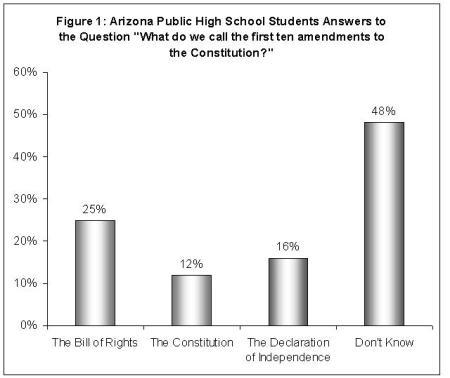
A majority of Arizona public high school students got only one of these questions correct, with 58% correctly identifying the Atlantic Ocean as being off the east coast of the United States, with 42% unable to do so. It was all downhill from there. 29.5% of students identified the Constitution as the supreme law of the land, 25% of students identified the Bill or Rights as the first 10 amendments to the Constitution (12% said they were called “The Constitution” and 16% “The Declaration of Independence.”)

Twenty three percent of Arizona public high schoolers identified the House and Senate as the chambers of Congress. Nine point four percent that the Supreme Court has nine justices. Only 25% of students correctly identified Thomas Jefferson as the author of the Declaration of Independence. An almost majority of 49.6 percent identified the two major political parties, only 14.5% answered that Senators are elected for six year terms. Finally, only 26.5% of students correctly identified George Washington was the first President. Other guesses included John F. Kennedy, Ronald Reagan, George Bush and Barack Obama.

Only 26% could identify the President as being in charge of the Executive Branch. All in all, only 3.5% of public school students passed the test by getting six or more items correct. That’s 40 students out of a sample of 1,134 district students.

There were no major differences in performance based on grade (Seniors did approximately as poorly as Freshmen) nor by ethnicity. Profound ignorance is quite equally distributed in large measure across students in the public school system.

Two obvious questions to ask: is it fair to give this test? In order to answer, I examined the Arizona state standards for 8th grade social studies, which all or nearly all of these students will have taken. These standards are included as an Appendix in the study. What they show is that students are supposed to have learned about John Locke, the Mayflower Compact, the Articles of Confederation, the Constitution, Checks and Balances, Seperation of Powers, etc. etc. etc.

Everything they ought to have needed, in other words, to have passed this test. If, that is, they had actually learned any of that material in practice, which they obviously did not.

Second, I gave the test to my own 1st and 2nd grade sons. They both got 3 answers correct. We’ll be working on that. In so doing, they outscored about 40% of the Arizona high school sample, and tied or exceeded about 60 percent.

Charter school kids performed far better but still terribly- with a passing rate about twice as high as the public school kids. Private school students passed at a rate four times higher, which ultimately is both much better and still pathetic.

I had a very difficult time writing a conclusion to this study. More on that for the next post, but you tell me: if you were an Arizona lawmaker what would you do about this?


Teasing Out Freedom from Responsibility

June 19, 2009

(Guest Post by Matthew Ladner)

I have a new study coming out from the Goldwater Institute called Freedom from Responsibility: A Survey of Civic Knowledge Among Arizona High School Students. You dear reader get a special sneak-peak!

This study employs a straightforward methodology: we designed a telephone survey instrument to test civic knowledge based upon the United States Citizenship and Immigration Services (USCIS) exam items. The USCIS administers a test to all immigrants applying for citizenship and makes the questions public.

USCIS officials choose 10 questions out of the item bank of 100 questions and give them as a citizenship exam. In order to pass, the applicant for citizenship must answer six out of the 10 questions correctly. The questions are not multiple choice, instead requiring applicants to supply an answer. When they ask “Who wrote the Declaration of Independence” the applicant has to answer “Thomas Jefferson” in order to get the question correct. 

Recently, the USCIS had 6,000 citizenship applicants pilot a newer version of this test. The agency reported a 92.4 percent passing rate for the test among citizenship applicants on the first try. I did not expect Arizona high school students to do that well of course, given that those seeking citizenship have had the opportunity to prepare for the test. On the other hand, Arizona high school students have some advantages of their own: multiple courses in American history and social studies, hopefully exposure to American history outside of school, etc.

I randomly selected 10 of the USCIS questions and included them in a survey, curious to see how many high school students would pass the test required of immigrants.

civics1Here’s your free sample: One of the questions was “What do we call the first ten amendments to the Constitution?” How many high school students attending public schools answered correctly?

“I don’t know” beat “the Bill of Rights” by almost a two to one margin, and 75% of students got the question wrong.

Notice also that 12% of Arizona students thought that the first ten amendments to the Constitution were called “The Constitution.”

Phoenix, we have a problem…


Rock Star Pay for Rock Star Teachers Part Trois

May 7, 2009

(Guest Post by Matthew Ladner)

A few months ago I got an angry email from an Arizona teacher claiming that her school had been terribly underfunded, and that she had 32 students in her classroom. I wrote to her:

If you have 32 children in your classroom, my first question is what is your school district doing with all of that revenue?

The JLBC put the statewide spending per pupil in Arizona at $9,399. A classroom of 32 at the statewide average would mean $300,768 in revenue from the students in your class.

Her response:

1-teacher, 1ELL teacher, 1 Special ED teacher, reading specialist, principal, janitor, secretaries, music, art, PE, computer teacher, Cafeteria workers, Para-educators, paper, textbooks, hands on science materials, Computers (this is the 21st century learning) building up keep, electricity, water, tables, chairs , etc…..

She forgot to mention administrative salaries from central command. There is one tiny little problem with all of this. According to the 2007 NAEP, 44 percent of Arizona 4th Graders scored BELOW BASIC in reading.

In other words, as Dr. Phil likes to say, how’s that hiring your average teacher from the bottom third of university students and supplementing them with crowds of others working out for you?

Shape up people!

The sad reality of American public education is that our schools have become revenue and employment maximizers that all too often are profoundly unfocused on the bottom line: student learning.  Public schools ought not to be jobs programs, but focused on their mission of equipping students with the academic skills necessary for success in life.

So, if you’ve got $300,000 in revenue from a classroom (many states have more) call me crazy, but I think you’ve got $100,000 for what research shows to be going away the most important factor for student learning gains: a high quality teacher. When I say a high quality teacher, I mean a verified high quality teacher whose student learning gains are being tracked over time by both administrators and parents on a continuous basis.

The best platforms for ongoing value added assessment are web-based data products that allow teachers to develop common assessment items based on state standards. If there are state standards for a subject, you can do value added analysis on it. When schools really get going on this, they give monthly assessments. This gives ongoing assessment data that greatly drops the amount of error (using only state tests, some of the pioneering value added models require 3 years worth of data).

Overall, it isn’t very hard to imagine a system that would improve upon the status-quo in these practices. We can no longer in good conscience socially organize our efforts to teach children to read along the lines of: let’s hire an army of people who want job security and summers off , do absolutely nothing to reward merit, and hope for the best.

This must change, and it will change.