Ancient Social Scientists Conclude that Ending Slavery Harms Outcomes

March 7, 2017

Image result for charlton heston moses pharaoh

Archaeologists in Giza have just discovered an ancient document summarizing the social science evidence on the effects of freeing people from slavery.  Given that many people will be celebrating Passover next month, perhaps they should stop just repeating ideological talking points and consider what the evidence has to say.  Here is a translation of that ancient document:

The confirmation of Moses as leader of the Hebrews was a signal moment for the Exodus movement. For the first time, the Hebrews are being led by someone fully committed to making the end of slavery and departure from Egypt the centerpiece of the Hebrew agenda.

But even as ending slavery is poised to go global, a wave of new research has emerged suggesting that freeing people from slavery may harm the people who are freed. The results are startling — the worst in the history of the field, researchers say.

While many policy ideas have murky origins, ending slavery emerged fully formed from a single, brilliant promise Abram received from G-d, the literal godfather later to be awarded a Nobel Prize in Economics (check this?). G-d declared: “You shall surely know that your seed will be strangers in a land that is not theirs, and they will enslave them and oppress them, for four hundred years. And also the nation that they will serve will I judge, and afterwards they will go forth with great possessions.”

The freedom idea sat dormant for nearly 400 years before taking root in a few places, most notably Goshen. As people began to experiment with ending slavery researchers were able to collect data to compare freed people with similar people who remained as slaves. Many of the results were released over the last 18 months.

The first results came in late 1446 BCE. Researchers examined the initial results of departing Egypt. “In mobility” they found, “freed slaves experienced a significant increase in wandering the desert.” They also saw a marked decline in food production, with Hebrews having to rely entirely on food assistance programs.

The next results came a few months later, in February, when researchers published a major study of civic order. They found large negative results in both idol worship and lawlessness. Former slaves who started as devout followers of G-d and then were freed dropped to forming a golden calf in a single year. Results were somewhat better in the second year, but were still well below the starting point.

This is very unusual. When people try to improve human behavior, sometimes they succeed and sometimes they fail. The successes usually register as modest improvements, while the failures generally have no effect at all. It’s rare to see efforts to improve human behavior having the opposite result. Thethi Neferti, a professor at the Luxor Graduate School of Social Science, calls the negative effects “as large as any I’ve seen in the literature”

In June, a third freeing-slaves study was released by the Thomas B. Fordham Institute, a conservative think tank and proponent of ending slavery (but only if it produces good outcomes and there are sufficient regulations in place). The study, which was financed by the pro-freedom Hatshepsut Family Foundation, focused on a large ending slavery program in Memphis. “Subjects freed from slavery fared worse economically compared to their closely matched peers who continued as slaves,” the researchers found. Freed slaves often became share-croppers and experienced public discrimination, leading social scientists to conclude that they would have been better off on the plantation, where food was more reliably available.

Three consecutive reports, each studying one of the largest new freeing-slaves programs, found that ending slavery hurt people’s outcomes. Researchers and advocates began a spirited debate about what, exactly, was going on.

Meriptah Djedptahaufankh of the Brookings Institution noted that the performance gap between freed people and slaves had narrowed significantly over time. He argued that stronger incentives for masters to provide slaves with food, clothing, and shelter were proving effective. The assumed superiority of freedom may no longer hold.

Some freedom supporters observed that many farms in Memphis chose not to employ freed slaves, and those that did had recently experienced declining crop production. Perhaps the participating farms were unusually bad and eager for labor. But this is another way of saying that exposing freed slaves to the vagaries of private-sector competition is inherently risky. The free market often does a terrible job of providing basic services to the freed slaves — see, for instance, the lack of grocery stores and banks in many neighborhoods with former slaves.

Others have argued that the reliable supply of food is the wrong measure of whether ending slavery is desirable. It’s true that ending-slavery programs in Cairo and some others elsewhere, which produced no improvements in access to food, increased the likelihood of freed slaves experiencing dignity and autonomy. One study of freeing slaves in Giza found positive results for feelings of self-worth among freed slaves.

But research has also linked the availability of food to a host of positive outcomes later in life. And freedom advocates often cite poor food supply for slaves to justify freeing slaves in the first place.

The new studies about freeing slaves stand in marked contrast to research findings that well-regulated indentured servitude in Heliopolis and elsewhere have a strong, positive impact on the availability of food. But while freeing slaves and changing slaves to indentured servants are often grouped under the umbrella of “freedom,” the best indentured servant programs tend to be run by well-meaning aristocrats, open to all servants and accountable to public authorities. The less “free” that ending slavery programs are, the better they seem to work.

The new evidence on ending slavery does not seem to have deterred the Moses administration, which has proposed the departure of all Hebrews from conditions of slavery in Egypt. Moses’ enthusiasm for freedom, which have been the primary focus of his plague-bringing efforts and advocacy, appears to be undiminished.


Pondiscio: Choice Is Not About Test Scores

March 6, 2017

il_340x270-1128328451_66jh

(Guest Post by Jason Bedrick)

In case you missed it, in today’s U.S. News & World Reportthe inimitable Robert Pondiscio gently chides fellow school choice advocates for getting caught up in a debate over test scores, which are ancillary to the true value of school choice:

Wonky battles over research studies can be illuminating. They can also be irrelevant or premature. While [school choice] advocates are correct that the preponderance of evidence tends to favor school choice, this entire debate puts the cart before the horse. When we look to test-based evidence – and look no further – to decide whether choice “works,” we are making two rather extraordinary, unquestioned assumptions: that the sole purpose of schooling is to raise test scores, and that district schools have a place of privilege against which all other models must justify themselves.

That’s really not what choice is about. Choice exists to allow parents to educate their children in accordance with their own needs, desires and values. If diversity is a core value of yours, for example, you might seek out a school where your child can learn alongside peers from different backgrounds. If your child is a budding artist, actor or musician, the “evidence” that might persuade you is whether he or she will have the opportunity to study with a working sculptor or to pound the boards in a strong theater or dance program. If your child is an athlete, the number of state titles won by the lacrosse team or sports scholarships earned by graduates might be compelling evidence. If faith is central to your family, you will want a school that allows your child to grow and be guided by your religious beliefs. There can be no doubt that, if you are fortunate enough to select a school based on your child’s talents or interests or your family’s values and traditions, the question of whether school choice “works” has already been answered. It’s working perfectly for you.

Deciding whether or not to permit parents to choose based on test-based evidence is presumptuous. It says, in effect, that one’s values, aspirations and priorities for one’s child amount to nothing. Worse, our evidence-based debate presumes that a single, uniform school structure is and ought to be the norm, and that every departure from that system must justify itself in terms of a narrow set of outcomes that may not reflect parents’ – or society’s – priorities. Academic outcomes matter, of course, but so do civic outcomes, character development, respect for diversity and faith and myriad others.

This isn’t to say that the research on the effect of school choice on test scores is meaningless. But it has to be read and understood in the broader context. Test scores are important, but they’re far from what’s most important about exercising educational choice. As Pondiscio concludes:

School choice proponents who seek to prove that vouchers, tax credits and scholarships “work” by citing test-score-based research have allowed themselves to be lured into argument that can never be completely won. They have tacitly agreed to a reductive frame and a debate over what evidence is acceptable (test scores) and what it means to “win” (better test scores). This is roughly akin to arguing whether to shop at your neighborhood grocery store vs. Wal-Mart based on price alone. Price is important, but you may have reasons for choosing the Main Street Grocery that matter more to you than the 50 cents per pound you’d save on ground beef. Perhaps Main Street’s fresh local produce and personal service are more important to you.

If we limit the frame of this debate to academic outputs alone, every new study provides ammunition, but never a conclusion. The real debate we should be having is, “What kind of system do we want?” Answer that question first, then use evidence to improve the school designs, policies and programs we have agreed deserve public support.

Amen, brother!


Kevin Carey Flashes Back to 2009 for a Wild West tax credit tale

March 3, 2017

(Guest Post by Matthew Ladner)

Kevin Carey is at it again- this time by flashing back to eight year old allegations about the Arizona tax credit program as a dire warning about the dangers of a federal tax credit. When these stories ran in 2009, here is what I had to say about it here on the Jayblog:

When presented with this type of information, the first instinct of some will be to deny it, to hunker down, to accuse our enemies of far greater misdeeds, or to otherwise try to put lipstick on a pig. Good luck with that.  It is blindingly obvious to me that Arizona’s tax credit is system is a good program overall that suffers from specific weaknesses that can and must be addressed.  Otherwise, writing articles like this one will become the journalistic equivalent of using a shot-gun to shoot fish in a bucket.

Since then, things have improved substantially, but Kevin did not get the memo. Here are a few items that Kevin left out:

Subsequent to 2009, the state enacted new legislation to require STOs to both consider financial need in the granting of scholarships, and to report to the Arizona Department of Revenue on the family income of recipients. When you examine the Arizona Department of Revenue Reports, you find that approximately 80 to 90 scholarship funds went to middle and low-income students. This not only is a more progressive distribution than many public schools and school districts, it beats the living daylights out of another Arizona tax credit for public school kids that overwhelmingly goes to advantaged public schools. Quite frankly it is likely that a large majority of private choice funds were going to middle and low-income children before the state required reporting. It’s just nice to have an Arizona Department of Revenue report that confirms it.

Carey wrote “Some states, like Alabama and Indiana, limit tax credit vouchers to low- and middle-income families, or to students who were previously enrolled in public school. But others, including Arizona, do not, subsidizing private education for the well-off.” Two of Arizona’s credits are means tested, and two are not. One of the two that is not means tested exclusively serves children with disabilities. I’ll be for completely means-testing private choice programs the very instant that Kevin gets means-testing passed for district schools. Until such time, let’s note for the record that the Arizona private tax credit programs serve provide far fewer dollars to “well off” kids than say, Scottsdale Unified. Someone please wake me up when the Times runs a breathless expose about rich kids getting exclusive access to fancy and abundantly funded public schools.

In addition to the state taking action, donors apparently expressed their displeasure with what they read about in the East Valley Tribune as well during the next donation cycle (see page 8.) If donors don’t like the way scholarship groups run their business, they have the option of not donating, or donating to other groups. 2010 was a rough year for scholarship groups. Decentralized accountability strikes again!

Reasonable people can disagree about the degree and extent of oversight and other devilish details in a program like this. Even we in the Wild West have to make adjustments on occasion, and the democratic process is ultimately pretty good at hashing these sort of things out. I’ll be happy to make my donation this April to help a low-income parent choose a school for their child.


Setting the Record Straight on Educational Choice

March 3, 2017

(Guest Post by Jason Bedrick)

In the last couple weeks, the New York Times has cranked their effort to discredit educational choice policies up to 11. The formula is simple: downplay the positive findings from all the previous gold-standard research and focus instead on more recent studies from Louisiana, Ohio, and Indiana — two of which are not random-assignment studies and one of which hasn’t even been released (not to mention the likelihood that overregulation is hampering Louisiana’s voucher program). Sadly, this distorted narrative is spreading, but some are pushing back. Yesterday, Paul DiPerna of EdChoice and Neal McCluskey of the Cato Institute each provided essential context for understanding the research on school choice.

In Education Next, DiPerna wrote:

Contrary to recent editorials in some major U.S newspapers, the empirical research on school choice programs is far more positive than not. Summaries of the effects of multiple programs generally show positive effects, as does a meta-analysis of gold-standard experimental research on school choice by Shakeel, Anderson, and Wolf (2016). Participating students usually show modest improvements in reading or math test scores, or both. Annual gains are relatively small but cumulative over time. Graduation and college attendance rates are substantially higher for choice students compared to peers. Programs are almost always associated with improved test scores in affected public schools. They also save money. Those savings can be used to increase per-pupil spending in local school districts. Studies also consistently show that programs increase parent satisfaction, racial integration and civic outcomes.

It’s true that recent studies have reported some initial negative effects on choice students’ test scores. The most sobering come from the rigorous, experimental evaluation of the Louisiana Scholarship Program (LSP). The LSP has a different, much more restrictive regulatory framework for private schools than other choice programs. The negative results in math should be monitored, but it’s important to note that the evaluation is only in its second of seven planned years.

Broad perspective and context are essential. Negative initial findings in one or two locations, based solely on one performance metric, should not halt the creation or expansion of school choice programs in other parts of the country. Generalizing those findings across states is problematic because education is sensitive to state and local cultural, political, governmental and economic conditions. The many places where we have observed significant positive results from choice programs swamp the few where we have seen negative findings. We need to consider the complete research base and not disproportionately emphasize the most recent studies.

McCluskey also turned a gimlet eye on the studies that found negative impacts on test scores:

First, the vast majority of random-assignment studies of private school voucher programs—the “gold-standard” research method that even controls for unobserved factors like parental motivation—have found choice producing equivalent or superior academic results, usually for a fraction of what is spent on public schools. Pointing at three, as we shall see, very limited studies, does not substantially change that track record.

Let’s look at the studies Carey highlighted: one on Louisiana’s voucher program, one on Ohio, and one on Indiana. Make that two studies: Carey cited Indiana findings without providing a link to, or title of, the research, and he did not identify the researchers. The Times did the same in their editorial. Why? Because the Indiana research has not been published. What Carey perhaps drew on was a piece by Mark Dynarski at the Brookings Institution. And what was that based on? Apparently, a 2015 academic conference presentation by R. Joseph Waddington and Mark Berends, who at the time were in the midst of analyzing Indiana’s program and who have not yet published their findings.

Next there is Ohio’s voucher program. The good news is that the research has been published, indeed by the choice-favoring Thomas B. Fordham Institute. And it does indicate that what the researchers were able to study revealed a negative effect on standardized tests. But Carey omitted two important aspects of the study. One, it found that choice had a modestly positive effect on public schools, spurring them to improve. Perhaps more important, because the research design was something called “regression discontinuity” it was limited in what it was able to reliably determine. Basically, that design looks at performance clustered around some eligibility cut-off—in this case, public schools that just made or missed the performance level below which students became eligible for vouchers—so the analysis could not tell us about a whole lot of kids. Wrote the researchers: “We can only identify with relative confidence the estimated effects…for those students who had been attending the highest-performing EdChoice-eligible public schools and not those who would have been attending lower-performing public schools.”

That is a big limit.

Finally, we come to the Louisiana study, which was random-assignment. Frankly, its negative findings are not new information. The report came out over a year ago, and we at Cato have written and talked about it extensively. And there are huge caveats to the findings, including that the program’s heavy regulations—e.g., participating schools must give state tests to voucher recipients and become part of a state accountability system—likely encouraged many of the better private schools to stay out. There are also competing private choice programs in the Pelican State. In addition, the rules requiring participating private schools to administer state tests are new, and there is a good chance that participating institutions were still transitioning. Indeed, as Carey noted, the study showed private school outcomes improving from the first year to the second. That could well indicate that the schools are adjusting to the change. And as in Ohio, there was evidence that the program spurred some improvements in public schools.

Both blog posts are worth reading in full, but the main point is this: the research literature is generally positive. The few negative findings are disconcerting and should cause education reformers to think critically about policy design, but the literature still generally finds that students exercising school choice tend to perform as well or better than their district school peers, they’re more likely to graduate high school and enroll in college, they’re less likely to be involved in crime, and all these positive effects come at a much lower cost per pupil to the taxpayer. Additionally, the overwhelming majority of studies find that choice programs have a modest but statistically significant positive effect of the performance of district schools.

Educational choice remains a win-win solution.


Keep School Choice in the States

March 2, 2017

img_1358

If D.C. wants to push school choice, it should make the D.C. voucher universal. Let D.C. clean its own long-neglected house and leave the states in charge of their own education systems.

As I told the New York Times in a story that ran today:

Greg Forster, a fellow at EdChoice, a research and advocacy organization that promotes school choice options, said that while he welcomes more support for the idea of school choice, he wants the issue to remain a state responsibility. “We have achieved a lot of victories at the state level by building bridges,” Mr. Forster said. Having Mr. Trump as an advocate “is a bigger problem for the school choice movement than it is a blessing, in my book,” he said.

He added that there is “no need for a federal push for school choice” because the options are increasingly gaining ground, leading to 61 private school choice programs in 30 states and the District of Columbia.

See also.


Why Arizona Charter Leaders Should Feel Confident About the 2017 NAEP

March 2, 2017

azmeritnaep

(Guest Post by Matthew Ladner)

So the 2017 NAEP is underway as we speak. As the NAEP released all six 2015 exams a cornucopia of good news spilled out for Arizona as a whole and (especially) for Arizona charters. Statewide Arizona has been leading the nation in 4th to 8th grade cohort gains since 2009. That’s a pretty good measure of overall school quality for those grades, as the demographic profile of the cohort isn’t likely to change much for a cohort between (for instance) the time when they were 4th graders in 2011 to when they were 8th graders in 2015. Kids will come and go of course, but absent a DC level of gentrification the academic ability of those coming and going should not skew heavily in a particular direction. You also have a measured amount of sampling error in both the 4th and 8th grade measures, but these are quite modest.

Arizona’s charter schools rocked all 2015 NAEP exams in the fashion of a New England state. This is quite impressive given the very modest level of per-pupil spending in Arizona charters, the majority minority student population etc. Sampling error is a bigger issue with regards to charter schools, but as you can see in the figure above, the state’s AZMerit exam tells us a story very similar to NAEP, and does not involve sampling. AZMerit in short provides backup to the findings in NAEP.

The figure above should lend confidence to Arizona charter leaders that they are likely to rock the NAEP again in 2017. The figure shows 4th and 8th grade NAEP scores from 2015 (proficiency rates) and then the proficiency rates for districts and charters from 2016 on AZMerit. These tests are not scaled exactly the same so you would not expect them to match up exactly, but the similarity in the pattern provides confidence that 2015 was not a fluke. Some of the differences between Arizona charters and districts can be attributed to differences in student demographics, although not nearly so much as sometimes are imagined, but New Hampshire doesn’t have any excuses for losing out to Arizona charter schools.

On the final set of columns on the right, for perspective, Arizona charters scored just a smidge below the highest performing state (MA) while Arizona districts would be right around the national average. Drawing random samples of students leaves room for goofy variation in subgroup scores, but there isn’t any reason to believe such goofiness would skew the same way in six different samples unless one wants to believe the NAEP is stacking the deck for charter schools in Arizona for some nefarious reason. While they were at it, the same conspirators would have to have infiltrated the AZMerit as well.

Absent goofiness and based on what we see in the AZMerit, I’m expecting Arizona charter students to CeleNAEP Good Times again in 2017. The statewide trend will be of even greater importance. Let’s see what happens next.


Jason Riley: The Next Step is Education Savings Accounts

March 1, 2017


(Guest Post by Matthew Ladner)

Jason Riley weighs in on ESAs, federalism and parental choice in his Wall Street Journal column today:

After years of federal overreach through No Child Left Behind, Common Core and Obama administration “guidance” on lavatory usage, the states—where Republicans now occupy 33 of the 50 governors’ offices—are not only reasserting local control of K-12 education but reimagining it.

In addition to this charter progress, education reformers see prospects for more private school choice in the form of education savings accounts, or ESAs, which they describe as the next step in school choice. Under an ESA system, money that would otherwise go to funding a child’s public-school education is instead placed into a restricted-use bank account, from which the family can withdraw to spend on a variety of education-related services. Like vouchers, ESAs allow the money to follow the child. But ESAs don’t limit education options in the way that vouchers do. Instead, families can use money in the account for tuition, textbooks, tutoring, test preparation, transportation, Advanced Placement courses, online learning and even college savings accounts.

Jason Bedrick, a policy analyst at the research organization EdChoice, told me that along with allowing families to tailor spending to the education needs of their children, ESAs can control costs. “Moving from a coupon or voucher model to a bank-account model helps guard against tuition inflation like we’ve seen in Pell Grants,” he said. With ESAs, “there’s no price floor. If you’ve got a $5,000 voucher, no school is going to charge less than $5,000. With an ESA, there’s a lot more competition because private schools are not just competing against each other and against public schools but also competing against other sorts of education opportunities.” In other words, a parent with an ESA has the ability to hold both public and private schools accountable.


Spontaneous Order, Foreign Aid and K-12

February 28, 2017

(Guest Post by Matthew Ladner)

Annie Lowrey’s NYT magazine article The Future of Not Working is well worth reading. The article describes a Silicon Valley funded experiment with a universal basic income in Africa. Personally I’m skeptical of the notion that human labor is going to become obsolete, and I am even more skeptical of the idea of a universal basic income when we currently stand tens of trillions short on previously made commitments. Nevertheless, this article is well worth reading to the very end, as it contains a powerful insight. With the benefit of modern cell phone banking account technology, this group has been giving aid in the form of small cash payments instead of whatever the aid organizations happen to want to give out. This allows people to work things out for themselves:

The residents of this village had received money in 2013, and it was visibly better off than the basic-income pilot village. Its clearings were filled with mango plantings, its cows sturdy. A small lake on the outskirts had been lined with nets for catching fish. “Could you imagine sitting in an office in London or New York trying to figure out what this village needs?” Bassin said as he admired a well-fed cow tied up by the lakeside. “It would just be impossible.”

Many popular forms of aid have been shown to work abysmally. PlayPumps — merry-go-round-type contraptions that let children pump water from underground wells as they play — did little to improve access to clean water. Buy-a-cow programs have saddled families with animals inappropriate to their environment. Skills training and microfinance, one 2015 World Bank study found, “have shown little impact on poverty or stability, especially relative to program cost.”

All across the villages of western Kenya, it was clear to me just how much aid money was wasted on unnecessary stuff. The villagers had too many jerrycans and water tanks, because a nongovernmental organization kept bringing them. There was a thriving trade in Toms canvas slip-ons: People received them free from NGO workers and then turned around and sold them in the market centers. And none of the aid groups that had visited the villages managed to help the very poorest families.

The article goes on to explain that cash payments have been abjured in aid programs in the past. It would deprive beneficiaries of the “benevolent guidance” of very well-meaning people, and would also require fewer such people. It however seems entirely obvious that the Kenyan villagers in this article know their own needs much better than the distant would-be do-gooder, and that they are far more capable of making good use of resources. All of this very much brings to mind the Douglas Carswell quote (via Matt Ridley):

The elite gets things wrong, says Douglas Carswell in The End of Politics and the Birth of iDemocracy, ‘because they endlessly seek to govern by design in a world that is best organized spontaneously from below.’ Public policy failures stem from planners excessive faith in deliberate design. ‘They constantly underrate the merits of spontaneous, organic arrangement, and fail to recognize that the best plan is often not to have one.’

Education Savings Accounts anyone?


How to Turn Your Leafy Suburban School Districts into Defacto CMOs

February 27, 2017

(Guest Post by Matthew Ladner)

I had the opportunity to catch up with Dr. Tom Patterson on Friday. Patterson was a crucial legislative supporter of both the Arizona charter and scholarship tax credit laws that passed in 1994 and 1997, respectively. Dr. Patterson related to me that in his first run for the state legislature in 1988, he attended a candidate forum at Arcadia High School, a Scottsdale Unified School District school to which I am zoned. At the time he was campaigning on an open-enrollment law (which came to pass in the 1990s), an idea that his opponent denounced as “crazy.”

A close look at Scottsdale today demonstrates that Dr. Patterson was crazy- crazy like a fox. In fact, without open enrollment Scottsdale Unified would be in trouble today. I came across an interesting power point presentation prepared by demographers for the Scottsdale Unified School District in 2014. Lots of interesting stuff in the document but when I came across the figure that Scottsdale Unified takes in 4,000 out of district transfers, it occurred to me that this was probably a large enough transfer population to get Scottsdale Unified to compare favorably to the state’s larger charter management organizations. Sure enough:

4,000 out of district transfer students would rank Scottsdale Unified as the 9th largest CMO in the state, if it were a CMO. Arizona law requires districts to adopt open enrollment policies, but gives district schools an free hand in deciding which students to accept.

Sadly no one collects statewide data on open enrollment these days, but my spidey-sense tells me that it is underrated here in the Cactus Patch. Based upon a report from the Arizona Auditor, Scottsdale should have a fairly acute interest in open enrollment transfers, as the Arizona Auditor General reports that the district was using 65% of facility capacity in 2012:

The higher cost was primarily caused by the District maintaining a large amount of excess school building space, which was likely not needed because many of the District’s schools operated far below their designed capacities. In fiscal year 2012, Scottsdale USD had total school building capacity of about 38,000 students but only had about 25,000 students enrolled, or in other terms, the District was using about 66 percent of its building capacity. Maintaining more building space is costly to the District because the majority of its funding is based on its number of students, not the amount of square footage it maintains. Had Scottsdale USD maintained a similar amount of school building space per student as its peer districts averaged, it could have saved approximately $3.8 million, monies that the District otherwise potentially could have spent in the classroom. Although the District closed one school campus at the end of fiscal year 2014, in light of its large amount of excess building capacity, the District should continue to review options to further reduce excess space.

Factors other than choice impact Scottsdale enrollment, including an aging population, higher home prices, etc. but choice is playing a role. The demographic report noted that while Scottsdale gained 4,000 students from open-enrollment that they had 9,000 school age children living within their district boundaries not attending Scottsdale Unified schools. Choice programs in other words interact with each other in a dynamic fashion. Many prominent figures in the parental choice movement have argued that Scottsdale kids “already have school choice” but it turns out that when you give them more meaningful school choice, you free up spots for other kids.

The report also includes an analysis of transcript requests as a method for tracking where kids are going. About half of requests came from charter schools-with BASIS and Great Hearts in the lead, another 29% came from private schools, and the remainder came from online schools.

The Arizona Republic wrote up a story about the presentation of the report to the school board, which included a question from a member of the school board as to why an online charter was the largest single recipient of transfer requests when the district had started their own online learning program. “These are kids who, essentially, most of them would be dropping out,” came the reply from an Associate Superintendent.

Two notes on this comment- an online charter was not only the largest recipient of transcript requests, another such school was the third largest single recipient. Not the best look if they were “kids who were going to drop out anyway.” Second, the possibility of negative selection bias may call for a far more careful look at the results of online charters. “Demographic twins” may or may not work out in a rough and ready fashion when we don’t suspect selection bias, but when we do have reason to suspect it..but I digress.

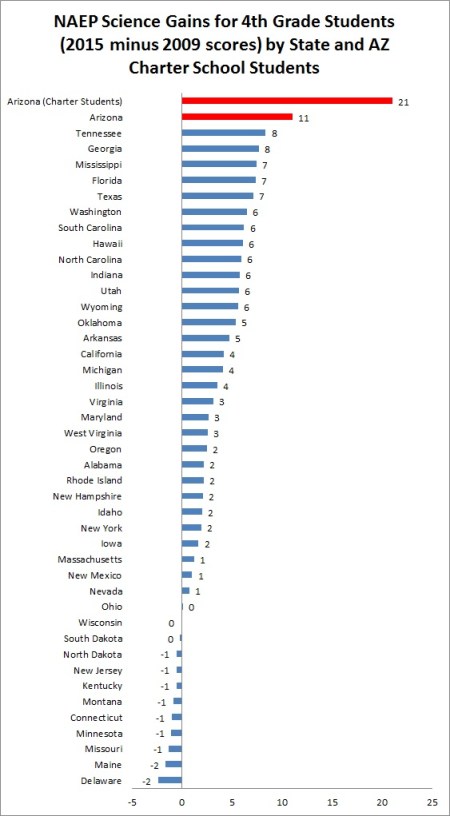
4th-grade-science-gains-charter

The overall picture in Arizona is one marked by robust accountability (losing students and money) rather than double secret probation accountability. The state turned off the A-F accountability system two years ago to revamp it in light of new tests. Word has reached my ears that the State Board recently had the opportunity to consider a formal written proposal to include student vegetable consumption in the school A-F grading formula.

No I’m not making that up. I also heard they decided not to move forward with the proposal. I’m comforted by the widespread use of the Greatschools website, which has their own ranking system and parent reviews. Overall the Cactus Patch has a vibrant bottom up accountability system (vrai pas faux) while still having to go through the motions on what appears to these eyes to be a relatively dysfunctional system of normal compliance activities amounting to…I’m not sure just what.

So it is great to have Scottsdale Unified competing in the choice mix. It makes me happier to pay my taxes than I otherwise would be. Should Arizonans want still more parental choice?


Tweets as a Window Into Foundation Strategy, Part 2

February 17, 2017

Image result for twitter bird flying through window

In my last post I described a method for understanding what ed reform foundations are really pursuing by examining the content of Tweets issued by their grantees.  When some assistants and I conducted this analysis we found that ed reform foundation grantees devote significantly more energy to promoting diversity than promoting school choice. In the prior post I wondered whether this strategy of emphasizing diversity relative to choice is wise given Republican dominance of state governments, where most education policy is formulated and implemented.

The grantees of major ed reform foundations not only give a lower priority to advocating for school choice — both charters and private school choice — but they also seem to prefer top-down accountability approaches over parental empowerment.  It was too difficult for non-expert research assistants to judge whether Tweets championed accountability to regulators as opposed to accountability to parents, but they could reliably count the number of Tweets that mentioned the words accountability, quality, and equity.  When Tweets are advocating top-down accountability they tend to use these words since they typically do not envision having to answer to parents as accountability and because they often argue that quality and equity are the goals of their top-down regulatory efforts.  Of course, some Tweets that use these words are not advocating top-down accountability, but it is also the case that one does not need to specifically mention the words accountability, quality, or equity to be arguing for top-down accountability.  While obviously imprecise, I think the number of Tweets talking about accountability, quality, or equity is a reasonable proxy for support of top-down accountability approaches.

If we compare the number of Tweets using any of these three words to the number of Tweets advocating school choice, we find far greater emphasis on top-down accountability than choice.  Among grantees of the Gates Foundation, Tweets mentioned accountability, quality, or equity 6.7 times as often as they advocated school choice.  Among Broad Foundation grantees the ratio was 3.1.  Arnold Foundation grantees mentioned accountability, quality, or equity 1.9 times as often as they advocated choice.  And at the Walton Foundation the figure was 1.0, representing a relatively even emphasis on top-down accountability and choice.

Another indication of how much foundation grantees favored top-down accountability relative to parental empowerment could be found in how they reacted to Betsy DeVos’ nomination for Secretary of Education.  Keep in mind that the time-period we examined was October 1 to December 15 of 2016, so DeVos had just been nominated toward the end of that period.  In addition, she had not yet testified, so support or opposition of her nomination was a reaction to her perceived position on issues rather than her command (or lack thereof) of the details of education policy.  Much more opposition to DeVos was mobilized and expressed after her confirmation hearings, which was after the time period we examined.  Lastly, it is important to consider that DeVos is a relatively centrist Republican reformer.  Her supporters included moderate advocates of top-down accountability, while opposition to her was marked by hostility to parental empowerment or support for choice only if it was accompanied by fairly strong top-down accountability measures.

When my assistants coded Tweets as supporting or opposing DeVos they found that grantees of the Broad Foundation opposed her 2 to 1, although this was based on a small number of Tweets.  Given that Eli Broad ultimately wrote a public letter opposing DeVos, this result is not surprising but does provide some validation for the method of analyzing Tweets as a window into foundation strategy.  Gates Foundation grantees had slightly more Tweets against DeVos than favoring her.  But among the Arnold and Walton foundation grantees, support for DeVos was much stronger, with Tweets 2.9 and 5.9 times more likely to support than oppose her, respectively.

Foundations can, of course, support whatever causes they prefer.  The major education reform foundations do not have to be enamored with school choice, can devote the bulk of their energy to promoting diversity, and can take whatever positions they like with respect to top-down accountability and Betsy DeVos.  My point in reporting these results is simply that the causes being championed by the grantees of these major education reform foundations may differ significantly in some ways from what many people think ed reform foundations support.  These causes being championed may even differ significantly from what the foundation staffs or boards think they are supporting.  The evidence suggests that major ed reform foundation grantees give far higher priority to advocating for diversity than for school choice, seem to favor top-down accountability more than parental empowerment, and sometimes only offer tepid support or even opposition to moderate Republican reformers.