NAEP Cohort Gains for Students with Disabilities, 2011 to 2015

March 22, 2017

(Guest Post by Matthew Ladner)

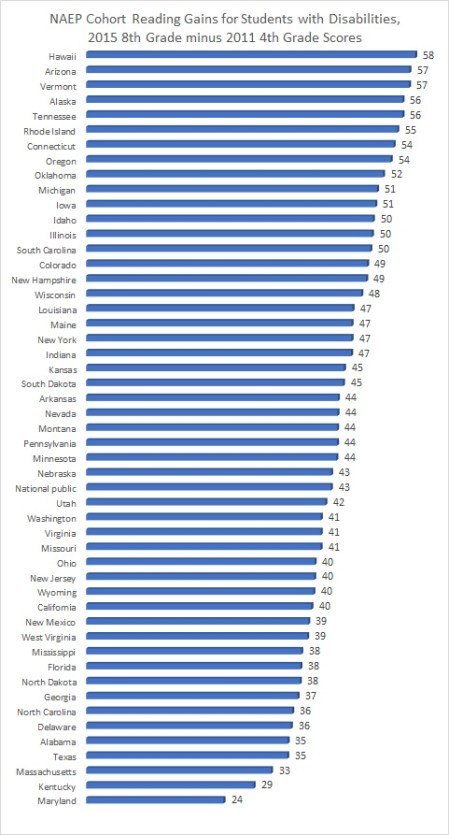
Which states had the most success teaching math and reading to their students between grades 4 and 8 on the most recent NAEP exams?

Quick (really boring) caveat section- tracking NAEP cohort gains gets more inexact due to the larger standard error of estimate when examining subgroup scores- which exists in both the 4th and 8th grade scores. Accordingly, don’t get too excited if your arch-rival Idaho edges you out by a point, because if we knew a true population score rather than sampled estimate it could easily be the other way around. It is more appropriate to look to see whether the state nearest and dearest to your heart landed near the top, or near the bottom of the list than to obsess about their ranking. Moreover, given the possible role sampling error, it is probably best to consider looking at the math and reading scores together. If a state rocks one of the tests and performs not so great on the other, you may have gotten a lucky sampling error bounce on one test, or a bad bounce on the other, or maybe your state is just better at teaching one of these subjects than the other. You would have to consult other sources of data to figure that out. Conversely, if a state does well on both reading and math it is unlikely that sampling error is driving the result in both cases, assuming randomly distributed error.

Ok so on with the show:

Top ranked Hawaii had gains more than twice as large as bottom ranked Maryland. Note that both of the bottom states (MD and KY) have a noted prior history of high exclusion rates for special needs children in NAEP. If they excluded a high percentage of kids in 2011 4th grade testing but not in 2015 8th grade testing, an appearance of catastrophe could sneak in. I am happy to note that my patch of cactus lies near the top. What about math?

Note that the overall gains for math are smaller than for reading. Also Hawaii is again at the top, and Arizona is near the top. Again Maryland appears to have taught a little more than one year’s worth of math to special needs students in four years, but I suspect that strange things are afoot at the MD Circle K on that one. I could dig into NAEP pdf files to check on exclusion rates but alas it is time for me to get out of my pajamas, so I will leave that to whatever you call people from Maryland. Marylanders?


Justice, Equal Opportunity, Diversity and School Choice

March 21, 2017

Little-sprouts_-Grow-bean-sprouts-in-your-back-garden

(Guest post by Greg Forster)

This weekend I was delighted to participate in an hour-long school choice debate on Moody radio’s coast to coast network. The experience left me all the more convinced that choice advocates must continue to de-emphasize the rhetoric of markets and competition, and emphasize instead justice, equal opportunity, diversity and freedom. In that order.

The proponent of the other side had come armed with empty, superficial anti-market talking points. Her argument against choice was basically “we want justice, equal opportunity and diversity, not markets and competition.” So when I opened my case with “we want justice, equal opportunity, diversity and freedom, and here’s how school choice delivers them,” and didn’t use the words market or competition, she was flummoxed.

Her superficial talking points would have been highly effective if I had said “we want justice, equal opportunity, diversity and freedom so we ought to embrace competition and markets.” That is, sadly, because reason and logic are not the only forces in public debate. Her strategy (consciously or unconsciously) seems to have been to use certain trigger words and phrases to prompt emotional responses in the audience – responses unrelated to logic. This is, as JPGB readers know, the nearly universal strategy of choice opponents.

If we stop using the words that allow them to do this to us, we take their toy away.

Of course the quesiton of why choice improves public schools did come up, and here it was necessary to make the point that choice prevents schools from taking students for granted. The body of empirical studies on choice and what they find also came up a number of times. One can make these points without 1) making them the be-all and end-all, or 2) using the specific trigger words that allow the other side to work their emotional trickery.

A final point: personal experience, unfortunately, trumps data. I talked about having visited several private schools in Milwaukee whose existence depends on the voucher program, and the amazing things these particular schools are doing. Then I mentioned the studies finding that choice is impoving education in Milwaukee. I played this card again when a caller raised the inevitable racist talking point “parents in the suburbs are involved with their children’s education but people in those neighborhoods aren’t.” Instead of saying “the data show urban parents make good choices for their kids; that’s a stereotype we shouldn’t be spreading” I said “my experience in urban neighborhoods leads me to believe they care about their children as much as other parents; that’s a stereotype we shouldn’t be spreading.” And then I tried to squeeze in a mention of the data.

Of course if there were a clash between my experience and the data, I’d have to go with the data. But we have to limit our appeals to data when speaking in public. In general, we should present opinions based on experience and then briefly validate them with appeals to data.


Pssst…NACSA…Size DOES matter

March 16, 2017

(Guest Post by Matthew Ladner)

I was looking at NACSA’s 2014 ratings for state charter school laws, as these would have been the most relevant before the most recent NAEP. Hailing from the out west, I noticed that Nevada had a score (26) nearly three times the score of both Arizona (9) and Colorado (9).

Longtime readers of JPGB of course will be aware that charter school students in both Arizona and Colorado rocked the 2015 NAEP exams like nobody’s business. Nevada on the other hand has had a very difficult experience with charter schooling. A decade ago or so ago I wrote a study for the Nevada Policy Research Institute that basically concluded that Nevada was missing out on high quality schools and the opportunity to relieve overcrowding in the public schools, and so should follow the example of their Arizona neighbor and get in the game. I wrote one of the earliest Jayblog posts on the subject called Fear and Loathing in Carson City:

Nevada, by comparison, has been hesitant in expanding parental options. In the five states surround Nevada (Arizona, California, Idaho, Oregon and Utah) and these states have 482, 710, 30, 81 and 60 charter schools respectively, collectively educating hundreds of thousands of students. With only 22 charter schools, Nevada is the tortoise of the region.

On November 30 of 2007, the Nevada Board of Education voted 8-0 to impose a moratorium on the approval of new charter schools. Board members told the press that the freeze was necessary because the state Education Department is being “overwhelmed” by 11 charter applications.

Arizona’s State Board for Charter Schools oversees 482 Arizona charter schools with a staff of 8. Nevada’s board overseeing cosmetology currently has 14 full-time employees.

The fear and loathing in this case referred to the sad fact that many in Carson City obviously feared and loathed charter schools. Imagine then my surprise to see a national charter school organization rank the same law a few years later as nearly three times higher than laws in nearby Western states that had produced far more opportunities for kids. Out of curiosity, I decided to check the 2015 NAEP scores for Nevada charter students.

NAEP yielded no information: the Nevada charter sector remains too small to reliably sample.

Now to give you some perspective on this, NAEP lists 5.6% of students in Nevada as Asians, and the data explorer will give you a number for male Asian students taking the 8th grade math exam in 2015 (Nevada’s Asian males did well on 8th grade math btw) but nothing for charter students of all sorts. NAEP cannot reliably sample charter students in Nevada because in 2013-14 they still only had 34 charter schools according to the National Alliance for Public Charter Schools. Those numbers for Arizona and Colorado btw were 605 and 197 respectively. Presumably the Nevada law would eventually like to have some “charter schools” result from their “charter school” law?

Next I decided to check out the 2015 rankings. The top 10 state charter sectors did not exactly cover themselves in 2015 NAEP glory. Indiana and Nevada tied for first place in their rankings, but neither state would yield NAEP estimates for performance. Alas Indiana’s 75 charter schools were not yet getting the job done in terms of scaling into the NAEP. The Nevada law passed in 1997 and Indiana in 2001. Hopefully this will get better in the future but for now:

The third ranked state (Ohio) has scores reported but those scores are consistently low, but Ohio’s NACSA score only recently increased. NACSA gets a Mulligan on that one, but continuing down the top 10 list however one fails to gain confidence regarding Ohio’s future prospects. Alabama ranks fourth, but is a relative newcomer to charter schooling so also cannot report scores. The Texas charter law ranks fifth on the NACSA 2015 list but has charter scores on NAEP that have yet to impress. I am a Texan who became an Arizonan and I would not swap charter laws with Texas even if they threw a shale formation into the bargain. In the vast majority of Texas schooling is still “take it or leave it” from the districts, whereas in Arizona even our Beverly Hills type districts are anxious for you to open enroll from outside the boundaries.

The same applies to seventh ranked Minnesota- the nation’s oldest charter law. You can get NAEP scores in MN, and I can’t thank them enough for inventing charter schools, but the feeling I get from MN charters is that they are safely contained rather than dynamic. The last three states in NACSA’s top 10-Mississippi, Missouri and South Carolina- all lack enough charter students to meet the minimum NAEP reporting requirements as well. Louisiana comes in 10th.

If you are scoring at home, NACSA’s top 10 is composed of six states with charter sectors that can charitably be described as “wee-tiny” and three others that have yet to flourish like an Arizona or Colorado, and then Louisiana. Tenth rated Louisiana’s charter sector does well in the NAEP, so bully for them, but they obviously have a unique charter history. Notably absent from NACSA’s top 10- very healthy charter sectors like Florida and Washington D.C.

Not to jump to any premature conclusions, but it appears that NACSA’s rating may be overly concerned with bureaucratic compliance rather than performance- either of the academic sort, or the “actually produces charter schools” kind. Arizona and Colorado produced hundreds of charter schools with NAEP scores that compare favorably to New Hampshire (and sometimes Massachusetts) with a 9 score from NACSA. I for one would like to see what they could do with, say, a five score from NACSA. What’s that you say? Three? Ok fine let’s try it out if you insist!

Now maybe I am missing something here, and that is why the comment section is open. I’ll leave you with the following question to consider- Nevada public schools suffer from catastrophic overcrowding. Public education in Las Vegas for a great many students involves sitting in a portable trailer being taught by yet another long-term substitute teacher. Clark County starts each school year with thousands of open teaching spots they are desperate to fill, and their officials told the New York Times they could build 23 new elementary campuses and they would be overcrowded on day one. The United States Census Bureau sees no end in sight for enrollment growth.

Please tell me why any Nevadan in their right mind would prefer Nevada’s charter law to what we see in Arizona and Colorado. I mean maybe scale and great results is not everyone’s cup of tea, but any port in a storm right?


We are but warriors for the working day, but our hearts are in the trim

March 14, 2017

(Guest Post by Matthew Ladner)

The Arizona Republic was kind enough to run the below letter to the editor from yours truly this morning in response to this editorial. If you are feeling the least bit skeptical, feel free to look these numbers up for yourself. The Republic’s editorial claims that now is not the time to expand parental choice because district schools are vulnerable. My claim is that Arizona district schools have never performed at a higher level than now and that we should in the immortal words of Darrel K. Royal “dance with the one that brung ya” which is to say stick with the strategies that brought success. Letter follows:

On the most recent Nation’s Report Card, Arizona 8th graders tied the state of Maryland in math, and outscored many states including Rhode Island, Delaware and North Carolina. These states spend far more per pupil than Arizona. None of these states has a majority-minority student population (Arizona does) but fortunately our students didn’t get the memo that they weren’t supposed to win. Instead they have been leading the nation in academic gains.

Arizona’s charter schools get still less money overall but scored higher than the statewide averages of 49 states on the same test. Arizona charter schools educate a majority-minority student population, but scored a single point lower than the highly funded and demographically advantaged Massachusetts-the nation’s long-time state academic champion. Again, the “you are supposed to lose” memo apparently went to Arizona’s spam folder, and our students and educators achieved an unprecedented academic triumph.

Arizona is never going to win a spending contest, but that is not the purpose of our investment. Our goal must be to maximize opportunity, not spending.


9


See You at the Crossroads

March 13, 2017

292348-crossroads

(Guest Post by Lindsey Burke)

Tulane’s Doug Harris found himself at a crossroads in the Austin American Statesman earlier this week, writing:

The school-reform movement stands at a crossroads. One camp wants unfettered free markets, while charter school leaders and others want to offer families choice and preserve meaningful oversight and accountability.

We’re certainly at a crossroads, but road signs look very different from where I stand. I see one road that leads to parents empowered to choose education options that work for their children, with schools that are held directly accountable to those parents, and another road (perhaps it winds through New Orleans) that puts up regulatory barriers on school choice options and creates no genuine accountability to speak of.

Who Knows Best? Families vs. Bureaucrats

Harris argues in the Statesman that “free markets don’t make sense for schools” because “families expect schools to do a lot of things for their children — teach academic skills, social manners and good values — most of which families don’t have good information about.”

But is it true that families don’t have good information about these facets of schooling? Or, to put it differently, that the government is in a better position to evaluate and make decisions about these difficult-to-quantify outcomes?

Markets produce voluminous information about goods and services that answer the questions consumers are actually asking about a particular product. The oft-referenced ESA Yahoo message board that families in Arizona established after the introduction of the education savings account option in 2011 is a good example.

Current and potential Empowerment Scholarship Account families of Arizona meet here and share ideas and resources for how to best acquire, keep and utilize the funding they need for their child’s individual education.

This is an informal, unaffiliated parent information group where we hope to share ideas, questions and information with each other as we make exiting, individual educational decisions for our special needs, military, D/F school, foster/adoptive children and grandchildren.

Although we list the official ESA website and may share many resources here, we are an informal group of parents and grandparents and are unaffiliated with any formal government or private organization.

As Julie Trivitt and Patrick Wolf have identified in their work on school branding, Catholic schools created a ‘corporate brand’ that signals to parents engaged in the school selection process that their schools provide a religious education and academic quality. This type of branding provides informative shortcuts for parents as they work to choose a school that meets the needs of their child. And critically, when a brand fails to accurately reflect a school’s attributes or quality, inaccurate brands become “an instigator of programmatic attrition.”

Not only do parents have the most intimate perspective on the needs of their own children, but they also tend to be savvy consumers of education services and products, which is why parents leave a provider when brand promises are not met. Choice increases parental involvement, introduces parent-driven decision making, and produces consumer information that is far more detailed (and actionable) than accountability measures in place in a government-run K-12 education system.

By contrast, district schools provide answers to how students perform (the answer usually being, not too well), using blunt measures largely based on state and national tests, and do little if anything to hold those in charge accountable for underperformance. As Matt Ladner has demonstrated, although just three in 10 students in eighth grade in Texas public schools are proficient in reading, 92.5 percent of school districts received a “met standard” designation, with just 6.5 percent of districts receiving a “needs improvement” label. Who’s being held accountable there?

Yet in a market – say, a robust ESA market – consumers not only have more useful information available to make informed choices that meet the needs of their children, they can hold providers to account for not meeting promises. As Jason Bedrick has noted, “real accountability means being directly accountable to those who bear the consequences of your performance.”

Measuring Quality: But By Whose Measure?

Harris also goes on to question the wisdom of choice without the omnipotent hand of the government regulating accountability. “Even if free markets did work well,” he says, “it would be reasonable for policymakers to ask for some measurable results. It’s hard to think of another case where government writes checks to private organizations without checking whether taxpayers are getting anything for their money.”

First, ESA and other education choice funds do not go to “organizations.” Funds go to families, not schools. Schools certainly benefit, by only by way of parents taking their funds to schools that fulfill what they’re looking for. Likewise, food stamps are for the hungry, not grocery stores; Section 8 housing vouchers are for those who need shelter, and are not subsidies designed to prop up the apartment building industry.

Second, the government regularly writes checks to individuals for use at a variety of organizations without requiring either those individuals or organizations to meet certain government-imposed metrics. Grocery stores accepting food stamps aren’t held to higher standards than those than don’t, nor are food stamp recipients required to abide by any dietary guidelines or limited to a certain caloric intake. Contra Harris, this approach is the norm for nearly every entitlement and welfare program, including Social Security, SNAP, WIC, Section 8, and so on. As Jay has noted, the feds aren’t checking on grandma to see that she spent her social security money on vegetables or rent.

This is the norm in education policy as well. Pell grants to colleges require accreditation, but that is far from a measure of academic quality. Colleges that accept Pell grants are not required to administer national tests or any tests at all. Nor are they required to meet government-imposed benchmarks for graduation rates or any other quantifiable measures, let alone to harder-to-quantify ones like civic values or noncognitive skills.

Third, and more germane to the choice conversation, is Harris’s notion that government is needed to ensure accountability. Not only are government regulations in education a far inferior form of accountability than market driven mechanisms, but they can actually have the inverse effect of what was intended by regulation-hawks. And coming from Louisiana himself, where the high-regulation model is in place (requiring private schools accepting students on a voucher to take the state test and punishing “underperformers” by kicking schools that parents have chosen out of the options pool), Harris should acknowledge that the so-called accountability regulations have not lived up to their proponents’ promises and may have had the exact opposite effect of what was intended.

Heavy-handed regulations (a state testing mandate, among others) have discouraged the vast majority of private schools from participating, while likely encouraging lower performers (as indicated by student attrition from those schools prior to entering the voucher program) to join the LSP, willing to incur the regulations in order to secure a new funding stream.

Fairness: Market Mote and Government Beam

Harris then goes on to argue that a free market in education wouldn’t be fair:

In the average free market, wealthier people get higher quality items while low-income families get the lowest. That might be tolerated when we are talking about buying breakfast cereal at the grocery store — but not when we are talking about schools.

To reiterate the argument choice proponents have been making ad nauseam since 1955, this is exactly the system that is currently in place. Wealthier families can currently pay for private options that are higher quality or meet their needs better than their assigned public school, or can purchase a home in a district that reflects their education preferences.

One concern Harris voices that is a valid discussion to have is whether vouchers could create a price floor for tuition prices. This is another reason why ESAs have advantages over traditional modes of school choice. The ability of parents to roll over unused funds year-to-year and to direct dollars to multiple services and products and providers mitigates this issue to a large degree. But that’s hard to see if you refuse to acknowledge that ESAs are functionally different than vouchers.

At the Crossroads: Assessing the Evidence

Harris concludes his op-ed with one last argument about what the research supposedly says:

The research lines up with what basic economics predicts. Across many studies, students using vouchers end up with lower achievement levels than those in traditional public schools. The effects have been especially bad in states like Louisiana and Ohio, where voucher programs are most similar to Senate Bill 3.

Actually, the school choice literature shows an excellent track record, that the government regulatory approach should be envious of. There have been 15 gold-standard, random-assignment evaluations of private school choice programs. Ten of those found statistically significant increases in academic outcomes, three found no difference, and two were negative. Those two negative evaluations were both from Louisiana, and were likely due to the uniquely prescriptive regulatory environment in Harris’s Pelican State.

Harris is indeed right that the school reform movement stands at a crossroads: we can either overregulate choice in a way that limits participation and basically replicates the public system, or we can allow choice and innovation to flourish by trusting families. If we want something different, it’s time to take the road less traveled.

Andy Smarick on K-12 Paradigm Shift

March 13, 2017

(Guest Post by Matthew Ladner)

Andy Smarick has a new paper out from AEI discussing Thomas Kuhn’s paradigm shift framework and the current context of American K-12. Everything he describes is very apparent in the discussion of K-12 out here in the Cactus Patch, especially the discussion about “Incommensurability.” Smarick describes the process by which adherents of the old and new paradigms stop making sense to each other:

According to Structure, the perspectives of adherents of the new paradigm are, in many respects, permanently and irrevocably incompatible with those of their predecessors. It is not just that the paradigms take different positions on particular issues; it is that they ask fundamentally different questions, look for different types of answers, and prioritize different things. Kuhn described it as talking past one another and “practic[ing] their trades in different worlds.

Just yesterday an unsigned editorial in the Arizona Republic read:

This year’s ESA budget is about $40 million according to the Arizona Department of Education. That is more than the state provided to fix things like lead-laced water and mercury in public schools.

In the same edition, Jeb Bush wrote a guest editorial:

ESAs will not cause a mass exodus from public schools. Instead the result will be improved public schools. An enterprise that can take its customers for granted behaves much differently than one that risks losing them.

In the Republic’s paradigm the state is responsible for flooring installed in some district campuses in the 1960s and 1970s and should cease giving students further choices until everything is all clear in district land. Obviously this is a serious problem that needs to be addressed, but the billions in funding that state taxpayers gave districts every year can be used on facilities, not just any additional emergency assistance. Moreover, the state was going to fund the ESA kids whether they went into the ESA program or not, and in fact the majority of them are special needs children, and the consistent claim of the districts have been that they must divert local funds for each child. It’s not like the budget for the ESA program in other words prevents districts and the state from addressing mercury-vapor inducing flooring in other words.

Under Governor Bush’s paradigm, the districts will continue to improve as long as parents have the ability to vote with their feet-whether it is to get away from toxic mercury vapors or a toxic academic or cultural climate etc.

And so it goes…


Chag Purim Sameach

March 13, 2017

For those recovering from yesterday’s Purim celebration and for those who don’t know what they missed, here are some great Purim costumes:

Israeli school students dress up in costumes at the Hanisuii school in Jerusalem on March 10, 2017, ahead of the Jewish holiday of Purim (Yonatan Sindel/Flash90)

אליאל הילל - העמוד הרשמי

12721870_10208782119249246_621946846_n

Image result for purim facebook twitter costumes

Image result for spiderman at the kotel

Image result for dog purim costume

Image result for purim costumes

Image result for purim photos


Illiberal Education Is Not a Public Good

March 10, 2017

(Guest post by Greg Forster)

University education isn’t a public good deserving taxpayer subsidies if it’s going to actively undermine our democratic and republican form of government, I write in OCPA’s Perspective in light of recent events at OU. Among other examples, this one stands out:

Recently, OU expelled students for using racial epithets, in flagrant violation of long-established First Amendment law. Six months later, the university paid $40,000 for a performance by a hip-hop artist who uses the same derogatory epithets. He also insults homosexuals, brags about physically abusing women in their genitals (hello, Donald Trump supporters!), and calls for the murder of police officers. Respect and toleration for others apparently go only one way at OU.

The question here is not whether the people targeted by OU in these cases are right or wrong. The question is whether OU believes that wrong ideas are best corrected and right ideas are best vindicated through open discussion and debate in a social atmosphere of free inquiry for all sides. The particular merits of the speech acts at issue in these controversies are, here as always, irrelevant to the question of whether everyone ought to have free speech.

Today, there is no longer a unique need for universities because they produce technical knowledge. Two hundred years ago, that may have been a key argument for institutions of higher learning; today, it is the universities who are constantly striving to catch up to Google and other leading technical innovators.

If universities are a public good, it can only be because there is an inseparable connection between truly liberal education and political freedom – because liberal education inculcates a respect for the integrity of the human mind that is the only possible justification for political freedom.

A hundred years ago, educator J. Gresham Machen summed up the connection between liberal education and political freedom: “Reasonable persuasion can thrive only in an atmosphere of liberty. It is quite useless to approach a man with both a club and an argument. He will very naturally be in no mood to appreciate our argument until we lay aside our club.” Machen even testified to the U.S. Congress against a scheme for federal control of education on grounds that it would remove freedom for diverse ideas in education. (The more things change, the more they stay the same!)

Because I’m not a university administrator, I welcome your free thoughts in reply!


The All-Too-Familiar Experience of a Pundit with a Home Office

March 10, 2017


Park Savings Accounts – An idea whose time has come

March 9, 2017

(Guest post by Adam Peshek)

I saw this flyer the other day by a group called Iowans for Public Education and it just made sense. We need to create Park Savings Accounts (PSAs) in Iowa!

As you know, back in 2018 the voters of Iowa decided to make summer camp compulsory. And for good reason. Social scientists from across the state and nation told us of the summer Brain Drain – that time between May and late August when our children lose the knowledge they gained during the school year.

And all because of an outdated notion of “summer break,” which we all know was a centuries-old holdover from farming days. As parents went off to work in June, the unsupervised children they left were running amok – getting into trouble, getting hurt, running with the wrong crowds, and using their free time to experiment with drugs and alcohol.

Some kids even start listening to rock and roll music.

The social costs were skyrocketing. Luckily, Iowans decided to fix this problem by amending the state constitution to create universal summer camps for all:

The safety and well-being of students is of paramount interest to all citizens of this state. Therefore, the state shall make adequate provision for summer camps for all children within its borders. Adequate provision shall be made in a uniform, efficient, safe, secure, and high quality system of free summer camps in local parks across the state.

Instead of funding individual students to pay for summer camps of their choice, tens of thousands of Local Park Agencies (LPAs) were created to manage the program. Large maps were taken out to draw circles around parks to determine which residences were to be zoned for which parks.

Beating Brain Drain, making good citizens, and preparing children for the challenges of the future is complicated work and you need qualified adults to do it. So, we created the park ranger licensing program to ensure the best quality adults were left with our children.

Money needed to pay for all of this is raised through state and local taxes and the average student gets $3,000 in services spent on them each summer. An LPA with 3,000 students in it would have a summer budget of at least $9 million. (The cost for constructing parks is not included in this amount.)

But the goal wasn’t to just build parks that people could choose to come if and when they wanted! We all agreed that summer camps should be compulsory. But we also admitted that requiring all students to go to summer camp at one locally-zoned public park is downright Orwellian! So, parents are given two other options.

The first option is called home camping, which allows parents to provide summer camp for their children as long as they submit documentation to the LPA detailing what activities they plan to provide. This is only an option for parents who can be home during the summer – and have the patience to do it. Despite being fairly commonplace in the 20th Century, home campers soon became seen as a group of outsiders. I mean, how weird is it do to summer camp in your house?! What about socialization? What about proper standardized services approved by the experts in the state capital? It’s just plain weird.

The other option is for parents to pay for private summer camp. These used to be much more prevalent in the U.S. before states started passing laws to provide free summer camp for every student in every neighborhood across the country. Those that remain mostly fill a niche: providing religiously-oriented programming, catering to wealthy parents, or just providing an option for an unsatisfactory local park.

No one ever envisioned a need for another option. But after a few years, parents started to make decisions about buying houses near the best public parks, and home prices became correlated with the quality of a local park. Parents began paying $300,000 for a home in one part of town, even though the exact same home would be worth no more than $100,000 in another part. Young couples with small children began the trend of moving out of cities to the suburbs to be able to afford a quality local park.

But when you have to send your child to the park you live closest to, as a parent you’re going to do what it takes to get them into the best. Let’s face it – some parks are better than others. Some parks have discipline problems, disruptive children, or seem like embodiments of the summer camp movies we grew up with in the 1990s. A lot of public parks are great, but for whatever reason they were not fitting the interests or needs for each individual child zoned to attend them. And why would we expect this setup to produce this outcome?

Even if you could, local park managers don’t actually have a budget or the ability to choose their staff, they’re assigned by the LPA. Workplace rules are written by the LPA, with the help of the local park rangers union. These rules dictate everything from the structure of the day, the exact number of hours rangers are expected to work, and other prohibitions that keep managers from being able to change the structure of the day to fit what is needed. Rangers get paid based on how long they’ve worked for the park service, their level of education, and a few other variables such as cost of living.

The best park rangers have no interest being assigned to the most difficult parks. Why would they? The difficulty of the job isn’t factored into the set salary schedule. Even the most idealistic young rangers, who are dedicated to taking the tough roles out of a sense of purpose, are chewed up and spit out by the system. The institutional rangers don’t like them and the unions question their motivations.

Despite some positive benefits for the billions and billions spent, the compulsory summer camp program is still falling short on achieving the goal of keeping children safe and educated through June and July.

After a while, some of us looked around and thought, “why does it have to be this way?” Why are parents paying 200% more for a house just because of the quality of its zoned park? A lot of people actually like living in cities and don’t like the idea of having to move to ‘burbs just to give their kid a shot. Why are low-income families relegated to parks that seem antithetical to the mission of compulsory summer camp? It’s not like they can afford to move to Pleasantville. Why does the government have to be the only one involved with providing services?

People seem to recall a time when there were ways of dealing with this without the LPA. Why can’t students take the money that would have been spent on them in their local parks to one of those private summer camps? Would there be more of them if this was an option? Would they be cheaper?

I mean, there are summer camps in ritzy country clubs that provide the same services for less money!

This is why we should support lawmakers in their effort to create Park Savings Accounts. PSAs would allow you to get just the state share of what your local park would spend on your child. You could use this to pay for private summer camp and other summer enrichment alternatives. If you like your local park, nothing will change for you! In fact, since PSAs do not touch local funds, public parks will have more money per student.

Are PSAs going to fix everything wrong with our compulsory summer camp system? No, and we shouldn’t claim that it will. But it might do something very beneficial to the 4% of 5% of kids who need something different.