(Guest post by Greg Forster)
Well, it’s not as good the second time you see it. It’s better!
See here for the premiere installment of the PTP: City of the Dark Knight series. Oh, and: Spoiler alert (duh).
This time I caught a lot more of the “moral hypocrisy” theme being set up earlier in the movie. It’s not as clear when you don’t know yet how significant it’s going to be later. But they’re clearly telegraphing that the restoration of moral order in Gotham is requiring some compromises of the rules – for example, this flew by me the first time, but Dent brings that mass prosecution of criminals knowing full well that he can’t make most of the charges stick. He argues to the mayor that they should go forward with prosecution anyway, because most of the bad guys won’t be able to make bail (Batman, Gordon and Dent having taken away most of their money) and thus will have to sit in the slammer while the cases grind through the system. “Think what you could do with eighteen months of clean streets,” Dent tells the mayor. Wrong? Not necessarily. Politics is the art of the possible. But it’s bending the spirit of the law.
Also, notice that Gordon tells his people to lie to the media about Dent’s disappearance. I did notice this the first time, and I thought about it for all of five seconds or so, and then I had to keep up with the movie. The second time, it stands out more as part of the hypocrisy theme.
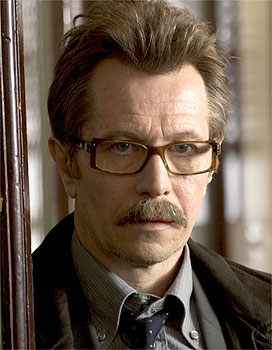
Perhaps the most important thing I caught this time around is why Dent blames Gordon and Batman for what happens to Rachel. It’s because Gordon built his Major Crimes Unit by including officers who were under a cloud of suspicion. This is another “moral compromise” narrative. Confronted about it at the beginning of the movie, Gordon first insinuates that when Dent was at Internal Affairs he had been bringing bogus corruption cases against clean cops in order to build his career. (At first I thought this might be a signal from Chris Nolan that the movie is right-wing, because prosecuting innocent people to build a career was always the right’s complaint about Eliot Spitzer. But then I remembered that Rudy Giuliani did the same thing.) However, Gordon seems to concede pretty quickly that his MCU does contain some shady characters. He says something like, “I have to do the best with what I have to work with.”
I also caught that they’re telegraphing from early on that Dent is not all he appears to be, morally speaking. The first time I saw the movie I wanted them to do more to establish Dent’s fall – he seems to go over to the dark side pretty quickly. But now I see that he was never really that good to begin with. That, plus it occurred to me that the “Two Face” Dent is still fighting for justice in his twisted way. He’s hunting down the people he blames for Rachel, subjecting each of them one by one to the judgment of the coin.
And now for something completely different: I noticed this time that the guy on the prisoners’ boat who throws the detonator out the window has a damaged right eye (his right, our left). I got really excited by this. I thought, where else in this movie did we see a black criminal have somthing happen to his eye? That’s right: “I’m going to make this pencil disappear!” So I thought: the Joker’s goal is to corrupt everybody. But what if one of his victims found himself forced to reexamine his life while sitting in the prison hospital, and he became good because of the Joker’s actions – and that same person’s goodness was the reason the Joker’s ferry experiment failed? Layers within layers within layers!
But, alas, I was barking up the wrong tree. Somebody has posted the pencil scene on YouTube, and it’s clearly not the same actor. Oh, well.
One more thing: I found an easy way to remember the mobster’s name, the one I couldn’t remember in my previous post. It’s Moroni – the same name as the angel who allegedly revealed the Book of Mormon to Joseph Smith. How’d that happen? Was the entire Warner Brothers marketing department asleep?
Let me close with a bleg: At the end, Gordon says that Dent’s rampage produced “five people dead, two of them cops.” I count Moroni’s driver, Moroni himself (assuming he died in the car crash), the first of the two crooked cops, and Dent himself. But the other cop won the toss and just got knocked unconscious. So that’s four people, one of them a cop. Whom am I missing? Are we supposed to assume Dent found a way to finish off the second cop despite the toss, just like he found a way with Moroni (assuming that’s what happened)? Is this a goof? Or what?


 Posted by Greg Forster




 Jay P. Greene's Blog