(Guest Post by Matthew Ladner)
…at least for most states.
(Guest Post by Matthew Ladner)
…at least for most states.
 2 Comments |
  NAEP | Tagged: NAEP 2017, NAEP trends for students with disabilites |
  Permalink
 Posted by matthewladner

(Guest Post by Matthew Ladner)
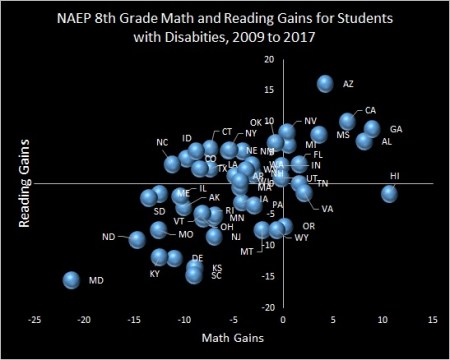
The news overall is grim. You want to be in the top right quadrant of this chart. Some states thankfully did land there-including the state with the largest student population- but many only barely due to small reading gains. If you need the dot size to push you in, it doesn’t count-better luck next NAEP.
You don’t want to land in the top left or in the bottom right, and you most of all don’t want to see your state in the bottom left quadrant (declines in both subjects). Mike Petrilli used the phrase “lost decade” to describe the results. Some states seem far more lost than others, but it is hard to find fault with that assessment overall.
The two main reform strategies employed since the 1990s have involved test-based accountability and increased parental choice. During the era covered by the top chart, the test-based folks swung for the fences by creating a federal incentive for states to adopt a preferred set of academic standards and to pass statewide teacher evaluation systems based upon the scores on those tests. Gigantic investments of political and financial capital supported these policy changes, but it is hard to characterize the results as much more than disappointing.
Now some of you will be thinking around about now “oh yeah but we’ve expanded choice during this period as well!” That is true, and while we have numerous studies establishing positive competitive effects on district schools from choice programs, few states have choice programs going at a scale to place a large amount of pressure on district enrolments. NAEP does however allow us to track state charter sector gains over time. Sixteen state charter sectors had scores for 8th grade math and reading in both 2009 and 2017, allowing the following calculation:

Excel had to change the scale of the axis for the above chart. You may not have noticed. Putting state averages and state charter sector averages into the same chart will help:
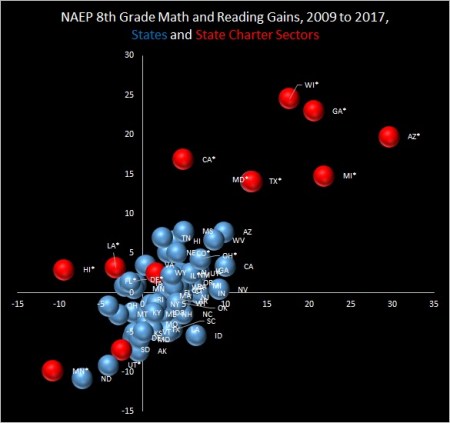
Suddenly those statewide gains in Arizona, California and Mississippi (i.e. the good ones) from the first chart don’t seem so impressive eh? I’m thinking out loud here and inviting you along for the ride. Gains aren’t everything, so the next iteration will include achievement and gains by subject area, but for the huge gainer sectors (spoiler alert) they didn’t get that way with low 2017 scores. I could go on about standard errors being bigger for charter sectors and whatnot, but who are you going to believe a boring statistics lecture or your own lying eyes? If someone can explain why random error would systematically dramatically favor charter sectors, I’m all ears and the comment section eagerly awaits your thoughtful challenge.
In fact there is a white lie in the above chart-some of the sectors and states that look meh in this chart immediately above had very high scores in both 2009 and 2017, and while not ideal there is no crime in holding your mud with high scores. Last year my friend Robert Pondiscio convinced me that combining achievement and gains to provide a clearer picture, so here goes for 8th grade math:
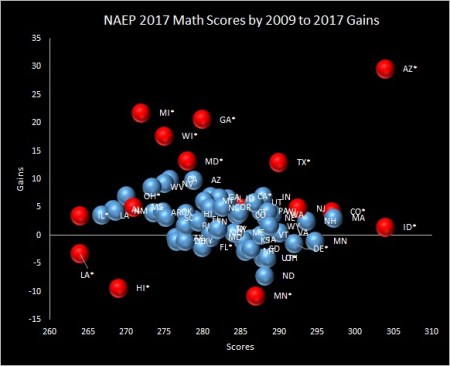
In this chart you either want to have large gains, or high scores, or preferably both of these things. I’m for instance not inclined to criticize Idaho charter schools for modest gains given that they outscore Massachusetts and all despite spending about half the amount per pupil.
Well…yup it is officially time:
5 Comments | charter schools, NAEP | Tagged: 2017 NAEP, NAEP score trends | Permalink
Posted by matthewladner
(Guest Post by Matthew Ladner)
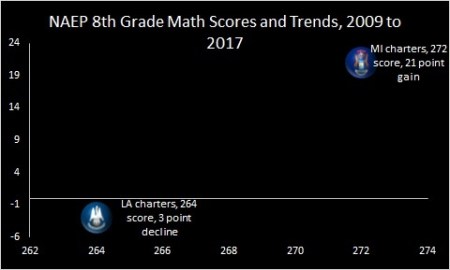
The effort by others to discredit Michigan charter schools during the DeVos confirmation struck me as a travesty, but living well is the best revenge. If you want to oppose someone’s nomination, fine go ahead but don’t stoop to smearing the efforts of thousands of people investing their lives in providing opportunities for kids in the process. They never deserved it.
The venn diagram between those who chose to bash Michigan charters and those who have been confidently asserting that RSD is the way, the truth and the ed reform light don’t entirely overlap, but they circles do partially imbricate.
Just you are feeling skeptical, here is the same chart for 8th grade reading:

I’m content to let RSD live in peace (at least from me) but can I get the same deal for MI and other “Wild West” charter sectors?
3 Comments | Uncategorized | Tagged: Louisiana charter school NAEP scores, Michigan charter school NAEP scores | Permalink
Posted by matthewladner

(Guest Post by Matthew Ladner)
Arizona charter schools continued to display impressive scores and gains on the 2017 NAEP. Note as always that only a random assignment study properly conducted could hope to isolate the role of school quality in all of this, and that such studies are not only unavailable but also are impractical for a statewide system of schools- not all of which are oversubscribed (a precondition for a random assignment study). Thus the role of average school quality in driving the above results remains a holy mystery- likely to be hotly debated, impossible to be resolved in this world. I and others will be digging into Arizona charter subgroup scores in the days ahead.
Now, behold the nothing burger that has been net American academic progress since 2009 (first set of columns). On the math and reading tests 10 points approximately equals a grade level worth of average academic progress (the science exams have a different scaling). Net American progress equals nothing, nothing, next to nothing a tiny bit of something in 8th grade reading.
The middle blue columns are the statewide numbers for Arizona. As you can see they consistently surpass the American nothing-burger. The final set of gains are the gains for Arizona charter school students.
Some of Arizona’s neighbors also have charter sectors that crushed the ball- starting again with Colorado. I’m happy to say that Nevada’s sector made the minimum reporting requirements for NAEP this year, and the results look good. Give me some time to dig, but a monster story may be California charters:

2 Comments | NAEP | Tagged: 2017 NAEP, Arizona Charter Schools NAEP | Permalink
Posted by matthewladner

(Guest Post by Matthew Ladner)
Sorry-nodded off before posting the final piece of the ethnic trilogy. On to other subjects…
Leave a Comment » | NAEP | Tagged: 2017 NAEP | Permalink
Posted by matthewladner
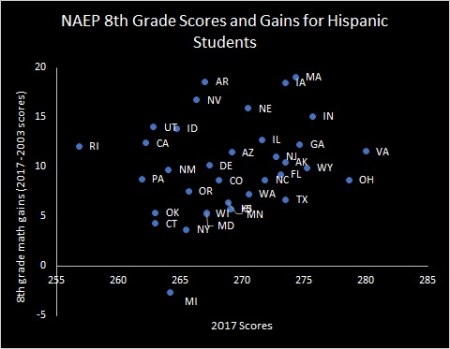
(Guest Post by Matthew Ladner)
A number of state Hispanic sectors closed the gap with the lowest performing statewide Anglo sector (274) in 8th grade math, which is good #MOARRR!
6 Comments | NAEP | Tagged: 2017 NAEP Hispanic Scores | Permalink
Posted by matthewladner

(Guest Post by Matthew Ladner)
A few months ago I speculated that a statewide Black population would catch up to a statewide Anglo NAEP score. It got close in 8th grade math with Arizona’s Black students scoring 272 and the lowest scoring statewide Anglo score coming in at 274. Here’s a chart on 8th grade scores and gains in math since 2003 (Black students did not make the minimum size for NAEP to report scores in several states):

Indiana and Arizona can thumb wrestle later for the championship.
1 Comment | Uncategorized | Tagged: 2017 NAEP, 2017 NAEP Black Scores | Permalink
Posted by matthewladner
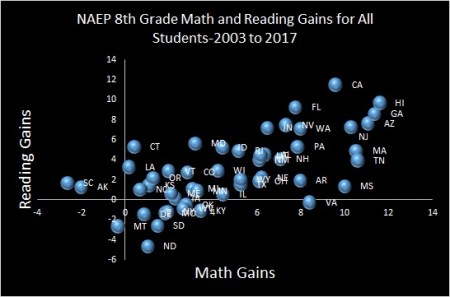
(Guest Post by Matthew Ladner)
So the data went live at midnight EST. The national data is basically flat on all four tests. Most single cycle differences are not statistically significant, so I’m looking at longer periods of time, but the 2015 to 2017 champ looks to be Florida. More details on this later but I’m resisting the temptation to bring Sally back pending further analysis…but only barely!
The short run (2015 to 2017) state level data doesn’t look terribly exciting. I’m still digesting the longer run state level data, but up top there’s a chart to tide you over. NCLB required all states to take math and reading NAEP starting in 2003, so here is the full period (2003 to 2017) gains for 8th grade math and reading by state. These are numerical gains subtracting 2003 from 2017 scores by state.
The 2003 to 2017 period is a natural one to examine, but so too is the post 2009 period, for a few different reasons. The 2009 NAEP happened both in the early days of the Obama administration and during the outset of the Great Recession. NAEP redid the 4th and 8th grade science exams that year. The inclusion of “non-tested” subjects is healthy in my view given concerns over curriculum narrowing. According to my bleary eyes two states have made statistically significant gains in all six exams for the entire available period- Arizona and Mississippi. For the 2009 to 2015 period it had been AZ alone. Arizona and Mississippi were also the only states to make statistically significant gains on all of the math and reading tests during the 2009 to 2017 period. Several states however had statistically significant gains in 3 out of 4 of the math and reading exams between 2009 and 2017-including California, Hawaii, Indiana and Wyoming. On the downside, I have not yet added up the number of significant statewide declines in scores during this period, but there are many of them.
Arizona had three flat aggregate statewide scores and a decline in 4th grade math between 2015 and 2017. At first blush Arizona and Colorado charter schools crushed the academic ball again in 2017, will dig further into details/subgroups but for now:
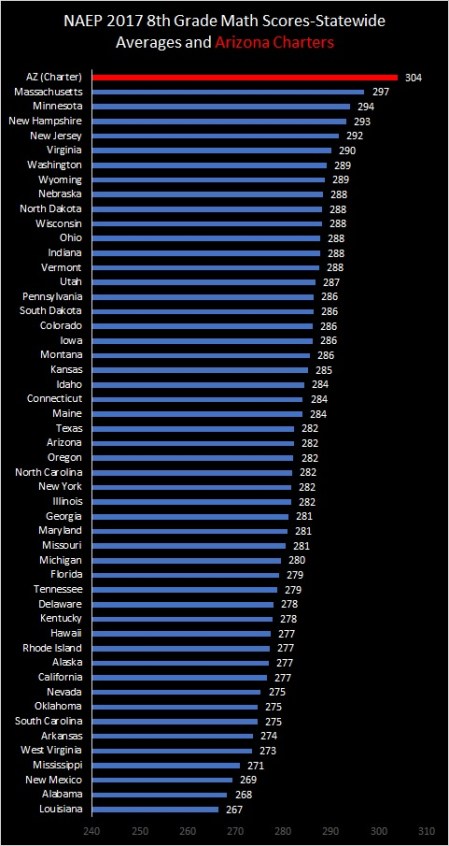
There is more good news in statewide charter sectors, haven’t touched the TUDA yet, stay tuned.
Leave a Comment » | Uncategorized | Tagged: 2017 NAEP, Arizona charter schools, NAEP gains by state | Permalink
Posted by matthewladner

(Guest Post by Matthew Ladner)
Shakespeare’s Henry V includes a scene in the tent of the French nobles in which the Dauphin prattles on an on about how many of the English he plans to slaughter on the following day in the battle of Agincourt. “Will it never be day!?!?!” the Dauphin exclaimed. Careful what you wish for…

NAEP’s 2017 results for Math and Reading for states and select large urban districts will become available tomorrow. I’ve got my basement primed with six laptops and a case of Monster energy drinks. Mrs. Ladner is planning to occasionally open the vault to hurl additional pizza boxes downstairs before quickly re-sealing civilization’s final defense against anarchy. A few notes:
Large score movements either up or down are rare so up is better than down but when examining a statewide average score. On the math and reading tests 10 points roughly equates to an average year worth of progress (e.g. if we did a random assignment exercise and had one group take the 4th grade math test as 4th graders and the other group as 5th graders we would expect the 5th graders to score about 10 points higher). Most gains or declines are of the incremental variety (1-3 points) but they can add up over time like in Arizona, or cancel themselves out like in New York:
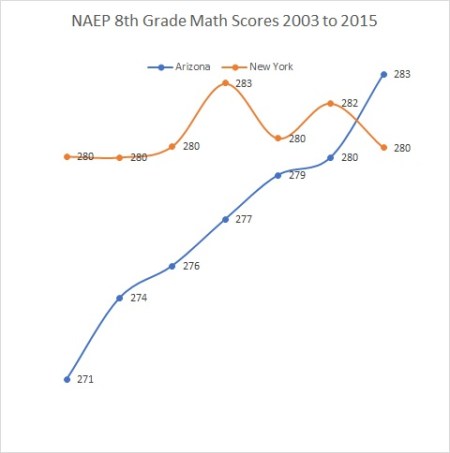
Was the 2015 NAEP a disappointing blip or the start of a new trend? A mere quarter century of national math improvement at both the 4th and 8th grade level came to an end in 2015. We’ll find out tomorrow.
If a trend, cry HAVOC and let slip the dogs of spin! Put me down as skeptical on some sort of lagged impact of the great recession given things like:
This will be a big NAEP for the Common Core project. I have not seen any reason to doubt the Tom Loveless analysis that measured the impact as a tiny positive. A tiny positive however was not what was promised. Let’s see what happens next.
Discipline Reform. I’ve been reading the debate on the discipline reform efforts of the Obama administration. I have no idea whether discipline reform had an adverse impact on academic performance, but if we are looking to subject the notion to conjecture and refutation, I would take the most interest in the score trends of low-income students of color in early adopting jurisdictions, and I would take a greater interest in 8th grade scores/trends.
Computerized testing. They piloted it in 2015, and then delayed the release of the 2017 NAEP to further study whether to make additional adjustments. Peggy Carr, the acting commissioner of the National Center for Education Statistics, told reporters last week “We have the full weight of scientific, psychometric evidence behind the release. We are comparing apples to apples. I think we can all be confident without a shadow of a doubt that we are going to be looking at true performance.” Perhaps understandably given the pressures involved some state chiefs took an interest in technical aspects of NAEP testing shortly after being briefed on their state scores, but the National Center for Education Statistics has a head start several years in the running on studying this issue, so I tend to believe them, unless Arizona scores tank, in which case…just kidding.
Stay tuned to this jayblog channel and remember…

7 Comments | Uncategorized | Tagged: 2017 NAEP | Permalink
Posted by matthewladner

It was bad enough that Marlins fans had to suffer under previous team owner Jeff Loria’s inept management of the team (after impressively winning the World Series twice in the first ten years of the team’s existence). And it’s even worse that a new ownership group led by former Yankee star, Derek Jeter, has dismantled what may have been the best outfield in baseball to conserve cash since the new owners seem financially exhausted immediately after having made the purchase. But the action that has significantly detracted from the human condition and made Jeter worthy of a nomination for the William Higinbotham Inhumanitarian Award is his decision to cancel The Great Sea Race.
Since 2012 the Marlins have held a race among mascots dressed in sea creature outfits during the 6th inning of home games. This contest between Bob the Shark, Julio the Octopus, Angel the Stone Crab, and Spike the Sea Dragon, however, has come to a halt under the new ownership led by Jeter. The exact reasons have not been given, but it appears that the new ownership group seems to view baseball as a serious enterprise, deserving of reverence. As one commentator put it: “[Jeter] doesn’t want fans to have anything to smile about this year.”
The late, great Bill Veeck understood what baseball was really about — fun. As owner of the Cleveland Indians, St. Louis Browns, and Chicago White Sox he packed the games with bread and circuses to make the experience entertaining. He hired Max Patkin, the “Clown Price of Baseball,” to coach the Indians. Patkin “had a face seemingly made of rubber that could make many shapes. He was rail thin and wore a baggy uniform with a question mark (?) on the back in place of a number, and a ballcap that was always askew. While some derided his act as corny, he became a beloved figure in baseball circles…”
In St. Louis, “some of Veeck’s most memorable publicity stunts occurred during his tenure with the Browns, including the appearance on August 19, 1951, by Eddie Gaedel, who stood 3 feet 7 inches tall and is the shortest person to appear in a Major League Baseball game. Veeck sent Gaedel to pinch hit in the bottom of the first of the game. Wearing elf like shoes and ‘1/8’ as his uniform number, Gaedel was walked on four straight pitches and then was pulled for a pinch runner. Shortly afterwards ‘Grandstand Manager’s Day’ – involving Veeck, Connie Mack, and thousands of regular fans, enabled the crowd to vote on various in-game strategic decisions by holding up placards: the Browns won, 5–3, snapping a four-game losing streak.”
And in Chicago, Veeck was the first to introduce an electronic scoreboard that lit up, made noises, and shot fireworks when the White Sox hit a home run. And in one of my greatest childhood memories, Veeck organized Disco Demolition Night, in which local DJ, Steve Dahl, dressed in a military uniform, drove a Jeep into center field, and blew up a pile of disco records during the middle of a double-header. Dahl got the crowd so riled up that they stormed the field, causing enough damage that the White Sox had to forfeit the second game. It was hilarious! Veeck was also the one to convince Harry Caray, who was the announcer for the White Sox at that time, to sing “Take Me Out to the Ballgame” to the crowd during the 7th inning stretch. Caray tried to refuse but Veeck said that he had a recording of Caray singing and would play it over the audio if Caray refused to perform it live. Caray continued this practice of singing to the crowd when he moved to the Northside to become the announcer for the Cubs. Thus was a much-loved baseball tradition born.
Veeck’s teams also played very well. Under Veeck’s leadership, the Indians won their first pennant in 20 years in 1948. In 1959, Veeck’s White Sox won their first pennant in 40 years. But Veeck understood that most teams fall short most years, so they have to offer their fans something other than victory to keep everyone entertained. Yes, they should offer quality play, but sometimes even that is beyond the reach of most teams. As we Marlins fans (can I use the plural for that?) wait for the team to rebuild with only moderate chances of being successful for many years, can’t we at least watch some frickin’ fish run around the outfield?
Jeter seems to represent the type of baseball fan who has watched Field of Dreams a few too many times. The game is not a sacred ritual, deserving of church-like propriety. It’s entertainment. It should be fun. For trying to make us all eat our baseball vegetables and taking away The Great Sea Race, Derek Jeter is worthy of The Higgy.
5 Comments | Uncategorized | Permalink
Posted by Jay P. Greene

 Jay P. Greene's Blog