Arizona Charters: I’m Not Left Handed Either

April 18, 2018

(Guest Post by Matthew Ladner)

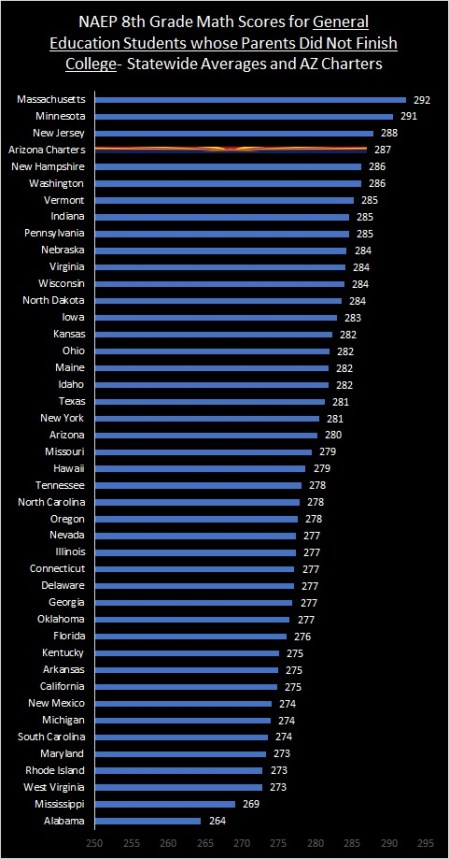
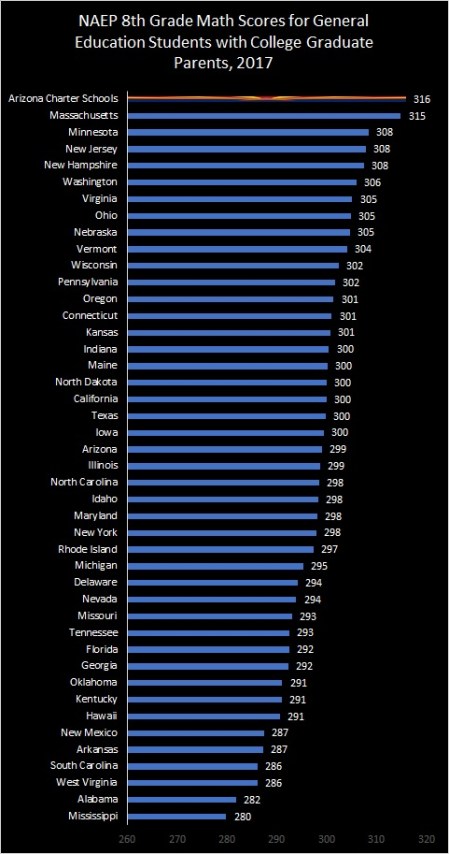
So Arizona charter schools rocked the 2017 NAEP again. In 8th grade math, Arizona charter students narrowly scored below the top scoring state (Massachusetts) in 2015 and above them in 2017. Arizona charter schools educate a majority minority student body, both overall and specifically in 2017’s 8th grade class. It’s really quite extraordinary to see them in the same academic neighborhood as MA, given their majority-Anglo, high income, spend twice as much per pupil combo status. If MA is a good sport, they would fight left handed- what chance does a majority-minority school system with half the spending per pupil have against the highest performing state education system in the nation many years running?

I decided to dig into the details.

The Free and Reduced Price lunch definition has become fairly sketchy, so in the below comparisons I will make use of parental education as a proxy for socio-economic status. Another source for variation between states and sectors involves special program students, so the below comparisons will focus on general education students (neither ELL nor SPED). The first set of scores are for students whose parents did not finish college and are in the general education program:

Massachusetts is still winning the duel, but not comfortably-switch to the right hand? Note for the record that 10 out of 10 of the top performing states have a majority Anglo student population. In fact you don’t spot a majority minority student population state until Texas pulls in at #19. Did I mention before that Arizona charter schools are majority minority? Oh, yes, well good that again then.

Now let’s run the same numbers for general education students with college graduate parents. This should be the MA right handed fighting btw- far more fancy degrees in Massachusetts than Arizona after all, more graduate degrees as well. Well, Arizona charter kids are not left-handed either:


NAEP Trends for Students with Disabilities

April 17, 2018

(Guest Post by Matthew Ladner)

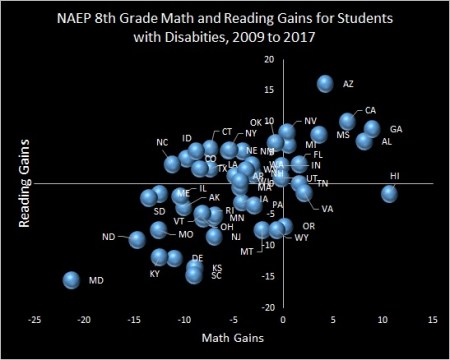
Last week I showed you the above chart on the math and reading trends for students with disabilities. As you can see, a plurality of states land in the quadrant showing declines in scores on both math and reading. Arizona landed as one of the few bright spots, and when I ran Arizona trends on all six NAEP exams since 2009 (when NAEP reconfigured the Science exams, the national economy collapsed and shortly into the then new Obama administration):

In both the AZ and the USA cases, these are the NAEP trends of students attending public schools. Just think of how much higher those Arizona gains might have been if these poor families had not been distracted by the opportunity to attend a private school or to customize the education of their child through the ESA program…


And the Higgy Goes to… John Wiley Bryant

April 17, 2018

Image result for John Wiley Bryant

Today taxes are due, so it is time to announce the recipient of this year’s William Higinbotham Inhumanitarian Award.  We had many (un)worthy nominees, so it was difficult selecting the winner (loser).  My nominee, Derek Jeter, is certainly annoying in trying to make us eat our baseball vegetables by denying fans the fun distraction of mascot races while the team loses a lot of baseball games goes through its rebuilding phase. But the criteria for awarding The Higgy states that: “‘The Higgy’ will highlight individuals whose arrogant delusions of shaping the world to meet their own will outweigh the positive qualities they possess.”  So, there should be some amount of coercion in whoever receives The Higgy and Jeter is not really forcing anyone to have no fun at baseball games.  If anything, it is my own darn fault for being a Marlin fan.  Jeter is just doing a poor job of running the team, but I am free to become a fan of another team or enjoy something else.

Jason’s nominee, Traci Wilke, was a principal who punished a student for secretly recording a teacher making threats against another student.  There is clearly an element of coercion in the principal’s behavior, but if we started awarding Higgies to every school administrator who suppressed the revelation of unflattering information, we’d run out of space on the internet.  It would be like handing out speeding tickets at the Indy 500.

This year’s Higgy really comes down to Greg’s nominee, Romanus Cessario, or Matt’s nominee, John Wiley Bryant.  Greg’s nominee is certainly vile for defending the forced abduction of a Jewish child because he believes Catholic doctrine requires it.  It almost feels like the sort of argument one might make as a freshman in college to see what ridiculous extremes you might reach if you followed a certain idea to its bitter end.  But this is a serious grown-up writing in First Things, which was once a respectable outlet.  As Greg notes, the really insidious part of the article is that it reveals how much social conservatives seem to be willing to abandon liberalism.  The way I’d put it is that these days you don’t have to scratch much beneath the surface to discover how many Jew-hating authoritarians there really are out there.

But I think Cessario falls short because he has no ability to shape the world to his ends.  Writing this kind of drivel has about as much influence on the world as the guy sitting on the park bench muttering to himself about how things will be different when he is in charge.  Greg is right that abducting children is BSDD, but I think writing in defense of it falls short of being PLDD.  The too-easy embrace of authoritarianism and Jew-hating by social conservatives is alarming, but Cessario is a very mediocre anti-Semite.  He couldn’t even achieve excellence at that.

John Wiley Bryant is the most deserving of this year’s Higgy because he arrogantly and coercively sought to reshape the world in a way he imagined would be better, but ended up making it significantly worse.  Like Matt and many other people of our generation, I gained significant cultural literacy (and had a ton of fun) watching Bugs Bunny cartoons.  For trying to force us to watch “educational” television instead of freely choosing quality programming, John Wiley Bryant is awarded the William Higinbotham Inhumanitarian Award.  He joins last year’s winner, Plato, the 2016 winner, Chris Christie, the 2015 winner, Jonathan Gruber, the 2014 winner, Paul G. Kirk, and the inaugural winner, Pascal Monnet.


Update — Thanks to Greg for being our official Higgy Historian and remembering earlier winners.


Test Scores and Life Outcomes

April 17, 2018

classroom-2787754_640

(Guest post by Greg Forster)

I have a post at OCPAThink on the lack of alignment between short-term test score changes and long-term life outcomes:

As an education researcher, I feel a little like an engineer hearing that the coefficient of gravitation has been cut in half as an energy-saving measure, or a mathematician getting the news that for the sake of simplicity, Pi will henceforth be rounded down to 3. We’ve spent a generation building our discipline—and education reform ideas—on the assumption that rising scores mean better education. If they don’t, we have to rethink everything.

We’ll have to look beyond tests for the next accountability – school choice and other forms of local control.

We won’t set high standards with the narrow tool of test scores alone. It takes a broad vision to know what education is, and qualitative human judgment to know when schools are providing it. The future of school accountability is the people at large—not a specialist expert class—empowered to use their full human judgment to evaluate schools that they know personally. In other words, school choice and other forms of local control.

The post contains tons of links to Jay’s writing on this, natch!


What’s Wrong With Portfolio Management in Louisiana?

April 16, 2018

Image result for falling off cliff

Education reform seems to be consumed by a string of fads.  When things don’t work out, we tend to move on to the next fad without reflecting very much on what went wrong so that we might avoid that error in the future.  Mike McShane and I recently edited a book on Failure, which explicitly attempted to correct this problem by acknowledging failures and trying to draw lessons from them.

One of the recent fads that enchanted reformers was Portfolio Management, which was supposed to ensure that only high-quality school options were available to families.  It’s beginning to be painfully clear that Portfolio Management is failing.  It appears to be failing politically, as Denver retreated from Portfolio Management before it even really got going and New Orleans shifted control of the portfolio back to the long-reviled traditional school district board.  But now there is some evidence to suggest that Portfolio Management is suffering educationally as well.

To the extent that NAEP results are informative about school quality (and I’ve previously expressed my doubts about this), test scores for Louisiana charter schools have been falling off a cliff. In 8th grade math, for example, scores rose to as high as 280 in 2013, but have dropped to 264 in 2017.  A change of 10 scale points is supposed to correspond roughly to a grade level, so this is a pretty precipitous drop over the last four years.  In 8th grade reading scores rose to as high as 261 in 2013 before falling to 254 in 2017.  4th grade reading and math scores have similarly declined.

I’d like to hear what champions of the Louisiana portfolio model think is going on.  I thought Portfolio Management was supposed to give us only high quality options — and it largely relies on test scores as an indicator of quality — so why are the scores dropping?  Are Portfolio Managers actually not very good at predicting quality?  Have there been other regulatory changes that came along with Portfolio Management that have harmed the educational environment?  For example, the leaders of the Recovery School District were at the forefront of eliminating exclusionary discipline from schools.  Could the change in school discipline have eroded behavioral control and harmed achievement?  Of course, it is always possible that there have been changes in the composition of students in charter schools which have caused these declines, although virtually all schools in New Orleans are charters and the composition of the city has not changed that much in 4 years.

But it is important to remember that just eyeballing NAEP scores is a horrible way to assess causal effects of programs, so we should be very wary of attributing any change in scores to any policy or practice.  Nonetheless, NAEP is useful for raising questions and generating hypotheses.  I’d like to hear the hypotheses that supporters of Porfolio Management have to offer that might account for the precipitous drop in NAEP scores in Louisiana’s charter sector over the last several years.


For the Higgy: The Unprincipled Principal

April 16, 2018

s-l300

(Guest Post by Jason Bedrick)

Thanks to Greg Forster (author of what is, IMHO, this year’s frontrunner for the Higgy), for reminding me that I submitted this Higgy entry back in November:

In 2015, a 5th-grade student surreptitiously recorded her teacher bullying and threatening violence against a fellow student (e.g. “I will drop you!”). Following the “if you see something, say something” and “zero tolerance for bullying” policies that officials drill into our heads, 11-year-old Brianna Cooper handed the video over to another teacher. Although the school fired the bully teacher, school officials also decided to suspend Brianna for one week claiming that she “violated” the teacher’s “expectation of privacy.”

Apparently Brianna had violated one the school’s unwritten policies: “snitches get stitches.”

It was only after local and state media outlets picked up the story that the superintendent intervened and the suspension was lifted. A string of emails uncovered by the website Photography Is Not a Crime show other district school officials complaining to each other about the principal’s poor decision and lack of responsiveness.

“Did you get a response from Traci?” asked Assistant Superintendent John Lynch. “No sir! Did you think I would?” responded Superintendent Genelle Yost, “I do not believe she truly understands the magnitude of the decision.”

Later, after telling Principal Wilke that it would be “in the best interest of all, district included, to lift the suspension.” Lynch then sent a private email to Yost lamenting, “I was hoping after some time for reflection, Traci [Wilke] would come to the conclusion to lift the suspension on her own.”

Although the suspension was eventually lifted, it is outrageous that any school official would think it appropriate to punish a student for whistleblowing about physical threats made against other students. Doing so sends a clear message that the principal puts the interests of adults working at the school ahead of the physical safety and wellbeing of students enrolled there.

Such warped priorities are deserving of the Higgy.

FYI: Samuel Gaines Academy now has a different principal.


For the Higgy: Romanus Cessario

April 14, 2018

431CF8D8-5EFF-48DE-96DA-5B67DA8C67D6

The Kidnapping of Edgardo Mortara, Moritz Daniel Oppenheim, 1862

(Guest post by Greg Forster)

Without a doubt, the biggest shock in years in the world of “social conservative” intellectuals was the publication, this February, of Romanus Cessario’s defense of Pius IX for forcibly removing six-year-old Edgardo Mortara from his Jewish parents in 1858, and raising him as a Christian. Cessario defends Pius not on “it was a different time” grounds, but absolutely, affirming the general principle.

Serious doubts about religious freedom and liberal democracy have been growing for some time among some people in the insular and deeply self-satisfied intellectual world of what used to be social conservatism. As doubts about religious freedom and liberal democracy have grown, the aptness of the label “conservative” has shrunk, for no one who wants to induce a catastrophic social revolution in order to overturn the 700 year political tradition that provides all our public moral language and shared moral universe ought to be called conservative.

Cessario’s folly has brought matters to a head by revealing what is really at stake in these growing doubts. Centuries ago, it was possible to govern out of authoritative traditions because social worlds were by and large epistemically isolated from one another. As a result, traditions were not much recognized as the social conventions they were. Traditions were not “traditions,” they were simply the wisdom of elders.

But once modernity makes us aware of how socially contingent traditions are – makes us aware of them as traditions – they are no longer authoritative. To impose them on the recalcitrant is merely an act of brute force. Today there is no governing out of traditions, there is only one social group ruling another.

There is no space to enter here into the details of how Cessario’s choice to pick this particular fight in this particular way smacks strongly of anti-Semitism or, for that matter, how the Mortara case can be related to the perfectly legitimate general debate over the validity of religious freedom and constitutional democracy. Of all political forms, liberal democracy has the least right to avoid responsibility for making a case for itself or tell its critics to shut up and go away. As I remarked to a friend during the Cessario blowup, every liberal’s business card should say “Justify Your Social Order – Ask Me How!”

The real Higgyworthiness of Cessario’s article is the desire it reveals, on his part and that of his allies, to eat their cake and have it, too – to defend the enforcement of religious laws on those of other religions, and then pose as champions of the downtrodden whose opponents are the real oppressors. Cessario emphasizes the global opprobrium heaped on Pius IX and on Catholics, especially traditionalists, today, comparing both to the Diocletian martyrs. Steven Spielberg is apparently working on a Mortara film, which Cessario expects to be anti-Catholic; hence the need to instruct the faithful about the Mortara case preemptively.

Cessario has attracted some defenders, but also a much, much larger number of sympathetic commentators who might be described as anti-anti-Cessario (links here). They’re not yet prepared to admit that their position logically entails Cessario’s, but the one thing they do know is that Cessario’s critics are defenders of “bourgeois society,” which is to them a sort of Anselmic being than which nothing worse can be conceived.

There is no question that Catholics continue to face widespread bigotry; readers of JPGB may recall some of the many occasions we’ve had to discuss that bigotry. But you can’t have it both ways. If you ought to be protected, so should everyone else. To take Jewish children by force and raise them as Christians is BSDD; to defend such acts and then paint yourself as the oppressed party is paradigmatic PLDD.

Image HT


Pass the Popcorn: Living in Shadows

April 13, 2018

08-chappaquiddick_w710_h473

(Guest post by Greg Forster)

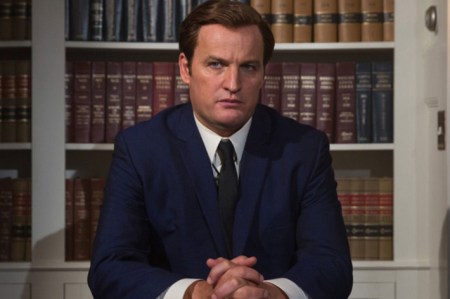
Chappaquiddick accomplishes something very few movies do: it explores why a man made an evil choice. That is very hard to do because (as James Q. Wilson put it in his brilliant little book Moral Judgement) any explaination for why someone made a decision naturally becomes an excuse for that decision. A man beats his children now because his father beat him twenty years ago; to the extent that the beatings twenty years ago really do explain the beatings now, the man’s choices seem less culpable, and to the extent that they don’t, the man’s choices are less comprehensible. Either the explanation of the evil act is not satisfactory as an explanation, in which case we are left unsatisfied, or the explanation of the evil act does satisfy as an explanation, in which case the act seems less evil.

Chappaquiddick does not compromise on the fact that Teddy Kennedy’s choices were evil. For that reason, it is getting a lot of attention from right-wingers who have long waited for some sort of justice to be done upon the Kennedy family’s crimes. Chappaquiddick shows, in ways that would be impossible for any fair-minded observer to deny, that Teddy Kennedy did evil things, and that is a sort of justice for which we have indeed waited long.

But if you walked out of this movie saying to yourself, “boy, Teddy Kennedy really did evil things in Chappaquiddick, didn’t he?” you missed the point of the movie.

The filmmakers have set out to explain, without excusing, what Kennedy did. And they succeed brilliantly.

I must reluctantly admit that part of the formula for success in this endeavor was for the film to steer completely clear of the sexual side of Kennedy’s depravity. This is unsatisfying to my sense of justice, in light of the fact that Kennedy spent his whole adult life – long after Chappaquiddick – leaving behind him a trail of harrassed and attacked women, not only in his own workplace and on his own payroll but in restraurants, airplanes, you name it. Full justice is not done to Kennedy’s depravity in this movie. But that is probably necessary, because such matters probably could not be depicted or even suggested without ruining the project of explaining rather than condemning.

The traditional story of the burden of growing up in the shadow of Jack and Bobby – and of Joe, Jr., who died a war hero – is of course an important theme. At the beginning of the movie, we see Teddy being interviewed for an upcoming television broadcast about Jack’s legacy. The occasion is the immanent landing of Neil Armstrong on the moon – Jack’s big challenge to the nation in 1961. Teddy displays the extraordinary Kennedy eloquence, which he possesses in equal measure to his brother, then suddenly cuts off the interview when the pain of contemplating his place in his brother’s shadow becomes too great. Then he lets a woman die on Chappaquiddick, and it’s all over the news. Then the moon landing comes and the interview airs, and the whole nation watches it with Chappaquiddick in mind.

But this movie places greater stress on the role of Teddy’s iron-fisted father, Joseph, Sr. Teddy, who is a vain and foolish man but has a real conscience, keeps wavering between doing right and protecting himself. He does not always make the evil choice, and when he does, he does not always stick to it. A cousin who was with him on the night of his disaster keeps urging him to do the right thing – to report the incident, to admit that he was the one driving, to resign his Senate seat rather than keep it at the cost of ghastly lies.

And every step of the way, Joseph, Sr. and his army of highly comptent schemers is there to demand more lies, more subversion of the law, more destruction of the innocent to protect the guilty.  And constantly, constantly reminding him that he has always been the family screwup, and will always be the family screwup.

MV5BMjk4ZDc0YmQtYzRlNy00ZDc3LWI1ZWEtMmYzYzc5ZGFjZmZiXkEyXkFqcGdeQXVyMTkxNjUyNQ@@__V1_UX477_CR0,0,477,268_AL_

Explanations of evil tend to function as excuses for it because they demand our human sympathy. What Kennedy did was evil. But let no one judge too harshly anyone who has had to grow up the son of that kind of man, and make moral choices while still professionally under his power. No, not even in a case of aggravated manslaughter – not even in the case of a man who escaped punishment for aggravated manslaughter, and got off with a slap on the wrist for leaving the scene of an accident, by a systematic campaign of lies and influence-peddling. Condemn, by all means, but spare also a charitable thought.

Reserve the venting of your spleen for the millions upon millions of Kennedy idolators, whose folly is given ample display at the end of the movie. They were not sons of Joseph Kennedy, Sr. They had no tyrant threatening to destroy them if they followed their conscience. And they chose cognitive dissonance and irresponsible moral relativism – anything rather than permit themselves to confront the monstrosity of the idol they had made in their own image.

And yet, and yet . . . I am left contemplating the contrast between Teddy Kennedy and another family screwup of a great American political dynasty. George W. Bush was the Teddy of the Bush clan for many years. Then he found Jesus, kicked the bottle, stayed home with his wife and became an honorable man. You may or may not join me in attributing the primary difference to the inscrutable mystery of divine providence, selecting one man and not another for the gifts of the Spirit. And I will grant that George H. W. Bush, tough as he undoubtedly was, was not the detestable tyrant Joseph Kennedy, Sr. was.

But that image of W. as the road Teddy didn’t take must heighten the imperative that we remember, not without some sympathy, what a monster Teddy really was.


I Say the Future is Ours if You Can Count

April 13, 2018

(Guest Post by Matthew Ladner)

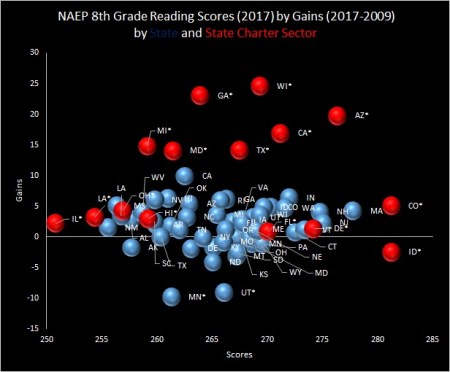
Yesterday we went over how states have done very little to improve in 8th grade math since 2009, but how many state charter sectors rocked it. Let’s see about reading, starting with the states:

There are more declines in scores than statistically significant gains in that first chart-some states more lost than others, but a lost decade nationally. Next let’s look at statewide charter sectors-these are the states with charter sectors large enough to make the sample in both 2009 and 2017 in 8th grade reading:


Once again, just as with math, Excel had to move the growth axis scale for several state charter sectors. You will appreciate this better when the following chart combines statewide averages and state charter sector averages:

So in this chart ideally you would like to see high scores and high gains, but there is no shame in just very high scores.

Can you dig it?

Can you dig it?!?

CAN YOU DIG IT?!?!?!?!


A Modest Counter-Proposal: Eliminate Think Tanks, Not College Sports

April 12, 2018

Image result for a modest proposal

The Urban Institute has a piece that explores how many low-income students could be offered college scholarships if college athletics were eliminated.  As it turns out, most college sports programs spend more than they receive in revenue (although this excludes other possible sources of revenue, such as donations and additional enrollment that may be related to support for the sports program).  Erica Blom, who is a research fellow at the Urban Institute, calculates that if you remove the amount of money devoted to athletic scholarships, sports programs at the top 230 institutions lose about $798 million per year.  At $4,000 per scholarship, she estimates that eliminating college sports could add another 199,400 scholarships that universities could offer to low income students.  Blom acknowledges that sports may produce some benefits, but she concludes that “many of these benefits, however, can arguably be gained through participation in intramural sports.”

Let’s leave aside whether she is accurately calculating the net cost of these sports programs.  And let’s leave aside her general conclusion that these programs produce little or no benefit in exchange for their cost.  And let’s further leave aside her implicit assumption that there is a superior benefit to be realized from spending the money instead on nearly 200,000 partial scholarships for students who may have a low probability of completing degrees for which they would be induced to take on substantial debt even with their partial scholarships.  What Blom’s argument boils down to is that she doesn’t like college sports and would rather that the money be spent on something else.  She’s not alone in this view.  Many education analysts have a distaste for college sports and would prefer those resources be diverted to other activities.

Of course, we could all pick different aspects of higher education that we think are of dubious value, and, without having to prove it, argue that money devoted to those functions should be spent on something that we think is better (without having to prove that it is really better).  I might say that there are entire degree programs, often ending in the word “studies,” that confer little or no benefit (and maybe even harm) on students and yet in aggregate cost hundreds of millions of dollars.  Why don’t we do away with those to pay for more scholarships?  The only reason people can so easily suggest abolishing college sports, as opposed to some other university effort, is that there is — quite literally — a prejudice against college athletics among education expert-types.

Most people outside of the edu-policy sphere, however, place a very high value on college sports.  This doesn’t just include the millions of fans who spend billions of dollars on watching sporting events and buying merchandise, but also the thousand upon thousands of college students who participate in college athletics each year.  They clearly think these activities have value, so why should we substitute Blom’s preference for theirs?  It’s not as if the handful of largely ambiguous social science studies to which Blom links prove that these millions of people are suffering from false consciousness in finding benefits in college sports.

To illustrate how specious it is to favor abolishing college sports to pay for scholarships, let me offer a counter-proposal: let’s abolish think tanks.  According to a 2013 report, a group of 21 think tanks generated $1.076 billion in annual revenue.  That’s just 21 of them.  There are scores more.  The social benefit of the funds devoted to these think tanks is of highly dubious value.  Like college sports, think tanks have been marred with corruption and sex scandals. And think tanks facilitate a large amount of PLDD where people sit in their offices imagining how they would run the world better, doing things like taxing snacks, building light rail, or abolishing college athletics.  Wouldn’t the world be better off if we eliminated think tanks and used those funds to pay for college scholarships instead?

See?  Isn’t this fun?  Let’s all imagine things we don’t like and fantasize how things would be so much better if only those resources were devoted to things we did like.  We could get jobs in think tanks to do it.