
(Guest Post by Matthew Ladner)

“The Force is with you young Charter Tejanos but you are not a mathematics Jedi yet. We would be honored if you would join us in CeleNAEPing good times!”
-Darth Cactus
(Guest Post by Matthew Ladner)
“The Force is with you young Charter Tejanos but you are not a mathematics Jedi yet. We would be honored if you would join us in CeleNAEPing good times!”
-Darth Cactus
 3 Comments |
  charter schools, NAEP | Tagged: Hispanic NAEP scores by state |
  Permalink
 Posted by matthewladner
(Guest Post by Matthew Ladner)
Oceania of Orwell’s 1984 made use of a daily “two-minute hate” to whip people into a frenzy against enemies of the state. As wikipedia explains:
Within the book, the purpose of the Two Minutes Hate is said to satisfy the citizens’ subdued feelings of angst and hatred from leading such a wretched, controlled existence. By re-directing these subconscious feelings away from the Oceanian government and toward external enemies (which may not even exist), the Party minimizes subversive thought and behaviour.
So about now you are wondering to yourself “why are you flashing me back to junior year English class?” Good question- I guess it came to mind because of things like this and this.

Jonathan Haidt describes the mind as an elephant (instinct) and a rider that serves the elephant (reason). The rider serves the elephant by seeking out information that confirms pre-existing beliefs, and avoids contradictory information. Individuals are thus not trustworthy in reasoning in support of their beliefs, but are pretty good at knocking down the theories of others. If however you find yourself isolated in an ideologically homogeneous tribe no one is likely to point out glaring flaws in your thinking as they either cannot or don’t want to see them any more than you do.
The problems with the above pieces seem entirely obvious to me, but apparently were invisible to the Republic. I knew this article was heading in a bad direction when I saw a former campaign manager for David Garcia described as “former BASIS parent.” Both of these descriptions are true…but one is incomplete without the other. The reporter’s effort in establishing whether the CMO management fee was reasonable given the services provided more or less ended with an assurance from a professional charter skeptic that it wasn’t. Well, can’t much argue with that…

Now for the record I don’t know the percentage of K-12 funds typically spent on the services provided by the BASIS CMO either. Given the outputs BASIS produces, I’ll confess to being broadly indifferent as to whether districts spend more or less. The Reporter’s elephant wanted to believe it was high, and sure enough he found someone to make this claim. Neither of them produced any evidence, or a rationale as to why we should care.
The two-minute hate moves into throw your shoe territory when our intrepid reporter reveals that the founders of the CMO put down a down payment on a condo in New York City…which is near private schools they operate…which charge approximately four times the amount provided by Arizona taxpayers to provide the same education that Arizona children receive free of charge. In an organization including charter schools in Arizona, Texas and D.C. and private schools in China, Silicon Valley and NYC that the highest ROI part of the operation would be in the modestly funded but very high performing AZ charter schools. The Republic reporter’s elephant lumbered off in the opposite direction however, with his rider helping to raise a vague concern that somehow Arizona taxpayers were being short-changed er somehow. In other pieces we see assertions that BASIS gets more funding per pupil than district schools in Arizona. A quick trip to the JLBC however reveals this to be false- charter schools get less total public funding per pupil than district schools in Arizona.
It is also common to see an organization critical of charter schools, the Grand Canyon Institute, described as “non-partisan” in the pages of the Republic. Having spent a few minutes on their website, I could detect no overt attachment to any political party, but the philosophical leanings of the group are entirely obvious (left of center).
I spent a number of years at the Goldwater Institute, and we spent years in public disputes and filed lawsuits challenging both Republicans and Democrats. Perhaps the memory fades, but I don’t recall the Republic referring to GI as “non-partisan.” When the GCI put out a report critical of charters, one of the paper’s columnists wrote that GCI “supports charter schools.” Things had just become soooo bad that they had no choice but to offer sharp but constructive criticism you see. GCI is run by a former official of the Janet Napolitano administration, and when I asked one of his former Napolitano colleagues about this assertion the reaction I received was “That’s absurd. George has always hated charter schools.” Again I assume that someone from GCI claimed to support charter schools, and it fit into what the columnist wanted to believe, but it isn’t terrible hard to check up on such things.
Now to be fair, the Republic does have some ideological diversity on the opinion page, which is approximately evenly split between a hard-left wing and an assortment of writers varying degrees to the right of Bernie Sanders. Center-right columnist Bob Robb has supported increased K-12 funding for years, but is an equal opportunity offender taking everyone from RedforEd to Governor Ducey to task. Centrist Joanna Allhands very helpfully noted for instance that er, guys, all schools raise money from parents, not just BASIS.
It’s not like the non-Bernie columnists challenge everything questionable put out by Team Bernie. If they did, they wouldn’t have much time to do anything else. The worst of it is that the news page seems be serving the elephant of the Bernie wing of the opinion pages: investigative pieces translate effortlessly into two-minute hate type opinion pieces.
For instance, when the Republic published a giant nothing-burger of a front page above the Sunday fold story about FOIAed emails between the Goldwater Institute and the Arizona Department of Education concerning the administration of the ESA program. Now if any of these emails were any more exciting than Jonathan Butcher writing to the Department to say “Guys there are ESA parents out here who haven’t had their accounts funded on time and they are getting very upset about it” I assume the Republic would have shared them with us. Gleefully. Instead, the Reporter’s elephant went in search of someone who would confirm that there was something very naughty going on:
“This is almost an iron grip-level of influence from the beginning of the process on,” said Thomas Holyoke, an associate professor of political science at California State University-Fresno, who studies interest groups and lobbying.
“This sounds like a full-service operation; it wasn’t just writing the legislation,” he added. “You have elected officials, who are supposed to be repositories of the public’s trust, who are pushing legislation and probably building careers off of big, high-profile bills that have some potentially extremely far-reaching effects.”
I won’t rehash the glaring flaws in this story here, but will ask a very basic question: if the Goldwater Institute had an “iron grip” on the administration of the program, isn’t it reasonable to think that accounts would be funded on time, proper records kept, etc?
Team Bernie on the opinion pages lapped it up. Worse still, when the Goldwater Institute asked to publish a response, the Republic chose not to publish it. This sort of thing has led to a large number of right of center Arizonans to angrily mutter about how they cancelled their subscriptions years ago, that the Republic is hopelessly biased, they only hung on for as long as they did to read Robb, etc.
I wouldn’t be writing this post if I were willing to join this line of thinking. I believe that keeping some common institutions to be of unspeakable importance. Checking out to entomb oneself in a comfortable echo chamber is a path to hopeless polarization. A few years ago the Arizona Chamber of Commerce began a “Race to the Tap” event with the hope of getting people from different K-12 silos at least occasionally talking to each other.

I’m pretty sure that Geoff Esposito pictured here with yours-truly makes Laurie Roberts look like a second coming of Barry Goldwater. I’m fairly confident that Geoff helped to draft the catastrophic mistake of a soak the rich tax initiative the Invest in Ed ballot initiative that would raise Arizona incomes taxes to New Jersey levels. Geoff and I don’t agree on much related to K-12, but we do listen to each other, which is an art that Americans are losing much to our detriment. Arizona could use a good deal more tap and less two-minute hates.
4 Comments | charter schools, Education Savings Accounts | Tagged: Arizona Chamber of Commerce and Industry, Arizona Republic, Bob Robb, Craig Harris, Geoff Esposito, Laurie Roberts, Yvonne Wingett Sanchez | Permalink
Posted by matthewladner

(Guest Post by Matthew Ladner)
Look ma! DCPS reform is working great as long as your parents graduated from college. The below charts are district schools only:

That’s a two point decline compared to a 17 point (!) improvement for those scoring at home. What about math?

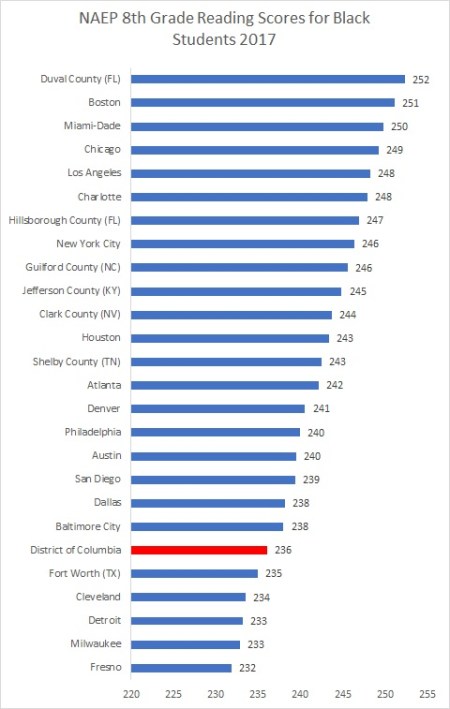
That is a 10 point improvement for students whose parents did not finish college compared to a 25 point (!) improvement for students whose parents did finish college. You see a similar pattern if you break the numbers down by race/ethnicity. Here is how DCPS looks (absent charter students) compared to the TUDA districts (also district only) for Black students in NAEP 8th grade reading:
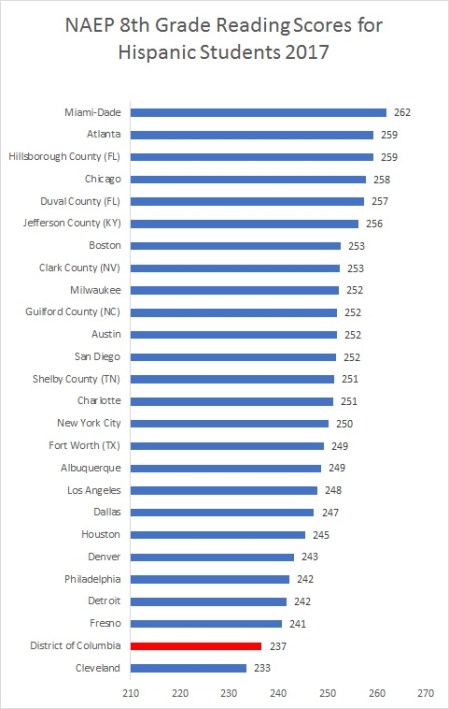
Here is how it looks for Hispanic students:
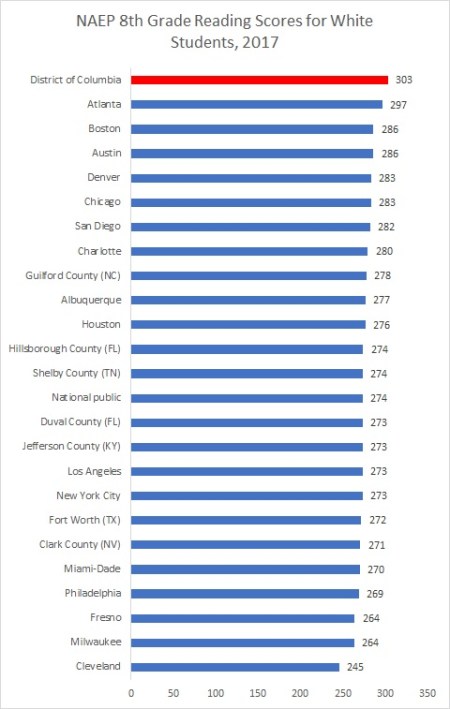
And…here is how it looks for White students:
6 Comments | NAEP | Tagged: DC NAEP | Permalink
Posted by matthewladner
Technocracy is the belief that government should be run by experts, with policies shaped by scientific evidence. Advocates of technocracy have little enthusiasm for people making decisions about their own lives or those of their children because people too often choose the wrong thing. Experts, guided by evidence, are much better situated to shape people’s decisions so that they work best for themselves and others.
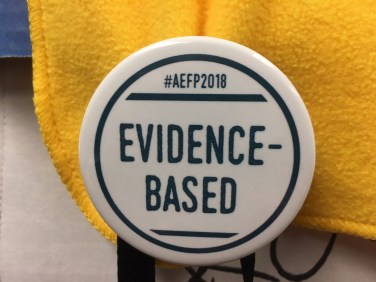
Technocracy rose to prominence during the Progressive Era, but it has hardly lost its appeal to elites since then. It is clearly the dominant mode of thought among education policy experts. In fact, at the most recent annual conference of the Association for Education Finance and Policy, attendees wore buttons declaring their creed, “Evidence-Based.” Let’s leave aside that appending “Based” to “Evidence” seems to negate what it is modifying, like “natural flavoring” or “based on a true story.” And let’s acknowledge that evidence is, of course, extremely useful for making good decisions. But the motivation behind this button and the thinking that pervades education experts is that policy should be “based” on evidence, not merely informed by it. Evidence is the foundation. Technocracy should rule.
To repeat, evidence is a good thing. But claims about what the evidence really says are often in dispute and science is a very limited and imperfect enterprise. So to be ruled by evidence rather than informed by it is extremely dangerous. Consider the example of eugenics, which is “the science of improving a human population by controlled breeding to increase the occurrence of desirable heritable characteristics.” Eugenics is now considered thoroughly disreputable, but for several decades it was the consensus approach of our scientific elite. Its science was widely respected and its practices and policy recommendations were “evidence-based.”
It’s a little too easy to dismiss eugenics as a horrible error of our pre-scientific past. For several decades, it was the scientific present of the most respected elites. As Sol Gittleman put it: “The presidents of MIT, Stanford, Cornell, and Harvard all supported eugenics research, and as early as 1914, academic courses on the subject were taught at Harvard, Columbia, Cornell, Brown, Wisconsin, Northwestern, Clark, and MIT. Presidents Theodore Roosevelt and Woodrow Wilson, meanwhile, spoke openly and wrote freely about ‘racial suicide’—their term for what would happen if the nation permitted the mixing of races.”
While laws against the “mixing of races” had been introduced during slavery, a flurry of new laws were adopted as a result of this scientific inquiry into eugenics such that 41 of the then 48 states eventually had such laws in place. You could say that these laws were “evidence-based.” In addition, laws calling for the forced sterilization of people deemed to be “feeble-minded” were adopted and ultimately upheld by the U.S. Supreme Court. Chief Justice Oliver Wendell Holmes famously declared in his decision, “Three generations of imbeciles are enough.” This ruling by the Supreme Court was also considered “evidence-based.”
During World War II, President Franklin Roosevelt organized a secret committee to consider what to do with the large number of war refugees, especially Jews, who he expected to flee Europe after the war. Roosevelt asked Aleš Hrdlička, curator of physical anthropology at the Smithsonian Museum of Natural History, to head this secret planning group. It’s worth quoting Steve Usdin’s account of this episode at length:
The two men had carried on a lively correspondence for over a decade and the President had absorbed the scientist’s theories about racial mixtures and eugenics. Roosevelt, the scion of two families that considered themselves American aristocrats, was especially attracted to Hrdlička’s notions of human racial “stock.”
A prominent public intellectual who had dominated American physical anthropology for decades, Hrdlička was convinced of the superiority of the white race and obsessed with racial identity. Shortly after the Pearl Harbor attack he’d written to Roosevelt expressing the view that the “less developed skulls” of Japanese were proof that they were innately warlike and had a lower level of evolutionary development than other races. The president wrote back asking whether the “Japanese problem” could be solved through mass interbreeding.
Roosevelt had long resisted opening the doors to large numbers of immigrants, not as a result of political expediency, but based on his understanding of what science had to say on the matter. In 1925 Roosevelt had written a series of columns for the Macon Telegraph in which he praised Canada’s immigration policies, which were designed “to prevent large groups of foreign born from congregating in any one locality…. If, twenty-five years ago, the United States had adopted a policy of this kind we would not have the huge foreign sections which exist in so many of our cities.”
This evidence-based resistance to increasing immigration condemned countless European Jews to their death. It also informed the findings of the secret committee he organized as to what to do with Jewish refugees following the war: “The solution, which the President endorsed, ‘essentially is to spread the Jews thin all over the world,’ rather than allow them to congregate anywhere in large numbers.” Apparently, he hoped to improve their stock through inter-breeding, as he speculated might be done to reduce war-like tendencies among the Japanese.
Keep in mind, eugenics was not championed by a fringe group. It was championed by the presidents of leading universities, researchers at the Smithsonian, and several presidents of the United States. I’m proud to note that my alma mater, Tufts University, never offered a course in eugenics, and a Tufts medical professor, Abraham Myerson, was a leading critic of the idea, including in his testimony against forced sterilization of the “feeble-minded.” But Tufts was the exception, while more elite universities like Harvard and MIT actively pursued eugenics. Only the close association between eugenics and the Nazis eventually brought the idea into disrepute.
Before we turn over policymaking to the current scholars at Harvard and MIT, we might want to reflect on how wrong evidence-based policies can be. And rather than smugly asserting that past scholars were quacks while current ones are true scientists, we might want to learn the lessons of humility that the eugenics episode teaches. Let’s be informed by evidence, but not be evidence-based.
2 Comments | Uncategorized | Permalink
Posted by Jay P. Greene
(Guest Post by Matthew Ladner)
Neerav Kingsland has written a response to posts by Jay and yours truly on Louisiana charters generally and the Recovery School District specifically. I will begin by confessing a sin- Neerav is correct that I go a bit over the top at times. The “Prime Directive” of JPGB has always been first and foremost for the authors to entertain ourselves. We do occasionally take ideas seriously, but we try to keep things light around here, which often involves reasoning by pop-culture analogy. Maybe some gratuitous use of an animated gif here or there, or an occasional musical interlude. All in moderation of course…
Like Leo Moracchioli we try not to take ourselves too seriously, but one idea that I do take very seriously is the one quoted in the original post from Jonathan Haidt, which merits repetition:
In the same way, each individual reasoner is really good at one thing: finding evidence to support the position that he or she already holds, usually for intuitive reasons. We should not expect individuals to produce good, open-minded, truth-seeking reasoning, particularly when self-interest or reputational concerns are in play.
But if you put individuals together in the right way, such that some individuals can use their reasoning powers to disconfirm the claims of others, and all individuals feel some common bond or shared fate that allows them to interact civilly, you can create a group that ends up producing good reasoning as an emergent property of the social system. This is why it is so important to have intellectual and ideological diversity within any group or institution whose goal is to find truth (such as an intelligence agency or community of scientists) or to produce good public policy (such as a legislature or an advisory board).
I do not wish to allow even the JPGB Prime Directive to interfere in this. I appreciate that David Osborne offered some comments, and that Neerav also took the time to respond in a civil fashion. I offer an apology if my bombast lacked civility as it must not interfere in the free exchange of evidence and ideas.
On the substance, I’ll offer the following comments in the spirit of the Haidt quote:
My preexisting bias before the release of the 2017 NAEP was that the Louisiana RSD was a clever policy innovation given the circumstances of post-Katrina New Orleans, but that the concept employed enormous amounts of financial and human capital. Perhaps too much of both to be of general interest.
David Osborne noted in a comment that only 43% of Louisiana charters are New Orleans RSD charters, which is a fair point to make. This however is about 43% more than the typical state, and a portion of the rest Louisiana’s charters are RSD charters operating outside New Orleans. Osborne noted in a comment that those charters aren’t going so well. In my preexisting frame, I interpret this as RSD not being able to make the trip down the Atchafalaya Bridge from New Orleans to Baton Rouge, much less to other states. This seems like confirmatory evidence to me, but maybe not. If not, why not?

NAEP data is still indeed inexact on this point, but state testing data for New Orleans specifically has also been in decline. NAEP shows large statewide declines in charter scores since 2013, and the state’s own testing data pointing in the same direction specifically for New Orleans.
What sort of evidence would lead a reasonable person to conclude that the RSD model is very difficult to replicate and to sustain? We all have theories of change, but is this one falsifiable? I believe that the combination of statewide NAEP scores and the decline of state test scores in New Orleans is an issue. I’m in favor of RSD continuing in New Orleans, but nothing about the evidence produced last few years is giving me the itch to replicate it in my home town.
Speaking of Phoenix, Neerav (correctly) noted a Credo multivariate study showing meh charter results in Arizona. Harvard’s Marty West found similar results, but both Credo and West used data that ended in 2012. I won’t go into the details here but I believe Credo, West, recent NAEP and recent AZMerit can all be correct. The 2012 Philadelphia Eagles went 4-12 but they won the Superbowl last season. Between lots of openings, closings, and schools maturing past their training wheels stage, AZ charters turned over their roster like a pro-sports team.
RSD advocates have a theory of change largely based upon increased state test scores in New Orleans. The more recent state data and NAEP however both seem to be signalling a warning sign. If this is just my preconceived notions getting the better of me, please help me out. Nevermind Arizona, based on anything and everything we can gather from Credo, NAEP, recent state scores and even random assignment studies, why should Louisiana charter policies be touted in preference to Michigan’s based upon the available results?
2 Comments | charter schools | Tagged: Arizona charter school NAEP scores, Leo Moracchioli, Michigan charter school NAEP scores, Neerav Kingland, Recovery School District, Toto | Permalink
Posted by matthewladner

Mike McShane and I have an article in the Phi Delta Kappan Magazine summarizing the lessons we learned from our edited book on Failure.
We took the contributions by Larry Cuban (from Stanford University), Matthew DiCarlo (the Shanker Institute), Anna Egalite (North Carolina State University), Rick Hess and Paige Wiley (the American Enterprise Institute), Ashley Jochim (the Center for Reinventing Public Education), Matthew Ladner (the Charles Koch Institute), Megan Tompkins-Stange (the University of Michigan), Martin West (Harvard University), and Daniel Willingham (the University of Virginia) and boiled it down to three trade-offs and three lessons.
But if like Hillel I had to state what we learned while standing on one foot, I’d say, “Education is an inherently political enterprise, so if you try too hard to substitute normal political processes with the authority of technical expertise, you will fail.”
4 Comments | Uncategorized | Permalink
Posted by Jay P. Greene

(Guest post by Greg Forster)
EdChoice carries my post using the new NAEP results to bring us back to our earlier discussion of Ian Kingsbury’s finding about what our condescending friends at NACSA do to minority charter operators:
If you’re wondering why the education status quo wants heavy regulation, ask yourself why Facebook CEO Mark Zuckerberg asked Congress to regulate social media: Regulation cements the power of dominant providers, shutting out smaller and less powerful rivals. That’s why heavy regulation does so much damage to minority communities. They have less political power to influence the content of regulations — which more powerful providers can shape in their own favor — and less ability to afford the enormous cost of compliance.
Borrowing Matt’s graphic above to make the point about Louisiana, land of the overregulated NACSA dream.
2 Comments | Uncategorized | Permalink
Posted by Greg Forster
You don’t have to wait until tomorrow, tomorrow, or tomorrow. Our article on the effects of student groups seeing live theater is available on Educational Researcher today!
The article is an updated and peer-reviewed version of the article we posted on SSRN last fall. In it we discuss the combined results of five experiments we conducted in which students were randomly assigned to go on a field trip to see live theater or be in the control group. In two of those experiments we added a second treatment condition in which students went on a field trip to see a movie version of the play. We found that students randomly assigned to see live theater experienced significantly higher tolerance and social perspective taking as well as stronger knowledge of the plot and vocabulary of the plays than the control group. Being randomly assigned to the movie treatment did not produce these same benefits.
So there seems to be something about experiencing live theater that cannot easily be produced by watching a movie instead. Given how often schools are inclined to watch movies and how rarely they are now willing to go see live theater, these results are quite relevant.
1 Comment | Uncategorized | Permalink
Posted by Jay P. Greene

(Guest Post by Matthew Ladner)
When I was a kid in the 1970s someone wrote a book about UFOs having visited earth in the past called Chariots of the Gods. The only thing I remember about this book was a photo of an ancient stone staircase and a caption that read “Staircase going down-to a spaceport?” Someone else wrote a book called “Crash Go the Chariots.” I never examined this book, but I imagine that it was a bit like shooting fish in a barrel.
I am in the midst of reading Jonathan Haidt’s The Righteous Mind: Why Good People are Divided by Politics and Religion and found the following passage quite striking. The book summarizes a great deal of psychological research to reach this point which I cannot do justice to, but roll with this in any case:
In the same way, each individual reasoner is really good at one thing: finding evidence to support the position that he or she already holds, usually for intuitive reasons. We should not expect individuals to produce good, open-minded, truth-seeking reasoning, particularly when self-interest or reputational concerns are in play.
Sounds dismal so far, but fortunately he goes on…
But if you put individuals together in the right way, such that some individuals can use their reasoning powers to disconfirm the claims of others, and all individuals feel some common bond or shared fate that allows them to interact civilly, you can create a group that ends up producing good reasoning as an emergent property of the social system. This is why it is so important to have intellectual and ideological diversity within any group or institution whose goal is to find truth (such as an intelligence agency or community of scientists) or to produce good public policy (such as a legislature or an advisory board).
Again, I can’t summarize the research that lead to this conclusion (read the book and see what you think) but basically Haidt lays out a case that says if you believe that you are some sort of scientist guided solely by sweet reason and evidence, you are the victim of self-delusion. Good reasoning happens through a social challenge process over time.
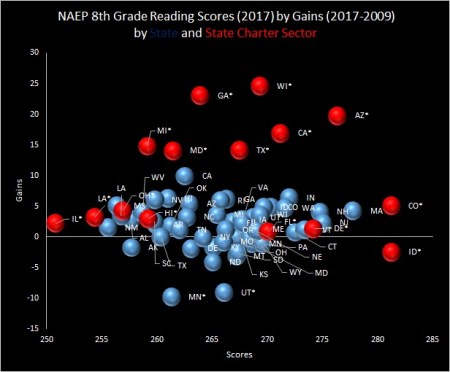
In that spirit of civil challenge, I’ll offer the following two charts. The first a scatterplot of the 8th grade reading 2017 scores by gains (2017 minus 2009 scores) for all 50 states and all 16 state charter sectors with scores in both 2017 and 2009.
There is a huge amount of success to celebrate in this chart for multiple state charter sectors, most of which have either unusually large gains, or unusually high scores, or else unusually high scores and gains.
Do however take note of Louisiana’s charter sector position in the above chart. Now let’s look at the same chart for mathematics:
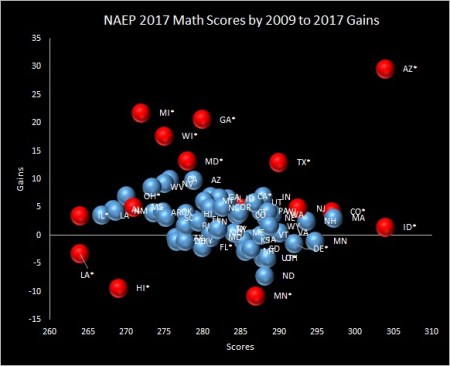
Again, there is a great deal to like here- multiple charter sectors with large gains (MI, WI, GA, MD, TX) or high scores (CO, ID) or both high scores and gains. Arizona, this one is for you:
Again however take a look at Louisiana’s charter sector-again low scores and low gains. A quick trip to the NAEP data explorer will demonstrate that this same trend is evident in 4th grade NAEP scores, and state scores have been trending in a negative fashion in recent years as well.
In recent years a school of thought arose in our space that a centralized authority or “harbor-master” could produce better outcomes by carefully controlling both the entrance and the exit of schools from charter sectors, primarily on the basis of standardized test scores. In the case of the Recovery School District in Louisiana, there was a period of strong gains in state test scores to buttress this belief. State test scores however have repeatedly shown themselves vulnerable to gaming and manipulation, especially when large consequences ride on them. Soviet steel makers reported non-stop prodigious growth in steel production for decades when facing such incentives as well. How much steel was actually made-who knows? Educators however have neither the incentive or ability to “teach to” or otherwise game the NAEP exams, which is why they have long stood as an external audit on state testing.
In this case, NAEP and state tests are both pointing in the same direction.
My preexisting belief, laid out previously on this blog, is that RSD was a very clever policy innovation for a district that at one point had little more than empty buildings to leverage. I’ve also however long suspected that the notion was over-hyped and ignored some very basic political realities. When for instance Denver announced that yeah, well, about that whole making facilities available thing, we’ve kind of discovered that we are a school district and that our dominant special interests don’t really like this idea after all. The reaction in my tribe was something along the lines of “duh- what did you think was going to happen?”
I’ll go further and say that RSD has a false allure for many of our technocratic friends: things can get better, but only if someone is in charge. Someone like me. True relinquishment means letting go: let operators develop new models, let parents respond to them, let the primordial soup bubble and bake. Don’t assume that you know what constitutes a “high quality education,” don’t aim a narrow vision of quality at a single type of community, allow the interplay of different choice programs to flourish.
Now, having fully confessed my preexisting beliefs, I have offered evidence that I believe confirms them. If someone has countervailing evidence to present, the comment section awaits your thoughtful challenge. If you buy into the harbor-master system, come and defend it.
7 Comments | charter schools | Tagged: Chariots of the Gods, Crash Go the Chariots, Jonathan Haidt, Portfolio Districts, The Righteous Mind | Permalink
Posted by matthewladner

(Guest post by Greg Forster)
My latest in OCPA’s Perspective is on ed schools as barriers to entry in the teaching profession:
Arne Duncan, the Obama administration education secretary, said in 2009 that “by almost any standard, many if not most of the nation’s 1,450 schools, colleges, and departments of education are doing a mediocre job of preparing teachers for the realities of the 21st-century classroom.” He said education schools are “cash cows,” and he’s right. Teachers who need credentials are hostages to the ed school system, so universities create ed schools in order to collect the ransom money.
In addition to economic rent-seeking, I also cover the ideological side of the problem:
Gregg Garn, the dean of the University of Oklahoma College of Education, lists “politics of education” as his first area of research interest. On his web page, a document full of left-wing political and policy posturing is listed more prominently than his curriculum vitae. I suppose since education schools seem to exist for political propaganda, it’s fair enough that he considers his political platform a more relevant credential to establish his qualifications than his academic track record.
School me on what you think!
3 Comments | Uncategorized | Permalink
Posted by Greg Forster

 Jay P. Greene's Blog