I’m My Own Grandpa — Lost Version

May 4, 2009

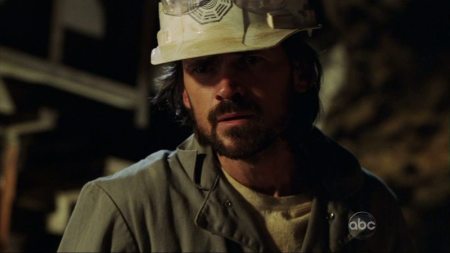
It didn’t dawn on me until Patrick’s comment on Greg’s last Lost post, but I’ll bet that little Charlie, Penny and Desmond’s child, is in fact Charles Widmore.  Little Charlie will be whisked to the past on the Island where he can then grow up to be the Charles Widmore we know.  He is, as the song says, his own grandpa.

The reason why Ellie and Charles are so determined not to change the course of events is not that it is impossible, but because it allows Charles to exist.  So Ellie goes around convincing people, including Desmond and Daniel, that time cannot be changed because she doesn’t want time changed.

I’d further guess that the coming war will be between those who are trying to change the course of time and those who believe that it can’t or shouldn’t be changed.  Jack will lead the change faction and John will lead the destiny faction.  That’s why Charles Widmore needed back on the island to ensure that the right side is going to win.

Update — And I’ll bet that Charlie has already been kidnapped by Charles and Ellie.  The nurse oddly told Penny to leave her child while visiting Desmond.  You wouldn’t bother having that bit of dialogue unless it mattered.

(edited to add link, correct typo, and add update)


“Can You Get this tape to him and ask him ‘WHY?!?'”

May 4, 2009

(Guest Post by Matthew Ladner)

Reason TV on DC vouchers. BOOOOOM!


Union Busting — Good for the NYT, Bad for Everyone Else

May 4, 2009

The NYT has threatened to shutter its Boston Globe subsidiary in 60 days if its unions don’t agree to various cuts.  According to the Times’ own coverage:

“The company has said since early April that unless the unions make wide-ranging concessions, it will close The Globe…”

Hmmm….  What would the New York Times say if someone else, like let’s say Walmart, threatened to close down its units because unions would drive costs too high.  Oh, wait, they did write an editorial about that on August 16, 2008.  It begins:

“It is hardly news that Wal-Mart will do whatever it takes to keep unions out of its stores, from closing down a unionized outlet to firing pro-union workers.”

I guess it is hardly news that the New York Times would engage in the same practices that they find deplorable if allegedly done by others.

And who could forget this gem of an editorial by the Times on December 28, 2008?  Just a few months ago the Times seemed to think that expanding union power was great because it would raise wages, which was necessary for economic recovery:

“Even modest increases in the share of the unionized labor force push wages upward, because nonunion workplaces must keep up with unionized ones that collectively bargain for increases. By giving employees a bigger say in compensation issues, unions also help to establish corporate norms, the absence of which has contributed to unjustifiable disparities between executive pay and rank-and-file pay.

The argument against unions — that they unduly burden employers with unreasonable demands — is one that corporate America makes in good times and bad, so the recession by itself is not an excuse to avoid pushing the bill next year. The real issue is whether enhanced unionizing would worsen the recession, and there is no evidence that it would.

There is a strong argument that the slack labor market of a recession actually makes unions all the more important. Without a united front, workers will have even less bargaining power in the recession than they had during the growth years of this decade, when they largely failed to get raises even as productivity and profits soared. If pay continues to lag, it will only prolong the downturn by inhibiting spending.”

  Come on NYT!  Can’t you follow your own advice?  Do your part for the economy and raise those Boston Globe wages higher rather than slashing them.

(edited for typos)


Get Lost – Do You Know What “Blocking” Is?

May 4, 2009

faraday-underground

Add “undercover agent” to his list of mad skills

(Guest post by Greg Forster)

Late is better than never – thoughts on last week’s Lost:

1) Waaaaaay back in the day, I used to play “theater sports.” If you’ve seen the show Whose Line Is It Anyway? you’ve got the general idea of what it’s like – actors do it for recreation and practice. Basically you’re given an outline of a scene and you have to start playing it immediately.

The cardinal sin of theater sports is “blocking.” This is what they call it when you violate the narrative cues you’ve previously laid down. It generally happens when two members of the team want the scene to go in different directions. One will say something like, “hey, check out that funny-looking bird up there!” and the other will say, “that’s not a bird, it’s a Chinese bomber – run!”

Blocking is the supreme sin because audiences need narrative structure. Surprise twists are one thing. But they need to take place within the context of a narrative universe that has “rules.” If absoultely anything can happen at any time, there’s no drama. So, for example, if it was previously established that the first character had bad eyesight, the dialogue in the paragraph above would not be blocking, it would be a gag. But you can’t just change the rules of the narrative every time you have a new idea for where you want it to go.

This issue has come up before on our Get Lost feature. So let me just admit that Jay has been vindicated – Lost is blocking big time. First they worked really hard to establish the one supreme rule of time travel – whatever happened, happened. Then they pull the rug out.

Even if it turns out that Dan was right the first time and you really can’t change the past – after all, he now thinks you can, but we haven’t seen him actually do it yet – last week’s episode was still blocking.

“Do you know what destiny is?” More like, do you know what good narrative structure is?

2) He’s a tortured artist, tragic lover, philosopher of time and space, undercover agent and cool-under-fire action hero. Oh, and he’s the son of the major villain! (Whoops – spoiler alert.)

I see the inexorable operation of the Wesley Wyndham-Price Axiom is well underway.

Daniel was shot at the end of the episode, but we know he’s not dead because the Axiom states he has to kill some bad guys and win the affections of at least one more smoking hot chick before he goes.

I had Matt hook me up with a Vegas bookie, who gave me the official odds (for entertainment purposes only) on which female will be the next to “notice” Daniel:

Juliet          1 to 5
Relationship with Sawyer is on the rocks; they’re both eggheads

Kate             1 to 20
Recently revised from 1 to 40 because she’s now stranded in the jungle with him

Claire         1 to 25
Remember Claire?

Naomi         1 to 50              
It could happen in a “flash forward” showing Dan’s recruitment

Sun               1 to 100           
A long shot, I know, but we’re running out of females here

Eloise           1 to Ewwwwwwwwwwwwwwwwwwwwwwwww.
Hey, Leia kissed Luke. (Bet you wish I hadn’t reminded you.)

3) Looks like Jay was right the first time when he expressed doubt that the past was really unchangeable.

4) I’ve noted twice before that for a guy with unlimited cash and an army of goons who’s made tons of enemies and tampered with terrifying occult powers, Widmore’s security really stinks. I wondered the first time whether there was some unknown reason Widmore couldn’t be killed. Now that time travel has been introduced on the show, perhaps that explains it.

But given that on last week’s episode, Dan just walked right into the Others’ camp with gun drawn and managed to take them all napping – well, it’s looking more like Widmore is just not a super-genius on the security front. I assume the Others got much more badass after Ben took over, which is why they’re all deadly forest ninjas in 2004.

5) How did Richard know Dan wouldn’t shoot him? Advance knowledge of the timeline? Or is he just a good judge of character? (Or perhaps he’s a lousy judge of character and Dan really would have shot him!)

6) Apparently Eloise knows the future – she apparently knew that Theresa is going to get the whammy from Dan’s Frankenstein-of-Time routine, and at the end she says that it’s the first time in a long time that she didn’t know what was going to happen. Does she have advance knowledge of the timeline, or a superpower? And why doesn’t she know the future now? Maybe because the timeline changed?

7) Dan unsuccessfully tried to persuade Dr. Chang that he was from the future. Afterward, he didn’t seem disappointed that he had failed. He tells Miles he was just trying to ensure Dr. Chang would do what he was supposed to do. What’s he supposed to do? Does Dan have a hidden agenda?

8 ) At a critical moment, Jack notices grey drums labeled FUEL. Wow, good thing Dharma labels absolutely everything with big, huge capital letters!


Merit Pay Smackdown

May 1, 2009

My colleague, Gary Ritter, and NEA boss, Dennis Van Roekel debated merit pay on the PBS NOW web site.

At the bottom you can vote for who you think won the debate.  Gary currently has 67% of the vote.  Bam!


More Letters to Arne

May 1, 2009

This one is from the ranking minority member of the House Committee on Oversight and Government Reform, Rep. Darrell Issa.  Rep. Issa wants to know who at the U.S. Department of Education knew what and when did they know it concerning the D.C. voucher evaluation released weeks after a crucial vote to kill the program.

Here is the press release from Issa’s office in full:

“Delay Release of Report Detailing Successes of DC Voucher Program?

WASHINGTON. D.C.– House Committee on Oversight and Government Reform Ranking Member Darrell Issa (R-CA) sent a letter today to Education Secretary Arne Duncan questioning the timing of a study evaluating the District of Columbia Opportunity Scholarship Program (OSP) which revealed that participants in the program outperformed those not in the program with regard to reading tests and other key measurements.

 “Prior to the release of the OSP evaluation, the Omnibus Spending Bill was passed by Congress and signed by the President on March 11, 2009.  The bill contained a thinly disguised “poison pill” which had the effect of terminating the OSP, threatening to force those students with these scholarships back into dangerous, academically-underperforming schools, and preventing others from being offered such scholarships in the future,” Issa wrote.  “I am puzzled by the timing of the release of the positive OSP evaluation; just three weeks after Congress de facto killed the program on March 11.  It is highly possible that Congress might not have terminated the OSP if my colleagues, not to mention the White House, had known that this positive evaluation was about to be issued.”

 Issa notes that Oversight Committee Republicans have received credible information that DOE officials were aware of the positive report but kept quiet until after Congress had acted to kill the program.  The letter asks Sec. Duncan to provide a response to key questions by May 13thbefore the Senate Committee on Homeland Security and Government Affairs is scheduled to hold a hearing on the OSP.

 Specifically, Issa asks the Secretary to provide the following: 

  1. A timeline concerning the completion of the IES report, including the dates and names of those individuals in the Department who were given drafts of the report or provided with the data contained in the report.  
  2. All records of communications within the Department, with the White House, Congress, or the District of Columbia officials referring or relating to the public release of the IES report. 
  3. All records of communications between the Department and any non-governmental entity or individual referring or relating to the public release of the IES report.

 The full text of letter is available here.


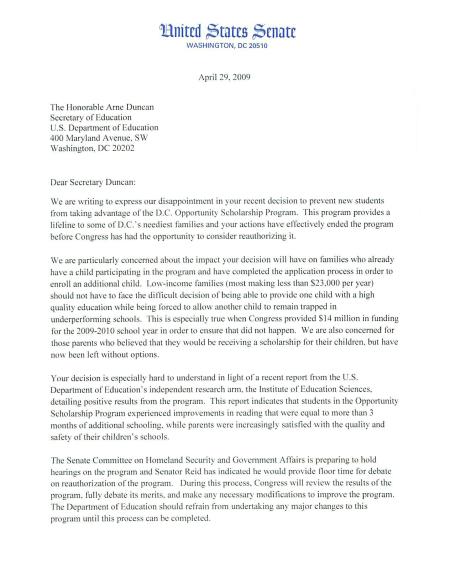
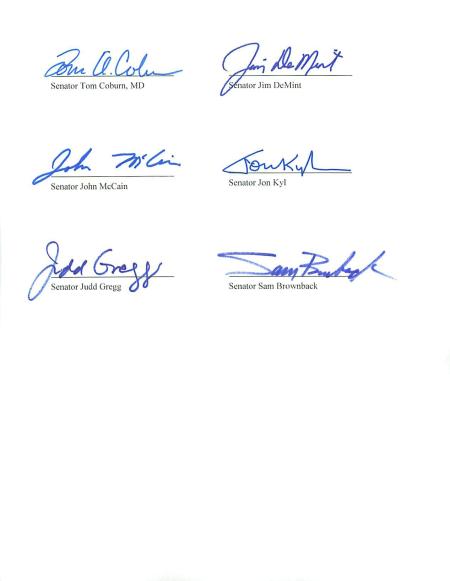
Bipartisan Senate Groups Asks Duncan to Reverse Good Friday Massacre

April 29, 2009

(Guest Post by Matthew Ladner)

duncan-letter2
duncan-letter-2
duncan-letter-31


“Forward” our Motto?

April 29, 2009

(Guest Post by Matthew Ladner)

The MacIver Institute, Wisconsin’s new think-tank, released a report today by yours truly comparing the NAEP scores of Wisconsin and Florida. Let’s just say that UW-Madison would have probably fared better against the national champion Florida Gators in football last year.

wisconsin

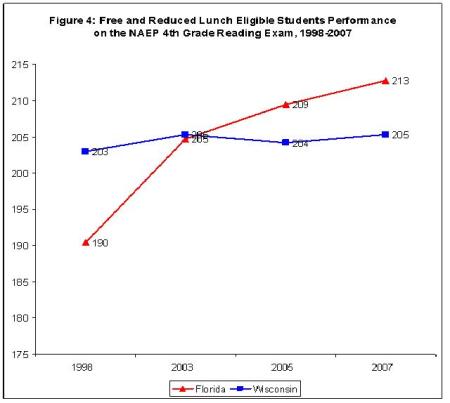
Florida spends considerably less per student than Wisconsin and has a student profile considerably more challenging. Despite that fact, Florida surpassed Wisconsin overall on 4th grade reading (although within the margin of error) on 4th Grade Reading scores in 2007.

Most impressively, this gain was driven by much larger gains among traditionally underperforming student groups. The figure above shows the progress among Free and Reduced lunch kids in Florida and Wisconsin. In 1998, Florida’s low-income students were an average of 13 points behind their peers in Wisconsin. In 2007 however they had raced 8 points ahead.

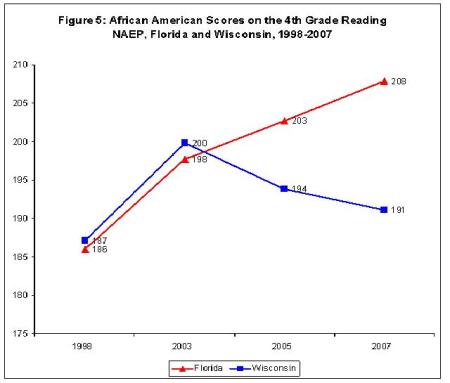
Among African American students, Florida and Wisconsin once shared space near the bottom in reading achievement. Wisconsin is still there. Florida’s African Americans students now outscore their peers in Wisconsin by 17 points.


wisconsin-african-americanOne finds the same pattern among children with disabilities. In 1998, Wisconsin students with disabilities scored 18 points higher than those in Florida. In 2007, it was 4 points lower.
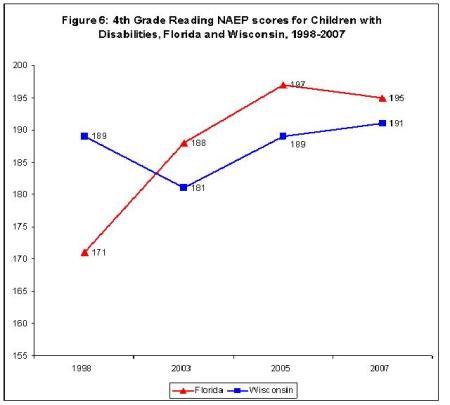
wisconsin-disabilities

The problem isn’t that Wisconsin’s scores are low, it is that they are flat.   When the Fordham Foundation found that Wisconsin had the lowest NCLB standards in the country it hinted that the state had not been vigorous in pursuit of broad K-12 reform.

Wisconsin of course was a trailblazer in parental choice with the Milwaukee Parental Choice Program. The learner has surpassed the master however with two statewide parental choice programs- one for low-income children, and one for children with disabilities. If anyone can explain why a low-income child in Milwaukee deserves an opportunity to attend a private school, but a similar child in Racine does not, I’d love to hear why. Florida also has a stronger charter school law.

Rather than sporting the lowest NCLB standards in the country, Florida doggedly pursued top-down accountability with the FCAT and grading schools A to F, and creating real consequences for school failure.

Florida embraced genuine alternative teacher certification, Wisconsin has not.

I am open to correction by my Cheesehead friends, but my distant view from the far-away desert leads me to wonder if Wisconsin may have become complacent when it comes to education reform. Coasting on their demographics, avoiding the tough calls and controversy necessary to improve public schools.

If so, perhaps inspiration can be drawn from the state song:

On, Wisconsin! On, Wisconsin!
Grand old Badger State!
We, thy loyal sons and daughters,
Hail thee, good and great.
On, Wisconsin! On, Wisconsin!
Champion of the right,
“Forward”, our motto,
God will give thee might!

Time will tell whether progressive Wisconsin will take this lying down. Will “Forward” or “comfortably stalled” be a better fitting motto for Wisconin in the next decade?


Rock Star Pay for Rock Star Teachers Part Deux

April 29, 2009

(Guest Post by Matthew Ladner)

Last year I was reading the comments section of a newstory online, and came across a comment from a public elementary school teacher. She was complaining that she had 34 students in her classroom.

So let’s do the math. The statewide average spending per pupil in the state: $11,000. Total revenue generated by this classroom = $374,000. Let’s assume the teacher gets a total compensation package of $60,000 including benefits. The question becomes- what did they do with the other $314,000?

Ah, that was what the teacher was really angry about. Her elementary school had 8 teachers in “non-classroom assignments.”

I don’t have a problem with 30 some odd kids in a classroom. It’s been done, and is being done. Remember?


Many insist that the period depicted by this photo constituted the “good ole days” of education. Jay and Greg have felt compelled to dispel the myth of the lost golden age of public education, back in the good ole days, when public schools were far more effective than they are today. The truth, of course, is that NAEP scores for 17 year olds are flat as far back as you can take them.

What has not been flat- public school spending- adjusted for inflation per pupil has steadily increased even while test scores have stagnated, even while Americans have become wealthier and poverty has declined.

Of course, there is no single explanation for this trend, but certainly the national obsession with lowering average class sizes must be viewed to have been an enormously expensive academic failure. Consider the international evidence:


class-size-11

Really big classes in Asia, really small in the United States. However, when it comes to achievement:

class-size-2

The average South Korean seventh-grader scores 21 percent higher than the average American on seventh-grade mathematics, despite having much larger average class sizes. While a variety of factors contribute to the relative deficiency of American public schools, many scholars are beginning to suspect the main factor is the relatively inferior average quality of American teachers.

In How the World’s Best Performing Schools Come Out on Top, the international management consulting firm McKinsey & Company point squarely at teacher quality as a key variable in explaining variation in international academic achievement. In its findings, McKinsey quoted a South Korean policymaker who noted, “The quality of an education system cannot exceed the quality of its teachers.”


McKinsey found that the top-performing school systems around the world recruit their teachers from the top third of each graduating cohort. Moreover, South Korean schools draw from the top 5 percent of college graduates. Larger class sizes create the resources to pay South Korean instructors much higher salaries.


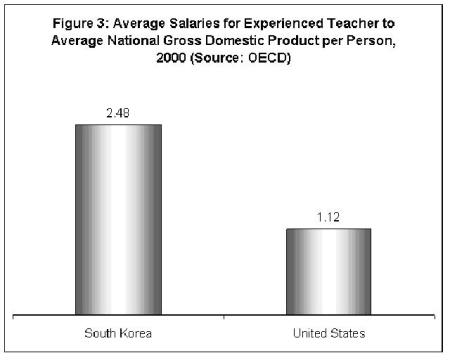
The Organisation of Economic Co-operation and Development measures relative teacher pay by comparing the average salaries of teachers with 15 years of experience with a nation’s gross domestic product (GDP) per capita. A high salary compared with per capita GDP suggests that a country invests more of its financial resources in teachers and suggests a relative prestige of the profession. By definition, the average person in each of these countries will earn a ratio of 1. Figure 3 compares teacher-salary-to-per-capita GDP for the United States and South Korea.

teacher-pay-korea

An experienced South Korean schoolteacher makes a relatively impressive wage compared with teachers in the rest of the world. In South Korea, teaching is an honored profession—not just rhetorically but in compensation as well. In the United States, meanwhile, a teacher with a college degree and 15 years of experience makes a salary relatively close to the average GDP per person. Not surprisingly, there are many qualified applicants for each open teaching position in South Korea.


McKinsey quotes the New Commission on the Skills of the American Workforce to contrast the United States with those countries having more successful education systems: “We are now recruiting our teachers from the bottom third of high-school students going to college…. [I]t is simply not possible for students to graduate [with the skills they will need] unless their teachers have the knowledge and skills we want our children to have.”


More Teacher Union Sock Puppetry

April 29, 2009

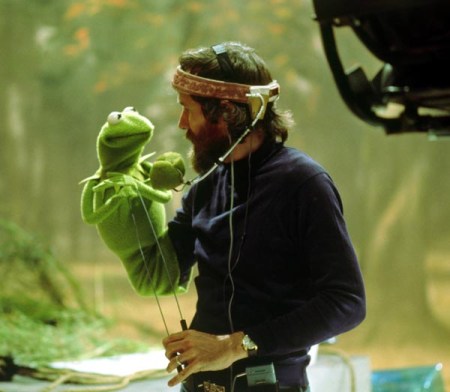
Henson and Kermit.jpg

(Guest post by Greg Forster)

Recently we had a lot of fun with the Leo Casey/UFT “cue card check” story. But one fact that I don’t think got a lot of attention (here or elsewhere) is that this is far from the first instance of teacher union sock puppetry.

In this week’s Communique, ALELR highlights another one – the NEA’s longtime practice of setting up dummy organizations that are entirely controlled by the union, but conceal this fact and present themselves as independent voices. This week he highlights ROVE (Republicans Opposing Voucher Efforts), which, from the evidence ALELR presents, sure looks a whole lot like it has the NEA’s arm sticking out the bottom.

Apparently their strategy is to pay a whole chorus of voices to sing out of the union songbook, while hiding the singers’ union connections.

Say, I think I feel a song coming on myself…

Why are there so many songs about unions?
And choruses on their side?

The singers are honest and independent
And they have nothing to hide

So we’ve been told and some choose to believe it
I know they’re wrong, wait and see
Someday we’ll find it – the union connection
The reformers, the reporters, and me!