Our Tax Dollars Paying for Penuchle

October 5, 2009

(Guest post by Jonathan Butcher)

Boy, does this sound familiar!  Apparently, the U.S. Post Service shells out $1 million every week to “pay thousands of employees to sit in empty rooms and do nothing.”  Mail volume has slid 12.6% compared to last year, and the Post Office simply can’t find enough to do to keep postal workers busy.  “So they sit — some for a few hours, others for entire shifts…They spend their days holed up in rooms — conference rooms, break rooms, occasionally 12-foot-by-8-foot storage closets…”  Funny, this reminds me of grad school (without the free food).

The employees can’t be fired due to union rules, of course.  Not only that, but workers at slower post offices can’t even be reassigned to busier locations.

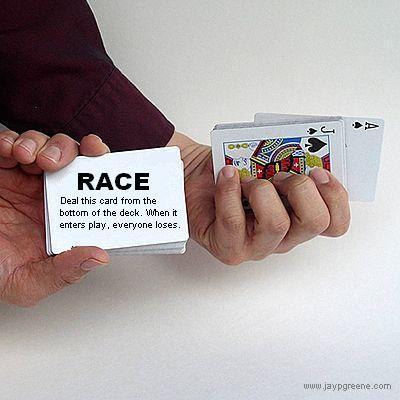
Why does this sound familiar?  Because teacher union rules in New York City created something remarkably similar.  As The New Yorker pointed out recently (and noted on jaypgreene.com here) , teachers unions have some 600 teachers in the city sit in “rubber rooms,” playing cards, chatting, or fighting over folding chairs.  These teachers get their summers off and are getting paid their full salary (in some cases upwards of $100,000 a year).

Unlike the postal workers, the issue with these teachers in a holding pattern is that they are under investigation for misconduct or incompetence.  But the fact remains that unions in both cases make it virtually impossible to fire anyone, the knights of the folding chairs still get paid a full salary, and they are all doing absolutely nothing for months on end.

Our tax money, funding penuchle games for federal and state employees everywhere.

(HT: Carpe Diem)


The Obama Administration to Date

October 4, 2009

This just about sums it up — that is zero-sums it up.


Pass the Clicker: John Adams

October 2, 2009

Adams

(Guest post by Greg Forster)

Recently I finally got around to watching the HBO mini-series John Adams. It’s very good and you should watch it!

But I think this material would have been better as, say, three or four separate movies rather than one long story. Because three or four separate stories is pretty much what you’ve got here. There is some overlap, especially between Adams’s political career and his marriage. But the multiple storylines would have come out better if we’d been able to focus on one at a time.

I’ve increasingly come to think that the “biopic” is a poor format for storytelling, becasue no human life meets the demands of narrative structure perfectly enough. Instead of focusing on “the life of John Adams and the big stories that he saw,” what you want is to tell each of the stories.

Adams & Washington

One of the stories is about Adams’s political career, and here you have the makings of both classical tragedy and triumphant epic rolled up into one narrative. Tragedy, in that Adams had the makings of a great statesman but he was constantly undermined by his own vanity and stubbornness. Triumphant epic, in that he repeatedly disregarded his own self-interest to accomplish great things for his country. From his first significant political act (defending the innocent British soldiers falsely accused in the “Boston Massacre” case) to his last (keeping America out of an unnecessary war with Napoleon), he repeatedly chose to do the right thing in the teeth of extreme pressure from popular opinion and political interests alike.
Real Hamilton 1Hamilton 1

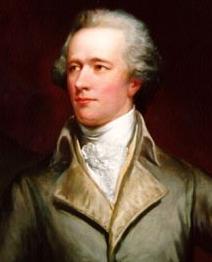
One story I especially enjoyed seeing was the gradual development and then explosion of the scorpions-in-a-bottle rivalry between Adams and his keep-your-friends-close-and-your-enemies-closer political ally, Alexander Hamilton. It’s a story I don’t think anyone else has ever taken a crack at on the screen, and it’s well worth seeing. I have to say Hamilton gets something of a bad rap in a show where our sympathies are meant to lie with Adams. But the exceptionally talented Rufus Sewell makes Hamilton into an effectively menacing villain.

John & Abigail

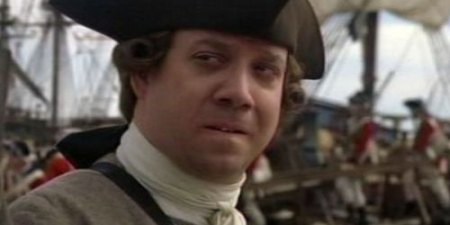
The second story, also combining triumph and tragedy, is Adams’s family life. Just his famous marriage to Abigail alone would be more that sufficient to carry a movie by itself, and Laura Linney’s outstanding performance matches Paul Giamatti’s step for step.

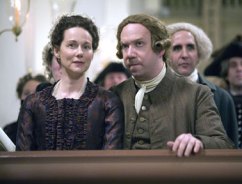
Real AbigailJohn & Abigail at meeting

Different productions have chosen different approaches to the John and Abigail relationship. The musical and movie “1776” went the cereberal route, depicting the relationship through the letters they famously exchanged (inevitable, perhaps, given that the story takes place while they were separated) with an emphasis on how these two equally sharp minds fenced and parried with each other.

John & Abigail alone

The HBO production, by contrast, periodically references Abigail’s intellectual impact on John, but focuses on two other aspects of their relationship. The first – and here is the overlap with the strictly political story – is the way she effectively tempered John’s fatal political weaknesses. When John and Abigail are living together, his ego is kept in check. She persuades him to minimize the rhetorical excesses of his defense speech in the Boston trial. She advises him to drop his extremely ill-advised campaign to add a quasi-royal honorific (“his excellency,” “his majesty,” etc.) to the presidency. But when they are apart, as they frequently are for extended periods, John’s demons keep rising to the surface.

The other focus is on John and Abigail’s role as parents, another story I don’t believe anyone has told on screen before. John’s stern insistence on controlling his children’s lives (especially his eldest son John Quincy) and his extended absences from the family both create extreme emotional burdens for Abigail and the children alike. As is well known, John Quincy turns out as well as his father, but we are made to see the dreadful price his father made him pay for it; as is not well known, his other children lived broken lives, his son Charles dying of drink and his daughter marrying a man with a tendency to lose money on speculation, and who ends up having to flee his bad repuation by moving west and starting over while his wife and children remain behind.

 Jefferson, Adams & Franklin

The third – and perhaps fourth, depending on how you count – story concerns the friendship and rivalry of Adams, Jefferson and Franklin. Here is where the series really shines; we see how these three very different men – Adams the blunt man of law, piety, and conservatism; Jefferson the quiet man of philosophy, romance, and radicalism; and Franklin the wry man of science, humor, and sensuality – at first become brothers bound by a common cause, and are then slowly but surely forced into opposition against each other by the divergent demands of their consciences. By far the two best scenes in the movie occur when Jefferson arrives in Paris, where Adams and Franklin have been serving as diplomats. Jefferson, after the deaths of his wife and child, is becoming cold and (even more) distant; Franklin and Adams have become rivals since Franklin felt he had no choice but to ask Congress to remove Adams from the French delegation due to his ineptness at diplomacy.
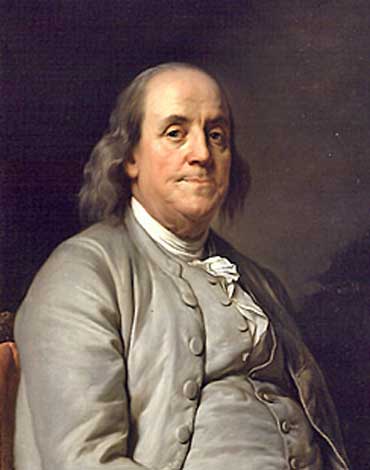
Real FranklinFranklin

Tom Wilkinson absolutely steals the show as Franklin. It’s hard to make Franklin fresh to an American audience, but Wilkinson does it, aided of course by the scriptwriters.

You could count the Adams/Jefferson/Franklin friendship as either one or two stories, since Franklin’s death leaves us with only the famous Adams/Jefferson relationship on screen, and the dynamic changes. Meanwhile, the Adams/Franklin story is equally worth telling, and (yet again) a story I don’t think we’ve seen on screen. On the other hand, the rivalry that develops later between Jefferson and Adams isn’t dramatically interesting unless it’s preceeded by their friendship, and Franklin was central to that part of the story.

Real JeffersonJefferson

Regarding the later rivalry between Jefferson and Adams, the thesis of the movie is that Jefferson hardened his heart after the deaths of his wife and daughter, and this is what led him to shrug his shoulders and make excuses as the French Revolution became more and more barbaric, distrust his former friend Adams as a liar and a cheat when their disagreements over France became politically critical, and ultimately permit his retainers to print scandalous lies about Adams in order to secure his election in 1800. I have always preferred Adams over Jefferson, even before it was cool, but it must be said that this storyline, while it works as drama, is unfair to Jefferson. It is clear in the record that he recovered emotionally from his wife and daughter’s deaths, as his famous “dialogue between my head and my heart” love letter to a French lady shows pretty clearly.

The case against Jefferson was much more effectively made in the David McCullough book on which the HBO series is based. McCullough tells us that when Jefferson was born, he was placed on a pillow and carried out of the room by a slave, and “he was carried by slaves for the rest of his life.”

As Matt might say: BOOOOOOOM!

Someday, someone needs to make a movie of the Adams/Jefferson relationship. “Thomas and John” would make a great title. (Get to work on that, Hollywood readers.)

There’s so much more packed into this mini-series that I can’t hope to include it all. There are constant little touches history buffs will smile at and history novices will find intriguing – in fact, some of the eccentricities of the real historical characters have actually been softened so that they could be presented without seeming implausible. The stiff and uncomfortable formality of Washington, the shyness of Jefferson, and the eccentricity of George III have all been noticeably toned down so that they could be presented without the audience feeling like they had been exaggerated.

It will take a significant chunk of your time to watch it. And it is not thrill-a-minute stuff. But if you make the investment, you will be rewarded.

Especially if you plan to take the citizenship exam.


Jay & Marcus in NR

October 2, 2009

NR cover (Jay & Marcus article)

(Guest post by Greg Forster)

In the new National Review, Jay and Marcus review the research on special education funding incentives, including the findings of their recent study on the impact of vouchers in Florida.

Financial incentives are particularly important in low-level disability categories like SLD, where a diagnosis is easily fudged. While you need pretty solid evidence to diagnose a child with a traumatic brain injury or other severe disabilities, schools have plenty of leeway on SLD. Some research suggests that public schools use low achievement alone to serve as an indicator of SLD. Studies dating back to the 1980s found that SLD students are indistinguishable from low-achieving regular-enrollment students, with one study estimating that over half the students identified as SLD in Colorado did not fit either federal or state definitions for SLD.

Digital subscribers go here; paper-only subscribers go here; non-subscribers go here.


Car Buyers Hate Bailouts

October 2, 2009

The Homer

(Guest post by Greg Forster)

You, the taxpayer, spent billions of dollars bailing out Chysler and GM.

Great news!

GM’s sales are down 45% from last September (when sales were already bad enough to drive the company into banrkuptcy). Chrysler is down 42%. Ford is only down 5%. Car buyers are clearly punishing the two bailout recipients brutally. Robert Farago of Truth About Cars predicts that GM and Chrysler will both “go down by the end of next year” without a second, new federal bailout. The only question, he says, is whether the two bailed out manufacturers will need the cash before the 2010 midterm elections.

Why is that great news? Because maybe it will help a few legislators learn their lesson for next time.

HT Kausfiles


Arne Duncan’s Doubleplusgood Doublespeak

September 30, 2009

(Guest Post by Matthew Ladner)

ABC quoted Arne Duncan yesterday on DC vouchers:

“The children who were in school, we fought hard to keep them in their schools. Congress has made it clear they are not accepting any additional students,” Duncan told ABC News last month. “So, kids that were in schools, we wanted them to go. Kids who weren’t yet in when the program ended, according to Congress, it didn’t make sense. … I encourage them to come in and look at what’s going on with the public schools here in D.C. It’s pretty exciting.”

Duncan strongly opposes vouchers and has made clear his belief that the money is better spent investing in lasting reforms.

“Vouchers usually serve 1 to 2 percent of the children in the community. And I think we, as the federal government, we as local governments or we as school districts, we have to be more ambitious than that,” Duncan said in a speech before the National Press club last May.

“I don’t want to save 1 or 2 percent of children and let 98 to 99 percent drown. We have to be much more ambitious than that. And we have to expect more,” he added. “This is why I would argue … rather than taking three kids out of there and putting them in a better school and feeling good and sleeping well at night, I want to turn that school around now and do that for those 400, 500, 800, 1,200 kids in that school, and give every child in that school, in that community, something better and do it with a real sense of urgency.”

Oi vey…

Duncan’s logical flaws smell so overwhelming that there isn’t really any need for me to point them out.  Duncan’s absurd claptrap does however remind me of a joke:

So one day a great flood came, and the sheriff went to the house of a man to tell him that he needed to evacuate to higher ground. “No, God will save me” replied the man.

So the storm raged on. The man’s house flooded, forcing him to flee to his roof. Rescue workers came in a canoe to save him, but the man again refused, saying “No, God will save me.”

Finally, the man stood desperately atop of his chimney. A rescue helicopter flew by and threw him a rope ladder, which he refused. “God will save me!” he screamed to the helicopter crew.

So the water rose and the man drowned.

After entering the Pearly Gates, the man asked “God why didn’t you save me from the flood?”

God replied “What do you mean? I sent you a police car, a canoe and a helicopter.”

If Duncan thinks DC schools are “exciting” then why doesn’t he enroll his own children in them? Strangely enough, they are off in the suburban Virginia schools. Admittedly, checkbook school choice does serve way more than “1 or 2 percent” of students.

“I don’t want to save 1 or 2 percent of children and let 98 to 99 percent drown. I am however willing to let 30-40 percent buy their way out and let the other 60 to 70 percent drown, so long as my kids are among those safely sequestered in the leafy suburbs.”

What’s that?  He didn’t say that?

You forget: actions speak louder than words.


Just About Everything is Endogenous

September 30, 2009

A common technique in analyses of education policies (and popularized in the book, Freakonomics) has suffered a setback recently.  The technique attempts to correct for endogeneity, which occurs when your dependent variable is causing one of your independent variables rather than simply the other way around.

It’s probably best to explain this with an example.  Let’s say you want to know how the number of police officers in a city affects the crime rate.  In this example the dependent variable is the crime rate and the independent variable is the number of police officers.  That is, you are trying to explain how the size of the police force causes crime rates to be high or low.

The trouble is that the causal arrow also goes in the other direction.  The crime rate affects the size of the police force because cities with a lot of crime may decide to hire a lot of police officers.  So, the number of police officers is endogenous to the crime rate.  

That endogeneity could produce some odd results if we didn’t do anything to correct it.  We might find that the number of police officers causes crime rates to be higher when it might really be the case that the size of the police force reduces crime but high crime rates cause larger police forces.

This kind of problem comes up quite often in econometric analyses in general and in particular in evaluations of education policies.  So, it was a great a thing that University of Chicago economist James Heckman developed a technique for unravelling these circular relationships and correcting for endogeneity bias.  Basically, the technique uses some exogenous variable to predict the independent variable without bias.

Again, it’s probably easiest to explain with an example.  If we can find something that predicts the number of police officers that has nothing to do with the crime rate, then we can come up with an unbiased estimated of the number of police officers.  We can then use that unbiased estimate of how many police officers there would be (independent of the crime rate) to predict the crime rate.  In theory the technique works great.  Heckman won the Nobel Prize in economics for developing it.

The tricky part is coming up with a truly exogenous instrument (something that predicts the independent variable but has no relationship with the dependent variable).  The only obviously exogenous instrument is chance itself.  An example of that kind of instrument can be found in analyses of the effect of using a voucher on the student achievement of students who actually attend a private school when the vouchers are awarded by lottery.  Those analyses use whether a student won the lottery or not to predict whether a student attended a private school and then used that unbiased estimate of whether a student attended a private school to predict the effect of private schooling on student achievement. 

Whether a student won the lottery is purely a matter of chance and so is completely unrelated to student achievement, but it is predictive of whether a student attends a private school.  It is a perfectly exogenous instrument.

The problem is that other than lotteries, it isn’t always clear that the instruments used are truly exogenous.  Even if we can’t think of how things may be related, they may well be.

A perfect example of this — and it is one that raises questions about how exogenous all instruments other than lotteries truly are — was recently described in the Wall Street Journal having to do with date of birth.  The date during the year when babies are born has long been thought to be essentially random and has been used as an exogenous instrument in a variety of important analyses, including a seminal paper in 1991 by Josh Angrsit and Alan Krueger on the effects of educational attainment on later life outcomes. 

Since states have compulsory education laws require that students stay in school until a certain age, babies born earlier in the year reach that age at a lower grade and can drop out having attained less education.  By comparing those born earlier in the year to those born later, which they believed should have nothing to do with later life outcomes, they were able to make claims about how staying in school longer affected income, etc…

But new work by Kasey Buckles and Daniel Hungerman at the University of Notre Dame suggests that the month and day of birth is not really exogenous to life outcomes.  As it turns out, babies born in January are more likely to be born to unwed, less educated, and low income mothers than babies born later in the year.  The difference is not huge, but it is significant.  And since this variable is not exogenous, perhaps some or all of the effect of attainment Angrist and Krueger observed is related to this relationship between date of birth and SES, not truly attributable to attainment.

And if birth order is not random when we all assumed it was, what other instruments in these analyses are also not truly exogenous but we just don’t know how yet?  It’s a potentially serious problem for these analyses.


Market Ideas at Work Around the World

September 29, 2009

(Guest Post by Jonathan Butcher)

It is a beautiful thing when improvements in how we live can be explained by economic theories rooted in free market principles.  When someone halfway around the world sees their way of life improve and this is featured in the media, dust off your favorite book by a free market thinker and look for the theory that explains it.

This week’s Economist provides an opportunity to do just that.  In a feature section on the telecom industry and emerging markets, this excerpt on cell phones in an article entitled “Eureka Moments” caught my attention:

“How did a device that just a few years ago was regarded as a yuppie plaything become, in the words of Jeffrey Sachs, a development guru at Columbia University’s Earth Institute, ‘the single most transformative tool for development’?  A number of things came together to make mobile phones more accessible to poorer people and trigger the rapid growth of the past few years.  The spread of mobile phones in the developed world, together with the emergence of two main technology standards, led to economies of scale…” (emphasis mine).

The casual reader may miss the significant principle at work here: the poor, even on the other side of the planet, benefit from developments in wealthier nations.  This idea is at least as old as 1960, as Friedrich A. Hayek, beautifully elaborates in The Constitution of Liberty:

“There can be little doubt that the prospect of the poorer, ‘underdeveloped’ countries reaching the present level of the West is very much better than it would have been, had the West not pulled so far ahead.  Furthermore, it is better than it would have been, had some world authority, in the course of the rise of modern civilization, seen to it that no part pulled so far ahead of the rest and made sure at each step that the material benefits were distributed evenly throughout the world…

“The over-all speed of advance will be increased by those who move fastest.  Even if many fall behind at first, the cumulative effect of the preparation of the path will, before long, sufficiently facilitate their advance that they will be able to keep their place in the march.”

So, if we want to help the poor at home or abroad, powerbrokers should do everything they can to foster the success of the successful.  Instead of redistributing wealth through higher taxes on the rich, policymakers should make policy that helps entrepreneurs succeed.  For it is the knowledge they create, use, and pass on with their enterprises that quickens the pace of progress, pulling everyone along at a faster rate as the new technology spreads.

It is not just tax policy or legislation pertaining to businesses to which this idea applies; other social programs can be improved in the same way, and education is no exception.  Charter schools are an excellent example of a public policy that promotes individual liberty and entrepreneurship—resulting in the creation of new ideas that can then be used widely.

Everywhere charters have spread, the new ideas on leadership and teaching, for example, that they carry with them have been copied.  Even those opposed to charter schools have decided to combat them using the charter concept.  For example, Pilot Schools were created in Boston by existing school leaders in response to charter schools, using concepts central to the charter movement (more freedom over administrative decision making, specialized mission statements, etc.).  The result is that parents have even more options than before—more schools to chose from and more freedom.

Likewise, President Obama’s recent call for a longer school day and year is nothing new; the much-heralded KIPP Academies, also charter schools, have been operating with this policy for many years.  Again, new ideas that survive once implemented, created in the realm of entrepreneurship, are difficult to ignore even at the highest level.

The Economist’s piece goes on to explain how cell phones help the poor in rural areas around the globe, by “generally mak[ing] it easier to do business.”  In fact, a recent study found that “adding an extra ten mobile phones per 100 people in a typical developing country boosts growth in GDP per person by 0.8 percentage points.”  Would that we could see such an improvement in student achievement from policies promoting educational entrepreneurship.  Here’s hoping policymakers let the successful succeed, in education and elsewhere.


EdWize’s Racial Libel

September 28, 2009

Race Card w watermark

(Guest post by Greg Forster)

On EdWize, Jonathan Gyurko finds himself forced to acknowledge that Caroline Hoxby’s recent blockbuster study is good news for charter schools. He then starts desperately groping for any excuse he can find to neutralize the good news.

Most of his claims will be familiar to those who have seen the teachers’ unions try to spin away gold-standard empirical evidence that their positions are wrong. We’ve read all these cue cards before.

But one of his claims deserves more attention. Like many before him, Gyurko tries his hand at racial demagoguery to make parental choice seem like a scary throwback to Jim Crow:

Such a dramatically-presented conclusion is sure to feature prominently in charter advocates’ efforts to expand the number of charter schools across the city and state. And if it’s true, then why shouldn’t we? The answer actually depends on how policymakers weigh the goal of improved student achievement against other worthy goals, such as greater educational equity and meaningful diversity. And on these other objectives, nagging questions dog the charter sector.

For example, Hoxby finds that 92 percent of charter students are black or Hispanic, compared to 72 percent in district schools and concludes that “the existence of charter schools in the city therefore leaves the traditional public schools less black, more white, and more Asian.” Such racial segregation is consistent with research on charter schools in other states including North Carolina, Texas and elsewhere.

Although this statistic is likely to be a function of charter schools’ location in largely black and Hispanic neighborhoods, Hoxby also reports that fewer white students are applying to the charters; although 14 percent of residents in the charter school neighborhoods are white non-Hispanic, only 4 percent are applying.

There are two claims made here:

1) If the citywide aggregate population of all charter school students is more heavily minority than the citywide aggregate population of district school students, charters must be increasing segregation.

2) If charter school applicants who live near the charter schools are disproportionately minority, charters must be increasing segregation.

Both claims are transparently bogus.

On the first claim: citywide aggregate figures tell us nothing whatsoever about the impact charters are having on segregation, for the simple reason that citywide aggregate figures can tell us nothing whatsoever about segregation in any context, even aside from the whole charter question.

Imagine for a moment that New York is made up of 50% green children and 50% purple children. Let’s look at two scenarios:

Perfect segregation scenrio: All the green children go to fully segregated schools made up exclusively of green children, and all the purple children go to fully segregated schools made up exclusively of purple children.

Perfect integration scenario: All children attend perfectly integrated schools made up of half green children and half purple children.

Now, let’s take a look at the citywide aggregate figures we would get under these two scenarios.

Perfect segregation scenario: Citywide aggregate 50% green, 50% purple.

Perfect integration scenario: Citywide aggregate 50% green, 50% purple.

You see? Aggregate figures are intrinsically incapable of providing any information about school segregation. To find out whether schools are segregated, you must look at the individual schools.

Let’s apply that principle to the real world. Hoxby finds that the citywide aggregate population of district school students is 72% minority. But does that mean every individual school is 72% minority? Of course not. You could very well have all the white children going to perfectly segregated exclusively all-white schools, all the black children to perfectly segregated exclusively all-black schools, all the Hispanic children going to perfectly segregated exclusively all-Hispanic schools, etc., and the citywide aggregate figure would remain unchanged.

And, in fact, the reality on the ground is a lot closer to that dystopian hypothetical than it is to the utopian scenario of ideal racial balance. But Gyurko’s argument relies on the unspoken assumption that the reality on the ground in district schools is utopian.

Meanwhile, the citywide aggregate for charter schools is 92%. As with district schools, the aggregate figure tells us nothing about the actual racial balance in any individual school. Supposing for a moment that New York’s district schools are very heavily segregated – which they are – it is quite possible that the actual charter schools on the ground are better integrated than the district schools even though their aggregate population figure is disproportionately minority.

And, in fact, given that the primary cause of school segregation is housing segregation, the fact that charters can break down neighborhood barriers and draw students from other neighborhoods with different demographics makes it highly likely that they are, in fact, better integrated. That’s the reality in voucher programs, where the empirical evidence unanimously shows parent choice improves integration.

But at any rate, the data to which Gyurko appeals don’t tell us either way.

Once the essential sham behind the first claim is exposed, the second claim is much easier to refute. What counts is not how the local applicant pool differs from the local resident population, but how the final makeup of each charter school differs from the final makeup of each district school. Once the process of parents making choices is completed, are the individual charter schools more segregated? This datum tells us nothing about that.

Ironically, Gyurko’s argument on this second claim really implies that he wants charter schools to represent the racial balance of their local neighborhoods. That would imply endless racial segregation, given that neighborhoods are so racially homogeneous. Any serious attempt to break down racial segregation in schools must begin by acknowledging that schools representing their neighborhoods is the problem.

That’s why hyper-arrogant courts forced us to go through the disastrous failed experiment with forced busing. That was a terrible idea, just like anything that robs parents of their freedom. But at least those tyrannical judges understood the source of the problem correctly.

If parents want to send their children to their local neighborhood schools, they should be allowed. But anything we do that forces them to send their children to school locally is – among so many other evils – going to increase racial segregation. Assigning students to schools by ZIP code is not only educationally bankrupt, it’s racially poisonous.


Pass the Clicker — Filled with Glee

September 25, 2009

With the possible exception of Flashforward, which I haven’t had a chance to see yet but looks promising, Glee is the best new TV show of the season.  It’s a dark high school comedy about the struggles and triumphs of the glee club coach and its members. 

The best part about it is its unhindered departure from realism.  No glee club really sounds that good.  All of the characters are outrageous stereotypes.  No high school is filled with as much viciousness.  I especially love the coach of the “Cheerios” cheerleading team enforcing the Darwinian social hierarchy and Principal Figgins with his hand always on the calculator looking to save money by feeding the students prison food.

But in fully departing from realism the show probably better captures the reality of high school life than any of the sappy, gritty, “realistic” high school dramas, like Boston Public, Dangerous Minds, or Dead Poets Society.  Those are adult fantasies of what they would like high school to be — filled with heroic teachers battling the odds to save eager students . 

That’s not high school.  High school is often banal, outrageous, awkward, and pathetic.  Surrealism captures the experience so much better than realism.  The only other depiction of high school that I can think of that similarly captures the high school experience is the movie, Election.

Given that much of the attraction of the show is its outrageousness and novelty, I expect that the quality of the show will rapidly fade.  By season 2 we will have exhausted the one-dimensional characters and become jaded to the show’s novelty.  But enjoy the ride for now.

And yes, a show about a glee club is pretty “gay.”  The show tackles this issue head-on by featuring the tension between youthful anxiety about masculinity and youthful desire to express one’s creative self.  Just watch how the football team uses a dance to Beyonce’s All the Single Ladies to win the game:

And if you need more dancing to that song (and who doesn’t?), check out this video of All the Single Babies:

(edited to correct typo)