The Price of Things to Come: Free

September 24, 2009

(Guest Post by Matthew Ladner)

I am half way through Chris Andersen’s new book Free: The Future of a Radical Price and I can already recommend the book.

Andersen’s treatment of disruptive technologies and firms is simply fascinating. Craig’s List, for example, has from one perspective “destroyed” far more profits for newspapers than it creates for itself. The entire firm runs on a few dozen employees, but has played a large role in reducing a huge revenue stream for the entire American newspaper industry.

Craig’s List actually hasn’t destroyed profits, but in fact has redistributed them to the general public. Craig’s List provides a superior service to a want ad, and it is almost always free.

Likewise, Britannica and others used to make large profits going door to door selling $1,000 encyclopedia sets. Then Microsoft came out with a $99 dvd encyclopedia, and profits withered. Then Wikipedia came along and Microsoft abandoned their dvd project, and Britannica and company will be required to reinvent themselves if they are to survive.

Technology is driving all of these changes-exponential increases in computing power, storage capacity, are driving changes that are fundamentally disrupting several industries: music, newspapers, and perhaps banking.

The question I have half way through this book: who will become the Google of higher education?

Google has a core business of showing you online ads that is very, very profitable. Most of what they do, however, is throwing out products for free. Google has over 100 free software applications online- maps, Earth, documents, etc. and develops new ones all the time.

Highly successful American universities seem to have a core mission of educating students. This however is questionable at best. Some of these universities have endowments so large that if they simply followed the rules for non-profits and spent 5% of their endowment per year, they could eliminate tuition for their students entirely.

What these universities are really about, of course, is getting research grants and adding to their endowments. What if, however, one or more of them were to go down the road of truly seeking to educate the world by putting up entire degree programs online for free.

A Harvard, Princeton or Notre Dame is likely to always have more applicants than spaces, and in any case, these places could survive without students, not that they will ever need to do so. Why not put up entire rigorous degree programs online, and invite anyone and everyone in the world to complete them for free?

Concerned that it would lessen a regular degree? Pshaw-distinguish it from a regular degree, and require an exit exam, say the GRE, that indicates the student knows quite a bit. Random half-baked idea alert, but if a score on the GRE high enough to admit the student in the upper half of graduate programs were required, we’d know far more about the online student than the traditional ones.

Worried about quality? You should be, but don’t forget the recent U.S. Department of Education study showing that technology based learning is substantially more effective than the old fashioned way.

Imagine if students in Bangladesh could earn a Princeton math degree, or a theology degree from Notre Dame for free, or more accurately for the time, computer and internet cost. The marginal players of the American academy would squeal as they are forced to reinvent themselves from making buggy whips, but this is a small price to pay for bringing opportunity to the world.

The only question in my mind is how long it will be until an elite player has the necessary vision to defect from the comfortable cartel. Several universities have the means to do this, and could receive philanthropic help to do so. Attention Oxford and Cambridge: it wouldn’t require an American university to pull this off. A British university could put out a low-cost version of this, and unlike their American counterparts, they aren’t swimming in resources.


Oklahoma Civics Continued

September 23, 2009

(Guest Post by Matthew Ladner)


First Amendment Repealed, Part Two

September 23, 2009

Pravda

(Guest post by Greg Forster)

No sooner do I put up a post on the death of the First Amendment than along comes Jim Geraghty with more free-speech funeral news.

On the floor of the Senate, Sen. Tom Carper appears to have openly and explicitly confirmed that legislators made an illegal quid-pro-quo deal with PhRMA to design health care legislation a certain way in return for a commitment to run ads supporting the bill.

Geraghty is focused on the bribery aspect – PhRMA bought a legislative outcome in exchange for money (spent on ads the legislators wanted). But it’s also a speech issue – congressional leaders used their power over the laws to bend political speech into the shape they wanted it.

The health care people just can’t destroy our freedom fast enough.


The First Amendment Is Hereby Repealed

September 23, 2009

Pravda

(Guest post by Greg Forster)

Items in the news this week:

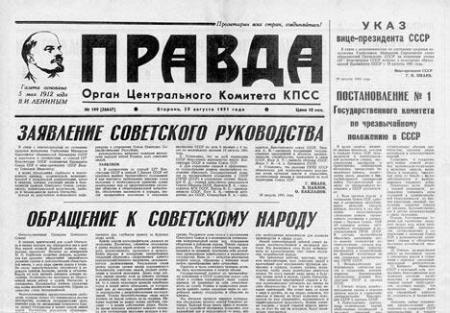
1) The president signals he’s open to a government takeover of the newspaper industry. No word on whether government-supported papers will be required to change their names to PRAVDA.

If you’ve been told that the bill in question doesn’t set up direct government funding for newspapers, you’ve been misled. It doesn’t set up federal funding for newspapers, but it does everything possible to grease the skids for state and local government funding – and who’s prepared to bet that won’t happen once the opportunity is available?

As I wrote back in April:

Since the law already allows nonprofits to publish and distribute their own newspapers if they want to, the only possible rationale for Sen. Cardin’s proposal is that it allows newspapers to continue charging money to cover their costs while also recieving tax-free subsidies. And who would be doing the subsidizing? Even if government (at the state and local level) doesn’t do it directly, it’ll do it indirectly. Politicians have lots of wealthy friends who would love to have their own pet newspapers.

In fact, Cardin’s proposal is actually worse than a direct government subsidy. At least a direct subsidy would be on the books and subject to disclosure, oversight, and some level of accountability.

Cardin invokes the old Jeffersonian saw that it would be better to have newspapers without government rather than government without newspapers. Yes – but either of those would be better than having government newspapers.

I also wrote that “the proposal is obviously going to go nowhere because it fails the laugh test.” But the laugh test is one exam that’s been pretty radically dumbed down over the past six months; these days anyone can pass it.

2) Meanwhile, the latest development in the health care debate: The U.S. government is now openly using the criminal law to censor core political speech solely because the speech in question advocates a position the government opposes.

When I say “censor” I don’t mean they’re regulating donations and spending levels or imposing restrictions on the when, where and how. I mean they’re threatening to impose criminal sanctions for having said a certain thing, simply because it’s something they don’t want said.

And, of course, once the threat is made there’s no real need to prosecute. The threat itself is sufficient to censor all future speech on the subject.

I’ve written before that health care reform is a knife at the throat of our freedom. I had no idea the enslavement process would move so quickly. Care to place bets on which clause of the Bill of Rights will be the next to go?

UPDATE: Yet another health-care-destroys-free-speech story.


More Charter Evidence

September 22, 2009

Diane Ravitch has declared that the Obama administration’s policy of expanding the number of charter schools has “no credible basis in research.”  This is just plain wrong.  And a new study coming out today from Stanford’s Caroline Hoxby demonstrates that she is even more wrong.

I’ve already noted that the highest quality studies — those that avoid bias from the self-selection of students into charter schools either with random-assignment or rigorous instrumental variable research designs — show significant academic benefits for students who attend charter schools instead of traditional public schools.  These studies examine the effect of charter schools in Massachusetts, Florida, Chicago, and New York City. 

And now add to that pile an updated study from Caroline Hoxby mentioned in today’s WSJ and NYT on New York City charter effects.  Students accepted by lottery into one of NYC’s charter schools in kindergarten and remained in a charter school through grade 8 closed the achievement gap with wealthy kids attending schools in Scarsdale entirely in math and two-thirds of the way in reading.

Critics are clinging to a study by Margaret Raymond at CREDO, which shows more mixed results.  While that study has the benefit of covering 15 states and DC, it can’t correct for the self-selection of students into charter schools like the highest quality studies linked above.  On average, students appear to be drawn to switching to charter schools because they are having trouble in their traditional public school.  Simply controlling for those students’ prior achievement and other observed demographic factors doesn’t quite correct for whatever negative factors may have caused students to switch to charters and that may continue to hinder their academic progress.  The CREDO study is as good as it can be given its approach, but I would have greater confidence in the consistent findings from several studies in different locations that do control for self-selection into charter schools.


Over There (But Not Over Here)

September 21, 2009

Several years ago I was part of a delegation sent by the U.S. Department of Education to a conference in China on private education.  The U.S. Dept of Ed believed that encouraging the expansion of private education in China would help promote democracy.  Apparently, they thought private schools were good for democratic values over there, but not over here. 

I was reminded of that experience while reading a recent New York Times article about severe problems with education in South Africa.  The piece states:

Despite sharp increases in education spending since apartheid ended, South African children consistently score at or near rock bottom on international achievement tests, even measured against far poorer African countries. This bodes ill for South Africa’s ability to compete in a globalized economy, or to fill its yawning demand for skilled workers. And the wrenching achievement gap between black and white students persists.

Sound familiar?

And what does the NYT tell us is a central part of the problem:

The teachers’ union too often protected its members at the expense of pupils, critics say. “We have the highest level of teacher unionization in the world, but their focus is on rights, not responsibilities,” Mamphela Ramphele, former vice chancellor of the University of Cape Town, said in a recent speech.

I see.  Teacher unions over there = bad, while over here = good.  Sometimes you have to get people outside of their vested set of domestic interests to see how they really think the world works.


Pass the Popcorn: Finding Solace

September 18, 2009

Bond - QOS ending

(Guest post by Greg Forster)

Not long ago I watched Quantum of Solace for the second time. When I first saw it I thought what Marc Forster (no relation) had done with the series gave it extremely high potential, so I tried to moderate my expectations. But it wasn’t enough; I couldn’t place the film any higher than “Passable” on the rubric of my unified field theorem of Bond movies.

Well, the second time I liked it better. Not a lot better – all my basic criticisms still stand – but I think I get more clearly now what they were going for, and I see some more subtle ways in which some parts of the movie work better than I thought.

Some of the subtlety I missed before is in the action sequences, whose poor handling in the editing room did so much to kill this movie’s potential. For example, in the foot chace through the Italian city early in the movie, they reverse the foot chase in Africa that took place early in Casino Royale. Then, the bad guy (a nobody bomb-maker) was stronger and more agile than Bond, and Bond had to beat him by being smarter and trickier. This time, the bad guy is working for the shadowy super-conspiracy, so he’s actually trickier than Bond; Bond beats him by being stronger and more agile.

Also, throughout the movie – in both action and non-action sequences – when the camera is showing us Bond’s perspective it frequently mimics the perspective of a head turning the way Bond’s head is really turning. It works well.

I said before that the movie had lots of fine moments. Well, I can appreciate them more now that the movie’s flaws aren’t hitting me in the face (because I’m ready for them). And there are actually a lot of them.

One other subtlety I missed is that the movie implicitly emphasizes, as Casino Royale did more explicitly, that Bond really doesn’t mind killing people to save the world. Yes, they emphasize the emotional price he pays to be what he is; that’s part of the main subject of QoS. But it’s very clear that the price is worth paying. If you really do need to kill people to save the world, then killing people to save the world is right and you shouldn’t feel bad about doing it, and we should be thankful that there are people willing to pay the price Bond pays to be what Bond is.

I see now much more clearly what the movie is really about – Bond needs to learn to forgive, but forgiveness isn’t in his nature because of the kind of man he is (and needs to be to do his job). The main tension of the movie is supposed to be the suspense created by the ambiguity of Bond’s motivation. Is he saving the world, or is he on a vengeance trip, and if that happens to involve saving the world that’s a nice bonus?

I missed this (well, I didn’t fully appreciate it) because I was looking for the movie’s substance in the wrong place – in the villains and their plot and Bond’s quest to foil them, all of which was flubbed so badly by the filmmakers. And part of the flubbing of the plot involved making the action sequences far too long, leaving less time for the filmmakers to develop what was really the movie’s core – Bond’s motivation.

In fact, it didn’t feel at all like there was any ambiguity about Bond’s motives. It was clear he was on a vengeance trip. I think the filmmakers wrongly assumed that “saving the world” would be our default assumption for Bond’s motivation, and we would need to be pushed to see that he’s out for vengeance. But the opposite is the case – Casino Royale set up the vengeance plot so brilliantly that that was our default.

The ambiguity, in fact, comes at the very end – where it was supposed to be resolved. I believe that Bond’s final act just before the credits roll, which is so shocking and stunning, was meant to demonstrate that he was saving the world all along, that the vengeance trip was just a temptation he was struggling with but was never his real motivation. Unfortunately, because they’d been pushing us in the vengeance direction the whole movie, the final act actually has the effect of introducing ambiguity. He says he “never left” MI6’s service – did he really? Was he only holding on to the necklace and the photo of Vesper’s boyfriend just because they were the evidence he needed to bring the boyfriend down, thus saving the world? I think the final image was meant to resolve these questions (with a “yes”) but in fact what it did was raise them for the first time.


The Echo Chamber of Public Input

September 17, 2009

The Fayetteville school board and district leaders fully supported a plan that was soundly rejected by the voters this week.  How did school officials so badly mis-read what voters wanted?  It’s especially puzzling how school officials could have seriously misjudged their constituents given the years of deliberations, countless hours of public meetings and charrettes, and even a commissioned opinion poll.

Unfortunately, these countless rituals of public input are exactly what misled school officials to support an unpopular plan.  They were misled because these rituals of public input are better indicators of the views of the self-selected, small minority of people with the most intense (and often the most extreme) preferences than they are indicators of what the electorate would want.  School officials mistook the opinions of this self-selected few as the voice of the people. 

School officials also hired consultants to lead these public conversations, but in doing so they were steering discussions in a pre-determined direction.  Bringing in education consultant Tony Wagner and requiring all school employees to read his book steered the plan toward a high school divided into small learning communities.  That idea didn’t come from the voters.  It came from certain school officials, was made the topic of discussion in schools and community events, and then was echoed back to school officials. 

Similarly, the design “charrettes” led by consultants from New Orleans were not truly open brain-storming sessions about a new high school.  If they were, how did several small break-out groups independently arrive at the same Trail of Tears design concept? 

There is nothing inherently wrong with holding public discussions on important decisions or with bringing in expert consultants to inform and direct those conversations.  The problem is in falsely believing that what results from those discussions is in fact the opinion of the community.  They are more like echo-chambers, repeating back the preferences that school officials had going into them.

But school officials saw the community discussions as a sign of general public support for their vision.  They even went so far as to describe the plan that was developed from these events as “The People’s Plan.”  And then when asked why voters should support the millage, the advocates and editorial writers told us that it was The People’s Plan and had come from us so we should support what the community had developed.

This People’s Plan campaign strategy almost felt like bullying.  If you weren’t among the tiny, minority of atypical people who could spend evening after evening in community discussions, you had lost your chance to have a say.  It was time for you to get in line and support what the involved people had already determined.

Perhaps for this reason opponents of the millage stayed generally quiet during the campaign.  Yes, there was a handful of active letter writers and a Facebook group with fewer than ten members, but there was no organized opposition, no “vote no” yard signs, and a string of elite (even if tepid)  community endorsements.  But in the privacy of the voting booth, people clearly felt free to open-up and clearly say no.  Once the result had been announced, opponents discovered that they weren’t so isolated, and Facebook pages began to light-up with people explaining their reasons for opposing the millage despite their commitment to education and their understanding of shortcomings of the existing facility. 

The solution is not to hold even more public input rituals to scale back the cost of the project but leave all other decisions in place.  Presumably, the $116 million price tag followed from all of the design and policy decisions that had preceded it.  If all of the design and policy goals could have been met for a lower cost, why wasn’t the initial millage for a lesser amount?

Instead, the solution is to stop the echo-chamber decision-making of meetings, charrettes, and consultants, and start with real leadership.  School officials should step-up and tell us what they think would be educationally desirable at a reasonable cost.  Of course, it is difficult for them to gauge what the community would consider a reasonable cost without public input, but the election result has given them better feedback than any town-hall discussion or charrette ever will.

Superintendent Vicki Thomas is particularly well-positioned to offer her vision of our educational future.  She bears no responsibility for the development of the failed millage plan and can start with a fresh slate.  We hired her to lead our schools and leadership is what we need.  She has enough information from voters and past public meetings to assess the community’s priorities.  Now she can give us a new plan and convince us that it is what she thinks is best, not what she thinks we told her to say.


Mourning Constitutional- OK kids score even worse than AZ

September 17, 2009

(Guest Post by Matthew Ladner)

Regular JPGB readers will recall that the Goldwater Institute gave a version of the United States Citizenship Test to Arizona high school students, only to learn that they were profoundly ignorant regarding American government, history and geography. Only 3.5% of Arizona public school students got six or more questions correct, the passing threshold for immigrants.

The Oklahoma Council of Public Affairs wanted to know how Oklahoma high school students would fare on the exam- so we surveyed them and gave them precisely the same set of questions we asked Arizona students.

Perhaps I ought not to have been so hard on Arizona students. After all, they passed at a rate that was 25% higher than their peers in Oklahoma!

That’s right: the passing rate for Oklahoma high school students was 2.8%. They somehow underperformed Arizona’s already abysmally pathetic performance.

My favorite part of writing this paper was poking around in the Oklahoma state standards for civics. Here’s a quote:

Oklahoma schools teach social studies in Kindergarten through Grade 12. … However it is presented, social studies as a field of study incorporates many disciplines in an integrated fashion, and is designed to promote civic competence. Civic competence is the knowledge, skills, and attitudes required of students to be able to assume ‘the office of citizen,’ as Thomas Jefferson called it.

A social studies education encourages and enables each student to acquire a core of basic knowledge, an arsenal of useful skills, and a way of thinking drawn from many academic disciplines. Thus equipped, students are prepared to become informed, contributing, and participating citizens in this democratic republic, the United States of America.

That all sounds swell, except for the part where despite being taught social studies from K-12, Oklahoma high school students come out knowing about as much about American history and government as they know about Quantum Physics or ancient Sanskrit.

These kids wouldn’t do much worse if the pollster asked them questions in Sanskrit instead of English. The pollster would say “I am going to ask you some questions about American civics in Sanskrit. Answer as best you can.  Question 1: संस्कृता वाक् संस्कृता वाक् संस्कृता वाक् संस्कृता वाक् ?”

There is some small chance they would answer “George Washington” after all.

I have an empty metal coffee pot in my office marked “Sweden Civics Survey Fund.” Please drop by a give what you can afford. Once it gets to a couple of thousand bucks, I’ll retain the pollster to give this exact same survey on AMERICAN civics to high school students in Sweden.

They couldn’t do much worse than the kids in Arizona and Oklahoma. Sadly, I suspect they would do much better.

(Edited for Clarity)


LAUSD “Reform” Not What It Seems

September 17, 2009

(Guest post by Greg Forster)

This morning Pajamas Media carries my column on the much-ballyhooed plan to put the management of up to 250 LAUSD schools up for bid. Back when the city school board was voting on the policy, it was sold as though it were a school choice plan – but the devil was in the details:

Earlier that day, Mayor Antonio Villaraigosa, a Democrat, stood outside the school district’s offices and told 2,000 charter school parents and other supporters that “we’re here today to stand up for our children.” Standing under a banner reading “Parent Revolution,” the name of an organization backed by charter organizers, he said: “I am pro-union but I am pro-parent as well. If workers have rights, then parents ought to have rights too.”

For good measure, he added: “This school board understands that parents are going to have a voice.”

So somehow, people got the crazy idea from all this that the reform in question involved school choice and empowering parents. “We are here to support parents’ ability to make choices,” said one parent attending the rally.

That parent got the wrong idea. The policy before the school board that day had nothing to do with school choice. It only said that contracts to manage schools could be bid out to non-profits. And bidding out the management of public schools without changing the underlying dynamic of the system has always proven to be a recipe for failure in the past.

Sure enough, when the first draft of the bidding rules came out recently, it contained a provision designed to ensure that the schools in question will not become schools of choice.

Improving public schools by bidding out the management contract is like trying to improve a baseball team with an incompetent owner by changing the team manager. As long as you have the wrong guy in the head office, you won’t get real change because no matter how good the management is, it always has to answer to the dunce at the top. To turn the team around, you need a change of ownership, not a change of management.

The same goes for schools. Right now, the government monopoly owns all public schools. Nothing major will change until we get new owners — namely parents, via school choice.

Matt was right to tout this as a slap in the face to the unions and an admission that the union-dominated status quo is catastrophic. It’s also further confirmation (if further confirmation were needed) that much of the left is turning against the unions. But that’s about where the good news ends.