No Instant Replay

October 26, 2009

It’s a bad call.  No doubt about it.   Of course, I mean introducing instant replay into baseball as well as the call in the Angels-Yankees game. 

Yes, the ump should have called both Yankee players out rather than just one because neither had a foot on the bag when tagged.  But to introduce instant replay to fix this or other errors in baseball officiating would make things worse than the problem it is meant to correct.

Officials are human and will make mistakes.  In the absence of corruption or bias (and there is no reason to assume that the men in blue are generally corrupt or biased), errors will be distributed randomly.  In the long run, they should even themselves out and no team should have a particular advantage.

It’s true that a particular call made at a particular moment will seem to alter the outcome of a game, series, or championship.  But the truth is that every call in every game has some minute effect on the outcome of that game and potentially a series or championship.  If any call went a different way, players and coaches could make different decisions about pitches to throw, ways to swing, players to substitute, etc…  Life is a string of choices; changing any one — no matter how small — might change all subsequent ones — including big ones.  In general, the best we can hope for is that errors in officiating are rare and unbiased.

Introducing instant replay might correct some errors, but it certainly wouldn’t be practical to try to use it to review all potential errors in officiating.  And since any call — even the one not at what seems like the pivotal moment — can alter the outcome of the game, the outcome can still be altered by errors unless all calls are reviewed.  And even if they are reviewed, there can be errors in the review.  In short, there is no way to remove errors from officiating.

Even if we tried to reduce error by reviewing certain calls, we couldn’t always know which calls really would influence the outcome of the game.  What’s more, instant replay reviews significantly slow down a sporting event and interfere with the play and enjoyment of that sport. 

People need some perspective.  It’s a game.  It’s meant as entertainment.  We should no sooner have instant replay reviews of baseball calls than judges’ votes in So You Think You Can Dance.  Let’s just assume that officials are acting in good faith and errors are a matter of chance, just as chance can influence whether the ball hits a seam and bounces in a strange direction.

But I suspect that discomfort with chance in life is part of the demand for instant replay.  To many people randomness feels like injustice — especially when that randomness goes against their interests.  There are no accidents in this view of the world, someone is responsible for everything that happens, and all wrongs must be righted.  An unwillingness to accept the reality of chance can lead to a headlong pursuit of justice that causes much more injustice.


Rhode Island Eliminates Tenure

October 25, 2009

(Guest Post by Matthew Ladner)

Check it out on this video. The unions are going ape- no one consulted them! They are going to sue! (HT Whitney Tilson)

First Michelle Rhee lets RIFs teachers without regards to tenure, and now her former protege strikes a blow against the indefensible practice in Rhode Island.

You go girls! Any men out there brave enough to follow suit?


Winters v. Murray Deathmatch on College

October 22, 2009

BelushiCollege

(Guest post by Greg Forster)

Today on NRO Marcus Winters throws down the gauntlet before Charles Murray and others who have made the increasingly common argument that too many kids go to college these days. As the economy requires workers to have more and more knowledge for good jobs, more kids should go to college, not fewer, Marcus argues; the research on teacher quality and school choice shows that improvements in K-12 education can increase the number of high school graduates who are genuinely able to handle college work; and the wage premium of a college degree is not going down, but up – because the K-12 system hasn’t kept pace with the increasing demands of technological development, and college does make students more productive workers (contrary to Murray’s claim that it serves mainly as a sorting mechanism).

Over on AEI’s blog, Murray responds, calling Marcus a “romantic,” going over a lot of research that doesn’t really address the point at issue, and then falsely claiming that Marcus presents only anecdotes about “a miracle school in the inner city” but offers no “interpretable data.” Anyone who reads Marcus’s piece will see that Marcus points to the eminently interpretable data of the broad research on teacher quality, school choice, and economic outcomes.


It Takes a Union of Millions to Keep Poor Kids Down

October 22, 2009

(Guest Post by Matthew Ladner)

I double dare Congressional opponents of the DC Opportunity Scholarship Program to watch this video to the end.

The aspirational ideals of the Democratic party, or for that matter any decent person, simply cannot be reconciled with the filthy reality of repealing the program.


Submit Your Nominations by Halloween!

October 22, 2009

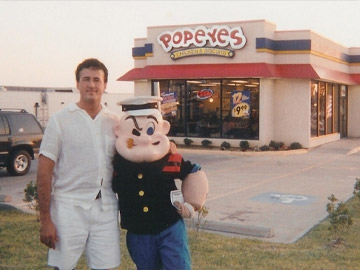
Al Copeland with Popeye

(Guest post by Greg Forster)

For those of you who have been following the announcements over the past week of this year’s nominees for the Al Copeland Humanitarian of the Year Award – we want to hear from you!

Whom would you nominate to recieve “the Al” – what person has made the largest net contribution to the happiness of humanity in a field of endeavor not traditionally recognized by the people who give out awards as contributing to the happiness of humanity?

Just leave a comment on any of the Al Copeland nomination posts with your nomination. If your suggestions strike our fancy we may compose a new post featuring your nomination. And make sure you tell us why you think that person is worthy of “the Al.”

Oh, and let us know which of this year’s nominees you think should win! Our panel of prestigious judges (well, OK, Jay) is not bound to respect the majority vote, any more than the Nobel committee is bound to respect basic common sense. But unlike the Nobel committee, our judges are at least interested in hearing what you think!

Get your nominations in by WEDNESDAY, OCTOBER 28. Why that deadline? Because in honor of the Halloween holiday, we plan to announce the winner of “the Al” on Friday, October 30.

popeye-costume-01

Halloween captures the spirit (so to speak) of the Al Copeland Humanitarian of the Year award almost perfectly. It’s a ton of fun and it’s harmless, and it therefore makes a large net positive contribution to the happiness of humanity. Yet the snobs and the do-gooders – whom Michael Miller of the Acton Institute once remarked should be called “mean-wellers” because on balance they rarely do more good than harm – don’t value that as a contribution to humanity.

Germanetti___Popeye's_20th_Anniversary

So reserve your seat at the head table, get your tux out of mothballs, and get ready to join us for the big awards banquet next Friday.

And until then, don’t miss your chance to make your voice heard!


The John Stuart Mill approach to Health Care Reform

October 21, 2009

(Guest Post by Matthew Ladner)

JSM once noted that if government would simply require an education, that it might save itself the trouble of providing one. He could have added trying to provide one at enormous cost, but let’s not quibble over details.

This was the approach to the Romney reform in MA, but that reform ignores the fundamental problem with our system: third party payers create a powerful incentive to ignore costs. The Romney plan did not address this central problem.

If you don’t believe it, give me an unlimited line of credit with your money at a Vegas casino and watch me transform into a gambling fiend.

The New York Times published an important piece suggesting a brilliant compromise: the government should mandate insurance, but only catastrophic insurance.

This would introduce supply and demand back into most of the health care market, which is precisely what is needed in order to curtail costs and thus prevent the continuing loss of coverage (which is a symptom, not the disease).

Government policy (both in the tax code and from Medicare and Medicaid) is directly responsible for the out of control costs we have experienced. Having quasi-socialized the health care system but without gaining monopoly power to dictate terms to health professionals, politicians have created a culture of “anything goes” in health care.

Paul Tsongas said it best “America is the only country that pretends that death is optional.”

The government, in essence, has created a health care culture which rejects the very essence of a government run plan, which is bureaucratically rationed care. Notice the scrambling to pretend that there are “no death panels” in the plan kicking around Congress. This is of course meaningless, as if there are no death panels there soon will be under a new name: Eurocare is all about having bureaucrats make cost/benefit decisions about health care. They withold treatment to 78 year old men with prostrate cancer so they can spend their limited resources on prenatal care.

Forget about arguing the ethics of Canadacare: after decades of anything goes Americans won’t go for it. If the Democrats pass it anyway, they are likely to rue the day. Put in death panels = driving off a cliff. Expanding coverage without rationing and death panels = faster fiscal suicide.

We’re caught in a trap…can’t walk out!

It seems to me then that some sort of catastrophic mandate/increased out of pocket expenses/health savings account approach outlined in the Times article far more profoundly sensible than the fiscal/political suicide pact currently under discussion.

Munchausen by proxy syndrome in health care might have been great fun for the politicians while it lasted, but with a $1.4 trillion dollar deficit this year, we can no longer afford it.


Getting Less for Less

October 20, 2009

Hawaii decided to fix their budget shortfall by eliminating 17 days from this school year in exchange for an 8 percent reduction in teacher salaries.  That means Hawaii public school kids will spend 163 days in school compared to about 180 for most kids nationwide.

Eighty-one percent of all teachers approved the deal, which leaves “teacher vacation, nine paid holidays and six teacher planning days … untouched.”  Teacher benefits, including pension and health benefits also remain unchanged. In addition, “[t]he new agreement also guarantees no layoffs for two years and postpones the implementation of random drug testing for teachers.”  

So, teachers work 9.4% fewer days for 8% less pay, full benefits and two more years of guaranteed employment.  It’s not a bad deal… as long as you are a teacher.  Kids will be shortchanged, parents have to scramble for daycare, and the state gives away more than it gets in savings.

The only risk for the teacher union in doing this is that we might discover that student achievement is unaffected by 17 fewer days of school.  If that’s the case why not cut 34 days of school for 16% less pay?  Or maybe get rid of it altogether.


Mary Quant — Nominee for the Al Copeland Humanitarian of the Year Award

October 19, 2009

There is a common theme in who has been selected to be nominated for the Al Copeland Humanitarian of the Year Award.  For the most part, the nominees have, like Al Copeland, done something to improve the human condition by improving our material pleasure.  Steven Henson gave us delicious ranch dressing.  Debrilla M. Ratchford saved our aching backs by developing the roller bag.  Ralph Teetor gave us the smooth ride of cruise control.  Only Fasi Zaka distinguishes himself from the other nominees in that he was nominated primarily for his contribution to liberty by ridiculing tyrants.

Our next nominee, Mary Quant,  has improved the human condition both by adding to our material pleasure and by promoting liberty.  Quant is credited with the invention of the miniskirt.  She also popularized hotpants and patterned leggings

The contribution of these inventions to material pleasure requires no explanation.  But unlike Henson, Ratchford, and Teetor who primarily sought to improve material pleasure, Quant was also seeking to expand liberty.  Women’s clothing has often been designed to confine women — to limit their liberty by limiting their ability to function in the world. 

Quant wanted to do more than decorate women, she also wanted to liberate women to be able to participate fully in the world.  As the Wikipedia entry puts it, Quant saw the miniskirt as “practical and liberating, allowing women the ability to run for a bus.”

And if you don’t think women’s clothing can be an assault on liberty, how about the requirement in many Islamic societies that women wear burkas?  Imagine running for the bus in this.

(ht Brian)

(edited for clarity)


William Higinbotham – NOT Nominated for Al Copeland Humanitarian

October 19, 2009

William Higginbotham

(Guest post by Greg Forster)

In our ongoing process of gathering nominees for the Al Copeland Humanitarian of the Year award, last week Jay nominated Fasi Zaka on grounds that ridicule of dictators (actual or aspiring) is an important part of mankind’s struggle for freedom.

Well, another important part of the struggle is serious condemnation. We must indeed laugh at dictators, because you can’t effectively undermine their support without including that element. But we must also sometimes sober up and be serious about the threat they pose.

For that reason, I am announcing that William Higinbotham, inventor of the videogame, will not be nominated for Al Copeland Humanitarian of the Year.

First, let’s dive head-first into the deeply divisive historical controversy over the invention of the videogame. (And you thought we were brave to take on the issues surrounding Christopher Columbus!)

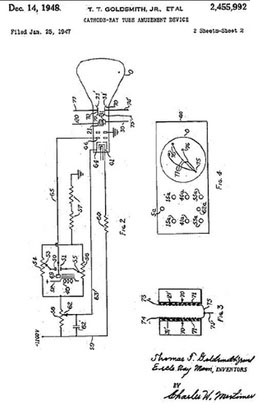
CRTamdev-preview

The first known electronic device created for gameplay was the Cathode Ray Tube Amusement Device (US Patent 2,455,992 granted February 1948) created by Thomas T. Goldsmith Jr. and Estle Ray Mann. The user twists a knob to guide a moving dot toward a target. But as it uses a non-representational display (rather than the graphical represntations implied by the term “video”) and is more a novelty skill test along the lines of a carnival “game” than a traditional “game” per se, it does not quite fit the meaning of the term “videogame.”

In March 1950 Claude Shannon published a program for a chess-playing game – but again without graphical representation.

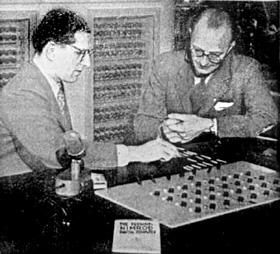
NIMROD-players-prev

Next we get the NIM (aka “Nimrod”) computer, created by Ferranti International and presented at the Festival of Britain in 1951. It used a series of lights and buttons to play an ancient Chinese numerical game in which players manipulate “heaps” containing different numbers of objects; the player who takes the last object out of the last heap is the loser. Once again, without graphical representations we don’t yet have the “videogame.”

OXO_emulated_prev

Alexander Douglas’s tic-tac-toe program in 1952, designed as part of a Ph.D. thesis on questions of user interface design, almost gets us there. But while the display of Xes and Os on a board is a step toward graphical representation, it’s not strictly there yet – the Xes aren’t crude representations of some kind of X-shaped object, but symbols – not essentially different from the symbols chess players use to express their moves in letters and numbers. I’ll grant that the visual positioning of the symbols is an important step. But it’s not really a “video” game until you have graphical representation.

Enter, stage left, the genius of William Higinbotham. In 1958, he worked at the Brookhaven National Laboratories and often had to entertain guests waiting to take tours of the labs. To keep them occupied, he designed a tennis game (christened “Tennis for Two”) on one of the lab’s oscilloscopes.

Oscillosopes are all computer programs now, but my father used to have one of the old stand-alone units with the tiny little screen that showed waves going by. When I was a little kid he let me play with it – you could change the shape of the waves by turning the dials. I was endlessly fascinated by this. Here’s what a standard oscilloscope used to look like:

oscilloscope

And here’s what William Higinbotham got it to do:

tennis_for_two-prev

You turned a knob to change the angle of your shot and pressed a button to hit the ball – and entertainment was revolutionized forever.

tennispaddle

The modern videogame evolved into its final form with breathtaking rapidity – by 1961, MIT’s Stephen Russell led a team that created a game called “Spacewar!” The Magnavox Odessey, the first home video game system, was a functioning prototype by 1967 (dubbed “The Brown Box”) and on sale in stores in 1972. Everything after that is just the same thing better and faster.

So why would this achievement not be worthy of the Al Copeland Humanitarian of the Year award?

Because we have standards, that’s why – and William Higinbotham doesn’t meet them.

Take it away, Wikipedia:

He helped found the nuclear nonproliferation group, Federation of American Scientists, and served as its first chairman and executive secretary. . . . He is said to have expressed regret that he would more likely be famous for his invention of a game than for his work on nuclear non-proliferation. When after his death, requests for information on his game increased, his son William B. Higinbotham wrote, “It is imperative that you include information on his nuclear nonproliferation work. That was what he wanted to be remembered for.” [Emphasis added]

We shall not tarnish the sterling silver of Al Copeland’s reputation by associating it with such filth. Copeland may have offended the delicate sensibilities of many with his penchant for fast cars and boats. He may have annoyed his neighbors to the point of filing lawsuits with his extraordinary Christmas decorations. He may have failed in some busienss ventures. More seriously, he may have had a turbulent family life.

But say this for Al Copeland – he never thought nuclear non-proliferation was more important than videogames.

That’s a stick in the eye to everything the Al Copeland award stands for. And that is why William Higinbotham will never have the honor of being nominated for Al Copeland Humanitarian of the Year.

HT Pong Museum and Gamer’s Quarter for most of the images


Pass the Popcorn: Anvil and Zombieland

October 16, 2009

finalbigfi7


(Guest Post by Matthew Ladner)

I’ve been knocked down by the flu this week, but last week I spent time in Austin Texas visiting my sister and attending some sort of odd male fertility ritual called a “bachelor party” or something like that. I think I may have attended a few more of those when I was younger, but I’m not entirely sure.

Anywhoo, a trip to Austin always means a trip to the Alamo Drafthouse for yours truly to see a flick. The Alamo is an Austin institution that serves a full menu of food and a full bar and goes out of their way to show off beat movies with fun themes.  Hong Kong action movies, spaghetti westerns, blaxploitation, vampire women in prison movies, whatever. Just before I moved to Phoenix they sponsored an all day canoe trip with free beer and free pig sandwiches, and an outdoor screening of Deliverance on the shore. For The Big Lebowski, they served White Russians, stopped the movie midway to have a mock joint-rolling contest, and took everyone bowling after the movie.

You get the idea.

The movies I saw last week- Anvil: The Story of Anvil and Zombieland.

Anvil is a fun little movie, basically Spinaltap meets midlife crisis. The movie is filled with Spinaltap references, even going so far as to have one of the main characters named “Rob Reiner.”

Basically, Anvil were the “demigods of Canadian speed metal” back in the 1980s. Sadly, such a status did little more than to earn them the admiration of some of the metal groups that made piles of money back in the day. Now working class joes, the movie chronicles their attempt at a comeback, which will RAWK!!! if, you know, they can get anyone to remember who they are and get the bar owner to actually pay them for playing.

Good stuff.

Very rarely however do you find a movie as well suited to the Alamo as Zombieland.

I laughed

I cried

It became a part of me.