The Destruction of a Profession

November 4, 2009

Edweekchart1_teachers_three_groups

Public Agenda’s portrait of the teaching profession

(Guest post by Greg Forster)

How would you feel if you found out, the moment you were going into surgery, that 40% of surgeons were “disheartened” about their own work?

How would you feel about it if you had no right to choose your own surgeon?

That’s how parents ought to feel about public schools.

“You don’t want somebody operating on you if they’re resentful about having to do it.” I heard somebody say that last week. It’s as good a case against the current movement toward socialized medicine as I’ve heard anybody make in just fifteen words. The legislation Congress is moving right now already anticipates huge cuts in Medicare reimbursements to doctors. And rest assured that more of the same will be on the way if the bill actually passes.

That’s the way it always goes when you socialize a service. In spite of the lavish promises made to them, the people who provide the service inevitably get the shaft. Well, OK, everybody (except the politicians and bureaucrats) gets the shaft. But the service providers get it first and worst.

The good news is, we still have a chance to avoid destroying the medical profession this way.

The bad news is, a big new teacher survey from Public Agenda shows we’ve already done it to the teaching profession.

The report is bursting at the seams with horrible, horrible data about the state of the teaching profession, and I encourage you to read it for yourself. But here are a few highlihgts.

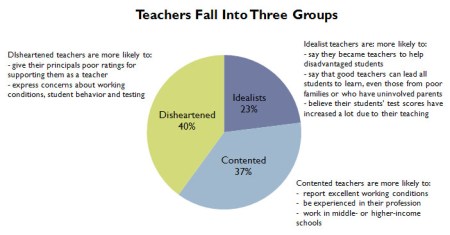
A large plurality of teachers fall into the “disheartened” category:

Members of that group, which accounts for 40 percent of K-12 teachers in the United States, tend to have been teaching longer and are older than the Idealists, and more than half teach in low-income schools. They are more likely to voice high levels of frustration about the school administration, disorder in the classroom, and the undue focus on testing…

A considerable degree of bitterness characterized the Disheartened in comparison to the other groups: Twice as many spoke of likely burnout as did the Contented and Idealists. Only two-fifths strongly agreed that “there is nothing I’d rather be doing” than teaching, compared with nearly two-thirds of the Contented and nearly half of the Idealists.

Think it doesn’t make a difference in the classroom? Think again – a shocking number of disheartened teachers think that teaching makes no difference:

Beliefs about their students and student potential also differed notably, with potentially significant implications for efforts to reshape the profession. A 22-percentage-point difference separated the Idealists and the Disheartened (88 percent to 66 percent) in their faith that good teachers can make a difference in student learning. Idealists strongly believe that teachers shape student effort (75 percent), whereas just 50 percent of the Disheartened believed that. Only one-third of the more disillusioned teachers were very confident in their students’ learning abilities, compared with nearly half among the other groups (48 percent of the Contented and 45 percent of the Idealists).

How do you suppose those attitudes affect their teaching?

“Potentially significant implications for efforts to reshape the profession.” No kidding. More than three quarters of all teachers are either “disheartened” or else “contented” – i.e. not interested in making the system any better than the lousy mediocrity it is now.

Delving through the data tables, here’s another intriguing tidbit I found. Given a choice between “I am able to create high quality lesson plans” and “I am not able to do this as much as I would like because of limited planning time,” the Contented teachers were 30 points more likely than Disheartened teachers to say they could create quality lesson plans (72% v. 52%). No shocker there. But a surprising number of Idealist teachers gave their own lesson plans a negative review – 38% say they can’t create high qualiy lesson plans as much as they’d like, while 60% say they can.

Do you suppose Contented teachers and Idealist teachers have different standards for what counts as a “high quality” lesson plan?

Which kind do you want teaching your kids?

Too bad you don’t get a choice. Government will decide which teacher will build (or destroy) your child’s future.

Unless, of course, you’re one of the ones lucky enough to have a choice.

It’s interesting that Public Agenda only surveyed teachers working in the government monopoly system. You can only find that out by wading deep into the weeds of the methodology section. In the body of the report, they just describe their survey population as “teachers.” Apparently government teachers are the only kind that count.

As it happens, federal survey data show that teachers in private schools are much, much happier with their jobs on a wide variety of measurements. That’s because, according to the same data, they’re free to teach – unlike the government monopoly, private schools give teachers autonomy in the classroom. Of course, they’re only able to do this because they’re also allowed to hold teachers accountable for results. But the much larger satisfaction figures for private school teachers – including much higher satisfaction with their school administrators! – show that this is an accountability model that works.


Everyone Wins in the Wall Street Journal

November 4, 2009

Everybody Wins

(Guest post by Greg Forster)

Today’s Journal has a hard-hitting editorial on Marcus’s new study showing that competition from charters improves regular public schools in NYC.

Opponents of school choice are running out of excuses as evidence continues to roll in about the positive impact of charter schools…State and local policy makers who cave to union demands and block the growth of charters aren’t doing traditional public school students any favors.

And where did you read about it first? Oh yeah.


CBS v. CDC on Swine Flu

November 3, 2009

Dr Horrible

(Guest post by Greg Forster)

Now, I know CBS News is a disreputable tabloid organization – not a highly reliable source of information, like, say, the National Enquirer. But here at JPGB we’ve always said that empirial research should be judged on its own merits, not on the identity of the researcher.

CBS is reporting that states checking up on H1N1 diagnoses have found that only a small (sometimes tiny) portion of those diagnosed by their doctors as having swine flu actually had it. California tested 13,704 cases of people who were told by their doctors that they probably had swine flu and found that only 2% actually had it. Florida tested 8,853 cases and found that only 17% had swine flu. Other states found similar results.

CDC stonewalled CBS’s FOIA requests for the data, saying the state agencies that reported the data didn’t feel confident enough in their accuracy to have them publicly released. Sorry, we’d love to help, but our hands are tied. In the report you can see the CDC spokesman promise that he’ll get those data right to CBS just as soon as the states tell him it’s OK with them to release them.

But when CBS went to the states and asked for the data, they handed them right over.

I can’t imagine why the CDC might feel like it has something to hide. Surely it has nothing to do with the president’s use of swine flu panic as an excuse to claim “emergency powers” to sweep away “bureaucratic obstacles” (formerly known as the rule of law).

Update: OK, admittedly we don’t have all the details here. Maybe there will turn out to be some issue of selection bias at work. But the reason this information isn’t readily available is because of the CDC stonewall. That’s the story here.


California vs. Texas Part Deux

November 2, 2009

(Guest Post by Matthew Ladner)

William Voegeli joins the fun in City Journal.

Money quote:

Bill Watkins, executive director of the Economic Forecast Project at the University of California at Santa Barbara, has calculated that once you adjust for population growth and inflation, the state government spent 26 percent more in 2007–08 than in 1997–98. Back then, “California had teachers. Prisoners were in jail. Health care was provided for those with the least resources.” Today, Watkins asks, “Are the roads 26 percent better? Are schools 26 percent better? What is 26 percent better?”

BOOOOOOOOOM!!!!!!!!!!!!!!!!!!

UPDATE: Great minds think alike as Kotkin brings the pain in Forbes.


Is Percentage-Based Compensation Unethical?

November 2, 2009

Teacher unions aren’t the only ones who have a problem with linking compensation to performance.  The Association of Fundraising Professionals (AFP), the interest group representing the people who raise money for non-profit organizations, has declared that it is unethical. 

As the AFP’s standards of ethics puts it: “Members shall not accept compensation or enter into a contract that is based on a percentage of contributions; nor shall members accept finder’s fees or contingent fees.”  According to the AFP, paying fund-raisers a percentage of what they bring in is not just a bad idea, it is wrong.

I have been a member of three non-profit organization boards and at each one the board was told that it could not pay a fundraiser a percentage of money brought in.  Instead, we were told that we were ethically bound to pay a fundraiser a flat fee and hope that the person would raise significantly more than the flat fee.  I must also add that at each one of these organizations the fund-raiser we hired barely covered his/her flat fee and the non-profit came away with virtually nothing. 

I have never understood why percentage-based compensation for non-profit fund-raisers is unethical.  I understand that it is in the AFP and their members’ interest to declare that it is unethical.  Doing so almost always stifles discussion on boards about what is the best way to compensate fund-raisers.  It also shifts all risk to the organization from the fund-raiser and assures them a profit.

The AFP has gone as far as proposing that Congress pass a law forbidding non-profits from using percentage-based funding for fund-raisers.  The argument about why this is such an awful practice that it needs to be outlawed is flimsy at best.  First, the AFP claims: “Percentage-based compensation sets up a conflict of interest. A consultant’s desire for personal gain shouldn’t trump the broader social interests of the organization.”  But it is not clear why paying fund-raisers a percentage of what they bring-in sets up a conflict of interest.  If anything, paying fund-raisers a percentage aligns the interests of fund-raisers and organizations by providing the fund-raiser with an incentive to raise more money, which is exactly what most organizations also want. 

If percentage-based compensation creates a conflict of interest, why should that be any more of a problem for fund-raisers in the non-profit sector than among sales-people in the for-profit sector?  As the AFP concedes: “Percentage-based compensation methods are generally legal. They are also common practice in the commercial sector.” 

Every objection that the AFP raises to percentage-based compensation could apply equally well to the profit-seeking sector.  And each of these problems can be successfully managed.  If they cannot, people in the profit-seeking sector would avoid percentage-based compensation as unproductive, but almost no one would denounce it as unethical.

Here are the objections that the AFP has that they say makes percentage-based compensation in the non-profit world unethical:

What if a consultant were to receive compensation based on an unsolicited gift or on an annual contribution that commenced before and continues after the consultant leaves? Such reward without merit would create resentment among organization staff and donors. Since many contributions are the result of teamwork among organization staff and consultants, no one person should be able to cart off the rewards of that effort. Consultants motivated by personal gain could unduly pressure a donor to make a contribution, without consideration of the donor’s wishes or timetable. And if the practice became widely known, the organization’s reputation and credibility could suffer irreparable harm.

Sales also come to businesses “that commenced before and continues after the [salesperson] leaves.”  Businesses that use percentage-based compensation devise ways of assigning responsibility for sales (some of which may be  arbitray) or they exclude certain sales.  These problems are not unique to non-profits and have been addressed in the profit-seeking sector.

It is also true that “many [sales] are the result of teamwork among organization staff and consultants, no one person should be able to cart off the rewards of that effort.”  Again, these are problems that also exist in the businessworld and solutions have been developed.

Lastly, it is also true that “[salespeople] motivated by personal gain could unduly pressure a [customer] to make a [purchase], without consideration of the [customer]’s wishes or timetable.”  This is also not a unique or intractable problem in the businessworld.

In the end, the declaration that percentage-based compensation for fund-raisers just feels like self-interested bullying.  Non-profits may choose not to pay fund-raisers on a percentage basis, but they should feel free to consider whatever way would best serve the organization without being told that they are behaving “unethically” without any valid reason.

I’m thinking about starting a new organization, “People United for Jay P. Greene.”  One of our first actions is likely to be to declare it unethical not to give Jay P. Greene a million dollars.  We’d have about as much reason for saying so as the AFP has for its “ethics.”


Debrilla M. Ratchford — Winner of the Al Copeland Humanitarian Award

October 30, 2009

We had several excellent nominees this year for the Al Copeland Humanitarian Award.  Each one of them has made a significant contribution to improving the human condition.  Steve Henson gave us ranch dressing,  Fasi Zaka ridiculed the Taliban,  Ralp Teetor invented cruise control, and Mary Quant popularized the miniskirt.  But this year’s winner is Debrilla M. Ratchford, the inventor of the rollerbag.

Ms. Ratchford was a flight attendant who realized that if you attached wheels and a handle to a suitcase, it would be much easier to transport baggage through airports.  She obtained a patent in 1978 for this invention, but it took almost a decade before the rollerbag became standard airport equipment.

Prior to the rollerbag people had to carry their suitcases or pay attendants with carts to get their luggage from the car to the check-in counter.  Dragging heavy bags to and from the car and around airports was a pain.  And having to wait for (or lose) checked bags was as much of a pain.  The rollerbag allows us to zip through airports and avoid checking bags.

This invention didn’t just ease our aching backs and save us time, it facilitates commerce.  Making it easier to travel, all things equal, means that there will be more travel.  More travel means more business transactions, which adds to our wealth.  Debrilla M. Ratchford didn’t just invent a handy device and make some money for herself.  She also benefited others by reducing the hassle of carrying around luggage and contributing to economic growth.  That makes someone a great humanitarian.

A central purpose of the Al Copeland Humanitarian Award is to highlight the fact that a humanitarian can be someone who benefits him or herself while also benefiting others.  There is no necessary tension between self-gain and improving the human condition.  On the contrary, when people are monetarily rewarded for their efforts, they are more likely to do things that benefit humanity.  The entrepreneur and inventor isn’t a necessary evil, he or she has a morally positive role in society.

This is what Al Copeland did, which is why this award is named in his honor.  As I wrote:

Al Copeland  may not have done the most to benefit humanity, but he certainly did more than many people who receive such awards.  Chicago gave Bill Ayers their Citizen of the Year award in 1997.  And the Nobel Peace Prize has too often gone to a motley crew including unrepentant terrorist, Yassir Arafat, and fictional autobiography writer, Rigoberta Menchu.   Local humanitarian awards tend to go to hack politicians or community activists.  From all these award recipients you might think that a humanitarian was someone who stopped throwing bombs… or who you hoped would picket, tax, regulate, or imprison someone else.

Al Copeland never threatened to bomb, picket, tax, regulate, or imprison anyone.  By that standard alone he would be much more of a humanitarian.  But Al Copeland did even more — he gave us spicy chicken.”

I decided against Steve Henson because I didn’t want to give the impression that only gastronomic innovation improves the human condition (although cool ranch Dorritos are pretty awesome).  I decided against Fasi Zaka because he has not yet achieved the improvement in the human condition he is seeking — making the Muslim extremists seem uncool in the Muslim world.  We wouldn’t want to give an award just for the hope of future accomplishment.  I decided against Ralph Teetor because I personally almost never use cruise control, so the improvement in the human condition seems less impressive to me.  And while Mary Quant was a close second, I decided against selecting her because, like my concerns with making this award too gastronomic, I didn’t want to suggest that improving the human condition was primarily sensual (although Quant also added to freedom — particularly the freedom to run for a bus more easily).

Congratulations to Debrilla M. Ratchford and Happy Halloween!


Public Education and its Enemies

October 29, 2009

(Guest Post by Matthew Ladner)

In the final scene of Shakespeare’s Henry V, the French sue for peace after Henry’s triumph at Agincourt. While the French king is away negotiating the final terms, Henry uses the opportunity to woo the King’s daughter Katherine to become his Queen.

Katherine is cool to this idea, but slowly warms to the notion under the glare of Henry’s charm. Finally, she asks “May it be possible zat I should love zee enemy of France?”

Henry replies:

“No Kate, it is not possible. For in loving me, you shall love the friend of France. For I love France so much that I will not part with a village of it.”

I think of this line often when K-12 reactionaries try to play the “well, I support public education” card. This you see, is supposed to put a reformer on a defensive and get them to scramble to say that they support public education too!!!

Nice try, but for my part, I have this to say: don’t tell me how much you love public schools unless you are willing to do what it takes to make them work for kids.

Yesterday Marcus Winters released a study showing that charter schools in NYC improve public school performance, especially for disadvantaged children. The effect sizes were modest, but what more can you expect given that the state still has a cap for the number of charters? The cap should be removed, and private choice options created.

Research has firmly established that ineffective teachers severely harm the education of children. Who is the enemy of public education- those who want to preserve tenure at all costs, or those who want to remove ineffective teachers from the classroom?

Last year, I was at a conference in Arizona. A philanthropist spoke movingly about the need to raise Arizona academic standards to internationally competitive levels. An assistant Superintendent of a tony school district said “We can’t meet the standards we have now, the last thing we should do is raise them.”

Who is the enemy of public education- the philanthropist or the administrator?

Later in that same meeting, I made a presentation about Florida’s success in improving public education, including the curtailment of social promotion to compel literacy training. One of the educators in the audience replied “I don’t want to see 9 year olds rolling on the ground crying because they don’t get to advance with their grade.”

That, you see, would be inconveint to her. It would be much less messy to simply pass the child along illiterate until he or she drops out in the 8th grade.

Who is the enemy of public education- me or her?

The reactionaries cleverly try to equate pouring more money on this broken system as compassionate. Balderdash. It is the goals of public education that people should be committed to, not any particular delivery mechanism, nor the employment interests of the adults working in the all-to-often dysfunctional system. We’ve tried the pour money method for improving public schools, and it failed miserably.

Show me don’t tell me how much you love public schools, apologists. As your critics multiply across ideological lines, the time has come to put up or shut up. I love public schools so much that I am willing to put in the right incentives and policies to make them work for a far larger number of children.

How about you?


Marcus Wins! Big Deal, So Does Everybody.

October 28, 2009

Everybody Wins

NOT the cover of Marcus’s new study

(Guest post by Greg Forster)

Well, I made no secret of who I thought was the winner in the Marcus/Murray deathmatch over college education.

But it turns out it’s no big deal, because Marcus says “Everyone Wins!”

In his new study of that title, I mean. Marcus finds that charter schools are improving regular public schools in NYC by creating healthy competitive incentives. The effect is small, fitting the overall pattern in the research – charters typically don’t give you as big a boost as vouchers, but having them is better than not.

For all you Rawlsians out there in JPGB-land, Marcus also finds that the lowest-performing students in NYC’s regular public schools benefit from charter competition; in fact, while the benefits for the overall population are statistically certain only in reading, they’re certain in both reading and math for low performers.


Swine Flu Socialism

October 28, 2009

robotinsurance2

Courtesy of the World Health Organization

(Guest post by Greg Forster)

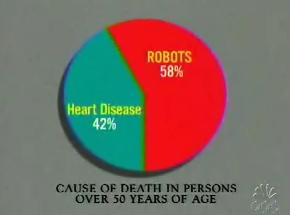
Further to Jay’s post below on how the supposed swine flu “pandemic” is sounding a lot like the ad for Old Glory Robot Insurance:

Michael Fumento, who has made a career out of calling BS on the political abuse of medicine, reports on just how bogus the swine flu panic is – and more importantly, the agenda behind it.

The World Health Organization’s old definition of “pandemic” required an outbreak not only to consist of multiple epidemics around the world, but also to pose an unusually severe threat to life and health before it could be called a pandemic. This was important because plain old ordinary flu causes multiple simultaneous epidemics around the world all the time, but it’s no cause for alarm because the plain old ordinary flu is a routine problem.

But just before swine flu was declared a pandemic, the WHO quietly rewrote the definition of “pandemic” to remove the necessity of an unusually serious threat.

Why’d they have to do that? Because the swine flu is actually less deadly – by orders of magnitude – than the regular flu:

Medically, the pandemic moniker is unjustifiable. When the sacrosanct World Health Organization (WHO) made its official declaration in June, we were 11 weeks into the outbreak, and swine flu had only killed 144 people worldwide — the same number who die of seasonal flu worldwide every few hours. The mildest pandemics of the 20th century killed at least a million people worldwide. And even after six months, swine flu has killed about as many people as the seasonal flu does every six days…

In Australia and New Zealand, flu season has ended, and almost all cases have been swine flu. Yet even without a vaccine, these countries are reporting fewer flu deaths than normal. (In New Zealand, that’s just 18 confirmed deaths compared with 400 normally.) Swine flu is causing negative deaths! [ea]

Update: When I originally posted this I forgot to include this wonderful tidbit. One of the very classy methods being used in the media to hype the swine flu is to report the total number of cases of all types of flu, including even undiagnosed cases with “flu-like symptoms.” Then the total figures for flu deaths and flu cases are falsely reported as swine flu figures.

Why would the WHO want to gin up a baseless panic about swine flu? Partly because they had already over-hyped avian flu and wanted to use a new panic over swine flu to retroactively justify the old panic over avian flu. “The world can now reap the benefits of investments over the last five years in pandemic preparedness,” boasts WHO’s director-general.

And partly it’s for the same reason the Old Glory Insurance Company wants you to believe in robot attacks – money. Apparently WHO makes a living off phony disease scares:

Yet this [CYA for the avian flu scare] doesn’t explain why the agency hyped avian flu in the first place, nor why it exaggerated HIV infections by more than 10 times, or why it spread hysteria over Severe Acute Respiratory Syndrome (SARS). That disease ultimately killed a day’s worth of seasonal flu victims before vanishing.

But the SARS scare was enough, leading to a broad expansion of WHO powers, including a degree of direct authority over national health agencies. It’s now using that to leverage more authority and a bigger budget. No shocker there.

But at least the Old Glory Insurance Company only wanted to take your money. They didn’t want to take your freedom as well. Not so much can be said for the WHO:

What may be surprising is that it wants to use that power to help bring about a global economic and social revolution–and that Director-General Chan was so blunt about it in a speech in Copenhagen last month.

She said “ministers of health” should take advantage of the “devastating impact” swine flu will have on poorer nations to tell “heads of state and ministers of finance, tourism and trade” that:

  • The belief that “living conditions and health status of the poor would somehow automatically improve as countries modernized, liberalized their trade and improved their economies” is false. Wealth doesn’t equal health.
  • “Changes in the functioning of the global economy” are needed to “distribute wealth on the basis of” values “like community, solidarity, equity and social justice.”
  • “The international policies and systems that govern financial markets, economies, commerce, trade and foreign affairs have not operated with fairness as an explicit policy objective.”

In related news, the WHO has announced a new panel of doctors to wield those “special emergency powers” we need to sweep away “bureaucratic obstacles” and combat swine flu. Here they are:

Dr No

Dr Horrible

Dr Doom

Dr Octopus

Dr Evil


Why Did They Make the Roadblocks?

October 27, 2009


President Obama’s declaration of a national emergency regarding swine (H1N1) flu reminds me of the Saturday Night Live fake ad for robot insuranceObama’s declaration was described by the AP as having “the goal … to remove bureaucratic roadblocks and make it easier for sick people to seek treatment and medical providers to provide it immediately.”  This raises the question, why were there bureaucratic roadblocks in the first place?

Similarly, in the SNL fake ad for robot insurance, Sam Waterston is the spokesman for Old Glory Insurance Company.  Their policy offers to protect anyone over the age of 50, regardless of previous health condition, against robot attacks.  One elderly woman in the ad wonders: “I don’t know why the scientists make them.” 

I guess we have bureaucratic roadblocks to medical care for the same reason scientists make robots that attack old people and eat their medicine for fuel — so that someone can protect us against these problems.

The good news, according to Mickey Kaus, is that the spread of the swine flu might not be as bad as media outlets are reporting.