
New Year’s Resolutions

December 16, 2009

(Guest post by Jonathan Butcher)

As I look forward to the New Year, a year in which I will celebrate my 18th birthday for the 14th time, I resolve once again to pursue a long-held dream: to play quarterback for the Notre Dame Fighting Irish.  I know, I know, 18 is a young age to expect to play QB for such a competitive program, but their starter from this season is leaving for the NFL—so they have an opening.  Plus, they just hired a new coach who ran a successful program at the University of Cincinnati (Brian Kelly), so things are looking up.

Irish wins are little scarcer than in the late ‘80’s, when they regularly competed for the top ranking in the AP poll…actually, they’re a lot scarcer.  ND hasn’t competed for a national championship since the early ‘90’s, when Clinton was president and the public hadn’t been introduced to Monica Lewinsky and an “iPod” was a plot element rumored for Alien 3.  With expectations set so high, it has been a painful new millennium of average Irish teams, for the most part.

ESPN.com’s Tuesday Morning Quarterback gave me something to be proud of as an Irish fan yesterday, though, confirming a suspicion I’ve held as a badge of honor taken out and polished every fall for the past several years to console myself after Michigan and USC thrash the Irish once again: ND requires their players to be students, as well as athletes.  Most major programs do not, contends TMQ’s Gregg Easterbrook.

Maybe the sports artificial universe won’t face the uncomfortable reality that the NCAA system uses football and men’s basketball players to generate revenue and great games — then tosses way too many of these players aside uneducated. It’s a lot more fun to talk about winning and losing than to talk about education.

He goes on:

In the past two decades, there’s been a race to the bottom, in which many football-factory schools have lowered academic standards for football and men’s basketball, dropping any pretense of education in pursuit of wins.

Today, between 70% and 80% of the players on major college football teams—programs that regularly compete for the national championship like Oklahoma, Miami, and Ohio State—will never play a down in the NFL.  In fact, 90 percent of the players in all of Division I college football will not play in the NFL.  Easterbrook writes, “Take into account that some of the NFL rookies are Division II, Division III or NAIA players, and it’s closer to 95 percent… If they don’t study and don’t go to class, they walk away from college football practically empty-handed.”

This is a shame not only because the college athletes are being used by adults they have trusted with their future, but also because there is evidence that schools can have high recruiting and educational standards.  TMQ notes that many schools with strong academic reputations such as Georgia Tech, the University of California, the US Naval Academy and Northwestern are headed to bowl games this year.  TMQ also points to a study forthcoming in the Review of Economics and Statistics linking high academic and athletic achievement among females.

Unfortunately, between reading the TMQ article yesterday and sitting down to write today, the punch line to my post has mysteriously vanished.  After praising ND for holding out against the trend among major programs to lower academic standards for their football team, Easterbrook wrote, “Rumor has it Brian Kelly’s deal to replace [former ND coach Charlie] Weis includes Notre Dame’s agreeing to lower its academic standards for top football recruits. If so, this is a sad, sad day for Notre Dame, and for college football.”  Interestingly, this line was gone from the article when I read it this morning (though a quick search finds the sentence, verbatim, in at least one person’s Twitter feed).  Now, my illusion of a perfect college football institution can remain intact, thanks to ND athletic director Jack Swarbrick, who appears to have replaced Tiger Woods as sovereign supreme over the sports media.

Pipe dreams and conspiracy theories aside, the NCAA and participating athletic programs should be forced to answer for what is happening at, say, Florida State, where “a suspiciously high percentage of football players have been classified as learning disabled, which creates exemptions from already lax academic requirements.”  Maybe committing itself to a remedy can be the NCAA’s New Year’s resolution, but with the amount of money generated in college sports, it’s more likely that I’ll be wearing a gold helmet next September.  Go Irish!


Book Review in WSJ

December 15, 2009

book121509

I have a review of the book, Boom Town, in today’s WSJ. It was odd reading a book about prejudices that seemed to contain so many prejudices of its own. Here’s a snippet:

If Ms. Rosen had wanted to identify resistance from white, rural Christians to diverse newcomers, she should have distinguished between Arkansas’s politics and its business and social life. Businesses like Wal-Mart and Tyson are progressive engines of diversity because they will recruit and hire able workers of any color or religion. The only color they see is green. Social integration has gone smoothly because local residents, assisted by religiously backed norms of politeness, have been generally welcoming. Unlike business, politics is a zero-sum game. Good-old-boy politicians in Arkansas (or anywhere else) are more likely to think that if they share power with newly arrived groups, they will lose some of their own. The few politicians we read about in “Boom Town” illustrate this point, trying to pit low-income whites against Hispanics. Clearly, they would rather be king of the Lilliputians than share a larger empire with the area’s newer residents.


Best Group Blog Nomination

December 14, 2009

I just noticed that JPGB has been nominated for the Best Group Education Blog from the Edublogawards.  That’s nice.  Click and vote if you feel like it.  Voting ends on the 16th.

If I win, I promise to donate all of the proceeds (of which there are none) to charity.  And I promise to give an awesome acceptance speech, like the one Obama gave for the Nobel.  But to fit that mold would I have to say the opposite of everything else I had been saying?  Would I praise the teacher union and the need to assign students to schools based on where they live?

Besides, what do they mean by “group blog”?  Don’t they know that it’s been all me, me, me (except for all of the funny stuff — that’s Matt, and all of the smart stuff — that’s Greg).


The Decade Challenge

December 14, 2009

Matt’s post from last week arguing that the Aughts (the decade about to end) was basically a dud sounds like an invitation for a challenge:  What has been the best decade (since 1940 when time began) and why?


Alternative Needed to Common Core: An Additional Consortium for ‎Common Standards

December 11, 2009

(Guest Post by Williamson M. Evers & Ze’ev Wurman)

A consortium to develop a set of “research-based and internationally benchmarked” college and career-ready standards in mathematics and in English-language arts (ELA) was established earlier this year by the National Governor’s Association (NGA) and the Council of Chief State School Officers (CCSSO), in partnership with Achieve, the College Board, and ACT.

This consortium was presented as a voluntary effort by the states, and in this way, it claimed to avoid the statutory prohibition of a federally-imposed national curriculum. So far 48 states (all except Alaska and Texas) have joined the initiative, and the consortium released its first draft of its proposed high-school “college and career readiness” standards late this last September.  Nonetheless, the Texas chief state school officer calls this project an effort “by the U. S. Department of Education” to impose “a national curriculum and testing system” and “a step toward a federal takeover” of public schools across the nation.

However, all is not well with the Common Core State Standards Initiative (CCSSI), as the effort has come to be known. In fact, many of the early concerns about such a national effort have materialized. They have to do both with the process and with the content.

In terms of process, the identity of the actual authors of the “college and career readiness” standards was kept secret for a long time and, when the names were finally published, it became clear that CCSSI had included few subject-matter experts among them. Only after early ones were leaked to the public in July did CCSSI finally publish its official draft “college and career readiness standards” for ELA and mathematics in September.  CCSSI finally also published the names of the members of its various committees, but these seem to keep growing in number and their membership changing.

CCSSI’s timeline calls for supplementing its “college and career readiness” standards with grade-by-grade K-12 standards, with the entire effort to be finished by “early 2010.” This schedule is supposed to include drafting, review, and public comment. As anyone who had to do such a task knows, such a process for a single state takes many months, and CCSSI’s timeline raises deep concerns about whether the public and the states can provide in-depth feedback on those standards–and, more important, whether standards that are of high quality can possibly emerge from the non-transparent process CCSSI is using.

The situation is, not surprisingly, worse on the content side. The proposed English-Language Arts “college and career readiness” standards (which we are told are not high school graduation standards) are largely a list of content-free generic skills. Rather than focusing on what English teachers are trained to teach (quality literature), the drafters seem to expect English teachers to teach reading strategies presumed to help students to cope with biology or economics textbooks.

In mathematics, the standards are perhaps even worse. While essentially all four-year state colleges require at least three years of high school mathematics, including Algebra 1, Algebra 2, and Geometry or above, CCSSI’s standards require only Algebra 1 and few bits and pieces from Algebra 2 and Geometry. In other words, students who graduate from high school having taken only math coursework addressing those standards (and presumably having passed a test based on them) will be inadmissible to any four-year college around the country.

This ill-advised rush to have national standards ready by early 2010 is driven by the U.S. Department of Education’s Race to the Top (RttT) $4 billion competitive-grant fund. Its final regulations, published in November, give a strong advantage to states that develop and adopt “common standards,” and, in these hard economic times, states will not be easily able to justify declining to pursue this money.

In late November, 2009, the Texas chief state school officer complained—quite justifiably on the face of it—that Texas is being discriminated against by the RttT criteria because it chose not to join the wild  rush to the standards. And indeed a wild rush it is. A bill introduced at the beginning of December in the California legislature to qualify the state for the RttT money proposes adopting CCSSI’s standards sight unseen.  Not even a complete draft of the grade-by grade standards has been finished yet.

Yet, if the President and Congress are going to use carrots and sticks to create national standards, we need to look for a way out of the current Common Core morass. The federal rules for the RttT money could not and do not explicitly require the adoption of CCSSI’s standards. Instead, the rules provide a general requirement:  States are to participate in a “consortium of states” that is developing a common set of K–12 standards which are “internationally benchmarked” and tied to “college and career readiness” and that includes “a significant number of States.”

Given the low goals of the “college and career readiness” standards proposed by CCSSI– to judge by its September draft–it makes sense to set up an alternative consortium.  That consortium would be composed of states whose standards have been highly rated by academic experts– like California or Massachusetts — together with states like Texas and Alaska whose reluctance to jump on the Common Core bandwagon has been clearly vindicated.

The new consortium would endeavor to create better and more rigorous academic standards than those of the CCSSI. These alternative standards will be truly internationally benchmarked. With over twenty per cent of the American population, such a consortium of states would easily qualify as “significant” as well. Such states might even be joined by other states that do not want to embrace the intellectually impoverished and internationally uncompetitive Common Core standards.

Drab and mediocre national standards will retard the efforts of advanced states like Massachusetts and reduce academic expectations for students in all states.

Yes, it is late in the game. But this should not be an excuse for us to accept the inferior standards that at present seem to be coming from the rushed effort of CCSSO and NGA.

==

Williamson M. Evers is a research fellow at Stanford University’s Hoover Institution and former U.S. Assistant Secretary of Education for policy. Ze’ev Wurman is a former senior policy adviser in the U.S. Department of Education.


It’s the End of the Aughts as we know it…and I feel fine

December 10, 2009

(Guest Post by Matthew Ladner)

So this decade is almost over, at least as such things are normally reckoned. Does anyone care?

I feel profoundly indifferent about the aughts. In terms of politics, all of the same problems that we faced at the start of the decade (out of control health care spending, unsustainable entilement programs, gawd-awful schools) we still face at the end. The Obama administration seems determined to make some of these problems worse rather than better.

Some of the newer problems that arose (Islamo-fascist terrorism and government nutured housing bubble) are far from resolution as well.  The only big thing I can think of to feel positive about was the continuing splintering of mass culture into subcultures. Oh, and mashups. Mashups are cool.

Best to put this decade to bed as a write-off and move on. Discuss amongst yourselves.


Incentives and Motivation

December 9, 2009

Surely we can find a happy medium?

(Guest post by Greg Forster)

I’ve just read a fascinating article – Frederick Herzberg’s “One More Time: How Do You Motivate Employees?” from the Harvard Business Review. The 1987 version, an update of the original 1968 article of the same title, went on to become HBR’s most requested reprint ever.

I can see why. Partly it’s the humor value, which  is considerable. “What is the simplest, surest, and most direct way of getting someone to do something?” Herzberg’s first answer: the KITA. (Hint: KIT stands for “Kick In The.” Herzberg claims original authorship of this acronym, and given that the article first appeared in 1968 I believe him.) The KITA comes in many forms, including what Herzberg dubs the “negative physical KITA,” i.e. the literal kick. But there are numerous problems with using the negative physical KITA to motivate employees, not least that “it directly stimulates the autonomic system, and this often results in negative feedback.” Translation: the subject may kick back.


Negative autonomic feedback

But Herzberg also makes a substantial contribution to organizational theory, one that’s forced me to do some new thinking on the regular debates we have on the role of incentives in education.

After a brief discussion of the negative physical KITA, Herzberg moves on to what he dubs the “negative psychological KITA,” i.e. making people feel bad unless they do something. The advantages of the negative psychological KITA over the negative physical KITA are considerable, including: “since the number of psychological pains that a person can feel is almost infinite, the direction and site possibilities of the KITA are increased many times”; “the person administering the kick can manage to be above it all and let the system accomplish the dirty work”; and “finally, if the employee does complain, he or she can always be accused of being paranoid; there is no tangible evidence of an actual attack.”

But it is pretty clear to most people that both types of negative KITA do not really produce what we usually call “motivation.” What they produce is movement. The subject moves, but does not become motivated. Hence – and this is the important part – the method is of limited effectiveness. As long as you keep applying KITAs the subject will keep moving, but only as long as you keep kicking and only as far as you kick. To be really effective, you need to do something to get the subject to keep moving – produce ongoing motivation.

Hence most organizations, sensibly enough, turn to positive incentives and discourage managers from using negative ones. And here things get really interesting. Herzberg argues that most of the positive incentives normally used in an attempt to produce motivation are really very similar in their outcomes to negative KITAs – producing movement rather than motivation. The subject subjectively experiences them as positive rather than negative, but objectively the result in terms of work output is similar. You’re just pulling rather than pushing. The subject only moves as long and as far as you pull. Herzberg thus gives these incentives the somewhat paradoxical label “positive KITAs.”

A positive KITA?

Herzberg’s examples of positive KITAs include pay and benefit increases, reduction in work hours, and improved workplace relations (i.e. communications and “sensitivity” training for managers, morale surveys and “worker suggestion” plans).

The positive KITA, Herzberg argues, despite being ubiquitous in the business world, is actually not much more effective than the negative – and it’s a lot more expensive. This is especially true since positive KITAs (unlike negative ones) must be progressive. If you give the worker a $500 bonus this year, when last year you gave him a $1,000 bonus, this objectively positive action will actually be subjectively experienced as negative.

Herzberg argues that a real, self-sustaining motivation can be produced in employees by something he calls “job enrichment.” That sounds like something the warm and fuzzy folks would advocate, but Herzberg actually spends a good deal of time taking the warm and fuzzy folks to task for their inanity. (This provides much of the humor value. It’s also historically interesting – it’s amazing to see how far the warm and fuzzy disease had already spread by 1968.) What Herzberg is arguing for is something more serious than the label implies.

His underlying psycological and organizational theory is a bit too much to recopy it all here, but here’s a capsule summary. He and others did a large number of empirical studies and found that job satisfaction and job dissatisfaction didn’t usually come from the same sources. For example, having a jerk for a boss produces job dissatisfaction, but having a nice boss usually does not produce any job satisfaction. Niceness in bosses simply prevents workers from feeling dissatisfied; it doesn’t actually make the job satisfying.

The key insight to get here is that removing dissatisfaction doesn’t produce any satisfaction, and highly effective motivation comes from producing satisfaction rather than from removing dissatisfaction.

His meta-analysis of the empirical research finds that pay and benefits, job security, company policy, working conditions and on-the-job relationships are all normally associated with levels of dissatisfaction, but rarely with levels of satisfaction. On the other hand, levels of satisfaction are associated with achievement, recognition for achievement, responsibility, advancement, aspects of the work itself, and development of one’s capacities to do the work.

Herzberg’s idea of “job enrichment” is to increase worker’s experiences of the things that provide high levels of satisfaction. Give workers more responsibility and more opportunity to achieve, and then recognize success – most importantly with advancement that brings still more responsibility and opportunity for achievement. The converse of this is that failure must also be “recognized” – primarily through withholding advancement and responsibility rather than through negative KITAs.

I find his theory and evidence persuasive. And it has helped me see a little more clearly the underlying logic behind some objections to education policies like merit pay.

Yet I don’t think this analysis actually does take anything away from the case for merit pay, still less from the case for other education reforms like school choice. If anything, it makes them stronger. And taking account of this analysis will help us make the case more effectively.

Some of the objections to merit pay are based on an essentially Herzbergian conception of worker motivation. Smart people don’t deny that money plays some role in motivating people to do more work. But even among those who don’t advocate touchy-feely romantic delusions about teachers who are angelic beings with no connection to the material world, there is a lot of skepticism that you can get them to work all that much harder just for “a few extra sheckels” (as one of the more sensible critics once put it in a comment here on this blog).

Yet consider what would have to happen for Herzbergian “job enrichment” to occur in the teaching profession. First of all, you’d need an objective measurement of achievement. Then you’d need to give teachers autonomy in the classroom and hold them accountable for results on that metric. And for the accountability to take the form of advancement and increased autonomy (and accountability), you’d need to remove the one-size-fits-all union scale and work rules that dominate the profession.

In other words, it’s not so much the pay that makes merit pay worth trying, as it is the fact that merit pay creates tangible recognition for success. The current system seems almost deliberately crafted to deny teachers as many opportunities for satisfaction as possible. Merit pay is an attempt to create more such opportunities.

It’s worth noting that Michelle Rhee’s proposed two-track system in DC labels the old, union-dominated track the “red” track and the new, merit-based track the “green” track. Rhee understands that what she’s offering isn’t just, or even primarily, more money. She’s offering DC teachers their professional pride.

But school choice looks even better by this light. Test scores would be a limited basis for creating opportunities for Herzbergian satisfaction. On the other hand, if your objective measurement of job performance is parental feedback, the sky’s the limit. In this context it’s worth noting that Herzberg says the only meaningful measure of job performance is ultimately the client or customer’s satisfaction; using any other measure is taking your eye off the ball.

You could even combine the two to create a truly graduated scale of autonomy and accountability. New teachers could be required to use a standard curriculum and be evaluated on how their students – all types of students, not just the rich white ones – progress in basic skills. (That, of course, is the real primary function of test-based accountability – ensuring that kids who face more challenges aren’t just warehoused for twelve years while the rich white kids get an education.) Teachers who prove they can deliver the goods on reading and math for students of all backgrounds could then be given more classroom autonomy and evaluated based on parental feedback rather than test scores. Freedom from test-based accountability is the payoff for proving you can teach basic skills reliably. Schools could set up any number of intermediate arrangements in between “pure” test scores and “pure” parental feedback, with teachers earning more and more recognition and autonomy as they prove more and more their ability to teach effectively.

Looking back at my previous posts on teacher autonomy and satisfaction levels in public v. private schools, the poisonous influence of one-size-fits-all pay scales, and the union-driven destruction of the teaching profession, I can see this is really the framework I’ve been trying to articulate all along. The unions keep bleating about how teachers should be treated like professionals. I agree. They should have autonomy, like professionals – and they should be held accountable for results.


Much Ado About Nothing

December 8, 2009

Education Week has an article suggesting that Education Sector’s recently released report on Charter Management Organizations may have been massaged to please big donors.  The author of the original draft of the report, Tom Toch, had his name removed, so the report was released without an author.  It’s unclear whether Tom was dropped as the author because he didn’t have time to review the final manuscript (having left Ed Sector for another job), because of a dispute over payment for the report, and/or because he disagreed with the revised content.

Whatever the reason for dropping Tom Toch as author, the attempt by Marc Dean Millot to turn this into a cover-up seems like a reach.  Millot leaked an earlier draft of Toch’s report on Alexander Russo’s blog. 

I’ve looked at the earlier draft and the final report and, frankly, I don’t think the basic message was changed very much between the two.  Both list a series of challenges that Charter Management Organizations have faced and steps that should be taken to overcome them.  Bother versions are just thought-pieces, not analyses of data.  Either version could have been influenced by the political pressures that regularly creep into DC think tank writing, so there is no reason to privilege the earlier draft as pure and the later as corrupted when it could just as easily be the other way around.  Or perhaps both versions are politically tainted.  Or perhaps neither are.

Read it for yourself and decide, but there is little sign of a conspiracy here.


Arizona Zombie Association Objects to NEA Comparison

December 6, 2009

(Guest Post by Matthew Ladner)

I received the following email yesterday from the Arizona Zombie Association (AZA) objecting to being compared to the Arizona Education Association (AEA). The email read:

Dr. Ladner,

I serve as President of the Arizona chapter of the American Zombie Association.  I want to let you know that the Zombie community is deeply offended by your comparison between long-suffering zombies and self-serving human groups such as the Arizona Education Association. Zombies have suffered a long history of discrimination, prejudice and oppression. Sadly your latest writing only reinforces this legacy.

Given your obvious ignorance, I will inform you of the many redeeming features of zombies. True, while being infected with the zombie virus does produce an overwhelming desire to consume human flesh, you may have forgotten that it also gives you killer dance moves:

You walking lunches humans living without the benefit of the zombie virus fail to appreciate how much zombies drive human innovation. For example, in the absence of zombies, does anyone seriously believe that humanity would have developed the ingenuity to develop machine gun/grenade launcher prosthetic limbs?

Also, we zombies have served as a constant source of artistic inspiration in ambulatory snack culture. How soon you forget such classics as this from your Irish Indie Rock subgenre:

Now that you hopefully have a greater appreciation of the greatness of Zombie culture, I will get to the crux our complaint.  Your writing on the actions of the AEA pointed to a study by the Brookings Institution showing very plainly that some teachers are much more effective than others. You then note that in defending mindless seniority, that the AEA were putting students at academic risk by threatening the careers of highly effective young teachers while defending experienced but highly ineffective senior teachers.

Why you chose to drag the zombie community into this discussion I will never understand. We zombies do indeed eat humans, but you may notice that we never attack each other. Despite the ignorant prejudices to which you seem to subscribe, we zombies do have a code of ethics: no zombie has ever harmed another, especially zombie children. Rest assured, if we zombies ever do set up a system of schools, we would never stoop to the level of defending the employment interests of adult zombies over the academic interests of zombie children. After all, there are literally thousands of other professions available which would not involve damaging the long-term interests of zombie children.

Sincerely,

GRRRRRR EATBRAIN

President, Arizona Zombie Association

My reply:

Dear President Eatbrain

Thank you for writing. You make a number of interesting points about zombies. Having grown up near the southwest border of Louisiana, I have known several zombies, and count myself stronger and more resourceful to have survived them.

Relating to the teacher quality post, I simply want to point out, however, that I was merely referencing the rules of survival in the movie Zombieland and drew no equivalence between zombies and the AEA. Any offense taken by the zombie community was purely unintentional.

Sincerely,

Matthew Ladner


Arizona Legislature Single Taps Union Zombie

December 4, 2009

(Guest Post by Matthew Ladner)

The movie Zombieland delivers a humorous take the zombie movie genre. The protaganist is a person who has survived the outbreak of zombe-ism by following a set of self-developed rules. “Cardio” is rule number one (i.e. stay in shape so you can out run the zombies when necessary). Rule #2: double tap. When you have shot a zombie, don’t leave them lying around wounded so that they can try to kill you later. Go ahead and finish the job.

In any case, last session the Arizona legislature passed some profoundly wise policy changes regarding public schools. They prohibited districts from paying people school district salaries to do union jobs. They required school district employees to use vacation days to do association work. Finally, in the event of a reduction in force, they prohibited the use of seniority as the sole criteria for deciding which teachers ought to be let go.

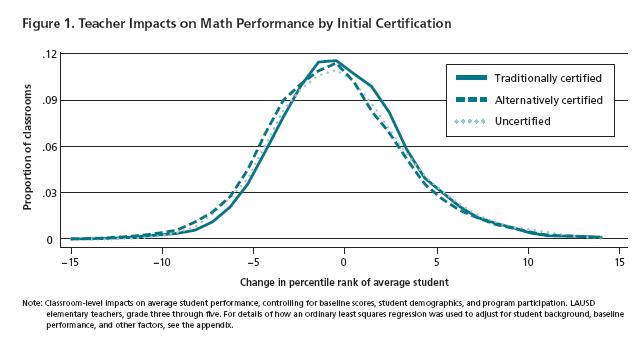
The first two items fall into the no-brainer category. No one should be getting paid to do classroom work without working in the classroom. The final item is the most important of all. The figure above is from a Brookings study, showing differences in academic gains by Los Angeles teachers. In short, some teachers are great- getting large gains, and some produce terrible results: not only failing to produce gains, but actually dragging their students down.

The Arizona Education Association is actively seeking to have these policy changes overturned. Rumor has it that this will be a condition for Democratic support in current budget session. One problem: it would be IMMORAL to keep highly ineffective teachers in the classroom simply because they had already spent years miseducating students. No one- conservative, liberal, libertarian or vegetarian should support such a policy. The AEA brings disgrace upon itself for seeking it, and any member carrying this water should be ashamed of themselves for doing so.

In short these policies represent a good start, but still only a single tap. Taking a cue from Zombieland, the Arizona legislature should go ahead and double tap the zombie by making it illegal for school districts to collect union dues from employee paychecks. School districts won’t collect dues for any other private associations, there is no case for them spending public money to do so for the AEA.

If people find the services of the AEA useful, they can write them a check in the same fashion that you do for any private organization that you support.