
Sara Mead’s inscrutable opposition to McKay Scholarships

May 19, 2010

(Guest Post by Matthew Ladner)

Thumbing through the latest edition of Education Next I found a letter from Sara Mead taking exception to Jay and Stuart’s previous article on McKay Scholarships. Mead’s argument seems to boil down to the idea that Jay and Stuart forgot that vouchers for children with disabilities are bad.

Jay and Stuart note in their response that Mead failed to cited any evidence for her opinions about special education vouchers. I will be happy to present some evidence that Ms. Mead is entirely mistaken. The above chart shows gains on the 4th grade NAEP reading exam between 1998 and 2009 for the nation and for Florida.

For those squinting at your IPAD, that big red column more than two and a half times bigger than the blue column is Florida. Florida beats the nation in progress for students with disabilities on all four big NAEP tests.

Now several other factors certainly were involved in driving Florida’s gains among children with disabilities. For instance, policy changes such as heavy weighting of children in the bottom 25% certainly played a role, and I suspect that the revamping of literacy instruction did as well. I make no claim that McKay was the sole cause of this improvement.

If however the fact that all children with disabilities gained the ability to attend private school early in the Aughts negatively impacted their learning, it is awfully difficult to see any evidence of it in their test scores. In fact, it seems far more reasonable to assume that it helped.

Mead wrote:

But there’s no evidence that children with disabilities need additional education options more than any other youngsters in underperforming schools, or that vouchers address the underlying problems in special education. Rather, voucher proponents have seized on this population because they are more sympathetic beneficiaries than poor and minority youngsters. Using children with disabilities to increase public support for vouchers may be smart politics, but it doesn’t mean that special education vouchers are good policy.

On the first point, I can’t help but wonder how much Mead has spoken to parents with children with disabilities. More broadly, this is quite an achievement for a single short letter: a number of unsupported assertions and faulty ESP regarding the motives of McKay supporters. It falls to me to break the news to Mead, but the case for special education vouchers is extremely powerful. If for some strange reason you wish to halt their progress into law, you’ll have to do better than to imagine theoretical problems.


Greece Ordered to “Consider” Privatizing Health Care

May 19, 2010

(Guest post by Greg Forster)

Under the latest amazing plan, it’s not just the Germans who will be paying for 45-year-old Greek hairdressers to retire to the beaches of the Agean. You and I have that privilege now, too, via a special deal that funnels US taxpayer dollars to the Greece bailout via the IMF.

But it gets better. Real Clear Markets (with story attribution to Investor’s Business Daily) reports the following jaw-dropper:

Greece was told that if it wanted a bailout, it needed to consider privatizing its government health care system. So tell us again why the U.S. is following Europe’s welfare state model.

The requirement, part of a deal arranged by the IMF, the European Union and the European Central bank, is a tacit admission that national health care programs are unsustainable. Along with transportation and energy, the bailout group, according to the New York Times, wants the Greek government to remove “the state from the marketplace in crucial sectors.”

Let’s save the schadenfreude for another time. (Like maybe a time when we might be more able to rise to the challenge of resisting the temptation to indulge our schadenfreude.) Inquiring minds want to know: who demanded this requirement?

The Obama administration?

The Germans?

The French?

The EU bureaucracy?

Is there anyone who could plausibly be behind this without being an astonishing hypocrite?


Polling Places and the Civic Mission of Public Schools

May 18, 2010

I voted this morning in the Arkansas primary.  The polling place used to be in the local elementary school, but for the past few elections, polling places in Fayetteville were moved out of the schools.  Ostensibly the reason for moving polling places out of public schools is concern for the safety of students.

This is part of a national trend.  A few years ago Education Week featured an article on this trend: “About 25 percent of Ohio’s 6,229 polling locations are in schools, according to research by the Ohio PTA. It passed a resolution last year encouraging local school boards to adopt policies that would prohibit schools from serving as polling places when school is in session. ‘We feel on election days, safety practices within schools are compromised, possibly putting thousands of children at risk,’ the resolution said. ‘We want to be proactive in preventing a tragedy rather than reacting to it.’”

Once again, public schools are forgetting the civic mission that is their raison d’etre.  Just as most school districts no longer use the naming of schools to promote civic values, they are failing to take advantage of elections in their building as civic teaching opportunities.

When the polling place is in the school, kids see democracy in action first hand.  They see posters out front from competing candidates.  They see people taking time to make voting a priority.  I thought educators were enamored with experiential learning.

The security problems of having the polling place in schools are grossly exaggerated.  Yes, people from the community come into the school, but it is usually through a single door and the polling place is populated with volunteers who can keep voters within the appropriate area.  Besides, every time schools take kids on a field trip they experience similar dangers of inter-acting with the public in settings that are only partially controlled.  Having a polling place in the school is like a field trip where the experience comes to the school rather than the kids going to the experience.  And if terrorists wanted to strike schools they could do so on any day with similar ease, whether there is an election or not.

It is also ironic that school advocates, like the PTA in Ohio, want to get polling places out of schools.  Making it easier for parents of school children to vote would improve the election-prospects of measures and officials that direct more resources to schools.

Unfortunately, school officials care more about political blame-avoidance than they care about their civic mission or even getting more money.


Blogs at Ten Paces!

May 17, 2010

(Guest post by Greg Forster)

Over the weekend, ALELR ran the numbers on Technorati and posted the Top 20 Education Blogs on his blog, Intercepts. Coming out on top – Joanne Jacobs. But what do you expect given that she’s married to royalty?

Tied for #10? Jay P. Greene’s Blog and . . .  Intercepts.

I say we settle this like men – on the field of honor. There can be only ten!


…but hold the class size amendment.

May 17, 2010

(Guest Post by Matthew Ladner)

Paul Peterson details research showing that the class size amendment was ineffectual in improving student achievement in Florida . These findings are entirely consistent with the substantial empirical literature on class size reduction as an education reform strategy.


Anti Defamation League Philadelphia Endorses Vouchers

May 16, 2010

For he who comes to his senses on vouchers shall be my brother...

(Guest Post by Matthew Ladner)

Must read column this morning from Jeff Jacoby on the growing support for vouchers on the American left.


Pass the Popcorn: Iron Man Inverted

May 14, 2010

(Guest post by Greg Forster)

My first movie post here on JPGB made the controversial assertion that Iron Man was good but Speed Racer was better, so I’ve been looking forwrad to blogging on Iron Man 2. (Alas, I’ll never get to blog on Speed Racer 2.)

Iron Man 1 got all the little things right, but the big thing right smack in the middle of the whole movie – Tony Stark’s psychology – was poorly handled. As I argued two years ago, the reason was marketing; Tony’s motivation could be read as either left-wing or right-wing, and they didn’t want to alienate half the audience by clarifying the issue.

I was pleasantly surprised by Iron Man 2. I was expecting that they would no longer get all the little things right – and that expectation was borne out. Iron Man 2 has lots of amazingly dumb moments. But what I wasn’t expecting was that this movie would have a clear message at the heart of it. This time, they got the big thing right. By which I don’t mean that they chose to make him right-wing or left-wing, but rather that they had something worth saying and they came out and said it in a satisfying way. Iron Man 2 is Iron Man 1 inverted – the dumb quotient is ratcheted way up, but the palladium arc generator implanted in the movie’s chest is now running at full power.

First, on all the little things they got wrong, let me be content to give you just one example.
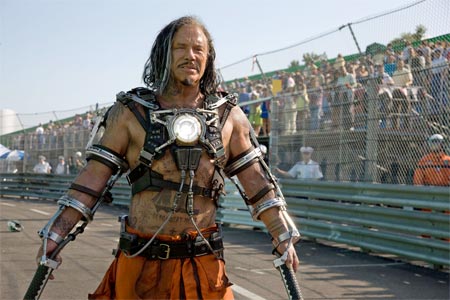
Early in the movie, the bad guy, Whiplash, has managed to pin down Tony Stark – alone, no weapons, no armor. Over and over again, Whiplash comes at Tony with his deadly high-tech weapons. Each time, Tony finds a cunning way to force Whiplash back or escape his attacks.

And each time, I kept thinking . . .

     . . . with all of Whiplash’s amazing technological weaponry . . .

          . . . it’s a good thing he’s too dumb to bring a lousy GUN!

Iron Man v. Whiplash, 1981 version

Also, while I’ll probably need another viewing before I’m sure I’ve judged this right, I think the Tony/Pepper relationship didn’t deliver as much this time. I certainly didn’t walk away feeling like it was an important part of the movie, as I did after Iron Man 1. But then, they do some subtle things with the relationship this time (I won’t spoil them) so it may be that on a second viewing I’ll get more out of those scenes.

But all of that is really as nothing next to the thought-provoking issue at the heart of this movie, which is: can superheroes be trusted with power any more than anybody else?

Just as Chris Nolan’s movie The Dark Knight borrowed extensively from Frank Miller’s comic The Dark Knight Returns, Iron Man 2 is drawing on a deep well – although in this case not from the same franchise. A while back Warren Ellis launched a comic called The Authority, in which a bunch of supers team up and use their powers not only to fight off super-powered world-threatening bad guys, but also to fight more ordinary injustices. They knock off tinpot dictators, force Russia to withdraw from Chechnya, and so forth.

At one point the president calls them up to give them grief about all the havoc and instability they’re causing. People will blame America for their actions and attack it in retaliation, he argues. They tell him they’re only doing what any decent people would do if they had the power.

“You just watch your step,” says the president.

“Frankly,” replies the team leader, “we could say the same to you.”

But later, the heroes get drunk on power and start partying all the time and behaving irresponsibly. Bad guys start winning again. The popular and political tides turn against them.

Grant Morrison summed up The Authority very nicely with one question: Superman always puts the flag back on top of the White House. What if he didn’t?

Iron Man 2 is not The Authority. It is, of course, a Hollywood movie, and (as has been noted) is dumb in many respects. Yet it’s asking the same interesting question. The plot revolves around the Pentagon’s anxiety that rogue states or terrorists will develop technology parallel to Tony’s. They want him to hand over his tech so that America will be ready to defend itself. He (of course) gives them the finger. He tells them that his tech is his, and if the government can take away his most cherished possessions at will, then citizenship is actually just “indentured servitude.” Plus, he argues that it’s better to break the government monopoly on protecting the public from dangerous threats: “I have privatized world peace!”

But then Tony starts partying all the time and behaving irresponsibly. His friend the Air Force colonel (remember him?) tries to stick up for him at the Pentagon, but when Tony gets out of control, he steals one of Tony’s suits and becomes War Machine – a government superhero.

The point of the movie: Governments are prone to corruption and must be held accountable to the people. But individuals who claim to speak for “the people” are also prone to corruption and must be held accountable. For that matter, each individual person is prone to corruption and must be held accountabile. Individual liberty and collective accountability must coexist; you can’t have one without the other.

Oh yeah, and Samuel L. Jackson is Nick Fury.

“Does he have a superpower?” my wife asked me. “Yes,” I replied. “He’s a badass. His superpower is badassery.”

If you have a high tolerance for Hollywood schlock – much higher than was required to enjoy Iron Man 1 – I recommend this movie wholeheartedly.


Whoever Wins, We Lose

May 14, 2010

(Guest post by Greg Forster)

A judge in LA has ruled that doing layoffs strictly by seniority is illegal because it denies low-income students their right to an education under the state constitution. The lawsuit, brought on behalf of three inner-city schools by civil rights groups, has the backing of Gov. Schwarzenegger, Mayor Villaraigosa (whose nonprofit operation manages two of the plaintiff schools), the state board of education, the city superintendent, and I don’t know who-all else.

The unions are saying they can’t comment because they spent the last several decades endorsing this kind of legally bogus judicial power grab and now it’s come back to bite them in the they haven’t read the decision yet.

I honestly don’t know whom to root for, the judicial tyrants who will cut down all the laws to do their will (which in this case happens to be good except for the cutting-down-all-the-laws-to-do-it part) or the unions, who are of course execrabale, but who, for once, are the legitimately aggreived party here.

You remember what Sellar and Yeatman wrote about the Cavaliers and the Roundheads, right?

HT Whitney Tilson


Job Opening: Basis Schools

May 13, 2010

(Guest Post by Matthew Ladner)

Vice President Growth: BASIS Educational Group

BASIS Educational Group seeks a Vice President for Growth who will bear primarily responsibility for the implementation of BASIS School’s growth plan. BASIS Educational Group is the Educational Management Organization for BASIS School, Inc., the charter holder for the nationally recognized college preparatory schools, BASIS Tucson and BASIS Scottsdale and for the new BASIS Oro Valley school scheduled to open in August of 2010.


BASIS Tucson, the charter group’s flagship campus, has consistently ranked in both the Newsweek and US News lists of the best high schools in America. Now, BASIS is embarking on an expansion aimed to make the schools a national presence within the next five years.


The Vice President for Growth will be the lead staff person responsible for implementing and coordinating all the elements of the BASIS replication plan. He/she will be responsible for coordinating all relevant applications for new schools and will be responsible for creating a positive recruiting environment in the relevant market areas as well as assuring that a suitable physical plant is ready for occupancy on opening day at all sites. He/she will support student recruiting efforts and will also assist with staff recruiting efforts for new schools as he/she becomes more familiar with the “BASIS model.


Specific responsibilities of the position include:

1.    Evaluating potential locations;

2.    Field testing potential school sites;

3.    Coordinating media relations in new markets;

4.    Coordinating with local BASIS booster groups;

5.    Managing Charter Board relations for replication efforts;

6.    Applying for and managing federal start up funding;

7.    Refining the BASIS building prototype with the BASIS architect;

8.    Consulting with Challenge Foundation Properties (CFP) on the choice of specific building sites;

9.    Coordinating with CFP on construction and financing of buildings.


The Vice President for Growth will work out of BASIS Educational Group’s office in Scottsdale, AZ. Salary is negotiable based on experience and knowledge related to the position. Please communicate your interest to Michael Block, Chairman, BASIS Educational Group, at mblock@basiseducation.net


DC NAEP Scores-Where is the Death Spiral?

May 13, 2010


(Guest Post by Matthew Ladner)

No one seems to be taking much note of it, but some Washington DC has some very favorable trends in their NAEP scores.

To be sure, the District’s scores still reflect widespread academic failure on an inexcusable level for a district blowing through $20k per child per year. The positive trend predates Michelle Rhee’s tenure, which is good, as I think we are likely to see further (badly needed) progress. It is still too early to judge whether Rhee will accelerate this rate of progress, but I’d be willing to bet she will.

If you go to the NAEP page for DC and look at the 4th grade reading scores, you will find that the catastrophically low score of 188 in 1992 fell to an even more pathetic 179 in 1994.   That’s almost a grade level drop from an already low base. A score of 179 makes me wonder what the score would be if we simply gave every child in DC a library card and hoped for the best. Mind you, that wouldn’t work well either, but it couldn’t work that much worse than DCPS circa 1994. Since 1994, however, scores have climbed 23 points. The percentage scoring basic or better increased from 24% in 1994 to 44% in 2009. Math improvement has also been impressive and shows the same trend- progress after the mid 1990s.

One blindingly obvious cause for the improvement: the 100 charter schools operating in the district educating over 30,000 children. DC’s charter law passed in 1996 (near the bottom of DC performance) and the opening of schools has been very strong. In 1996-7, DCPS had 78,648 students enrolled. In 2007-08 it had dropped to 58,191.

This is no doubt why DCPS spending per pupil has spiralled to such absurdly high levels. No on apparently thought that it might be appropriate to cut the budget for a district that is 20,000 fewer students, but I digress. DC’s scores still stink, but in the progress department they have clobbered all states other than Delaware and Florida.

I’m not willing to celebrate a district that spends over $20k per student per year and has 56% of 4th graders illiterate. I am however willing to celebrate progress, and DC has momentum. If they would like to accelerate that progress, parental choice policies that would be helpful would be to reverse the shameful decision of the NEA robots majority of the Democratic caucus to kill the DC Opportunity Scholarship Program. The program merits not only renewal but a large expansion.

In addition, DC should institute a McKay Scholarship program with children with disabilities, if they would like to stop paying for the 5th homes and country club memberships of the attorneys endlessly battering DCPS on failure to provide FAPE under IDEA. Both the kids and the district budget would win big from such a program.

The enemies of parental choice have always painted the nightmare scenario of an academic death spiral for the children “left behind” in the district. Perhaps these same folks would like to explain to us now how it is that DCPS lost a quarter of their students since the mid 1990s and watched their reading scores improve by 23 points. Where is the death spiral? Oh, I mean in DCPS scores.  The death spiral for the credibility of choice opponents is impossible to miss.