Who’s the Criminal?

January 26, 2011

In Akron, Ohio a woman who put her children in a better public school was sent to jail when private investigators hired by the school found that she did not live in the district.  Her father did and she sometimes stayed with him, but that was not enough to keep her out of prison for seeking a better education for her children.

Meanwhile, in Atlanta there is evidence of widespread cheating on standardized tests by teachers and administrators as well as a potential cover-up in the investigation of those accusations.  No one has gone to jail (and no one ever will) for robbing children of a quality education and then lying about their true achievement by cheating on the state test to hide that fact.

A few years ago Atlanta and other Georgia districts violated the state law to prohibit the social promotion of students who failed the 3rd grade reading test.  There was a procedure for exempting students if the schools and parents met and decided it was in the best interest of a student to be promoted, but many districts exempted virtually all of the students and did so without actually holding the required meetings.  They already knew what was best for children regardless of what the law said.

I could keep going with stories along these lines, but I think you get the idea.  So, who’s the real criminal here?


Bureaucratic Bloat – Bathroom Edition!

January 24, 2011

(Guest post by Greg Forster)

Short version of this post: I clean my own toilet, therefore school staff unions should be abolished.

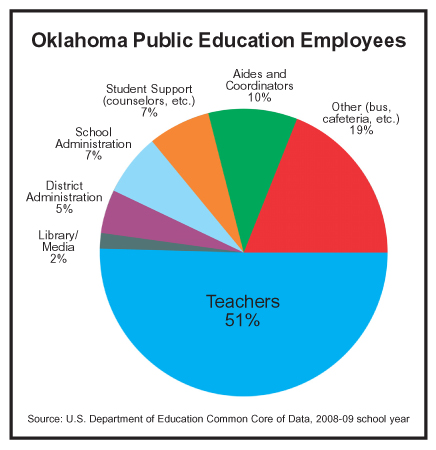
Long verson: I just had an article come out on bureaucratic bloat in Oklahoma schools, in which I noted that only half of the state’s K-12 public education employees are teachers. That’s pretty much par for the course nationwide.

(Before you ask, the breakdown looks similar if you do it by dollars instead of by headcount. I use headcount because it’s simpler – with dollars you have to navigate a more complex set of categories – and because there are categories of spending over which states have little control, such as debt service, whereas headcount is more flexibile.)

One argument I made was that instead of focusing on bloat in “administration,” we should really focus on privatizing services in the giant “other” category – bus, cafeteria, etc. Private companies already exist that can provide all those services better and cheaper. There’s no reason these functions should be performed by unionized civil servants under outrageously dysfunctional personnel rules that ensure substandard performance and with gargantuan nuclear exploding pensions that cost ONE TRILLION DOLLARS.

A disgruntled teacher writes in (anonymously) to say, among much else, that my argument is invalid because I don’t clean my own toilet:

 Not only do you expect us to teach our children, which I gladly and proudly do well, but you expect us to do so with out the assistance or limited assistance of janitorial staff, nurses, aides, bus drives and cooks. So we are to teach successfully as well as clean the toilets, cook their meals, take their temperature and drive buses (which we do anyway)…I wonder if Mr. Forster has someone that cleans his office and bathroom or if he does that himself?

(Read the letter in all its unabridged, unedited, undiluted glory here.)

Now, there are several problems here. As William F. Buckley once wrote: “I have seen non-sequiturs in my life, baby ones, middle-sized ones, and great big ones, but they all stand aside in awe at yours.”

First, I didn’t argue that teachers should clean their own toilets; I said we should hire private service providers to do it instead of using unionized civil servants. The teacher herself, curiously, seems to recognize this, but only in the non-toilet context; she complains elsewhere in the letter that under my argument “we are to contract out to professionals to provide meal service.” (I will leave unremarked upon her implicit acknowledgement that unionized civil servants cannot be considered “professionals”; unremarked upon as well will be the question of what this implies about teachers.)

The real problem with her argument, though, is that I do, in fact, clean my own toilet. The office in which I work does not hire janitorial staff. We are all responsible for cleanliness, including the bathrooms. On my first day, this fact was impressed upon me with some force by the administrative staff. And I’m proud to say that I have lived up to my responsibilities.

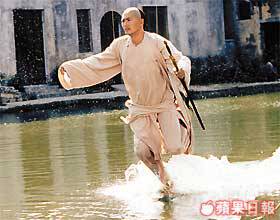
After all, I learned my skills through discipleship with a true master – the Li Mu Bai of toilet cleaning.

Sure he can walk on water – but does he clean it?

My first job in education was working for Jay Greene – yes, the Jay Greene – and we had no janitorial staff in that office either. In addition to our each taking responsibility for our messes daily, Jay appointed a regular schedule for comprehensive office cleaning. We each took a task – dusting, vacuuming, etc.

Jay always took the bathroom cleaning job. Every time. He told us this was his way of setting an example for the staff, citing a motto from the Israeli officer corps: “Follow Me!”

I still do.

So, if my arguments would be invalid if I didn’t clean my own toilet, doesn’t it therefore follow that since I do clean my own toilet, my arguments are valid?


Reason TV

January 24, 2011

I don’t find much on regular TV that I want to watch, especially since Lost went off the air.  But there is almost always new, exciting stuff on Reason TV, especially when I’m on it.


The Educationist View of Math Education

January 23, 2011

(Guest post by Barry Garelick)

In Jay Greene’s recent blog post, “The Dead End of Scientific Progressivism,” he points out that Vicki Phillips, head of education at the Gates Foundation misread her Foundation’s own report.  Jay’s point was that Vicki continued to see what she and others wanted to see: “‘Teaching to the test makes your students do worse on the tests.’ Science had produced its answer — teachers should stop teaching to the test, stop drill and kill, and stop test prep (which the Gates officials and reporters used as interchangeable terms).”

I was intrigued by the education establishment’s long-held view as Jay paraphrased it.  This view has become one of the “enduring truths” of education and I have heard it expressed in the various classes I have been taking in education school the last few years.  (I plan to teach high school math when I retire later this year).  In terms of math education, ed school professors distinguish between “exercises” and “problems”.  “Exercises” are what students do when applying algorithms or routines they know and can apply even to word problems. Problem solving, which is preferred, occurs when students are not able to apply a mechanical, memorized response, but rather have to apply prior knowledge to solve a non-routine problem.  Moreover, we future teachers are told that students’ difficulty in solving problems in new contexts is evidence that the use of “mere exercises” or “procedures” is ineffective and they are overused in classrooms.  One teacher summed up this philosophy with the following questions: “What happens when students are placed in a totally unfamiliar situation that requires a more complex solution? Do they know how to generate a procedure?  How do we teach students to apply mathematical thinking in creative ways to solve complex, novel problems? What happens when we get off the ‘script’?”

As someone who learned math largely though mere exercises and who now creatively applies math at work, I have to question this thinking. I believe that students’ difficulty in solving new problems is more likely to be because 1) applying prior knowledge to new or non-routine problems is hard for everyone, and 2) it is even harder for students who may lack the requisite knowledge and/or mastery of skills—not because they possess such knowledge and mastery.   So while the educationists distinguish between “exercises” and “problems”, the view refuses to distinguish between novices and experts.

Daniel Willingham, a cognitive scientist who teaches at the University of Virginia, finds the distinction between novice and expert to be quite important.  He maintains that it takes time and effort for knowledge to accumulate to the point that connections between learned material and new and difficult problems can be made.  Willingham refers to the difficulty that novices have with thinking critically as “inflexible thinking.”  In fact, he characterizes such difficulty as perfectly normal and to be expected among students.  Willingham argues that understanding the deep structures of a discipline such as mathematics is an important goal of education, “but if students fall short of this, it certainly doesn’t mean that they have acquired mere rote knowledge and are little better than parrots.” Rather, they are making the small steps necessary to develop better mathematical thinking. Simply put, no one leaps directly from novice to expert.

I was therefore extremely interested to see the sample problem of the Balanced Assessment in Mathematics (BAM) in Appendix 1 of the Gates Foundation’s preliminary report. The BAM is to be used to assess teacher effectiveness and according to the Gates Foundation’s preliminary report, “In comparison to many other assessments, BAM is considered to be more cognitively demanding and measures higher order reasoning skills using question formats that are quite different from those in most state mathematics achievement tests. There is also some evidence that BAM is more instructionally sensitive to the effects of reform-oriented instruction than a more traditional test (ITBS).”

The sample problem is reproduced below and is from the 8th grade mathematics assessment:

The diagram makes it clear how one is to count the number of tiles needed, so the first question is relatively easy.  Question 2 requires more thought, and the student must be able to extend the counting algorithm for the 4ft pond in question 1 to ponds of other sizes; i.e., they must understand that 4 is added to the product of the number of one foot long squares that fit on one side of the pond times 4, or 4n + 4 where n is the length of one side of the square pond in feet.

There are four additional questions that become increasingly difficult:  “How many paving stones are needed to surround a fish pond that is 20 feet by 20 feet?”, “Chris has 48 paving stones.  Find the size of the largest square pond the paving stones can surround.”  “The garden center sells many different sizes of square fish ponds. Write down a rule that will help Chris figure out how many paving stones are needed to surround square  ponds of different sizes.”  “The garden center decides to sell rectangular ponds.  Find a rule that will help Chris figure out how many paving stones are needed to surround rectangular ponds of different sizes.”

This set of questions is fairly challenging to beginning algebra students. (It is even more challenging if they have had no algebra at all, but since this is a problem for 8th grade students, I am assuming that they have had some experience with algebraic expressions and equations. This is not always a safe assumption but that’s a topic for another article.) The sample problem is illustrative of the type of problem that the education community deems coach-proof since it appears that memorization of problem solving techniques and “drill and kill” exercises will not work here.  But in fact, practice with some exercises would help students in tackling such a problem—specifically, having students express in mathematical terms certain situations described in English.  For example, “Three more than two times what John’s age will be in five years” (3 + 2(x + 5) ).  These types of exercises are frequently deemed by the education establishment to be inauthentic and irrelevant to the deeper underlying concepts of math unlike “reform oriented instruction” which purportedly provides such deep understanding through so-called authentic problems and a minimum of “exercises”.

Interestingly, the TIMSS exam—an international exam given every three years—also contains questions of this sort, as well as more straightforward problems.  For comparison’s sake, I looked at TIMSS eighth grade questions in algebra (found at http://nces.ed.gov/timss/pdf/TIMSS8_Math_ConceptsItems_2.pdf ) and found a similar type of problem:

This problem requires students to understand and ultimately express the relationship between the number of smaller squares on each side of the larger square, and the number of triangles contained in the square.  Question C, in fact, requires the student to be able to express the relationship mathematically in order to calculate the number of triangles.  The TIMSS report in which this appears provides some interesting data related to this question; namely the percent of students taking the test in each country that obtained the correct answer:

The top five scoring countries for this question ranged from 44 to 49% correct.  For the more straightforward problems the top five scores tend to be in the 70 and 80 percent range.   The US students obtained 19 percent correct for this problem; on more straightforward problems, the US scores in the 50 and 60 percent range. Thus, for all students, regardless of country, non-routine problems prove to be difficult.  Of interest, however, is that the five top scoring countries for this particular problem are Asian,  frequently criticized for using drilling and “inauthentic” exercises which they maintain do not properly prepare students for solving non-routine problems.

If Vicki Phillips’ statement about teaching to the test is any indication, however, the educational establishment will see what they want to see.  They will likely proclaim that the higher scores obtained by Asian countries on non-routine problems serves as evidence that the Asian countries use “reform-oriented instruction”.  Either that, or they’ll shrug their shoulders and say “It’s the culture; what can you do?”  (See http://www.educationnews.org/commentaries/104502.html )

In any event, whether the education establishment realizes it or not, the new generation of coach-proof tests that will be used to evaluate teachers, appear to be measuring the skills students are expected to be learning.  And by teaching what should be taught, teachers are teaching to the test, whether the Gates Foundation and its look-alikes realize it, like it, or not.

BIO: Barry Garelick is an analyst for a federal agency and is cofounder of the U.S. Coalition for World Class Math. (http://usworldclassmath.webs.com/ )  He plans to teach math later this year.


Has the Washington Post lost their BS detector?

January 21, 2011

(Guest Post by Matthew Ladner)

Valerie Strauss over at the Answer Sheet put up a guest post from a fellow Arizonan, Michael Martin, who is a research analyst at the Arizona School Boards Association, about the “real” source of Florida’s education gains.

I’ve never met Martin, but was taken aback a few years ago when he authored a column in the Arizona Republic claiming that the state ought not to take over the Roosevelt School District, one of the worst in Arizona. Martin made this claim based on the assertion that there was a massive incidence of lead poisoning in the district.

I thought that this was an extraordinary claim to make that ought to be incredibly alarming to parents in the district. I spoke to local health officials, who assured me that there was zero evidence to support such an irresponsible claim. I called on Martin to provide evidence to support the notion that South Phoenix kids had been turned into uncontrollable lead poison zombies.

Strangely enough, I never heard back from him. But other than that, I’m sure he is a swell guy.

Now in the WaPo blog, Martin spins a yarn about Florida NAEP scores which is far beyond absurd. The first clue that something is wrong here comes in the fact that the Arizona School Boards Association disavowed the “analysis.”

Good move on their part.

So go read the thing for yourself. People in the comments section began to decimate the Martin analysis, but the comments section is now closed. When they were closed, no one had yet made the most obvious possible criticism.

I’ll give you a hint: according the the National Center for Education Statistics there are 4,491 district run schools in the state of Florida.


Big Win for Tuition Tax Credits in Jersey

January 20, 2011

(Guest Post by Matthew Ladner)

BOOOOOOOOOOM!


Education Savings Accounts Duel in Florida

January 20, 2011

(Guest Post by Matthew Ladner)

Look for the Goldwater Institute study on using Education Savings Accounts as a vehicle for school choice next week. Meanwhile, they are already dueling over the concept in Florida. In this corner, Patricia Levesque from the Foundation for Excellence in Education represents the good guys with Let the Parents Choose.

In the opposing corner, representing the good but misguided faction, Betty Castor with Don’t Endanger Our Schools.

Notice the difference in emphasis regarding students vs. schools.

Those of us who support a fundamental overhaul of our system of schooling have a great deal of work to do to get people to understand that the methods of public schooling are fundamentally at odds with the ideals of public schooling. If you had to start from scratch, who in their right mind would order up the system we have today? Castor is right that Florida public schools have made a great deal of progress, and no one enjoys celebrating it more than me. It bears mentioning however that many of the people working Florida’s public school system fought the changes that produced those gains tooth and nail.

They were **ahem** completely wrong last time, but never mind that, this idea is dangerous so everyone run to your corners and Let’s Do the (2002) Timewarp Again!!!!

A decade ago, Florida’s public school establishment and their many willing accomplices in more than a few Florida newspapers were busily throwing up a firestorm over Governor Jeb Bush’s reforms. We all know how that ended: with Florida’s low-income, Hispanic and Black students outscoring statewide averages on NAEP.  Before we give any credence to the Little-Boy-Who-Cried-Wolf crowd, note that Florida has been offering children with disabilities all of their state money in the form of a voucher since 1999. Last year, 5% of children with disabilities utilized the program. That’s right- only 5% after a decade.

What do we know about the program? Participating parents love it and scores for children with disabilities are way up in Florida in part because of competition from the program. Oh, and it helps curb mislabelling of children into special education.

Ummmm…..where is the apocalypse? The mad rush for the exits? The terrible harm to schools and students?

The magic of the McKay program, and choice more generally, is that you don’t actually have to use it to benefit from it. Parents of children with disabilities now have the ability to walk with their feet if they think their school has served their child poorly, or that another school would do a better. The fact that only 5% of parents have actually pulled the trigger doesn’t matter much because all parents have the potential ability to pull the trigger. There are constraints, of course, most notably the availability of private options, but you get the point.

Nationwide, 2% of children with disabilities attend private schools at school district expense. Generally speaking, they were the kids with parents who had the ability to hire fancy attorneys who specialize in federal disability law. Sometimes these kids have successfully sued the district to get to a private school, sometimes a consensual agreement is reached for a private placement. Sometimes it is consensual, and other times it is “consensual” in the sense that districts are pretty good at figuring out when they would lose a lawsuit and cut their losses.

In any case, McKay gives parents who don’t have fancy lawyers power- the power to leave. McKay children stopped being a largely captive audience and became more like a client- a client you can lose if you fail to satisfy them.

This is what the education savings account concept is about: power for parents. The customer is King, and I want to give parents as close to full sovereignty over the education of their child as possible, down to the penny. This goes well beyond whether I should have choice over whether I send my child to a charter or a district school, or a private or district school. The idea is to allow every parent to customize an education for their child based upon their unique needs and interests from as wide an array of education service providers as possible: whether from public schools, private schools, virtual schools, private tutors, trade schools or colleges and university courses. Parents should be able to judge opportunity costs and cost-effectiveness, and save money over time for university expenses.

Would this spell the end of public schools? Hardly- did McKay end public schooling for children with disabilities? Yes but if McKay gave options beyond private schools, maybe 10% of students may have left instead of 5%!

EEEEEEEEEEEEEK!!!!!!!!!!!!!!!!!!!!!!

Would it change education savings accounts change the way schools operate? Yes- for the better.

What about equity concerns? Give disadvantaged children greater funding weights than the current public school funding system.  Can anyone seriously justify $1,500 from the feds as making a serious dent in the role poverty plays in education, especially when often only half of it reaches the classroom? Who wants to stand up to defend a system of school funding which covertly gives far more to the children with the most, cleverly disguised in district averages? Can we really go on ignoring the abject failure of state funding equity lawsuits without seriously revamping the broken power structures of urban districts which often absorbed massive amounts of additional funds without producing significant improvement?

We can do much better than this- and putting parents in charge is the right way to do it.


“Academics” and the “Practical” Part IV: Seizing Power

January 19, 2011

(Guest post by Greg Forster)

For a while now I’ve anticipated that the next installment of this series would be about power. Since Jay has broached the subject, I guess it’s finally time to get around to writing what I’ve been planning!

A quick review of my Unified Field Theorem of Education Reform:

Part 1: Education reformers shake out into two groups, which I call the “liberal artists” and the “pragmatists.” The liberal artists want to teach first the three Rs, then traditional “academic” content more generally. Their strength is their insistence on tangible accountability for teaching all children; their weakness is their overreliance on standardized testing – now culminating in the current effort to create a government-controlled national testing regime which logically implies the further step of imposing a single curriculum on all schools under the control of a central authority. The pragmatists want to make education in various ways “more relevant to real life.” Their strength is their desire to create new models of education that will prepare students better for life in the (changing) world. Their weakness is their tendency to discount (in practice if not in rhetoric) the value of traditional academics, and especially their fear of accountability systems.

Part 2: Both sides undermine not only education governance (the focus in Part 1) but pedagogy as well. The pragmatists want to abstract “skills” from “content” and focus on teaching the skills; they fail to appreciate that the only way to learn skills is by leaning content. You can never teach “skills” directly. The liberal artists want to abstract “knowledge” from “practice” and focus on teaching the knowledge; they fail to appreciate that all the really important knowledge is intricately bound up with practice, and can only be learned practically.

Part 3: Liberal artists need to get over their testaphilia, and pragmatists need to get over their testaphobia. A vast quantity of what students deperately need to learn must be learned in ways that can’t be tested with the level of objective systematization the liberal artists insist upon. You can “test” practical knowledge but not in the ways the liberal artists want – and not in ways that can be effectively used as the basis of an accountability regime. Yet standardized testing, and more generally the “rote” “regurgitation” of “mere” “facts,” is always going to be a crucial part of good education. In Daniel Willingham’s language, you can’t get to the “deep structure” of problems, which is what the pragmatists want, until you’ve first mastered the “surface structure,” which is the rote facts the pragmatists disdain. You have to walk before you can fly.

Running through all this is the tension between governance and pedagogy. Once we decide what we want schools to do, how do we structure the system to try to get them to do that?

The links beteween each camp’s pedagogy and governance, both in their good and bad aspects, run much deeper than it may at first appear. What’s really at stake is our view of the human person.

An analogy to politics will help here. In modern political philosophy there are basically three anthroplogies on offer. They give rise to different political systems.

  • You can be cynical about human nature, thinking that people are basically bad. This leads more or less directly to an explicitly authoritarian, implicitly totalitarian tyranny of “enlightened” despots. Because people are basically bad, no one can ever have legitimate power (no one deserves it) and the world will really operate by illegitimate power no matter what you do. So you might as well give the power to the smartest people so they will at least make things run more smoothly and everyone will have an easier time of it. Machiavelli and Hobbes fit this model.
  • You can be naive about human nature, thinking that people are basically good. This also leads more or less directly to an explicitly authoritarian, implicitly totalitarian tyranny of “enlightened” despots. Because people are good, they will naturally want to cooperate to make everyone better off, which of course means putting things under the control of the smartest, best people. And those people ought to have the power to coerce everyone’s cooperation, becasue such power won’t really need to be exercised very much – just enough to encourage people to get over their less powerful selfish tendencies and live into their natural desire to benefit others, which is (underneath the superficial layer of selfishness) really their deeper and stronger desire. The payoff from giving dictatorial power to experts is huge (because the experts are not only smart but good and trustworthy) and the cost is small (because the power won’t have to be exercised much). Rousseau and Hegel fit this model.
  • You can take a mixed view of human nature, thinking that people are both basically good and basically bad. They need freedom to do their good stuff, but also enough restraint to keep them from getting out of line and destroying other people’s good stuff; the rulers, in turn, must be strong enough to restrain violence, but not so strong that they themselves become unaccountable. This is the anthropology of liberal democracy, freedom of religion, and the entrepreneurial economy; Locke, Montesquieu and Madison are its architechts.

The thing to note is that societies cannot be counted on to remain faithful to one model. In particular, the mixed model on which liberal democracy, freedom of religion and entrepreneurial economy are built is really darned difficult to maintain. We are constantly falling away into cynicism on the one side (e.g. Cass Sunstein, Catherine MacKinnon, Saul Alinsky) or naivete on the other (e.g. Michael Lerner, Alan Wolfe, Jim Wallis) with the same disastrous consequences every time.

How does this relate to pedagogy and governance in education? I propose that education needs to be based on a mixed model, but is constantly falling away into one or the other of two truncated models – and that’s why substantive education issues are constantly being hijacked by brute political power.

Look at the liberal artists. How did we get to a point where the people dedicated to the full flowering of human knowledge represented by “traditional academics” are in the process of reducing the content of education to what can be measured by bubble tests – and lining up to create a national dictator that will reach into every school in America and crush everything that isn’t bubble tests?

It’s because their anthropology privileges intellect over action. A human being is a mind that has a body. What they want is to educate the mind. The body is really of no concern to them. Even the mind is only of interest insofar as it knows things – the mind’s ability to do things through the body is not interesting. Re-reading my first post in this series, this is really clear in the exchange between Jay and Checker about whether schools should teach things like “entrepreneurial attitudes.”

Checker Finn’s ideal school

This anthropology implies an aristocracy of intellect. The system should serve the interests of those who are capable of learning. The liberal artists think they’re egalitarians and democratizers because they stick up for the poor black kids who want to learn – and, as I have said over and over, they’ve done us a great service. They have indeed been the great titanic warriors against race and class aristocracies. But there are other kinds of aristocracies as well. The liberal artists only stick up for the kids who want to learn in a certain way: the intellectual way, the bubble test way. They want the whole system to serve only the kids who desire to know for knowledge’s sake – and that’s not most kids. What about the kids who want to invent new things, or acheive greatness in other ways, and who might be willing to learn academics as a stepping stone to that but not for its own sake? They’re chucked into the maw of the intellectual tyranny.

Ken Robinson was wrong (in that video back in Part 1) to attribute this anthropology to the Enlightenment; it is actually far older, and has historically been associated with undemocratic power structures. Mind/body dualism was the philosophy of Greco-Roman aristocracy – Athens was the only democracy of any importance in the ancient world, and it executed the great dualist Socrates. Even during the Enlightenment, those who strongly embraced mind/body dualism (like Descartes) were strong supporters of traditional power structures. It was those who challenged mind/body dualism, like Locke, who ushered in democracy.

What about the pragmatists? It’s tempting to say that they have the opposite problem – they think kids are bodies that have minds. But that’s actually wrong. The strength of the pragmatists is that they’re not plagued by mind/body dualism.

Their problem is egalitarianism. They don’t want education to result in inequalities – no inequalities of life outcomes, but more fundamentally, no inequalities of educational outcomes. To draw a distinction, even in thought, between those who can accomplish more and those who can accomplish less is itself wrong. Anything that tends to reinforce the appearance of such distinctions, or (worse) explicitly assume such distinctions and build on them, is in principle radically evil.

This explains their testaphobia and their general aversion to accountability systems. It also explains why they are de facto but not de jure hostile to traditional academics. They have no objection to academics in principle – provided the illusion of equal outcomes is not punctured. But, of course, it always is. Much safer to stick to content-free, purely “practical” projects that teach “skills.”

The picture offered to us is one of glorious diversity in which every child is radically different, and none of the differences matter.
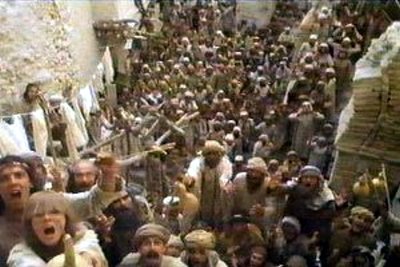
“You can think for yourselves!”
“Yes! We can think for ourselves!”
“You are all individuals!”
“Yes! We are all individuals!”

Naturally, while the liberal artists are striving to build an aristocracy, the pragmatists are striving to build a tyranny of the majority – the mob rule of unlimited democracy. This was their original sin going all the way back to John Dewey, whose perfidy begins right at the beginning when he sets out to redesign the whole educational enterprise to produce, not the fullest possible flourishing of human capacities, but people suited to fit the new, radical political system that early 20th century progressives were working so hard to build. Human beings are little clay figures just waiting for Dewey and his acolytes to mold them into the politically convenient shape. All the worst aspects of educational pragmatism can really be traced back to this original politicization of the project.

So both camps find substantial resistance to their desires – the liberal artists, in children who are capable of achievement but don’t highly value knowledge for its own sake; the pragmatists, in children who are capable of excellence (even the kinds of excellence pragmatists claim to value) and need special nurturing to achieve it.

And both camps, their vision cramped by narrow anthropologies, fail to see the legitimacy of this resistance. To them, the resistance appears to be simply obscurantism. Hence they feel perfectly justified stamping it out by force.

And naturally, when they seek power, they both reach for the strongest of all social weapons in modern culture – science.

Say that you favor a given approach – in education, in politics, in culture – because it is best suited to the nature of the human person, or because it best embodies the principles and historic self-understanding of the American people, and you will struggle even to get a hearing. But if you say that “the science” supports your view, the world will fall at your feet.

Of course, this means powerful interest groups rush in to seize hold of “science,” to trumpet whatever suits their preferences, downplay its limitations, and delegitimize any contrary evidence. If they succeed – which they don’t always, but they do often enough – “the science” quickly ceasees to be science at all. That’s why “scientific” tyrannies like the Soviet Union had to put so many real scientists in jail – or in the ground.

This was, again, the original sin of Dewey and the whole “pragmatist” movement in early 20th century philosophy. The goal of that school was to undermine the philosophical structure of knowledge on which real science depends, so that they would then have a free hand to bend “science” to their will. I believe it was George Orwell who said that philosophical pragmatism amounts to saying that truth is determined by who has more guns.

But the liberal artists are no longer very much better. They didn’t used to flatten their understanding of a good education down to the level that could be measured “scientifically” on tests. But the imperative to seek power and crush resistance has driven them to that point.

How, then, do we escape from both aristocracy and mobocracy, and undo the tyranny of science? Stay tuned.


More on Scientific Progressivism

January 19, 2011

I just wanted to add a few thoughts to my post yesterday.  Readers may be wondering what is wrong with using science to identify the best educational practices and then implementing those best practices.  If they are best, why wouldn’t we want to do them?

Let me answer by analogy.  We could use science to identify where we could get the highest return on capital.  If science can tell us where the highest returns can be found, why would we want to let markets allocate capital and potentially make a lot of mistakes?  Government could just use science and avoid all of those errors by making sure capital went to where it could best be used.

Of course, we tried this approach in the Soviet Union and it failed miserably.  The primary problem is that science is always uncertain and susceptible to corruption.  We can run models to measure returns on capital, but we have uncertainty about the models and we have uncertainty about the future.  Markets provide a reality test to scientific models by allowing us to choose among competing models and experience the consequences of choosing wisely or not.  Science can advise us, but only choice, freedom, and experience permit us to benefit from what science has to offer.

And even more dangerous is that in the absence of choice and competition among scientific models, authorities will allow their own interests or preferences to distort what they claim science has to say.  For an excellent example of this, check out the story of Lysenko and Soviet research on genetics.  For decades Soviet science was compelled to believe that environmental influences could be inherited.

Science facilitates progress through the crucible of market tests.  Science without markets facilitates stronger authoritarianism.


The Dead End of Scientific Progressivism

January 18, 2011

In Education Myths I argued that we needed to rely on science rather than our direct experience to identify effective policies.  Our eyes can mislead us, while scientific evidence has the systematic rigor to guide us more accurately.

That’s true, but I am now more aware of the opposite failing — believing that we can resolve all policy disputes and identify the “right way” to educate all children solely by relying on science.  Science has its limits.  Science cannot adjudicate among the competing values that might attract us to one educational approach over another.  Science usually tells us about outcomes for the typical or average student and cannot easily tell us about what is most effective for individual students with diverse needs.  Science is slow and uncertain, while policy and practice decisions have to be made right now whether a consensus of scientific evidence exists or not.  We should rely on science when we can but we also need to be humble about what science can and can’t address.

I was thinking about this while reflecting on the Gates Foundation’s Measuring Effective Teachers Project.  The project is an ambitious $45 million enterprise to improve the stability of value-added measures while identifying effective practices that contribute to higher value-added performance.  These are worthy goals.  The project intends to advance those goals by administering two standardized tests to students in 8 different school systems, surveying the students, and videotaping classroom lessons.

The idea is to see if combining information from the tests, survey, and classroom observations could produce more stable measures of teacher contributions to learning than is possible by just using the state test.  And since they are observing classrooms and surveying students, they can also identify certain teacher practices and techniques that might be associated with greater improvement.  The Gates folks are using science to improve the measures of student progress and to identify what makes a more effective teacher.

This is a great use of science, but there are limits to what we can expect.  When identifying practices that are more effective, we have to remember that this is just more effective for the typical student.  Different practices may be more effective for different students.  In principle science could help address this also, but even this study, with 3,000 teachers, is not nearly large enough to produce a fine-grained analysis of what kind of approach is most effective for many different kinds of kids.

My fear is that the researchers, their foundation-backers, and most-importantly, the policymaker and educator consumers of the research are insensitive to these limitations of science.  I fear that the project will identify the “right” way to teach and then it will be used to enforce that right way on everyone, even though it is highly likely that there are different “right” ways for different kids.

We already have a taste of this from the preliminary report that Gates issued last month.  Following its release Vicki Phillips, the head of education at the Gates Foundation, told the New York Times: “Teaching to the test makes your students do worse on the tests.”  Science had produced its answer — teachers should stop teaching to the test, stop drill and kill, and stop test prep (which the Gates officials and reporters used as interchangeable terms).

Unfortunately, Vicki Phillips mis-read her own Foundation’s report.  On p. 34 the correlation between test prep and value-added is positive, not negative.  If the study shows any relationship between test prep and student progress, it is that test prep contributes to higher value-added.  Let’s leave aside the fact that these were simply a series of pairwise correlations and not the sort of multivariate analysis that you would expect if you were really trying to identify effective teaching practices.  Vicki Phillips was just plain wrong in what she said.  Even worse, despite having the error pointed out, neither the Gates Foundation nor the New York Times has considered it worthwhile to post a public  correction.  Science says what I say it says.

And this is the greatest danger of a lack of humility in the application of science to public policy.  Science can be corrupted so that it simply becomes a shield disguising the policy preferences of those in authority.  How many times have you heard a school official justify a particular policy by saying that it is supported by research when in fact no such research exists?  This (mis)use of science is a way for authority figures to tell their critics, “shut up!”

But even if the Gates report had conducted multivariate analyses on effective teaching practices and even if Vicki Phillips could accurately describe the results of those analyses, the Gates project of using science to identify the “best” practices is doomed to failure.  The very nature of education is that different techniques are more effective in different kinds of situations for different kinds of kids.  Science can identify the best approach for the average student but it cannot identify the best approach for each individual student.  And if students are highly varied in their needs, which I believe they are, this is a major limitation.

But as the Gates Foundation pushes national standards with new national tests, they seem inclined to impose the “best” practices that science identified on all students.  The combination of Gates building a national infrastructure for driving educator behavior while launching a gigantic scientific effort to identify the best practices is worrisome.

There is nothing wrong with using science to inform local practice.  But science needs markets to keep it honest.  If competing educators can be informed by science, then they can pick among competing claims about what science tells us.  And they can learn from their experience whether the practices that are recommended for the typical student by science work in the particular circumstances in which they are operating.

But if the science of best educator practice is combined with a national infrastructure of standards and testing, then local actors cannot adjudicate among competing claims about what science says.  What the central authorities decide science says will be infused in the national standards and tests and all must adhere to that vision if they wish to excel along these centralized criteria.  Even if the central authority completely misunderstands what science has to say, we will all have to accept that interpretation.

I don’t mean to be overly alarmist.  Gates has a lot of sensible people working for them and there are many barriers remaining before we fully implement national standards and testing.  My concern is that the Gates Foundation is being informed by an incorrect theory of reform.  Reform does not come from science identifying the right thing to do and then a centralized authority imposing that right thing on everyone.  Progress comes from decentralized decision-makers having the freedom and motivation to choose among competing claims about what is right according to science.

(edited for typos)