PISA Results by Subgroup

January 17, 2011

(Guest Post by Matthew Ladner)

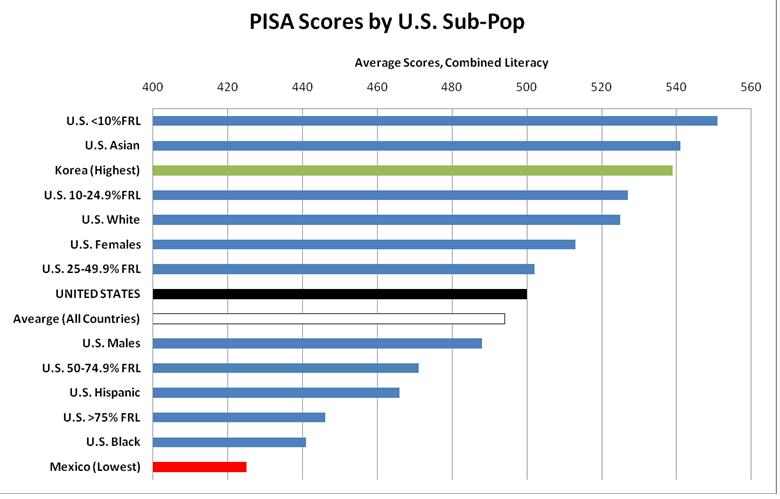
Hat Tip to Whitney Tilson for sending along this fascinating chart in his email blast today. This chart shows PISA data for 15 year olds (10th graders).

This serves as a Rorschach test. The usually reliable Robert Samuelson looks at this and says points out that American Anglos are pretty competitive.

Two problems: first from what we can tell from TIMMS, these numbers would probably look worse if we were examining 17 year olds (the U.S. has a large drop in rank between 8th and 12th grade).  Second, we are spending far beyond the OECD average on a per pupil basis, especially in the leafy suburbs, so our cost/achievement ratio still probably stinks, even for wealthy White kids.

The real story here is how much closer Hispanics and Blacks in America are to Mexico, the lowest scoring OECD country, than to an internationally competitive level.


Common Core Smackdown

January 13, 2011

Actually it was much more civilized than that.  You can see below my discussion with Mike Petrilli on the pros and cons of Common Core (national) standards.


National Review Online on Education Savings Accounts

January 12, 2011

(Guest Post by Matthew Ladner)

NRO’s Reihan Salam on the revolutionary potential of education savings accounts. Goldwater Institute proposal by yours truly and Nick Dranias coming soon…


China Envy

January 12, 2011

We are beginning to be envious of all things Chinese.  For some indication of this trend see the book on the superiority of Chinese mothers described (and mocked) in yesterday’s post.

I’ve seen this movie before when it was called Gung Ho.  And that movie sucked.  Is anybody else old enough to remember the late 1980s and early 1990s when media and policy elites were convinced that the Japanese had figured out better ways of doing everything and we needed to imitate them before we were crushed?  I specifically remember a bunch of education experts (and you know who you are) telling us that we had to imitate Japanese schools.  How did all of that work out?

I expect we are about to hear all of the same stuff, but this time it will be about the Chinese.  We need to parent like they do, eat like they do, run the economy like they do, etc… to imitate their success and prevent from being crushed by their superiority.

I don’t even believe the accuracy of the stereotypes we are supposed to emulate.  The Japanese were not all working together as if they were the same team.  Chinese parents do not all raise their children in the same way (nor do “Western” parents all do something different).  This is the worst kind of “pop” social science — incorrectly attributing the success or failure of a society to inaccurate stereotypes.

If you want a more accurate picture of China, see the photo at the top of this post.  And over the long run I cannot imagine that a centrally planned economy, like China’s, will be the one we need to emulate to prosper.  We have plenty of good social science to tell us that liberty, relatively free markets, and the fair rule of law are much better predictors of economic success.

Yes, China is gaining rapidly, but so did the Soviet Union when it fully mobilized its agrarian workforce into the industrial sector.  That type of growth levels off without markets to properly allocate capital, property rights to ensure that entrepreneurs can keep the fruits of their innovation, and liberty to critique the favoritism and corruption that undermine the fair rule of law.  China has been making some strides toward market allocations of capital, but remember that most of the banks are government controlled.  And property rights in China remain murky, which will hinder innovation.  And there isn’t much freedom to critique the government.  Without much more progress on these fronts I see little prospect of the Chinese overtaking us economically.

If you want to keep an eye on a rapidly growing developing country, I would look at India.  Yes, India is messy, complicated, and often inefficient, but that’s how freedom looks.  If they keep liberalizing their economy and politics, I see India growing much more rapidly over the long run.


Are Chinese Moms Superior?

January 11, 2011

I have no idea.

But, in a piece in the Wall Street Journal, Yale Law professor and author of a new book on the subject, Amy Chua, extols the virtues of Chinese parenting styles over Western ones.  I thought she was describing Jewish mothers, but apparently the Chinese are Jews… or Jews aren’t Western… or something.

And in the wonderful age of auto-animation, someone has already critiqued Chua’s piece with this video:

UPDATE

And here is the comedian, Louis C.K., making an argument similar to Amy Chua’s about effective parenting.  Wait a minute.  How can he do that?  Doesn’t he know that he isn’t Chinese?


New Grad Rate Study in Milwaukee

January 10, 2011

School Choice Wisconsin has released a new study by the University of Minnesota’s John Robert Warren of graduation rates for the voucher and public school systems in Milwaukee.  Here’s the highlight from the release:

Based on seven years of data, Professor Warren estimates that the graduation rate for students in Milwaukee’s choice program was about 18% higher than for students in MPS.  Had MPS achieved the same graduation rate as students in the MPCP, an additional 3,939 Milwaukee students would have graduated from 2003 to 2009.  Based on findings in separate research reported by the Milwaukee Journal Sentinel, the annual impact from these additional graduates would have been about $4.2 million in extra tax revenue and $24.9 million in additional personal income.

Warren’s research shows a general pattern of growth in Milwaukee graduation rates.  From 2003 to 2009 the MPS rate grew from 49% to 70%.  For the MPCP the rate grew from 63% to 82%.

Of course, this is not a causal analysis.  We do not know (and the study does not claim) that the higher grad rate among voucher students is caused by the program.  A forthcoming analysis by the University of Arkansas’  School Choice Demonstration Project, led by my colleague, Patrick Wolf,  should be able to address that issue.

But the this descriptive report is nevertheless encouraging.  Not only do voucher students graduate at higher rates than MPS students, but both sectors have been improving their graduation rates.  That finding is consistent with a scenario in which choice and competition are improving outcomes for all students — public and private — in Milwaukee.


Rankings Revised

January 6, 2011

Rick Hess along with Daniel Lautzenheiser have devised a ranking of the “public presence” of education academics.  They developed a 7 itemscoring rubric [that] reflects a given scholar’s body of academic work—encompassing books, articles, and the degree to which these are cited—as well as their footprint on the public discourse in 2010. ”

There is always something arbitrary and crappy about these rankings, but Rick is right when he argues, “For all their imperfections, I think these [ranking] systems convey real information—and do an effective job of sparking discussion (about questions that are variously trivial and substantial).”  Recognizing that these kinds of rankings are part recreation and part reality, I’ve made a slightly revised ranking presented below (with help from Misty Newcomb).

One of the problems with the ranking Daniel and Rick developed is that it combines some measures that accumulate over one’s career with other measures that only count accomplishments in the last year.  The career measures, Google Scholar and books published, will tend to be higher for people who have had longer careers.  Given that the ranking is meant to capture the current influence of education academics, these career items are biased in favor of senior scholars whose work may have been influential in the past, but less so in the present.

A more junior colleague pointed out this distortion to me, so I have tried to standardize the Google Scholar and book measures so that those with longer careers would have no particular advantage.  In particular, I calculated the sum of the two “career measures” — Google Scholar and books published.  Then I divided that sum by the years since the scholar received his or her terminal degree.  And to ensure that books and articles would still have the same weight in the overall score, I multiplied by the mean number of years since degrees were earned, about 23.2.

In making this adjustment I am assuming that every scholar would maintain the same rate of book and article productivity over his or her entire career.  So, the book and article “public presence” in the past year would be in proportion to the total book and article production per year over an entire career.

I make no changes to the 5 other measures in Daniel and Rick’s ranking: current Amazon sales as well as mentions in the education press, blogs, newspapers, and Congressional Record.  All of those measures reflect current “public presence.”  Adding the adjusted two career measures to these annual measures we get an adjusted total score.

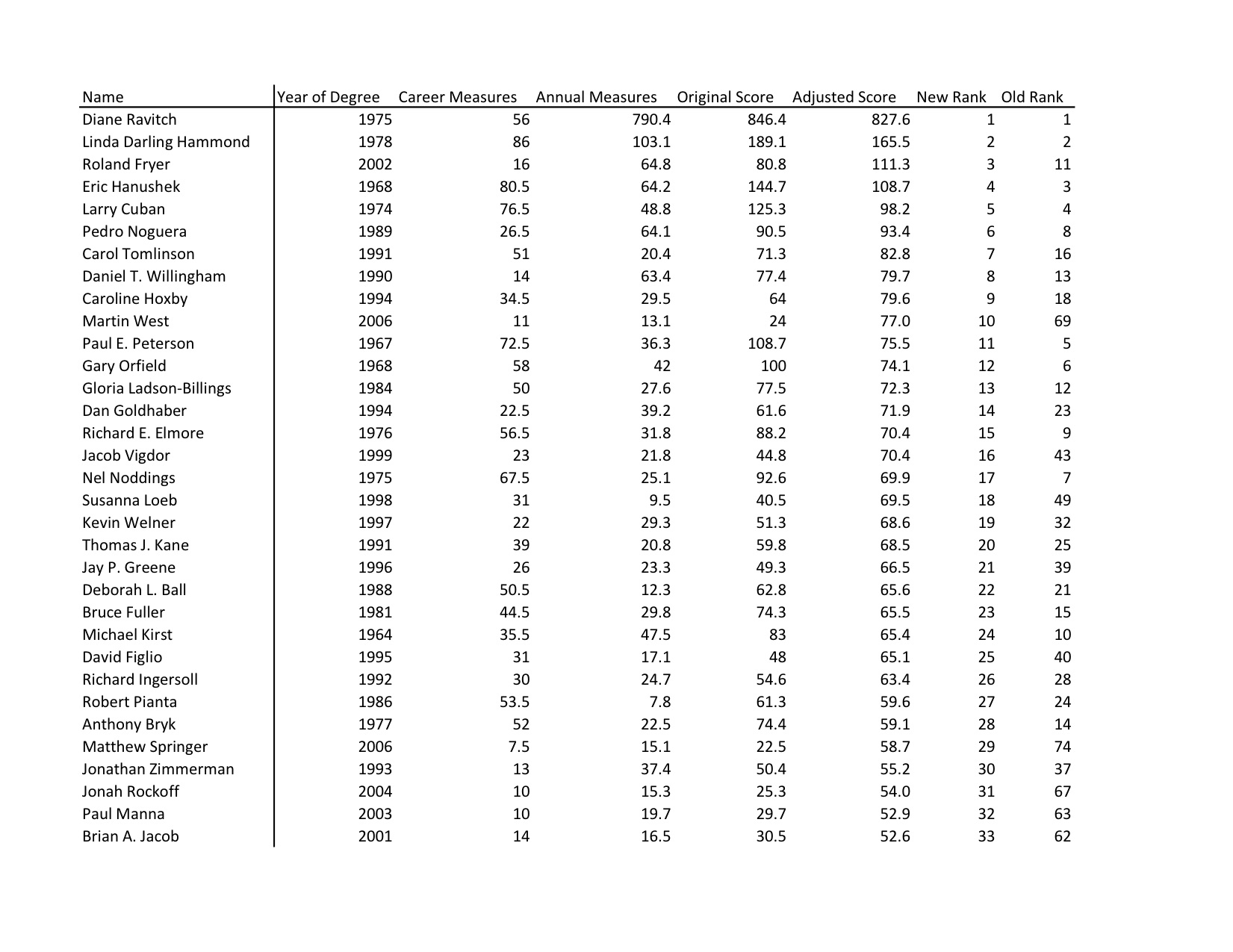
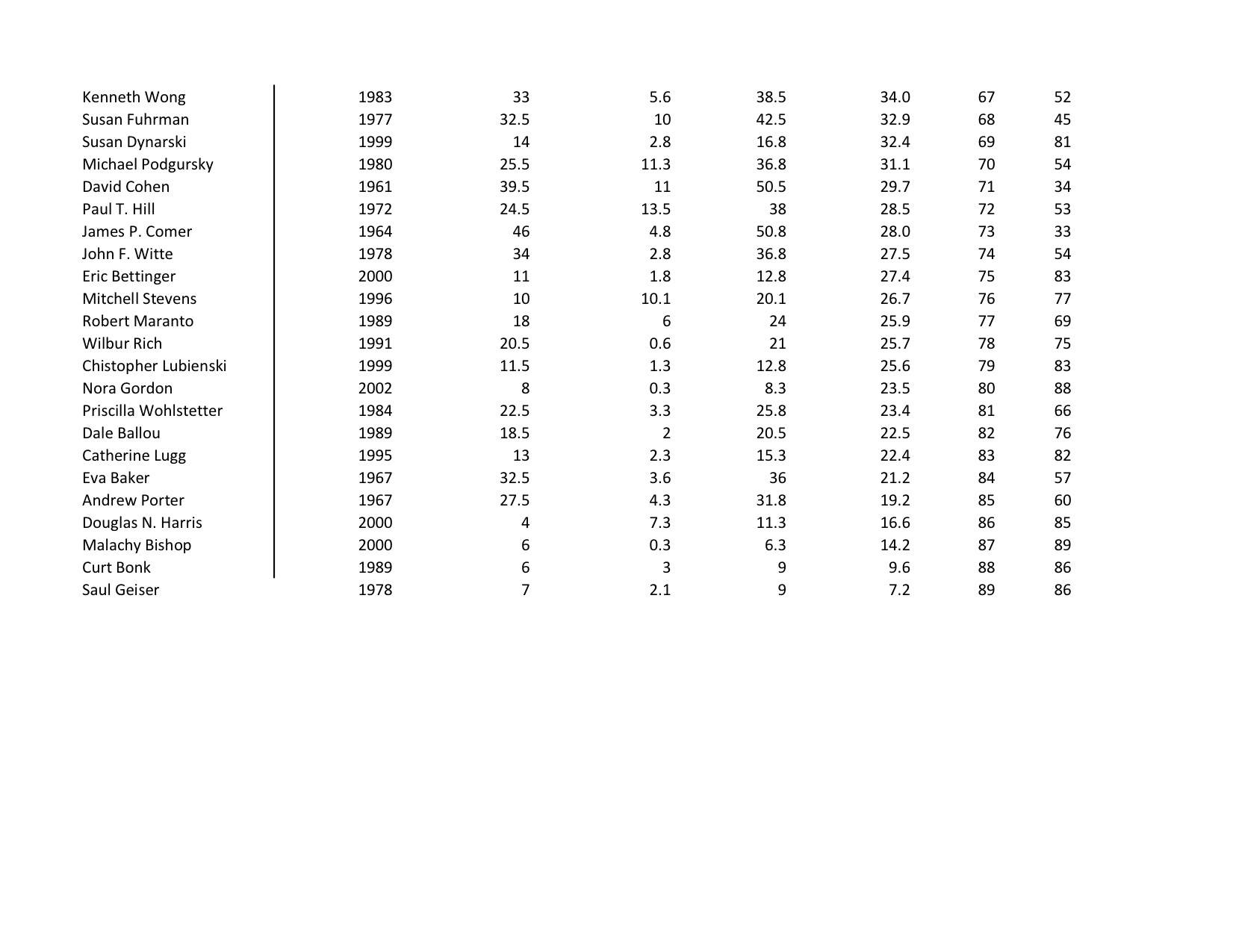
Making the adjustment for length of career does not alter who is at the very top of the rankings.  As you can see below, Diane Ravitch and Linda Darling-Hammond still rule the roost.  But there are some significant changes below that, where more junior scholars jump in the rankings and more senior scholars drop.  For example, Martin West leaps to 10th place from his previous ranking of 69th, surpassing his mentor, Paul Peterson, who drops from 5th to 11th.  Roland Fryer moves up to 3rd from 11th.  Jacob Vigdor rises to 16th from 43rd.  Susanna Loeb goes to 18th from 49th.  Matthew Springer rises to 29th from 74th.  And Brian Jacob, Jonah Rockoff, and Sara Goldrick-Rab all jump almost 30 places.

On the other hand, some more senior scholars decline significantly in their public presence ranking once we make this adjustment.  Gene Glass sinks from 20th to 50th.  Henry Levin falls from 17th to 52nd.  David Berliner drops from 19th to 57th.  Kenneth Zeichner moves from 30th to 62nd .

These changes make sense and I think improve Rick and Daniel’s ranking.  Hotshot researchers like Roland Fryer, Jacob Vigdor, Susanna Loeb, Matthew Springer, Brian Jacob, Jonah Rockoff, and Sara Goldrick-Rab are having a large impact on current education policy discussions even though their careers have not been long enough to accumulate a longer list of books and articles.  The original ranking shortchanged these scholars in measuring their current “public presence.”

At the same time, more senior scholars, like Gene Glass, Hank Levin, David Berliner, and Kenneth Zeichner may have been given too much credit by the old ranking system for books and articles that were influential in the past but do not give them as much of a public presence in recent policy debates.

Of course, of greatest interest to me was what happened to my ranking.  I moved up to 21st from 39th.  This must be a better ranking.

Click on the images below to see the original and adjusted results for all 89 education academics that Rick and Daniel included in their “super-sized” ranking.  Have fun and, as David Letterman would say, please… no wagering.

Surviving a Friedman Crisis

January 6, 2011

(Guest Post by Matthew Ladner)

Isaac Asimov’s Foundation series details a future in which humans have colonized the entire galaxy, which is ruled by a great Galactic Empire.  Hari Seldon, an advanced social scientist, calculates that the empire is in terminal and unavoidable decline into chaos and anarchy. Convinced that the catastrophe cannot be prevented, Seldon sets up two Foundations at the opposite ends of the galaxy in order to preserve human knowledge and technology. The mission of these foundations: to shorten the period of barbarism, eventually restoring order, peace and prosperity.

Much of the rest of the series concerns how the initially tiny First Foundation faces one “Seldon Crisis” after another over the course of many centuries. The Foundation knew that their founder, Seldon, had the ability to peer deep into the future. Whenever the Foundation faced an existential threat, they knew that it had been anticipated by Seldon, and that it had a solution. They just had to figure it out. Upon the resolution of a Seldon crisis, a holographic recording of the long dead Seldon (see picture above) would appear to explain how he had calculated the situation would play out, congratulate them for overcoming the crisis and urge them on. The Foundation emerged from each crisis stronger than ever.

The last few years of the parental choice movement feel like a crisis. The ballot loss in Utah was quite a blow. Sunshine patriots deserted. Teacher union stooges in Congress began the process of pillow-smothering the DC Opportunity Scholarship Program.   Articles proclaimed the death of the private choice movement.

I’m feeling pretty spry, for a dead guy.

There will be further Seldon challenges in the years ahead, but I am ready to call this one over. In fact, I think the best is yet to come.

I am half-expecting Robert Enlow to discover a dvd from Milton Friedman recorded in 2006 congratulating us on surviving, telling us that he knew we would figure it out, and urging us on to still greater things.


The Education Reform Book is Dead

January 5, 2011

I have a new piece in 10th anniversary edition of Education Next reviewing education reform books of the last decade.  My somewhat over-stated thesis is that the education reform book is dead — that books don’t have nearly as much influence in shaping the education policy agenda as they used to.

Here is a taste:

Why is it so difficult to identify a book that embodies the incentive-based reforms of the decade and relatively easy to list books that argue against them? One reason is that books have lost their place as primary vehicles for shaping education policy. Just like in other realms, books are being displaced by other media.

A film like Waiting for “Superman” can have considerably more influence over education policy than any book. Articles and reports can be released on the Internet as soon as they are written. Even blogs are swaying education policy discussions to a greater extent than books. The power of blogs is especially clear when it comes to debating the merits of the research on various policy questions. There is little point in writing a book that reviews and adjudicates research findings when online articles and blog posts can do the same thing and be available within days or even hours.

The lack of policy influence that is attributable to recent education-reform books is not for lack of sales. Some have even become national best sellers. The problem is that policymakers and other elites are less likely to be among their readers. Instead, the buyers increasingly seem to be those actively participating in education reform debates; the people actually shaping policy appear to be paying relatively little attention.

For example, teachers and others hostile to incentive-based reforms consume works by Diane Ravitch, Linda Darling-Hammond, and Tony Wagner to affirm their worldview. These books are not setting the agenda for policymakers. They are feeding the resentment of practitioners to an education reform agenda that draws its inspiration from nonbook sources and is advancing despite the hostility stirred by such books. These best-selling volumes are, in the words of their intellectual nemesis, “standing athwart history, yelling stop.”


Government Takeover of STEM

January 4, 2011

(Guest post by Greg Forster)

In his Sunday column, George Will advocated a government takeover of the economy. Well, not quite – but close.

Will points out, correctly, that the economy is really, ultimately driven by the discovery of new ways of serving human needs. From this, he concludes that the enormous government regime of subsidies (and consequent control) of “basic science” and other STEM (science, technology, engineering and math) research in universities must not only continue, but be dramatically expanded.

He makes the by-now standard argument for government control of STEM:

  1. STEM contributes to the economy through “basic science.”
  2. “Basic science” doesn’t yield useable results rapidly enough to show up on quarterly earnings reports.
  3. Businesses are incapable of seeing past quarterly earnings reports when making decisions.
  4. Therefore, only government (through its hired retainers in the universities) has a long enough time horizon to be entrusted with control of basic science, and hence STEM.

How is this wrong? Let me count the ways.

The error starts right at the beginning. “Basic science” is not what drives entrepreneurial innovation and economic flourishing. “Basic science” is part of the liberal arts and is not all that much different from the study of poetry. It’s about investigating the fundamental structure of the universe simply for the sake of understanding it – just like poetry, in a different way, investigates the fundamental structure of the universe simply for the sake of understanding it. Basic science not only doesn’t produce economic benefits on a quarterly basis, it doesn’t produce economic benefits at all (except insofar as it contributes generally to the maintenance of a humane culture). 

This matters because it is universities who fundamentally drive “basic science,” but not entrepreneurial innovation. There’s a reason Bill Gates had to leave Harvard to found Microsoft.

It’s entrepreneurially minded businesses that drive entrepreneurial innovation and economic flourishing. The assertion that businesses don’t support long-term innovation is false. Some do, some don’t. The ones that do are where the dynamism of the economy comes from. Google encourages employees to spend a set portion of their time working on side projects over which they have total control, and which are not expected to produce defined results; the Google News service was created as one such project. Yes, there are many businesses that can’t see past their quarterly earnings reports. But the solution to that is for a partnership of philanthropy and educational institutions to raise up a new generation of entrepreneurial leaders who can see past their quarterly earnings reports.

If business as a sector is congenitally and permanently incapable of long-term thinking, the United States is scrod, and we should all quit trying to save it.

The worst error is to think that government and universities are capable of better long-term strategic thinking than business. The opposite is the case. Just look at the outstanding examples of long-term strategic thinking we have before us in those sectors today – in government, $14 trillion debt with bailouts, nationalizations and endless Keynesianism (on the right and left) at home, and fecklessness and appeasement abroad; in the universities, a ridiculously unsustainable business model, the most dysfunctional labor policy (tenure) of any sector of society, and a total abandonment of the sector’s core function (education for human life) in favor of hyperspecialization of technical competencies.

The main difference between business and the government/university axis is that business occasionally does really take care for the long term.