Jennifer Dounay Zinth, a senior policy analyst at the Denver-based Education Commission of the States, which has been tracking the legislation closely, said the protracted interest in revamping the teaching profession amounts to a “sea change.”
“It’s hard to get your arms around—not just the number of bills being enacted but the breadth and depth of changes being made,” she said.
Note that while Red states are in the lead, even deep Blue states like Illinois have undertaken reform as well.
Ms. Weingarten, who has long opposed the cuts — both budgetary and rhetorical — made to teachers, told her audience that the current debate on education “has been hijacked by a group of self-styled reformers” from “on high” who want to blame educators’ benefits and job security for states’ notorious budget problems. Calling the union gathering “an affirmation,” she countered that change to the education system should instead come through greater community support for teachers themselves and recognition for the commitment to children they already demonstrate.
“Hijacked from self-styled reformers from on high”
…oh sorry…
…just savoring the moment.
We are still in what I view as the early stages of divorcing ourselves from the entirely indefensible practice of treating teachers like interchangeable widgets. We have a great deal to learn, and may need to develop a reliable system of third-party academic assessment as we seek to attach greater consequences to student learning gains if techniques like erasure analysis ultimately fall short. Rather than an argument for the status-quo, this is all the more reason to get on with it.
The debate hasn’t been hijacked Randi, it’s been won fair and square.
Kitzhaber envisions the board using financial incentives to shift the focus of public education from what he calls “seat time” to learning. The board might, for example, financially reward districts for each student, whether 15 or 18, who meets high school exit standards…A more individualized approach to education would be more efficient by allowing some students to advance faster while reducing needs for remediation, said Duncan Wyse, president of the Oregon Business Council who is helping Kitzhaber design a budget based on outcomes. It also fits the growing diversity of Oregon’s school population and suits learning for the 21st Century better than the current system rooted in the 19th Century, he said.
Kitzhaber’s plan is still taking shape, could still be crushed by the blob, and is a good ways off from Indiana’s reform touchdown. Nevertheless, there is more than one path to the top of the mountain, and Governor Kitzhaber has obviously recognized the urgent need to improve the achievement of Oregon public school students.
Read the Oregonian story, and keep an eye on Kitzhaber.
UPDATE: You can find the e-book version for IPad on the Encounter Books web site. That version is very handy because it has hyperlinks to all of the sources. Encounter also has a great price of $4.19
Actually, a full-blown train-wreck is not inevitable there is still time to reauthorize ESEA, even if they wait until after the election. Seeing states engage in what could either be described as civil disobedience or lawlessness does send a clear signal that Congress and the administration need to deal with the 2014 event horizon, and that the Safe Harbor loophole is insufficient.
Closer…..move a little closer….a little more….GOTCHA!
Reauthorization beats waivers, and waivers beat the status-quo, which runs the risk of a great cut score dummy down. Washington would be awfully dull without some brinkmanship every now and then, so let’s see how they work this out. Something that would allow states with a system to nudge improvement out of their schools (which NCLB is doing very little of) to run their own testing systems still seems like a sensible idea to me.
However, if Kitzhaber is truly able to streamline decisions and pass substantial reform while keeping his appointments apolitical, Oregon may see relief for a system that, as lobbyist for the Confederation of Oregon School Administrators Chuck Bennett described, is “wallowing in mediocrity.”
Wallowing in mediocrity may be a bit too kind to describe Oregon’s academic progress, or lack thereof. Win or lose, Kitzhaber has taken a bold step to assume responsibility for progress in Oregon schools.
Congress badly needs independent feedback on the very costly jar of snake oil that the USDE has enticed 46 clueless state boards of education into purchasing, with many national organizations handsomely funded by the Gates Foundation assisting in the seduction. Congress could do no better than speak to some of the many teachers and administrators across the country who, according to Catherine Gewertz’s June 29 blog titled “Educators Don’t Understand Common Standards, Boards Told,” don’t see differences between their previous standards and Common Core’s standards, adopted by these state boards this past year.
At http://blogs.edweek.org/edweek/curriculum/2011/06/educators_dont_understand_comm.html Gewertz reported on a meeting for members of state boards of education designed to help them learn how to implement Common Core’s standards. Speaker Susan Tave Zelman, once Ohio’s superintendent of instruction, tried to warn attendees about the core problem. According to Gewertz, she said that “most folks just don’t understand how the new standards are different from the one’s they’ve already got.” “You’ve got to… make clear what is different between your current standards and the common core standards.” “I’m telling you, out there people don’t see the differences.”
Educational disaster is farce, as well. The sponsors of the meeting assured them that the biggest problem they face is “communication” and that the James B. Hunt Institute in North Carolina has secured a public-relations consultant to help them convince educators in their state to support their newly adopted standards.
However, it is not unreasonable for teachers and administrators to see little difference between the standards they had and what they now have. First, as the Thomas B. Fordham Institute has pointed out repeatedly, based on its evaluations of state standards for over a decade, most states had poor to mediocre standards. Second, according to CCSSO and the NGA, the states also helped to shape Common Core’s standards (often with the help of the very same “experts” and organizations that developed their poor to mediocre state standards). Given the non-transparent process CCSSO and NGA used to develop and validate Common Core’s standards, why should teachers and administrators now scrutinizing Common Core’s standards for the first time see significant differences between the poor to mediocre standards they had and the standards they must now prepare to use?
If the new standards are much better than the old ones, why weren’t these differences pointed out to state board members at the meeting? After all, educators in these 46 states are being asked to spend en enormous amount of time and money learning how to use the array of test instruments, curriculum materials, technologies, and professional development aligned to Common Core’s standards.
Isn’t it time for state board members to justify to educators in their own state the decision they made to adopt Common Core’s standards as their state’s standards this past year? How many state boards have requested to review drafts of the curriculum models, guidelines, and other materials, as well as the specifications for the tests themselves, as part of their responsibilities? State boards of education, whether elected or appointed, should be as accountable to the teachers and school administrators in their state as the latter are going to be to the USDE for making all students college-ready by the end of high school. Teachers may begin to wonder how many of their board members ever read Common Core’s standards before adopting them.
Choice by itself won’t lift U.S. K-12 education to where it needs to be…But choice is essential to driving reform because it erodes the union-dominated monopoly that assigns children to schools based on where they live. Unions defend the monopoly to protect jobs for their members, but education should above all serve students and the larger goal of a society in which everyone has an opportunity to prosper.
I can only think of one reason for this move, the Obama people are going into over drive to get as much into Obama’s coffers as possible, and thus asked for this explicitly. These are action of a very desperate campaign…on both sides. The Obama administration obviously is not raising enough money; the NEA is losing friends on the Democrat side of the aisle (see Cuomo).
Geraghty also points to this comment on Daily Kos:
I am a building rep for the NEA. I actually spoke personally with about 2/3 of my unionized teachers when the early endorsement – the first such in NEA history – was proposed. Out of the more than 80 teachers with whom I spoke only one supported the early endorsement. Many did not like giving up what little leverage the union had with the administration.
The comment just gets better from there – go read the whole thing. And there’s more where that came from!
In resopnse to these concerns, a team of spokespeople for the NEA released the following joint statement:
CONSTABLE: O, hell!
ORLÉANS: O Lord, the day is lost! All is lost!
DAUPHIN: Dear God! All is lost, all! Regret and everlasting shame sit on our helmets, mocking us.
[A brief blast of battle noises]
What stinking luck! Do not run away.
CONSTABLE: Our men have all broken ranks.
DAUPHIN: O, everlasting shame! Let’s fall on our swords. Are these the wretches that we threw dice for?
ORLÉANS: Is this the king we offered to ransom?
BOURBON: Shame, eternal shame, and nothing but shame! Let us die honorably. Back into the fray once again! He who will not follow me now, let him depart and stand in the doorway like a pimp, cap in hand, while some slave, no nobler than my dog, violates his daughter.
CONSTABLE: Maybe we can benefit from the same chaos that has defeated us. Let’s go offer up our lives en masse.
The National Center for Education Policy, having put out a “review” whose central thesis was refuted in its own appendix, have decided to try again this time by “reviewing” a powerpoint presentation that Governor Bush made in Michigan. Oh well, I guess it is time to lop off another limb.
Btw, I am not making this business up about them reviewing a powerpoint they didn’t see presented. Perhaps Governor Bush should make sure to spell-check his emails, because they may be up next for a “review.”
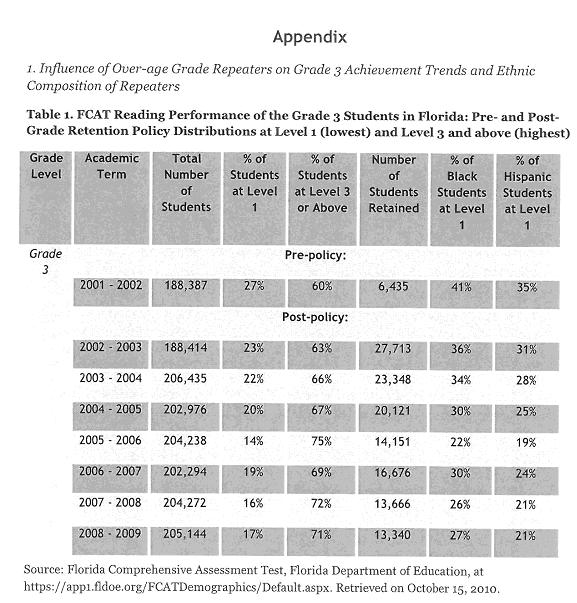
Madhabi Chatterji to very likely be the cause for much or most of the NAEP gains—but not in the positive learning sense that Mr. Bush is arguing. Chatterji demonstrates that by screening for low reading scores and then holding these students back a year, the state is able to initially exclude low-scoring students from the fourth-grade NAEP. Then, once these students are promoted to the next grade, the state is able to give the fourth-grade test to a group of students who would otherwise be fifth-graders. That is, these students have another year of learning under their belts. Further, these retained students are disproportionately from minority groups, meaning that the retention policy simultaneously falsely inflates overall scores while creating a misleading impression that the achievement gap is closing.
Ooooops…I still have the Appendix from the previous “review”:
If retention is causing “much or most” of the improvement in 4th grade scores, why have 3rd grade scores improved so much? Why did reading scores improve by a grade level worth of progress before the retention policy went into effect? Why have scores continued to climb even as retentions have substantially declined?
NEPC response:
The fact that Mathis doesn’t address any of this, but simply reasserts the flawed conclusion (the new reviewer at least attributes it to Chatterji rather than claiming it as his own this time- but should credit Haney instead continuing to rip him off) as valid tells you what you need to know about these guys. They are out to muddy the water if they can, not to engage in a serious debate.
It seems painfully obvious that the reviewer neither watched Governor Bush’s presentation in Michigan, nor even a video of it. Much of the review reads like an ed-school graduate student trying to get their comprehensive exams past a committee including David Berliner and Gene Glass: I cited you! I cited you! The poor chap seems to think that things these guys wrote in the past about programs in other states serves as proof positive about programs in Florida (they don’t) and that a consensus among left wing ed school profs constitutes evidence (it doesn’t).
“Unfortunately, if research is our guide, the effect of the Florida reforms will likely prove to be a more inequitable and inadequate educational system,” Mathis wrote. Mathis should have said “Unfortunately, if the nonsense that passes for ‘research’ in my ideological tribe is our guide, the effect of the Florida reforms will likely prove to be a more inequitable and inadequate educational system.”
That’s an awfully tart statement. You were just thinking “Can he back that up with evidence?” Glad you asked!
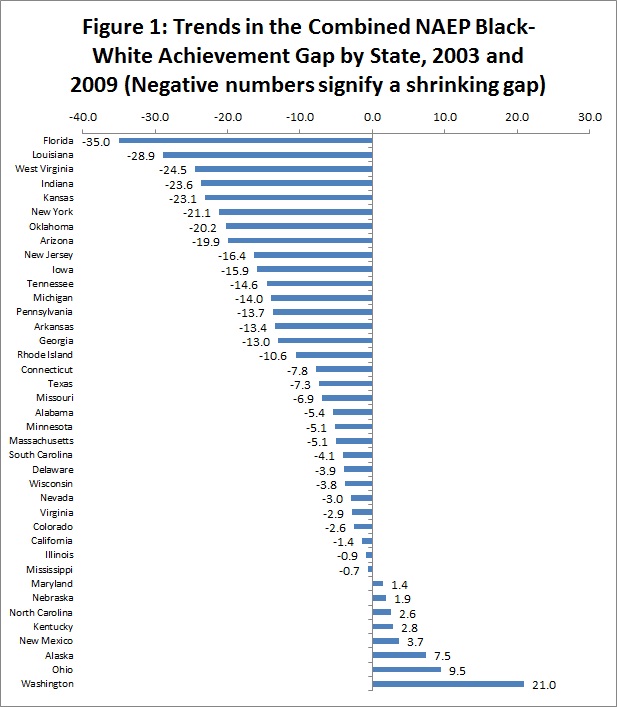
It just so happens that I have been digging into the NAEP data to look at achievement gap trends by state. I combined all four major NAEP exams (4th grade reading, 4th grade math, 8th grade reading, 8th grade math) for the entire period that all 50 states participated (2003-2009). Anyone can go and look these numbers up for themselves, and here is a little sneak peek:
If you guessed that Florida made more progress than any other state in narrowing the Black-White achievement gap on the combined NAEP exams, give yourself a gold star. If you don’t believe it, go look the numbers up for yourself. White students made gains, but Black students made bigger gains. This is really the only good way to narrow an achievement gap, and it is the way it happened in Florida. The same is true of the Hispanic-White gap- Florida led the nation, and bettered the national average by a factor of almost six. Florida achieved the second largest narrowing in the gap between poor and non-poor students, and between children with disabilities and without them.
However, following the example of Arthur, King of the Britons, we’ll call it a draw.
UPDATE Commentor Chan S detected a computational error in the Black-White achievement gap which underestimated Florida’s progress in reducing the gap. After double checking the figures, I’ve included a corrected chart.
In 1916, legendary Georgia Tech coach John Heisman had a score to settle with Cumberland College. His engineers led 126-0 at halftime, inspiring Heisman to tell his players “We’re ahead, but you just can’t tell what those Cumberland players have up their sleeves. They may spring a surprise. Be alert, men.”
The final score: Georgia Tech 222, Cumberland College 0. The Atlanta Journal reported, “As a general rule, the only thing necessary for a touchdown was to give a Tech back the ball and holler, ‘Here he comes’ and ‘There he goes.’ ”
DC (1) Opportunity Scholarships reenacted, expanded
Florida (2) McKay Scholarship expansion, Step Up for Students Tax Credit Expansion
Georgia (1) Tax credit expansion
Oklahoma (1) New tax credit, (major fix of special need voucher)
Indiana (3) New statewide voucher, expansion of tax credit, new tax deduction
Louisiana (1) Tax deduction expansion
Wisconsin (2) Milwaukee Expansion, New Racine Program
Iowa (1) Tax credit expansion
North Carolina (1) New special needs tax credit
Ohio (3) Cleveland expansion, Ed Choice expansion, Autism to Special needs expansion
Most legislative sessions are winding down this year, but we could see some additions to the list. There are too many great stories to cover here, from the heroic struggle to save the DC Opportunity Scholarship Program, to Colorado’s turning a court defeat based upon “local control” on its head, and Wisconsin emerging from years of toil and struggle to enact an amazing expansion, to Arizona lawmakers embarking on an experiment in liberty to give parents control down of the education of their child down to the last penny.
Lots of important reforms outside of private choice as well- major tenure reforms, charter caps lifted, some pathbreaking expansions of digital learning. It will take time for the smoke to clear just to see what actually passed, much more before we will have any clue about results.
A few states have taken what I would describe as deep reform dives-embracing a broad set of reforms making truly historic changes. Florida of course has long been in the lead here, and Florida had a fantastic education reform session this year, reforming tenure, expanding digital learning and passing a truly amazing law to expand high quality charter schools.
Indiana however may be the pupil that has exceeded the master.
Indiana adopted critical Florida reforms, like grading schools A-F and social promotion curtailment, last session. During this session, Indiana’s reformers went far beyond enacting the most far reaching choice programs. Go and read the transcript from Governor Daniels speech at AEI. After detailing Indiana’s far reaching collective bargaining, teacher quality and parental choice reforms, Daniels sort of casually mentions:
And here’s another little calendar quirk that we just moved the school board elections from the spring to the fall. So test from the fall to the spring, elections from the spring to the fall, what’s up with that, you want to know? Well, spring is when we have primaries, nobody votes. It’s a lot easier to dominate, for a small or for an interest group to dominate the outcome and elect a friendly school board in the sparsely attended primary elections. And so now they will have more of the public at least eligible or at least on hand to take part in those elections, we’ll see if it makes a difference.
Now this, ladies and gentlemen, is comprehensive education reform: grading schools A-F based on student proficiency and gains, curtailing social promotion, tenure reform including the mandated use of student performance as a part of formula, throwing out the 900 page collective bargaining agreements, and what will be the nation’s largest system of parental choice. Oh, and by the way, we are going to take a shot at massively increasing democratic participation in school districts while we are at it, just for fun.
Govenor Daniels described these reforms as “mutually reinforcing” in his AEI speech. When I heard that line, I literally gasped and thought to myself: he really gets it!
Indiana lawmakers have not however suspended the law of unintended consequences. Many challenges known and unknown attend such profound change, and the hardest work lies ahead. Among the known challenges: Indiana has term limits, and these far reaching reforms come in the twighlight rather than the dawn of the Daniels terms of office. Seeing this business through will be an enormous challenge for the next crop of Indiana policymakers, if they choose to accept it.
Ok, enough of the grim warrior business. If you can’t pause to celebrate victory, you won’t last the season. This has easily been the best year for K-12 reform, and the best is yet to come.


 Posted by Jay P. Greene




 (Guest Post by Matthew Ladner)



 Jay P. Greene's Blog