How I Learned to Stop Worrying and Love the Demographic Time Bomb

May 22, 2014

Ladner Orlando

(Guest Post by Matthew Ladner)

Yesterday I had the opportunity to present at the American Federation for Children conference in Orlando along with Pat “PDiddy” Wolf, Lance Izumi, refereed by our main man Ed Kirby.  Lance busted out depressing “Not as Good as You Think” evidence on suburban public schools  in California and Illinois.  PDiddy used Bud and Sissy from one of the greatest really bad movies of all time to tell us that school choice research is looking for love in all the wrong places, and even included the great Scott Glenn:

 

Make fun of my transparent muscle shirt and I will put you in the hospital…

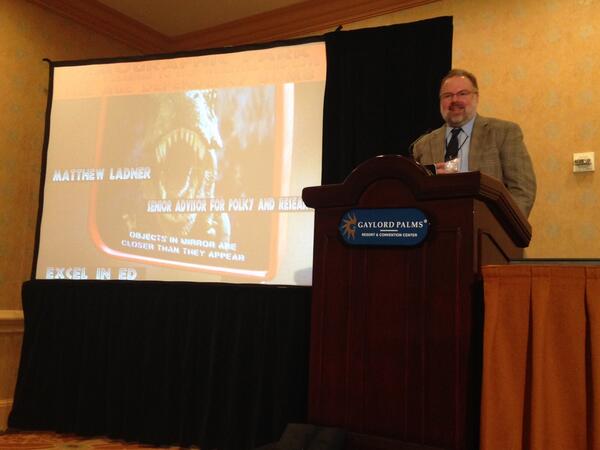
I batted clean up with a talk on age demographics. Someone told me that you can save a power point as jpg files, so I gave it a try. Here is the first slide:

Slide1Here is the most relevant middle slide, showing that a number of states are set to get hit with a double challenge of large increases of young and old people by the year 2030 according to Census Bureau estimates, causing all kinds of health care, pension and education challenges:

Slide6

So some of you are wondering what your state looks like. Let me just tell you- it is bad. Stay tuned for a Friedman Foundation with the gory details by state. Oh by the way, the people who will be in their prime earning years in 2030 are in the public school system right now, and only a minority of them are being educated to a high level. Ergo the conclusion:

In short, everything we’ve done up to this point needs to have been baby steps towards what comes next.  What comes next needs to be a far deeper and more powerful policy interventions than incremental policies like our current charter and voucher programs. In an earlier panel, Derrell Bradford related that we used to buy our music at Tower Records, used to buy whole albums in order to get a single song, but that Napster and then iTunes had changed all of that for the better. Gisele Huff then made the point that too much of what we are doing in the school choice movement is dedicated to setting up new record stores.

Or perhaps in getting public funds to add a new wing on to the existing Tower Records.

I don’t want to pick on my friends in Indiana too much, as this idea of using public funds to add existing space onto participating private choice programs would doubtlessly have a higher ROI than much public K-12 spending in Indiana and would provide a better opportunity for thousands of disadvantaged children.  Having said that, it strikes me as a troubling idea. In my opinion the focus should clearly be on how to get many of the 2/3 of Indiana private schools who do not participate in the voucher program to change their minds (**cough**less regulation **cough**).

Next, let’s get the scholarship amount up to something decent, let the colleges and universities into the K-12 space, have blended learning make the jump into private schooling, see if you can get a private tutoring sector to flourish (it worked out really well for Alexander the Great and many of the founder fathers btw) etc.  In other words, let’s give parents control of the money and an incentive to consider opportunity costs and see what they come up with.  This could resolve a number of vexing questions.  For instance, how should technology be used to improve learning? I’m not sure, and if you are sure then you may need to work on humility. Perhaps we should let the parents figure that out through a system of voluntary exchange, let them change, customize and improve it over time.  How much should a digital course cost? I have no idea but we have these demand and supply curves that have a really strong track record in figuring questions like that out.

Right now we have an incrementally expanding charter school sector and few private choice programs capable of spurring new private school creation. Even if we improve our choice programs to spur new private school creation, it will essentially resemble a second charter school program incrementally adding new space year by year. This is both highly desirable and nowhere close to where we urgently need to go.

We need to be in this for the kids and the parents, not for a tiny preexisting stock of private schools. Don’t get me wrong private schools- I do deeply love you– but choice funding is the entitlement of the child not of any system of schools.  Private schools need to be a bigger part of the solution, but we should never mistake them for the entire solution.

“We’ve squeezed everything we can out of a system that was designed a century ago,” Marc Tucker, vice chairman of the New Commission on the Skills of the American Workforce told the Christian Science Monitor in 2006. “We’ve not only put in lots more money and not gotten significantly better results, we’ve also tried every program we can think of and not gotten significantly better results at scale. This is the sign of a system that has reached its limits.”  Personally I can think of some ways to squeeze more out of the current system, but their political sustainability will always have limits and Tucker is basically right in his assessment. “I think we’ve tried to do what we can to improve American schools within the current context,” Jack Jennings told the CSM. “Now we need to think much more daringly.”

Time to change the “current context”

Here is my version of daring- let’s give parents complete control over our K-12 funding within a system of financial oversight and academic transparency and incentives to economize and sit back and marvel as they figure out solutions of how to make the best use of limited resources.  We are going to have far fewer resources to provide in the future due to the looming battle between health care and education spending. We must go faster towards increased return on investment and customization. The Economist magazine said it better than I can after it reviewed the evidence on choice and concluded:

In rich countries, this generation of adults is not doing well by its children. They will have to pay off huge public-sector debts. They will be expected to foot colossal bills for their parents’ pension and health costs. They will compete for jobs with people from emerging countries, many of whom have better education systems despite their lower incomes. The least this generation can do for its children is to try its best to improve its state schools. Giving them more independence can do that at no extra cost. Let there be more of it.

Lots and lots more as fast as possible.


School Choice Is The Answer

May 22, 2014

(Guest Post by James Shuls)

Lately, I have had a number of people say to me, “School choice is not the answer.” For those that make this claim, I’m really not sure what question they are asking.

Opponents of school choice like to claim that choice just puts a Band-Aid on a problem or that it simply misdirects resources from struggling public schools. This is a fundamental misunderstanding of how school choice works and the implications it has for the education system. Below, I highlight several questions and I show that school choice is the only answer to the most vexing problems in education. At least it is the only answer that solves issues without government compulsion and unintended negative consequences as a result of government action.

How do we get schools to have high learning standards for students without relying heavily on standardized tests? School Choice.

Most people agree that schools should be held accountable. That is, we established public schools to educate students; therefore, schools should educate students. Our current method of ensuring that schools have rigorous standards and that students are learning is through test based accountability. We set learning standards, mandate standardized tests, and impose penalties or sanctions for schools that fail to achieve.

There are concerns that this model has led to a narrowing of the curriculum and an overreliance on standardized tests. The strongest complaints against this system come from educators themselves.

School choice changes the dynamic. Rather than being accountable to perform on standardized tests, schools in a choice system are expected to meet the needs of their students and parents. Enabling parents with the power to choose empowers them to be the direct enforcers of accountability. If a school is not educating students, parents can choose to send their children somewhere else. Choice is accountability.

How do we improve the quality/respect of teachers in the classroom? School Choice.

Currently, the education system treats teachers like widgets with no respect for performance. In most schools, great teachers have no ability to be rewarded for their efforts. They are paid almost exclusively based on years of experience and their credentials. More importantly, there is little competition for a teacher’s labor. It is rare for schools to actively recruit excellent teachers from other schools and offer financial incentives for them to move. This is the exact opposite of nearly every other sector, including the professions with which teachers aspire to be considered.

When schools are held accountable to parents through school choice, they have an incentive to seek and reward excellent teachers. The end effect is that choice breaks up the monopsony of the public school system and creates a market for talented teachers.

Demand for good teachers is how you improve the quality and respect for professional educators. We have tried and have been unsuccessful in achieving as much through stringent licensing requirements, pensions, and a host of other measures.

How do we overcome problems of poverty in urban school districts? School Choice.

Throughout the country schools in urban settings are struggling. Many are considered drop out factories, where half of the students fail to graduate. Stalwarts of the traditional public education system like to say, “Teachers and schools aren’t the problem, poverty is the problem.”  They are right.

Poverty and all that it entails is the single biggest obstacle to students achieving excellence in education. Poverty is a problem everywhere, even in rural schools, but it is particularly pronounced when schools have a high-concentration of poverty. In many urban schools, nearly 90% of the students qualify for free or reduced price lunches – a common metric of poverty status.

School choice does not lift people out of poverty, but it does help ameliorate the effects.

First, it is important to recognize that schools with high concentrations of poverty are the product of residential zoning of traditional public schools. When we create artificial barriers around school districts, we lock housing values to the quality of schools. Over time, this results in wealthier families sorting into better school districts and pricing out the poor families. In many ways, good public schools are a lot like my private neighborhood swimming pool – you can get in if you can afford a house in the neighborhood.

Choice also gives low-income families the ability to advocate for their children – something many parents lack – and it gives schools the incentive to improve. If poverty is the problem, the answer is more choice, not less.

I could go on.

School choice is not a magical fix. It will not result in miraculous improvements tomorrow, but Chubb and Moe were right when they wrote:

…choice is not like the other reforms and should not be combined with them as part of a reformist strategy for improving America’s public schools. Choice is a self-contained reform with its own rationale and justification. It has the capacity all by itself to bring about the kind of transformation that, for years, reformers have been seeking to engineer in a myriad of other ways.

If you are asking the right question, school choice is most definitely the answer.

——————————

James Shuls is the Director of Education Policy at the Show-Me Institute. Follow on Twitter @shulsie


“Doesn’t God Believe in My Pursuit of Happiness?”

May 21, 2014

(Guest post by Greg Forster)

My nomination of Kickstarter for The Al didn’t get off the ground, but after watching this trailer, I already feel like I got full value for the $40 I chipped in to help Zack Braff make this movie without letting the idiots who seem to be in charge of Hollywood mess around with it. Enjoy!


Centralized and Decentralized Reform Longevity in NYC

May 14, 2014

This is my apprentice Darth de Blasio. He will deal with your beneficial retention policy….

(Guest Post by Matthew Ladner)

Jay’s important post on choice programs developing a stronger constituency than many other types of education reform has an obvious recent example in Mayor de Blasio’s New York City. New York City has a earned promotion policy for improving literacy instruction. The program demonstrated strongly positive results, including not one but two positive evaluations from the RAND Corporation using advanced statistical analysis.  Sadly when this worthy retention policy ran up against Darth de Blasio the result was:

The unfortunate reality is that the earned promotion policy, while demonstrably effective, has a limited constituency to defend it.  A large population could benefit from the continuation of the policy but lacks organization. One of the most basic laws of politics is that organized interests defeat disorganized interests 99 times out of a hundred trials, or thereabouts.

What happened when de Blasio went after charter schools? Oh yeah…

So how did the assault on charter schools turn out for the Darth Randi’s apprentice?

Does this mean we should avoid all top down policies like the plague and focus only on promoting choice? Not in my book, but it is worth noting that policies enjoying little support outside a small group of supporters can be easily reversed. Developing a base of support is essential to policy longevity.  I don’t think that choice is the only K-12 policy reform that has the potential to develop broad support, but it is an equation that few other policies have solved.


How People Hate Jews, The ADL Counts the Ways

May 13, 2014

The Anti-Defamation League (ADL) released today an amazing global survey measuring anti-Semitism.  Researchers interviewed 53,100 people in over 100 countries using an index that the ADL has been using for 50 years to track hatred of Jews.  A person is considered anti-Semitic if they said that at least 6 of the following 11 statements is “probably true”:

ANTI-SEMITIC STEREOTYPES

1) Jews are more loyal to Israel than to [this country/the countries they live in].
2) Jews have too much power in the business world.
3) Jews have too much power in international financial markets.
4) Jews don’t care about what happens to anyone but their own kind.
5) Jews have too much control over global affairs.
6) People hate Jews because of the way Jews behave.
7) Jews think they are better than other people.
8) Jews have too much control over the United States government.
9) Jews have too much control over the global media.
10) Jews still talk too much about what happened to them in the Holocaust.
11) Jews are responsible for most of the world’s wars.

You really should read the Executive Summary to learn about what they found, but here are some of the highlights (or should I say lowlights):

  • 26% of respondents globally thought that at least 6 of these 11 anti-Semitic statements is probably true.
  • In the Middle East and North Africa (MENA) 74% met this threshold of anti-Semitism.
  • Muslims reported the highest levels of anti-Semitism (49%), followed by Christians in Eastern Orthodox countries (36%), Catholics in majority Christian countries (25%), people with no religion (21%), Hindus (19%), Budhists (17%), and Protestants in majority Christian countries (15%).
  • Region seemed to trump religion.  Christians in MENA had rates of anti-Semitism (64%) that were closer to the average in their region and very different from Christians elsewhere.  Conversely, Muslims in W. Europe and the Americas had lower rates of anti-Semitism (29%) than Muslims in MENA (75%).
  • Only 54% globally were aware of the Holocaust.  Of those who were aware, 32% believed that the Holocaust was a “myth” or “exaggerated.”  These answers on the Holocaust are strongly related to rates of anti-Semitism

There were, however, some positive signs:

  • Younger people (under 25) are less anti-Semitic (18%) than older people (34% for those over 65).  Perhaps more positive views will gain traction as the older generation of Jew-haters dies out.
  • People living in countries with more Jews have lower rates (22%) than those in countries with few or no Jews (28%).  Of the 26% reported as anti-Semitic, 70% had never met a Jew.  Familiarity reduces hatred.
  • In the Americas, W. Europe, and Oceania, higher education levels are associated with lower rates of anti-Semitism.  But in MENA the opposite is true.  Education can reduce hatred, but it depends on what is taught.

You can see all of this and much more in the Executive Summary and on the cool web site.  I was particularly struck by some of the results for individual countries.  Residents of the West Bank and Gaza top the list of countries with a 93% anti-Semitism rate.  Greece tops the list among countries outside of MENA at 69%.  South Korea, which has a grand total of about 100 Jews, has the highest rate in Asia (53%).  The US has one of the lowest rates (9%), which is down from 29% in 1964.


The Political Virtue of Choice

May 13, 2014

We’ve been offering much strategic advice to ed reformers on this blog lately.  I’ve warned about the dangers of over-reach, recommending instead an incremental and decentralized approach.  Greg has warned that a national system of standards without control over implementation provides license to every quack, crackpot and anti-Semite to un-accountably pursue their own agendas while claiming that national standards made them do it.  Matt has nicely documented how heavy regulation of private choice programs, especially requiring private schools to administer the state test, defeats the very purpose of  expanding choice by driving 2/3 of private schools out of the program while forcing the remaining 1/3 to teach the state curriculum.  You can choose any McDonalds franchise you like and they will compete to make the best burger — too bad if you are a vegetarian.  And Matt has balanced my call for incrementalism with a warning that reforming too slowly fails to land a winning blow.

All of this is, I think, very sound advice.  But these may all be smaller pieces of what I believe is the big advice ed reformers need to hear — there is political virtue in pursuing choice as a reform strategy over top-down reforms, including standards, accountability, curriculum, and pedagogy.

Choice does not depend on policymakers being brilliant or benevolent.  With top-down reforms the people selecting the standards, designing the tests, setting the cut-scores, devising consequences for performance, writing the curriculum, and picking the instructional methods have to get it just right.  They also have to be right for many different kinds of kids who may need different approaches.  And they have to be right over and over again as circumstances and information change.  Oh — and they have to somehow ignore their own interests and pressure from other interested groups of adults that may pull them away from making the right decisions for kids.

People will also make mistakes in choice systems.  But when they do, those mistakes do not affect thousands or millions of kids.  They are also less likely to make those mistakes because the people choosing, usually parents, are closer to the children and more likely to know what those children need.  Parents have interests that are also more likely to be aligned with those of their own children and interested groups are incapable of capturing all of them to influence decisions.

More importantly, from a political perspective, choice has the virtue of creating its own constituency.  As families get the ability to choose, they develop an interest in keeping that ability.  So, they will fight efforts to roll-back or restrict choice.  As more people get to choose, the constituency for choice grows and the ability to protect and expand those programs gets stronger.

Top-down reforms, on the other hand, are the most popular on the day they are adopted and steadily lose their constituency over time.  To get adopted, top-down reforms usually have to maintain some level of ambiguity about what they will do to attract a winning coalition.  As they get implemented they have to make more clear what will and won’t be taught, who will and won’t experience consequences, etc….  The losers discover who they are and begin to organize against top-down reforms once they are implemented.

Elites outside of the education system may support accountability testing, merit pay, or mandated curriculum, when they are abstractions being considered for adoption.  But once they are put into place and opposition grows stronger, who remains as the champions of these top-down reforms?  This is why top-down reforms are so easily blocked, diluted, and co-opted.  They have no natural constituencies and gain none as they are implemented over time.

Choice does, however, have three major political vulnerabilities.  First, choice program may be easier to protect once they are adopted, but they are harder to adopt in the beginning.  Their opponents are fully mobilized against them when they are proposed and their potential beneficiaries do not yet know who they are.  This is why the expansion of choice has been relatively gradual.  But each new victory gets easier as the constituency of choosers grows.  And setbacks are very rare because only un-elected judges have repealed programs — politicians won’t cross the swelling ranks of empowered parents.

Second, even if choice tends to be a one-way ratchet where victories are permanent and defeats are temporary, the programs are vulnerable to slow-motion strangulation by regulation.  Rick Hess and Mike McShane had an excellent piece in USA Today recently warning about this.  But again, the natural and growing constituency of choice parents and schools can provide a useful check on excessive regulation.  This is not perfect — sometimes people are too willing to trade away their liberty for the promise of security — but freedom is very attractive and people tend to fight to keep it once they have it.

The third vulnerability is that when people get to choose, some of them will make mistakes and some providers will be bad actors.  Opponents will seize upon these bad outcomes, even if they are rare, and use them to argue for strangling regulation or even repeal.  Of course, top-down systems contain plenty of mistakes and bad actors — in fact they are more likely to have them for the reasons discussed above.  Because choice grows its own constituency, it can generally hold back calls for strangling regulation or repeal stemming from individual cases of bad decisions or bad actors.

The central political virtue of choice over top-down reforms is that choice gains more supporters as it grows while top-down reform lose supporters as they grow.


Sun Tzu and the Art of Education Reform

May 12, 2014

(Guest Post by Matthew Ladner)

Jay recently wrote two excellent posts about policy overreach and the pace of reform. Little Ramona even took time off from whipping her AFT intern pool with a cat o’nine tails to get them to write fake Diane Ravitch tweets faster to write an admiring post regarding Jay’s advice:

Greene ends his second post with a sage observation that ought to be pinned to the wall in every government office, every executive suite of every foundation, and every advocacy group:

Whether your preferred policy solution is based on standards and accountability, parental choice, instructional reform, or something else, the better approach to reform is gradual and decentralized so that everyone can learn and adapt. Your reform strategy has to be consistent with the diverse, decentralized, and democratic country in which we live. You won’t fix everything for everyone right away, but you should avoid Great Leaps Forward. Seek partial victories because with the paradoxical logic of ed reform politics total victory ultimately leads to total defeat.’

Jay’s post got me to thinking about my favorite warrior-sage, Sun-Tzu. What might he think about this?

On the one hand, Sun Tzu explicitly warns against long wars:

When you engage in actual fighting, if victory is long in coming, then men’s weapons will grow dull and their ardor will be damped. If you lay siege to a town, you will exhaust your strength. Again, if the campaign is protracted, the resources of the State will not be equal to the strain. There is no instance of a country having benefited from prolonged warfare…In war, then, let your great object be victory, not lengthy campaigns.

In other words win and win fast.  Sun Tzu advises against one of those hours long Rocky vs. Apollo type slug-fests where even the victor goes to the hospital.  He advises something more along the lines of:

Alas the education reform movement finds itself caught in an Ali rope a dope fight rather than an Iron Mike early conquest.  Neither George Washington, Winston Churchill, George Kennan, Ho Chi Mihn nor Martin Luther King Jr. had the opportunity for a quick and easy knockout either so you are in good company.  Jay’s point about seeking total victory leading to total defeat finds echoes in Sun Tzu as well:

In the practical art of war, the best thing of all is to take the enemy’s country whole and intact; to shatter and destroy it is not so good. So, too, it is better to recapture an army entire than to destroy it, to capture a regiment, a detachment or a company entire than to destroy them. Hence to fight and conquer in all your battles is not supreme excellence; supreme excellence consists in breaking the enemy’s resistance without fighting.

As an example of the above, I think it is safe to say that Sun Tzu would have little admiration for the quality of the effort put forward by American abolitionists.  From John Brown to Sherman’s March to Reconstruction these well-meaning people with a just cause seemed overly fond of the full frontal assault.  None of this excuses the actions of southerners at all. Note  however that it would have been rather extraordinary if the justices on the United States Supreme Court had failed to notice that the federal efforts in the south had almost completely backfired by the time of the contemptible Plessy case. Abolish slavery, hello sharecropping!  Amend the Constitution, say hello to Jim Crow. Deeply resentful southern racists eventually took  over the United States House and people in the north grew weary of their occupation of the south much faster, which is what one should expect given that everything they were doing more or less backfired.

Plessy was deeply horrible on many levels, but it essentially ratified the facts on the ground-facts that with sickening irony that abolitionists had helped to create.  Abolitionists did not achieve supreme excellence- they not only did not break the enemy’s resistance without fighting, they failed to break it with hundreds of thousands dead.  Their lack of supreme excellence, along with a great deal of idiocy on the part of southerners, helped usher in an additional century of Southern dark age.  We of course will never know how much of this tragedy could have been avoided, but we do know what actually happened and it was awful.  Britain and France went to war with Nazi Germany to protect Poland’s freedom only to see Poland put under the Soviet boot, but at least this only lasted half a century.  In the aftermath of America’s bloodiest war America’s slaves were transformed into sharecroppers without the right to vote and with little decent schooling.  We are still grappling with this sordid legacy today.

As Jay said, seeking total immediate victory often leads to abject failure.

All this is all the more tragic given that American abolitionists could have learned a great deal from the earlier triumph of Wilbur Wilberforce in England in abolishing the slave trade and eventually slavery itself.  Notice the crucial elements of success: undaunted effort, indirect means, an eventual embrace of patient incremental policies after the failure of multiple frontal assaults, no bloody war ultimately accomplishing little to nothing.

It’s no mystery why a reactionary like Diane Ravitch would find solace in Jay’s Rx- she is quite happy with the status-quo, and has a lot of K-12 workers hanging on her every word as she tells them what they desperately want to believe. This does not however mean that reformers should ignore Jay’s advice-he’s on to something important regardless of whether Ravitch or other reactionaries hope to make use of it. In fact, reactionaries themselves should fear reformers taking this advice to heart. If they do, defenders of today’s failed status quo will face far more effective opponents.  Jay is yelling reformers a warning from their blind spot.

Last year I spent a lot of time in Texas working on education reform. During the session I got an email from someone whose opinion I highly respect and who told me some things I really, really, really did not want to believe.  The email said in part:

Matt, Some of the efforts to improve ‘choice’ were heavy handed and arrogant. Vouchers always have had common enemies from both the left  and right, from rural and suburban, from minorities who would be the  beneficiaries.

Expectations were too high and ignored several factors—the  finance lawsuit being a major factor, delaying any real reform efforts  until it’s settled.

Some leading ‘reformers’ collected a variety of practices  purported to be effective in other states and proposed those for  Texas without doing the necessary base building for real support.  Even the A through F idea was  never  really sold well.  The battle fought last session over the over-engineered  accountability system was won by proponents but  they ultimately lost the war, exacerbating the growing  anti-testing sentiment.

The business community was split on ‘accountability’ for good  reason. There has been an over emphasis on ‘college ready’ and not  enough focus on ‘job ready’ with the latter having been subsumed by the former.  The resulting curricular pathways will show that for some segment  of employers simply raising standards is no longer enough and some new  designs are needed.

A big part of me wanted to fire off an angry email explaining that illiterate Texas kids didn’t have another day to wait, etc. Instead I let it sit for a day.  The next day I had to confess to myself:

Damn it all to hell he’s right on every single point.

Sadder and wiser I wrote back:

You are totally correct that there are going to be plenty of servings of humble pie to eat at the end of this session. I also fear that we reformers have gotten into the habit of viewing reforms as military conquests over bad guys to the detriment of efforts to inform and persuade. Persuasion is slow and its benefits can be ambiguous but where to you ultimately get without it?

Well it is mid 2014 now and the answer from the Texas example is pretty clear- nowhere.  Private choice failed, the commissioner did not implement A-F school grading after having the legislature forbid him to do so, the legislature has left the state’s accountability system as a complete train-wreck.  Sign me up for a double serving of humble pie.  Even the raising of the charter school cap represented only a symbolic victory as there were already ways around the cap and charter holders can open multiple campuses under preexisting Texas law.

Don’t get me wrong: I still believe that Texas school kids don’t have another damn day to wait for better schools. I must accept however the fact that failed attempts at reform don’t do them any good.  If there is going to be major changes in Texas K-12 education reformers are going to have to convince far more than 76 members of the Texas House, 16 members of the Texas Senate and one governor that they are good ideas. In fact, Texas reformers might be better off thinking of those 93 people as the last on the list to persuade rather than the first. Mere legislative majorities resemble words written into the sand of a beach without broader consensus and support.

If reformers want faster change, we must embrace the need to persuade a broader universe of people on the justice of our cause and the effectiveness of the means by which we hope to achieve them. If mere legislative majorities tempt you into thinking you can proceed without such consensus, think again.  Parental choice supporters should therefore embrace the burden of building a broad consensus while recognizing the danger overreach.  Persuasion is slow and its benefits can be ambiguous but where do you ultimately get without it?

Stomp on the gas reformers, but do take a look at the traffic conditions.  Your car won’t do you much good if it gets you and more importantly your passengers killed.


This Just In: Human Existence Validated

May 9, 2014

(Guest post by Greg Forster)

Ladies and gentlemen, a YouTube channel consisting entirely of board game reviews called GETTIN’ HIGGY WITH IT! exists.

Human life is now confirmed valid. That is all.


As if guided by Greg’s Invisible Hand…

May 8, 2014
(Guest Post by Jason Bedrick)
First George Will stole Greg’s money as a movie star, and now it appears that Jonah Goldberg — in the very same Fox News segment! — had intended to make the same point that Greg made earlier this week.
Here’s Greg:

Folks, from the moment you set yourself up as the dictator of the system,you officially own everything that happens in the system. This is not a new phenomenon. This is simply what you get when you announce that you have set a single standard for a huge, sprawling, decentralized system with literally millions of decision-makers, very few of whom have much incentive to do what you want, but very many of whom have some pet project they’d like to push through using your name to do it.

And here’s Jonah:

One of the problems the Obama administration faces with regard to Obamacare is that basically any adverse changes to health care will be blamed on Obamacare, even if the law has little to nothing to do with it. That’s because Obama and the Democrats vowed that Obamacare would transform the entire health-care sector. As a result any changes in that sector can be chalked up to Obamacare. In other words, Obama broke it, now he owns it. At least for public schools in 45 states, the same will likely hold true for Common Core. Not every stupid decision by a school administrator should be laid at the feet of Common Core, but because Common Core is transforming public education it will be easy to blame it for any bad decisions.

Not only that, but they both used the same example to buttress their point: California superintendent Mohammad Z. Islam blaming the Common Core for the ridiculous decision to have students write a paper taking sides on the question of whether the Holocaust occurred.
Greg, there is yet hope for your future as a talking head!