Vouchers and Low-Income: Reality Check

November 10, 2011

(Guest post by Greg Forster)

Have school vouchers moved away from their historic focus on low-income students? The political hacks at the Center on Education Policy think so. And as we know, whenever CEP weighs in, that’s reason enough to check the facts.

Paul DiPerna of the Friedman Foundation did a headcount and found that as of now:

  • 11 of 17 existing voucher programs have no income limits
  • 7 of these are statewide special-needs programs (FL, GA, LA, OHx2, OK & UT), 3 have geographic caps (ME, VT & OH) and one has a numeric cap (CO)
  • Of the 6 programs with income limits, 5 have limits that are above 200% of the poverty line

What do you know? CEP is right!

Of course, other kinds of limitations can be equally problematic. If our goal is to create a thriving marketplace of innovative options, the key is to provide enough students with enough choice to support new entrants – educational entrepreneurs – so we get beyond just moving kids from existing public schools to existing private schools. We don’t really have any existing programs that do that.

On the other hand, even among poorly designed programs there are better and worse forms. The income limitation was worse for educational entrepreneurship than, say, a straight numeric cap or a straight geographic limitaiton. As Milton always said, show me a program for the poor and I’ll show you a poor program. The hard reality is that lower-income people are not the population that throws its support behind truly innovative ventures. They have too much at risk. It’s the well-off, educated parents who are most likely to feel secure trying newer or more specialized schools. (Programs like EdChoice that are not “straight” geographic limitations but shift eligibility areas from year to year based on public school performance are another matter – they’re hugely problematic from this standpoint.)

The quickest way to unlock educational innovation and deliver better education to low-income students is to give vouchers to everyone. That way the innovations will, you know, actually happen.

Since I know you’re wondering, here are the tax-credit scholarship numbers for comparison purposes:

  • 3 of 10 tax-credit scholarship programs have no income limits
  • One of the three (AZ) is a statewide special-needs program
  • 6 of the 7 programs with limits have limits that are above 200% of the poverty line

2011 NAEP: Florida Finally Hits a Wall

November 3, 2011

(Guest Post by Matthew Ladner)

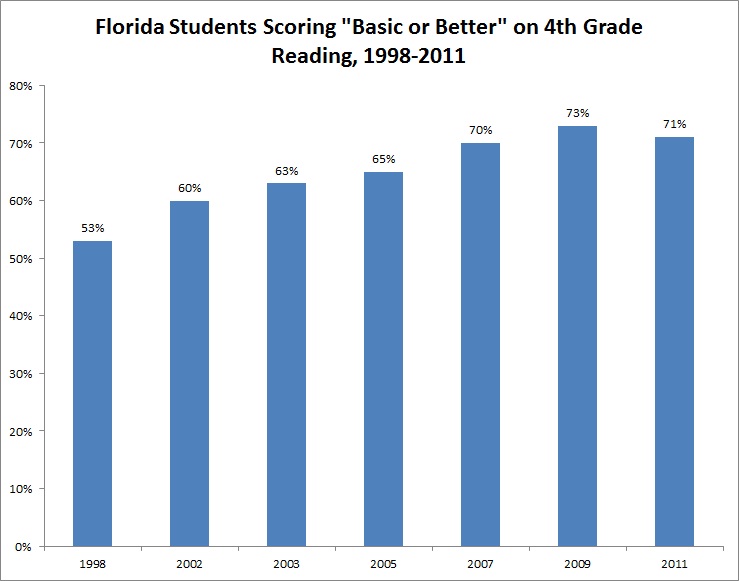
The Florida Age of Public School Improvement hit a wall in the 2011 NAEP. This should not be terribly surprising, as Florida’s improvement seemed certain to plateau in the absence of additional reforms.

Governor Jeb Bush relentlessly pursued a dual strategy- transparency with teeth from the top down, parental choice from the bottom up. Together these reforms drove improvement in the public schools for a number of years.  Accountability measures included school grading (A-F) and earned promotion in the early grades. Parental choice measures included Opportunity Scholarships for children attending F rated schools, the nation’s first special needs voucher program (McKay Scholarships), the nation’s largest scholarship tax credit program (Step Up for Students), a decent charter school law and the nation’s most robust system of digital learning. Florida lawmakers also attempted to thoughtfully incentivize success.

Governor Bush took office in 1999 and left office in 2007. It would be nice if these efforts could indefinitely push progress forward, but there have been plenty of bumps and problems along the way. In 2006, the Florida Supreme Court rendered a logic-free ruling abolishing Opportunity Scholarships (failing school vouchers) for private schools, and followed that up by ruling against a state authorizer for charter schools. Tax-credits, McKay and digital learning continued to incrementally advance, but not at an earth-shattering rate.

The larger problem may have come in the top down measures. The chart below presents the distribution of district and charter school grades, with one line being the A/B grades and the other D/F grades. The dotted lines represent instances when the state board raised school grading standards.

The setting of these standards represents far more of an art than a science. Set them far too high and disaster follows (this happened in Arizona). Set them too low, and you remove the tension in the system needed to drive improvement. Even after the last increase in grading standards, more than 10 times as many Florida schools received A/B grades as D/F grades.

Florida’s policymakers raised standards four times, and last year (wisely) put in an automatic trigger to raise standards by a preset amount when a certain ratio of schools get A or B grades. In addition, a fresh set of reforms passed the Florida legislature in 2011, revamping teaching and increasing charter school and digital learning options.

Just as it is impossible to exactly pinpoint how much of what caused the gains, it is likewise impossible to say exactly what made them stall. Note however that one of the favorite explanations of the anti-reform crowd, the pre-school, finally saw the advent of children old enough to have participated in the program and age into the 4th grade NAEP sample. I hope that someone is carefully studying variation in participation and corresponding trends in FCAT data, but the results at the aggregate level thus far seem underwhelming.

Plenty of other things, however, have been going on- including the collapse of a housing bubble, cutbacks in public school funding (including of some of the incentive funding programs) and a variety of other very bad things. My advice to Florida policymakers: roll up your sleeves and get back at it. Despite the enormous amount of progress seen on NAEP (and no one loves celebrating it more than me) too great of a gulf lies between a state system awarding ten times as many top grades as low grades but still  suffering from large minorities of students scoring below basic on the NAEP exams.

Governor Bush has consistently said for years that success is never final, and reform is never finished. The 2011 pause in progress demonstrates that he called it correctly.  Moving the needle on student learning on a meaningful scale and at a sustained basis represents one of the greatest public policy challenges of our times. Governor Bush has passed the torch to a new generation of Florida reformers, and they must now find new ways, and fine-tune the old ways, to push academic progress forward.

Edited for typos


The End of the Beginning

October 14, 2011

(Guest post by Greg Forster)

The new School Choice Advocate just arrived, and it contains a short interview with Janet Friedman Martel and David Friedman – Milton and Rose’s children.

I thought this was especially well put:

We’ve seen uprecedented strides forward in school choice this year. How does the progress of this year measure up against Milton and Rose Friedman’s vision?

We are still short of the vision of a school system where private schools compete on equal terms with public schools. Measured by the fraction of students with access to vouchers, our achievement is still small. But measured by the rate at which that number is increasing, it has been large. As Churchill put it, this is not the beginning of the end, but it might be the end of the beginning.


Steve Jobs on Education

October 6, 2011

Everyone is talking about Steve Jobs this morning.  The acknowledgement of how he improved the human condition while also making billions in profits for himself and others almost makes the Al Copeland Humanitarian Award unnecessary this year.  Steve Jobs embodied the entrepreneur as humanitarian — not because he gave away his wealth as if to cleanse himself of the sin of having earned it, but because he created and promoted consumer items that significantly improved our lives while justly generating enormous wealth for himself, his employees, and shareholders.

In addition to embodying the spirit of “The Al,” Jobs had quite a lot of smart things to say about education reform.  I’m grateful to Whitney Tilson for reminding me of this.  Here are some selected remarks from Steve Jobs on education:

[On Unions]

I’m a very big believer in equal opportunity as opposed to equal outcome. I don’t believe in equal outcome because unfortunately life’s not like that. It would be a pretty boring place if it was. But I really believe in equal opportunity. Equal opportunity to me more than anything means a great education. Maybe even more important than a great family life, but I don’t know how to do that. Nobody knows how to do that. But it pains me because we do know how to provide a great education. We really do. We could make sure that every young child in this country got a great education. We fallfar short of that…. The problem there of course is the unions. The unions are the worst thing that ever happened to education because it’s not a meritocracy. It turns into a bureaucracy, which is exactly what has happened. The teachers can’t teach and administrators run the place and nobody can be fired. It’s terrible.

[On Vouchers]

But in schools people don’t feel that they’re spending their own money. They feel like it’s free, right? No one does any comparison shopping. A matter of fact if you want to put your kid in a private school, you can’t take the forty-four hundred dollars a year out of the public school and use it, you have to come up with five or six thousand of your own money. I believe very strongly that if the country gave each parent a voucher for forty-four hundred dollars that they could only spend at any accredited school several things would happen. Number one schools would start marketing themselves like crazy to get students. Secondly, I think you’d see a lot of new schools starting. I’ve suggested as an example, if you go to Stanford Business School, they have a public policy track; they could start a school administrator track. You could get a bunch of people coming out of college tying up with someone out of the business school, they could be starting their own school. You could have twenty-five year old students out of college, very idealistic, full of energy instead of starting a Silicon Valley company, they’d start a school. I believe that they would do far better than any of our public schools would. The third thing you’d see is I believe, is the quality of schools again, just in a competitive marketplace, start to rise. Some of the schools would go broke. Alot of the public schools would go broke. There’s no question about it. It would be rather painful for the first several years

DM: But deservedly so.

SJ: But far less painful I think than the kids going through the system as it is right now.

[On Digital Learning]

The market competition model seems to indicate that where there is a need there is a lot of providers willing to tailor their products to fit that need and a lot of competition which forces them to get better and better. I used to think when I was in my twenties that technology was the solution to most of the world’s problems, but unfortunately it just ain’t so… We need to attack these things at the root, which is people and how much freedom we give people, the competition that will attract the best people. Unfortunately, there are side effects, like pushing out a lot of 46 year old teachers who lost their spirit fifteen years ago and shouldn’t be teaching anymore. I feel very strongly about this. I wish it was as simple as giving it over to the computer….

As you’ve pointed out I’ve helped with more computers in more schools than anybody else in the world and I absolutely convinced that is by no means the most important thing. The most important thing is a person. A person who incites your curiosity and feeds your curiosity; and machines cannot do that in the same way that people can. The elements of discovery are all around you. You don’t need a computer. Here – why does that fall? You know why? Nobody in the entire world knows why that falls. We can describe it pretty accurately but no one knows why. I don’t need a computer to get a kid interested in that, to spend a week playing with gravity and trying to understand that and come up with reasons why.

DM: But you do need a person.

SJ: You need a person. Especially with computers the way they are now. Computers are very reactive but they’re not proactive; they are not agents, if you will. They are very reactive. What children need is something more proactive. They need a guide. They don’t need an assistant. I think we have all the material in the world to solve this problem; it’s just being deployed in other places. I’ve been a very strong believer in that what we need to do in education is to go to the full voucher system. I know this isn’t what the interview was supposed to be about but it is what I care about a great deal.

(Source: Smithsonian Institution Oral and Video Histories)

The above interview was from 1995, but it is clear that Jobs did not significantly change his mind over time.  In 2007 he reiterated that unions and lifetime employment for teachers were at the heart of the problem.  This is from PC World:

During a joint appearance with Michael Dell that was sponsored by the Texas Public Education Reform Foundation, Jobs took on the unions by first comparing schools to small businesses, and school principals to CEOs. He then asked rhetorically: “What kind of person could you get to run a small business if you told them that when they came in, they couldn’t get rid of people that they thought weren’t any good? Not really great ones, because if you’re really smart, you go, ‘I can’t win.’ ”

He went on to say that “what is wrong with our schools in this nation is that they have become unionized in the worst possible way. This unionization and lifetime employment of K-12 teachers is off-the-charts crazy.”

After Steve Jobs made these comments I wrote an op-ed for the NY Sun, which stated:

There is a price to be paid for this kind of frank analysis and Steve Jobs knows it. “Apple just lost some business in this state, I’m sure,” Mr. Jobs said. Of course, Apple sells a large portion of its computers to public school systems. By taking a stance against school unionization, Mr. Jobs may lose some school sales for Apple.

Sharing the stage with Mr. Jobs was Michael Dell, the chief executive officer of Dell, a competing computer manufacturer. By comparison, according to the description of the event, Mr. Dell “sat quietly with his hands folded in his lap,” during Mr. Jobs’ speech while the audience at an education reform conference “applauded enthusiastically.”

Mr. Dell followed Mr. Jobs by defending the rise of unions in education: “the employer was treating his employees unfairly and that was not good. … So now you have these enterprises where they take good care of their people. The employees won, they do really well and succeed.”

Whether Mr. Jobs or Mr. Dell is right about the role unions have played in public education, one thing is perfectly clear – attacking the unions is a controversial and potentially costly choice for corporate CEOs.

The safe thing is to make bland declarations about the need to improve the quality of education without getting into any of the messy particulars that might be necessary to produce a better education. Changing the status quo in education almost certainly requires ruffling someone’s feathers, but doing that is almost certainly bad for business.

In part this is why we see highly successful entrepreneurs who survive in a world of ruthless competition abandon these business principles when they turn to education philanthropy. People who would never endorse the idea that businesses should be granted local monopolies, offer workers lifetime tenure, or pay employees based solely on seniority, embrace a status quo public system that has all of these features.

While some CEOs may sincerely believe that education is somehow different from the rest of the world in which they live, others have been cowed into submission. Teachers are a very large, well-organized, and relatively affluent consumer and political bloc….

Steve Jobs has embarked on a perilous path, but with solid evidence and persuasive arguments, he can move all of us toward higher quality schools. He should be applauded for having the courage to say out loud what scores of other business leaders are too sheepish to say.

Unfortunately, Steve Jobs will no longer be with us as we try to advance on this perilous path of education reform.


(Edited somewhat for brevity.  See Jobs’ full interview at Smithsonian Institution Oral and Video Histories)


Carr Makes It 19-0

August 17, 2011

This finding’s been replicated more often than Picard’s Earl Grey.

(Guest post by Greg Forster)

Still clearing the backlog: I haven’t had a chance yet to tout this new empirical study of Ohio’s EdChoice voucher program, by my old colleague Matt Carr, finding that – guess what, you’ll never believe this – vouchers improve outcomes at public schools!

Building on a large body of previous studies, this makes it nineteen (19) high-quality empirical studies finding school choice improves public schools and zero (0) studies finding it harms public schools.

Interestingly, Carr finds the positive impact is concentrated among the highest and lowest performing students. Since EdChoice is a failing schools voucher, you might expect schools to respond by improving service to those “bubble” students who are near the state proficiency cutoff. However, Carr finds the opposite.

Matt hypothesizes – plausibly enough – that schools are responding by improving services to the students who are most likely to use the voucher to leave. Low-performing students have the most obvious motivation to seek better services, while high-performing students are the most likely to have actively involved parents.

I do have one quibble with the study. Matt writes that his study “provides an analysis of a voucher program that has not yet been rigorously studied for its competitive effects on traditional public schools.”

Oh, really?


Podcast on Power

August 16, 2011

(Guest post by Greg Forster)

Still catching up on a travel backlog – in case you missed it, here’s my latest pod-type casting module over the inter-net system of tubes via Heartland. Main topic: the delicate balance between truth and power, and how the late unpleasantness shows the dangers to which some education reformers are already succumbing as they displace the minions of the blob as gatekeepers to the center of the conversation. Our old friend Jack Jennings, aka the human torch, also makes an appearance!


Indiana Families Line Up for Vouchers

August 12, 2011

(Guest post by Greg Forster)

Catching up with a travel backlog: my Friedman Foundation colleague Paul DiPerna hit the HuffPost yesterday to let you know how the new voucher program is doing in Indiana:

In just a month’s time, some 2,200 students have already applied for scholarships to transfer to private schools for the 2011-2012 school year. Most of these kids have tried the public schools for at least one year, but they are now looking for a school that is better tailored to meet their needs.

I believe that’s easily the fastest takeup rate in the first year of a school choice program.


Emanuel Chooses a School as a Father Rather than a Mayor

August 10, 2011

(Guest Post by Matthew Ladner)

Choice for me but not for thee, episode 5,486.

It’s easy to send a torpedo slamming into the USS Rahm below the waterline on this, but for the record, I think Emanuel should make schooling decisions as a father, rather than as a Mayor or the leader of the Chicago Public Schools. I also however think that if choice is good for his family it is also good for all families. Morality is best when private matches public.

I wouldn’t put my children in CPS, neither would you. Barack Obama also of course chose an elite private school for his daughters. They made the right decision as fathers, hopefully they will come around as leaders.

Others already have done so.

Back in 2006, we parental choice supporters in Arizona were thrilled when Janet Napolitano became the first Democratic governor to sign a new parental choice law.

Since 2006, it has become old hat.

Since 2006, Democratic governors have signed 9 private choice expansions, including a new voucher program in Oklahoma last year and a new tax credit in North Carolina this year.  This comes in addition to widespread and growing support for charter schools, which to its credit includes the administration.

Jay has correctly noted in the past that the idea that parents should have the ability to choose schools is now only a debate over the degree to which this should happen, within the bounds of respectable opinion. Oh sure, there are plenty of Ravitch-zombies out there crying in their beer, but the reason these people are angry is precisely because serious people have tuned them out.

Many great things that have happened over the last two years. It is worth noting however that the average low-income child in this country is attending a school almost entirely dictated by their zip code. That average low-income child finds themselves being taught by a teacher who will neither be rewarded for excellence, nor will be dismissed for ineffectiveness. Mayor Emanuel obviously didn’t want this for his own children (who would?) and I hope, that as the leader of the Chicago Public Schools, he will do everything in his power to see that those less fortunate than himself also enjoy expanded opportunities.


Misleading “Market”

August 5, 2011

(Guest post by Greg Forster)

Over the past two weeks we’ve basically gone back to basics and done a ground up survey of why competition is preferable to technocracy (“scientifically” determine the “best” reforms and then strongarm schools into doing them).

Jay’s last post in particular, outlining why it’s better to build whole new institutions than try to gradually develop programmatic reforms within existing ones, made me want to step in with this point:

I think we who emphasize competition between different school models need to quit relying so heavily on the word “market” to describe the mechanism we’re trying to create. I’m not saying we should never use the word, I just think we’ve invested too heavily in it. Let’s focus on competition between different school models. If we can get people that far, which I think is very doable – consider how business-savvy the cool kids are; they know that competition is good and healthy – then we can let people think and discover what kind of mechanism creates that kind of competition. The realization that this mechanism is really a “market” can come later, or even never. Call it a bannana split if you want!

It’s bad enough that the word “market” is misleading to the many people who have limited conceptions of what a “market” is. For many if not most people “market” conjures up images of widget factories and green-eyeshade negotiations in which dollars and cents matter most. And you simply cannot deal with that by telling people that isn’t what a market “really” is. In a society like ours with no general social agreement on what counts as knowledge and meaning, it simply isn’t possible any longer to correct people’s misuse of words by telling them that the word “really” means something else. Not to them it doesn’t! And who are you to tell them their meaning is “wrong” while yours is “right”?

But more importantly, I think shallow thinking about what counts as a “market” has infected too many people in the school choice movement itself. On Jay’s post I left a comment with a snippit from this 1988 article by Milton Friedman:

In some ways, referring to “the market” puts the discussion on the wrong basis. The market is not a cow to be milked; neither is it a sure-fire cure for all ills.

Well, here’s a passage from that article that I think the school choice movement would do well to ponder. Discussing the privatization of government-owned monopolies, with particular concern for the opening up of China’s economy, Milton writes:

One way to overcome the opposition to privatization, widely used in Britain is, as described by Robert Pool,

To identify potential opponents and cut them in on the deal, general by means of stock ownership. The specific applications of the principle are (1) employee stock ownership, and (2) popular capitalism…

A pitfall to be avoid in adopting such expedients is to sweeten the deal by converting a government monopoly into a private monopoly – which may be an improvement but falls far short of the desirable outcome. The U.S. Postal Service illustrates that pitfall as well as the fallacy that mimicking the form of private enterprise can achieve the substance. It was established as a supposedly independent government corporation that would not be subject to direct political influence and that would operate on market principles. That has hardly been the outcome, and understandably so. It remained a monopoly and did not develop a strong private interest in efficiency.

Isn’t that what we’re doing in the school choice movement now? Not a single existing school choice program – not one – is designed in a way that is attractive and supportive for educational entrepreneurs who want to create new school models? Re-read Jay’s post about creating new institutions that reinvent the school from the ground up. If you were one of the cool kids and wanted to start a school like that, would any of the existing school choice programs be attractive to you? Or are we just transitioning from a government monopoly system to a public/private oligopoly in which a small group of powerful school systems (government, Catholic, and a few others) divide the spoils and keep entrepreneurs outside in the cold?

Something to think about, anyway.


Enlow’s Year of School Choice

July 29, 2011

(Guest post by Greg Forster)

Yesterday Robert Enlow had a piece in Education Week heralding the “year of school choice”:

Sixteen years ago, as students were enjoying their summer break, Nobel laureate Milton Friedman issued his own report card on the American education system. In a guest commentary in The Washington Post, he described it as “backward,” often producing “dismal results.”

Not much has changed in 16 years.

Friedman noted that education had been stuck in a 19th-century model for decades, producing results that hadn’t kept up with our fast-paced world…

The explosion of new and expanded school choice programs shows that Milton Friedman got it right when it comes to mounting frustration with monopolies.

“Support for free choice of schools has been growing rapidly and cannot be held back indefinitely by the vested interests of the unions and educational bureaucracy,” Friedman wrote in the Post in 1995. “I sense that we are on the verge of a breakthrough in one state or another, which will then sweep like a wildfire through the rest of the country as it demonstrates its effectiveness.”

In 2011, that wildfire broke out.

Let’s keep rubbing it in!