Happy Friedman Legacy Day!

July 29, 2016

Friedman Day Tribute

(Guest post by Greg Forster)

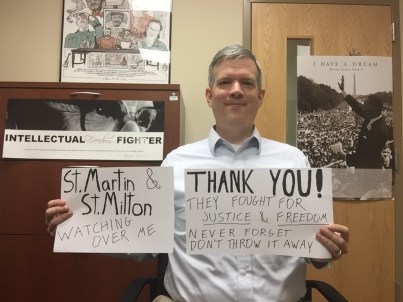
Milton turns 104 this weekend. Above is the tribute I contributed to the Friedman Foundation’s photo series. We should, indeed, never forget.

When he came on the scene, half the world was in slavery to totalitarian socialism, and he made a material contribution to their liberation. Here at home, both parties were deeply committed to statism, and he rightly advised the friends of freedom not to spend most of their time trying to elect the “right” side. He emphasized that all politicians are powerfully affected by self-interest while in office, so instead of trying to elect people who say they support freedom, we should work to change incentives for officeholders so it will be in their interest to support freedom. “Don’t change the players, change the game,” he wisely said. Words to remember.

I was honored to work for Milton in the last years of his life. I admired that he was so eager to help other people learn. One way you could see this was that he was always asking people questions – questions intended to help them notice their blind spots and become aware of internal contraditions in their thinking. He never talked “at” anyone. He asked you what you thought, in a way that made you think. That’s another thing we’d be wise to remember.

If you’re near Indy, join my Friedman friends for the main event. I’ll be spending the evening tonight with the Wisconsin chapter of Americans for Prosperity, saying a few words about Milton’s legacy – and of course school choice.

However alarming things may be now, let’s remember that the danger to freedom was even worse in his time. Yet he didn’t lose hope that people could be enlightened and persuaded. And he didn’t let personal or factional hostility take over what was supposed to be a debate about ideas. Let’s carry that legacy forward, whatever comes!


Debunking a Brazen Lie about Education Savings Accounts

July 24, 2016

pants-on-fire1

(Guest Post by Jason Bedrick)

An article in the Texas Tribune regarding the push for education savings accounts contained an incredible whopper from the state teachers’ union lobbyist:

Monty Exter, a lobbyist for the Association of Texas Professional Educators, said education savings accounts are worse than vouchers because there is no good way to control how parents spend the money. The states that have implemented such programs have included no provisions that allow them to reclaim money if parents spend it on “a flatscreen TV or a bag of crack,” he said.

“Who’s to say that a laptop isn’t an educational expenditure, but who’s to say that it is? Who is going to police that?” he said. “Are we going to pay someone at the state level to monitor this program, and how much is that going to cost?”

Frankly, he should be embarrassed to be peddling a lie that is so easily debunked.

*All* of the existing ESA laws in Arizona, Florida, Mississippi, Nevada, and Tennessee contain financial accountability provisions to ensure that parents are spending the ESA funds only on approved educational expenses, which are clearly defined in law.

Like any government program (e.g., district schools), there is bound to be some amount of fraud. Fortunately, due to the tight financial controls, Arizona (the first state to enact an ESA law) has been able to recover misspent ESA funds. Moreover, an independent auditor recently determined than less than one percent of Arizona’s ESA funds were misspent, as the Goldwater Institute reports:

Last year, the state deposited nearly $26 million in families’ education savings accounts. The auditor uncovered misspending that totaled less than 0.8 percent of the distributed funds—an unacceptable amount, because any fraud involving taxpayer money and children is unacceptable. But it’s a manageable amount. The department of education should follow through on the auditor’s recommendations, as the agency stated it would in its response letter, and continue to improve the ways parents and students find quality learning opportunities with education savings accounts.

Arizona parents have spent more than 99% of ESA funds on approved educational products and services, and 100% of ESA parents surveyed in 2013 reported being satisfied with their child’s education.

The Texas teachers’ union needs a new talking point.


Mississippi ESA Update: The Magnolias Are Blooming

July 21, 2016

magnolias-white

(Guest Post by Jason Bedrick)

Back in February, opponents of educational choice criticized Mississippi’s new ESA program for attracting fewer than half the number of students with special needs as there were slots available, claiming that this showed that the program was a “failure.”

Well, surely they will now issue a press release declaring the ESA program a success now that it is oversubscribed for next year. Empower Mississippi has the details:

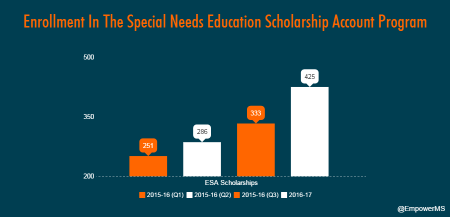
Yesterday the Mississippi Department of Education (MDE) conducted a lottery to award the remaining 175 scholarships for the Special Needs Education Scholarship Account (ESA) program. This year a total of 425 scholarships will be awarded to students in Mississippi.

The lottery drawing, held at MDE’s temporary headquarters at the South Pointe Business Park in Clinton, utilized a random number generator to determine the 175 recipients. There were 304 approved applications in the lottery competing for the available slots. Those that did not receive a scholarship, along with those that continue to apply, will have their name put on a waiting list for future openings.

Last year, in the first year of the program, 251 of the 434 available scholarships had been awarded by the beginning of the school year. Because of the rolling application process, and the available slots, that number increased each quarter last year. This year the program will be at maximum capacity of 425 students at the beginning of the year.

Enrollment in the program has grown by 70 percent over a one-year period and the number of approved applications has increased by more than 120 percent during the same time period.

special-needs-esa-enrollment

Source: Empower Mississippi

Next step: raise the cap on participation!


American Jewish Committee Endorses Abolishing Public Schools?

July 21, 2016

31042d1227149941-what-would-you-like-see-government-abolish

(Guest Post by Jason Bedrick)

In response to calls at the Republican National Convention for more school choice, the American Jewish Committee’s spokesperson announced that not only do they oppose the taxpayer subsidy of private schools, but they even oppose public schools. See for yourself:

For more than 50 years, school choice has been a contentious issue for American Jews. Decades ago, mainstream Jewish organizations were vociferous in defending the separation of church-and-state, worried that if the government got involved in funding religious schools in any way, it could lead to infringement on Jewish religious freedom. Those fears, according to American Jewish Committee associate general counsel Marc Stern, remain today.

“The Jewish community has long been concerned that government not be in the business of supporting private education,” Stern said. “Communities that want to maintain religious schools should pay for them on their own without government support. People shouldn’t be taxed to support things they don’t agree with.”

Okay, so he didn’t say it explicitly, but Mr. Stern is intelligent and knowledgeable enough to know that lots of Americans object to what is taught in public schools, so this was a clear endorsement by the AJC for the complete abolition of public schooling.

Heck, this “people shouldn’t be taxed to support things they don’t agree with” principle is something that my colleagues at the Cato Institute could really get behind. I’m sure that by the time the sun sets today, we could assemble a very long list of government programs to which many Americans object and we welcome the AJC’s support in abolishing them as well.

Then again, it’s always possible that the AJC’s attorney misspoke. Perhaps they’re not really in favor of abolishing the public school system and hundreds of other government programs, and the attorney just didn’t think through the logic of what he was saying. But if the AJC isn’t embracing anarcho-capitalism, then their “people shouldn’t be taxed to support things they don’t agree with” objection has no force or consistency. What they really mean is “we don’t think people should be taxed to pay for things we don’t like, but they should be taxed to pay for things that we do like,” which is not really a principle so much as an expression of political will — a political will that is fundamentally anti-pluralist, as I’ve explained previously:

Let’s consider an imaginary “public” school district where there are three groups of people: Hobbits, Ewoks, and Terrans. Each groups has very different and passionately held views about what should be taught in school and how it should be taught. All three groups are required to pay taxes to support the district school, which is ostensibly nonpartisan, nondenominational, and open to all. However, the majority of the district is Terran so the school reflects the Terran preferences. When the Hobbits and Ewoks open their own schools and seek equal per-pupil support from the local government, the indignant Terrans respond that the district school is meant for everyone. “It’s your right to open your own schools,” explain the Terrans, “but it’s your responsibility to pay for them.” Thus the majority brazenly forces minority groups either to abandon their values or to pay for two school systems. And lower-income minorities may have no choice at all.

Fortunately, other Jewish groups understand this and are willing to advocate for the greater freedom and pluralism that school choice programs deliver:

The Orthodox Union and the Orthodox Rabbinical Council of America have both successfully lobbied for New York City and New York State to fund programs like security and special education for private schools. According to Maury Litwack, the OU Advocacy Center’s director of state political affairs, more than 100,000 students attend Jewish day school in New York City.

“For parents who send their kids to Jewish day school, tuition is prohibitively high,” Litwack said. “They pay property taxes and a variety of other taxes. In American education there’s too often a one-size-fits-all approach to education. There should be more options.”

Republicans agree. A section of the party’s 2015 platform, titled “Choice in Education,” says, “Empowering families to access the learning environments that will best help their children to realize their full potential is one of the greatest civil rights challenges of our time. A young person’s ability to succeed in school must be based on his or her God-given talent and motivation, not an address, ZIP code, or economic status.”

The AJC is an organization that claims to be committed to the principle of pluralism. I look forward to a day when they fully embrace the ideal of pluralism in education.

[H/t David Benkof. Cross-posted at Ricochet.]


Checker Finn: Ed Reform as the Faber College Pan-Hellenic Disciplinary Council

July 18, 2016

(Guest Post by Matthew Ladner)

Checker Finn wrote a read-worthy lament for the state of ed reform for Hoover. Read the whole thing but this paragraph in particular caught my attention:

Exacerbating the disagreements on those questions is the self-righteousness that seems to have swamped this field in recent years. Education has never been a mirth-filled realm, but when I first got into it a lot of participants could still smile, occasionally giggle, even tell the odd joke—and the chuckles were, often as not, bipartisan. Today, however, practically nobody seems to have a sense of humor, at least not about anything bearing on ed reform. Is it because of our unfunny national politics? Because social media and 24/7 news mean that even a short chortle can be turned by one’s foes into evidence that one is making light of something? I’m not sure about the cause, but I can attest that it’s hard to make common cause with people who can never share a spoof or jest.

Practically nobody?!? It is alas a lonely task, but we continue to hold this last, best outpost of making light of things in ed reform-especially the deeply misguided and doomed to fail yet uhhh-gain sorts of things. We have been spoofing and jesting here at JPGB non-stop since 2008 and ed reform continues to provide plenty of material.

Checker makes an important point-social justice warriors make for poor dinner guests. It reminds me of this Charlie Rose debate about the 1960s when Barbara Ehrenreich droned on sternly while PJ O’Rourke’s related that his fondest 1960s memories involved LSD and picking up hippie women at protests.

Lighten up, Francis-we may as well keep a good sense of humor during what constitutes a protracted process of figuring things out.


The Greene-Polikoff Wager: An Update

July 12, 2016

14305514cold-beer-t-shirts-and-hoodies-education-is-important-but-cold-beer-are-importanter

(Guest Post by Jason Bedrick)

In 2014, Jay made a wager with education policy wonk Morgan Polikoff regarding how many states would, after 10 years, still be a part of Common Core (defined as having “shared standards with shared high stakes tests-even if split between two tests”). The loser owes the winner a cold beer.

At the time the wager was made, the states had almost unanimously adopted Common Core so Morgan was confident but Jay thought political support for CCSS was a mile wide but an inch deep.

Morgan noted that “At last count, 1 state out of 45 has repealed the standards.”  I responded: “I’m sure gay marriage opponents felt similarly triumphant in 2004. How many states have effectively implemented Common Core?” […]

According to Heritage’s count, 15 states have already refused to join Common Core, paused implementation, or downgraded or withdrawn from participation in national tests.  I just need all of these states to continue toward withdrawal from Common Core and 11 more to join them over the next ten years.  I like my chances.

Just a few months later, Jay posted an update:

With the withdrawal of Iowa this week from the Smarter Balanced testing group, there are only 26 states that plan to use one of the two national tests to assess their students during the 2014-15 school year.  It’s true that 35 states remain part of the two testing consortia and some of the 9 states that have delayed implementation of the common tests may begin using one of them in the next few years.  But it’s safe to say that several of those 9 delayed start states will never follow through.  And some of the 26 states actually using a common test in 2015 are already making noises about withdrawing.  See for example reports coming out of Wisconsin and South Carolina.
If one more state that is currently using one of the common tests drops it than decides to follow through on implementation, I will have won the wager.  And we have more than 9 years to see that happen.

So how is the bet looking two years later? Well put it this way: Jay can probably already taste that beer. From Education Next:

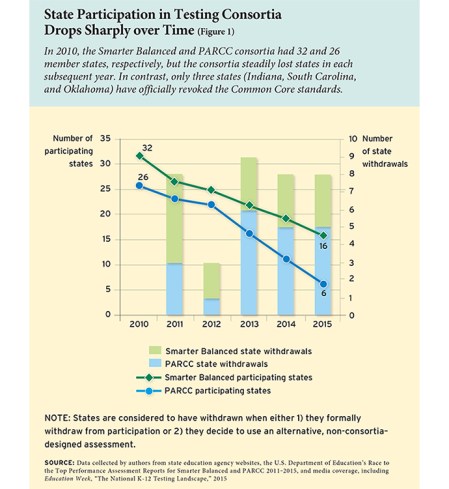
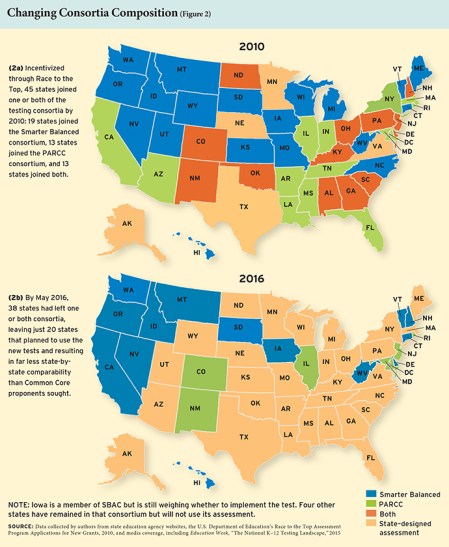
State participation in the consortia declined just as implementation of the new standards and tests was set to begin. The pace of withdrawals quickened over time, particularly for PARCC, which five or six states left every year between 2013 and 2015 (see Figure 1). As of May 2016, just six states planned to implement the PARCC-designed assessment in the 2016-17 academic year. SBAC also faced attrition but fared better and still retains 14 states that plan to use the full test. (That figure includes Iowa, where a legislative task force has overwhelmingly recommended the SBAC assessment, though as of early 2016 state officials had yet to formally accept the recommendation.) By early 2016, 38 states had left one or both consortia, short-circuiting the state-by-state comparability that the tests were designed to deliver (see Figure 2).

ednext_xvi_4_jochim_mguinn_fig01-small

“Oh, how the mighty have fallen!”

ednext_xvi_4_jochim_mguinn_fig02-small

Common Core in retreat.

Note that these charts do not reflect the fact that Illinois has just replaced PARCC with a “revamped” version of the SAT for its high school students. Students in grades 3-8 will still take the PARCC, so perhaps Illinois should count as half a state for purposes of the Greene-Polikoff Wager.

Of course, it’s always possible that the remaining CCSS states will work out the kinks, opposition will fade as people get used to the testing regime, and then the political winds will shift again and states will re-enter one of the CCSS testing consortia. A lot can happen in eight years. But there is no denying that Jay was prescient in his read of the situation.


The Blob’s Shameless Self-Interest

July 11, 2016

SHUT UP AND GIVE ME MONEY

(Guest post by Greg Forster)

The education blob has never been shy about demanding that we hand them money, with little to justify their demands beyond sheer bullying self-assertion. But this year has seen an especially outrageous spate of self-dealing activism in Oklahoma, as I write in my latest article for OCPA:

Perhaps there’s a rational case that Oklahoma should spend more on schools. If so, I haven’t run across it going through pages and pages of the blob’s invective. Their argument boils down to “we spend X amount and it’s too little! We need to spend more more more!”

A press corps with any self-respect or sense of professional responsibility would ask the blob questions like these: Why have previous increases in school budgets and teacher salaries failed to produce educational improvements? Why shouldn’t the new spending you demand be targeted to more specific, publicly identified needs instead of being allocated indiscriminately? How much spending—give us a dollar amount—would be enough to make you say spending is sufficient and any problems that persist are the responsibility of the schools?

Come for the fake Tocqueville quote; stay for the philosophical analysis of the role of self-interest in the American political order!

Like them, we need to be realistic about self-interest, but not cynical. Human nature is powerfully affected by self-interest, as the embarrassing spectacle of the Oklahoma blob shows. We need not be revolutionaries and try to make a brave new world where no such selfishness occurs; as Madison and Tocqueville both warned us, such utopianism is the quickest road to a pure dictatorship of the selfish. But democracy is nonetheless threatened by unrestrained selfishness, for the majority can in fact vote itself largesse.

As always, your comments – whether self-interested or not – are very welcome!


Grasping at Straws Over Detroit’s Charter Schools

July 1, 2016

grasping20at20straws

(Guest Post by Jason Bedrick)

Following the exposure of all the errors, distortions, and key omissions in the recent NYT hatchet job on charter schools, the new line from the reporter and her teacher union allies is that the CREDO data is current only through 2011-12, but the charter cap was lifted starting in the 2012-13 school year. So sure, charters may have been outperforming district schools before “opening the floodgates,” but now the supposed “free market” (which, for the record, has no price mechanism, no free entry and exit, and lots of regulations regarding school mission, admission standards, testing, etc.) is letting in all sorts of bad actors.

But is there any hard evidence for this? Charter critics point to several anecdotes, but as Jay noted earlier, the plural of anecdote is not data. They’re simply grasping at straws.

Until CREDO updates their report or some other group tries to replicate it, we won’t have accurate apples-to-apples comparisons. Until then, we can’t conclusively reject or accept that hypothesis. But what data we do have cast doubt on it.

According to the Mackinac Center’s “2014 Michigan Public High School Context and Performance Report Card,” which used data through 2013, Michigan’s charter schools are punching above their weight: “Though charter schools make up just 11 percent of the schools ranked on this report card, they represent 35 percent of the top 20 ranked schools.” Two of the top 10 high schools in the state were charter schools in Detroit. The study awarded an “A” or “B” to four of the 14 Detroit charter high schools, while only two received an “F.” By contrast, 12 of 14 non-selective Detroit district schools received an “F.”

Results from their 2015 Elementary & Middle School Report Card are more mixed, but charters still come out slightly better.

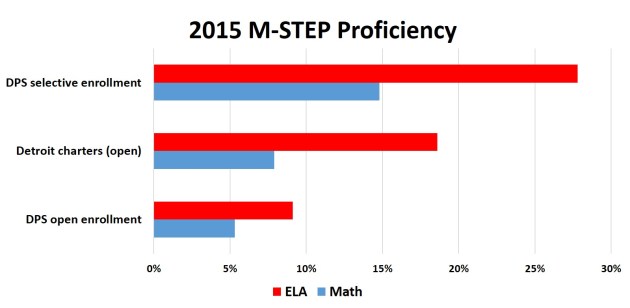
The Great Lakes Education Project also broke down the 2015 M-STEP proficiency and found that Detroit’s charter schools–which must have open enrollment–outperformed Detroit’s open-enrollment district schools, although they lagged behind Detroit’s selective-enrollment district schools (and, frankly, none of the sectors have particularly stellar performance). Again, this is not an apples-to-apples comparison, so we should be cautious in interpreting these data, but they certainly don’t lend support to the notion that the charter sector is particularly troubled.

ed561657-352e-434f-ac45-8ff15d0854ab

Detroit’s open-enrollment charters outperform open-enrollment district schools.

Moreover, as shown in this infographic that GLEP put together, Detroit’s charters are over-represented among the top-performing schools and outperform Detroit’s district schools on average:

18 of the Top 25 schools in Detroit are Charter schools

22 of the Bottom 25 schools in Detroit are DPS schools

 Charter average: 14.6%

 DPS average: 9.0%

 Charters are 62% more proficient than DPS

 71 charters (79%) perform ABOVE the DPS average and 19 charters schools (21%) perform BELOW the DPS average.

 20 DPS schools (30%) perform ABOVE the DPS average and 46 DPS schools (70%) perform BELOW the DPS average.

 12 DPS schools (18%) perform ABOVE the charter average and 54 DPS schools (82%) perform BELOW the charter average.

 40 charter schools (44%) perform ABOVE the charter average and 50 charter schools (56%) perform BELOW the charter average.

To reiterate yet again, these are not apples-to-apples comparisons. For that we will need another carefully matched comparison, like the CREDO studies, or (better yet) a random-assignment study. But until then, charter critics should be more circumspect in their allegations. Certainly there is plenty of room for improvement in both Detroit’s charter and district schools. But the charter critics have not presented any hard evidence that Detroit’s charter sector is particularly troubled, or that the increased choice and competition is at fault for the poor performance in either sector (especially since Detroit’s district schools have been seriously troubled for decades).

Neither Detroit’s charter schools nor their district schools are above criticism. But critics should put their criticism in its proper context — and be sure to bring evidence.


Controlling Math Curriculum

July 1, 2016

(Guest Post by Ze’ev Wurman)

Recent weeks saw a welcome attention to the groupthink that saturates what is mellifluously called the “education reform” community. I thought Rick Hess’ (School Reform Is the New Ed. School) and Jay’s (Ed Reform is Animal Farm) were particularly powerful, but their main focus was – as it should be – on the systemic and structural aspects of school reform that has become the new orthodoxy, and on the reform movement character becoming essentially a power struggle for control, not much different from what ed schools and teacher unions already do.

Here I want to focus on a particular aspect of this change by school reformers – the effort to  impose their curricular ideas based not on what works but on their interest in centralized control, and about their efforts to silence objections and dissent.

Last week the Fordham Institute published its 2016 look at Common Core math implementation in the classroom. Fordham has been a big Common Core supporter from early on so it is not surprising that despite finding skepticism and frustration among parents and students, and despite finding enthusiasm among elementary teachers (who largely know little math) but a negative response among middle school teachers (who actually know some math), Fordham still is supportive:

For the first time in our nation’s history, there is a high level of consistency regarding what’s taught in American elementary and middle school math classrooms. Fewer teachers appear to be closing their classroom doors and doing their own thing.  … [S]tudents are being exposed to fewer topics in more depth, spending significant time on applications.” (p. 44)

What struck me was the praise for the “high level of consistency,” justified by students spending “significant time on applications.” Perhaps I shouldn’t have been surprised by Fordham’s love of consistency. After all, it was Checker Finn who signed the 2011 Shanker Manifesto that called for uniform national standards – not only in math and English, but also in civics, the sciences, and health and physical education. Clearly, centralized uniformity has been a high priority for Fordham for quite some time.

But what about the praise for “significant time on applications” brought by Common Core, supposedly Fordham’s  justification why it is OK to impose Washington’s will on the country? Just three days before the Fordham report was published, a new large study of students found that the “difference between the math scores of 15-year-old students who were the most exposed to pure math tasks and those who were least exposed [and exposed instead to real-world problems] was the equivalent of almost two years of education.” Surely if Fordham was driven by research evidence rather than by faddish support of centralized education it would have at least restrained itself from blindly supporting one-size-fits-all model, when a year old study clearly says:

[G]iven the pervasiveness of the belief in a conceptual-then-procedural sequence despite the lack of empirical evidence, would additional research convince those who hold the belief? In fact, widespread endorsement of this belief among mathematics education researchers may help to explain why so little research has directly evaluated it. Thus, it seems important to briefly consider nonempirical reasons that might support this belief and which could impede progress in addressing it … [C]ulture may play into the persistence of this belief. The directionality of developing conceptual and procedural knowledge seems to only be debated in the USA. This may be because in the USA and some other Western cultures, practice is not believed to aid the development of understanding. In many Asian countries, by contrast, practice is viewed as a route toward understanding, where there is a public perception that only through a great deal of practice can true understanding be developed. Our anecdotal interactions with mathematics education researchers in non-Western countries suggests that they are confused by the debate in the USA. Elsewhere, it is taken as obvious that procedural knowledge can lead to conceptual knowledge (and vice versa).

I wanted to comment on Fordham’s site about this, and then I realized that … Fordham has eliminated reader comments. I guess it was tired of even those few dissents that found their way to their pages. So no more of that! Now that I think of it, Education Next, the journal that “will steer a steady course, presenting the facts as best they can be determined, giving voice (without fear or favor) to worthy research, sound ideas, and responsible arguments” also decided recently that giving voice to sound ideas does not include readers’ (moderated) comments and shut them off without warning. So much for openness to dissent, so much for the voice of the parents and the unwashed masses, so much for being research driven.

The creatures outside looked from pig to man, and from man to pig, and from pig to man again; but already it was impossible to say which was which.


We Win! NEPC & Lubienski Admit Choice Improves Outcomes

June 30, 2016

HVherald

(Guest post by Greg Forster)

As long as we’re talking about ridiculous hit pieces, the servants of the edu-blob at NEPC have published a hatchet job by Christopher Lubienski attacking the new edition of my Win-Win report reviewing the evidence on school choice, as well as another recent research review by three authors at U.Ark.

Guess what? Both Lubienski and (in their press release) NEPC now admit that school choice improves educational outcomes!

Don’t believe me? Check out how the press release opens:

The degree to which students benefit from voucher programs, which allow parents to use taxpayer dollars to send their children to private schools, has been debated for years. Most studies have found only modest benefits, at best. Two new reports claim to offer empirical support for the effectiveness of vouchers.

That’s right – what’s debated is not whether school choice improves students’ academic outcomes but the degree to which they improve outcomes.

It’s over, folks. Just like Jay said years ago…

WE WIN!


medal

giphy

tumblr_m07dqpmyPV1r1fuq8

Let’s also note that they shamelessly ignore four of the five sections of my report. The research on how school choice affects outcomes in public schools (it improves them), taxpayers (it saves money), segregation (it breaks down racial barriers) and civic practices (it strengthens democracy) is dismissed without notice:

While the report weighs in on a number of outcomes from voucher programs, including the competitive and fiscal impacts on public schools, the effects on civic values, and on racial segregation, these issues have not been seen as central to questions of voucher efficacy, and are not always illuminated by randomized studies.

Segregation and impact on taxpayers hasn’t historically mattered in choice debates? That will come as a surprise to a lot of legislators and activists I know!

The hit piece itself is a lot of sound and fury signifying nothing, as we’ve come to expect from the all-hat-and-no-cattle Lubienski and NEPC. They make a lot of noise about “misrepresentations of the research literature,” but if you actually read their report (which they’re counting on you not to do) they bring no substantial allegations that might back that up – only pedantic interpretive quibbles that aren’t even worth responding to here.

Their only real accusation is the old “cherry-picking” routine. As always, they say we cherry-picked the research that supports our conclusions. Of course we didn’t; in my report I bent over backward, methodologically speaking, to ensure I didn’t exclude anything. Doesn’t matter. Whatever method researchers use to discover studies, they say it’s “cherry picking.” If they saw me walk right past a cherry tree without touching it, they’d accuse me of cherry picking.

Lubienski and NEPC know that most reporters don’t understand or even read research reports, so they can say what they want and get away with it. I’m content to let my work stand for itself; anyone who reads my report will see that the cherry-picking accusation is false, and none of Lubienski’s other accusations adds up to much beyond quibbling over issues where reasonable people can disagree, none of which (singly or jointly) affects the overall finding of my report.

My personal favorite part of the hatchet job was this gem. My method is to count a study as having found a positive effect if any of its reported results were positive, and to count it has having found a negative effect if any of its reported results were negative. I do this to avoid cherry-picking which of the results “really count” and which don’t. Lubienski complains, in the context of discussing a report that was put into the positive column under my method:

Nevertheless, the Friedman Foundation classifies this report as demonstrating “positive effects” if it has any single positive estimate, even when a “study typically includes multiple analytical models — sometimes many of them, occasionally even more than 100.” (While a single negative estimate could also place a study in the “negative effect” category, there are no such instances of this in the Friedman Foundation report.)

Got that? There were no studies of this kind that had any negative findings reported, at all, and that somehow tells against my positive finding because it means my method never put one of those studies in the negative column.

If that doesn’t discredit Lubienski, I’m not sure what would.