The Ambition of Delaware’s ESSA plan

July 26, 2017

(Guest Post by Matthew Ladner)

Taking up where Jason left off the topic of USDoE labeling Delaware’s ESSA goal to cut the number of low-performing students as “not ambitious” I decided to look at NAEP gains in Arizona. You may or may not have heard, but Arizona students have been leading the nation in NAEP gains in recent years basically regardless of how you measure gains. Arizona was the only state that saw a statistically significant gains on all six NAEP exams for the entire period we can track all of them (2009-2015). When you subtract declines from gains the average state landed at +1. Measured on a cohort basis, Arizona students lead in gains between 4th grade in 2009 and 8th grade in 2013, and lo and behold they did it again between 2011 and 2015.

Arizona students did not however come remotely close to reducing the percentage of students scoring “Below Basic” by half on any of the NAEP exams on a statewide basis.

Not.even.close. You can track NAEP scores for Arizona’s super-high flying (on average) charter sector from 2005 to 2015, and even they don’t show that kind of progress and those folks moved a majority-minority student body into New England NAEP score range on all six tests.

The ESSA statute calls for “ambitious” rather than “completely fantastic” goals.


The Future of School Choice: Bickering about Words!

July 25, 2017

Logomachy

(Guest post by Greg Forster)

Will Flanders is right that school choice is not welfare (you heard it here first) and more broadly that school choice has not benefitted from appropriating the Rawlsian language of fairness (ditto). But he is wrong to think we would be better off making big investments in the free market movement’s language of markets and competition. I’m as big a fan of Milton as anyone (proof) but that language has all the wrong non-cognitive associations for the present moment. Flanders cites Jonathan Haidt but doesn’t seem to have learned the biggest lesson Haidt has to teach, which is that the non-cognitive content of language is more politically important than its cognitive content.

What we need is a new language of justice, equal opportunity, diversity and freedom that both Rawlsianism and the free-market movement used to have, say, fifty years ago, but that neither currently has in a very robust form. Much, much more about that here.


Playing Ostrich About the Effects of Regulations

July 17, 2017

aaeaaqaaaaaaaanzaaaajdk2mte2y2vkltc1yzctndvkos04njkzlwm0ymi4nzm4mzcwmq

(Guest Post by Jason Bedrick)

There’s plenty to quibble with in Mark Dynarski’s post at EdNext this morning, but his claims about over-regulation theory are downright odd:

Some commenters have concluded that the negative effects in Louisiana were the consequence of the program being ‘over-regulated.’ [6] But the conclusion that the Louisiana program was overregulated relies on unstated premises that private schools that agreed to participate were academically inferior to ones that did not agree but would have if the state did not impose requirements, or that regulation itself impairs academic achievement. Evidence of either is noticeably lacking in the argument.

Far from being an “unstated premise,” the notion that “private schools that agreed to participate were academically inferior to ones that did not agree but would have if the state did not impose requirements” is the explicit argument that I was making in the EdNext post to which he links.

And far from “lacking evidence,” I spelled it out. First, private schools in highly regulated Louisiana were much less likely to accept voucher students than private schools in states with less regulated school choice programs:

Due to the LSP’s high regulatory burden, two-thirds of Louisiana private schools do not accept voucher students. In an American Enterprise Institute survey of private schools, 79 percent of Louisiana school leaders reported that concerns about program regulations played a deciding factor in their decision not to accept LSP students, including 64 percent who listed this as a major factor. In particular, 71 percent worried about the effect on their school’s admissions policies, including 45 percent who stated that this played a major role in their decision. In addition, 54 percent expressed concerns about administering the state test, including 34 percent who said it played a major role in their decision. Other areas of great concern included paperwork and the effect on the schools’ character or identity.

By contrast, the same survey found substantially lower levels of concerns about school choice regulations among school leaders in Indiana and Florida, where the regulatory burdens are considerably lower. While both states limit their vouchers and tax-credit scholarships to low-income students, they do not otherwise restrict admissions criteria, nor do they prevent schools from charging full tuition. Like Louisiana, Indiana requires schools to administer the state test to voucher students, whereas Florida allows schools to choose among many nationally norm-referenced tests.

Unsurprisingly, Florida has the highest level of private school participation among the three states (about two-thirds), followed by Indiana (about half), and Louisiana (one-third). Moreover, Florida schools are the most likely to plan to increase the number of choice students they enroll, while Louisiana schools are the most likely to decrease that number.

Second, there was “suggestive but not conclusive” evidence (as I wrote) that the private schools that did participate were lower performing than those that chose not to:

Low rates of private school participation would not be so troubling if they reflected the decisions of high-performing schools to accept voucher students while the regulations kept low-performing schools away, as proponents of the regulations had desired. However, the regulations may have had the opposite of their intended effect, as Professor Jay P. Greene of the University of Arkansas recently cautioned:

The only schools who are willing to do whatever the state tells them they must do are the schools that are most desperate for money. […] If you don’t have enough kids in your private school and your finances are in bad shape, you’re in danger of closing — probably because you’re not very good — then you’re willing to do whatever the state says.

Indeed, Greene’s concern is borne out by the data. According to the NBER study, “LSP schools open in both 2000 and 2012 experienced an average enrollment loss of 13 percent over this time period, while other private schools grew 3 percent on average.” The authors note that this “indicat[es] that the LSP may attract private schools struggling to maintain enrollment,” and they conclude that these results “suggest caution in the design of voucher systems aimed at expanding school choice for disadvantaged students.”

And, indeed, the recent study by Wolf, DeAngelis, and Sude lends further evidence to the Over-regulation Theory:

Our results largely confirm our hypothesis that higher tuition levels and larger cohort enrollments, conditions normally associated with high quality schools, identify schools that are less likely to participate in voucher programs. We also find a consistent negative relationship between Great Schools Review score and the school participation decision, indicating lower quality schools have a higher tendency of participating in voucher programs in all three states, however the coefficients are not significantly different from zero. State fixed effects reveal private schools in D.C. and Louisiana, the two states that have higher regulatory burdens, are less likely to participate in voucher programs.

The evidence is still merely suggestive, not conclusive, but it’s the best evidence we have. Dynarski might not be persuaded by it, but he can’t ignore that it exists.


Getting Facts Right

July 13, 2017

Image result for Everyone is entitled to his own opinion, but not his own facts.

Education policy debates, like national political disputes, are increasingly frustrating because we are having difficulty agreeing on and sticking to a set of facts.  It’s particularly frustrating because people are mis-stating basic facts that quite often are not even necessary for continuing to hold their opinions.  I’m not sure what accounts for this sloppiness in public discourse, but I suspect that it is a general decay in professional norms and standards of behavior encouraged by the stupid brevity and speed of Twitter.

Let me describe a recent example of an obvious, factual error from a debate about charter schools and regulations.  To be clear — there’s nothing wrong with making mistakes.  So what is remarkable about this example is how the people making the demonstrable, factual error never say “Oops, I made a mistake.”  They could easily admit the mistake and still continue to hold their opinion and make their arguments.  The fact that they don’t is what is truly troubling.

A Recent Example — Greg Richmond, who is the head of the National Association of Charter School Authorizers (NACSA), wrote a piece for The 74 in which he claimed: “A recent report from Tulane University’s Education Research Alliance found that a school’s rating from the independent application review process was the only factor that predicted its success.”  But if you look at the report, specifically in Table 7, you will see that the NACSA rating of charter school applications is not a significant predictor of any student outcome.  Richmond’s claim is demonstrably false.  He says that a report found something that it simply does not find.  I had previously noted the falsehood of this claim, but this has not deterred the folks at NACSA from repeating it.

Rather than admit the error, NACSA tries to rescue the claim.  Importantly, they don’t rescue the claim by showing that it is true.  They can’t.  Instead, they shift the discussion to a different point.  NACSA’s Nelson Smith, echoed by their spokesperson Kristen Forbriger, quote a policy brief written by Doug Harris summarizing the findings of the report he co-authored and that they falsely invoke:

“None of the application measures predict the value-added performance of schools, though there are signs of a positive relationship between the NACSA ratings and value-added (emphasis added). It is not surprising that our statistical confidence is weak here because value-added measures are imprecise and the NACSA ratings did not vary much among approved applications.” In other words, it’s hard to detect correlation to specific outcomes when the approved applications all scored at high levels.

Note that this does NOT say that the report “found that a school’s rating from the independent application review process was the only factor that predicted its success.”  In fact, it clearly states that Richmond’s original claim is false: “none of the application measures predict the value-added performance of schools.”  And saying there are “signs of a positive relationship” is just spin, not the actual finding.

Rather than support the truth of the original claim, this quotation provides a rationalization for why the report did not unearth the desired finding — the sample size was too small and there was too little variation in the NACSA rating.  Whether the rationalization is persuasive or not, the fact remains that the report did not find what Richmond claims it found.  His assertion is demonstrably false.  But neither he nor his colleagues at NACSA will say so.  Instead, in Trump-like fashion, they continue to assert that they were right all along even as the evidence contradicts them.

Unfortunately, this recent example of a factual error that is never acknowledged or corrected is becoming part of a pattern.  If people in our field can make demonstrably false claims without having to acknowledge or correct them, it’s unclear to me how we are going to make progress in policy debates.  I am not arguing here what the correct policy should be.  I’m simply arguing that if people in these debates can make false claims with impunity, we have allowed the Trumpization of debates to creep into the area of education policy and will suffer similar highly negative consequences.


If You Give the Feds a Cookie…

July 12, 2017

if_you_give_a_mouse_a_cookie

(Guest Post by Jason Bedrick)

Proponents of the Every Student Succeeds Act (ESSA) assured us that it would curb executive overreach by the U.S. Department of Education. Skeptics like Neal McCluskey and Lindsey Burke warned us that the law didn’t go nearly far enough. In their view, ESSA contained enough ambiguous language that a clever EdSec or her staff could mold it into practically anything.

It’s becoming increasingly clear that the skeptics were right. (Neal jokes that he was wrong, but he was only wrong about which ambiguous language the DOE would exploit first.) Earlier this month, the feds rejected Delaware’s ESSA compliance plan because aiming to cut the number of low-performing students in half by 2030 is “not ambitious enough.” You see, ESSA calls for “ambitious” goals, but doesn’t define the term “ambitious.” Acting assistant secretary Jason Botel explained to the New York Times, “Because the statute does not define the word ‘ambitious,’ the secretary has the responsibility of determining whether a state’s long-term goals are ambitious.”

As the skeptics said, give the feds an ambiguously worded cookie and soon they’ll be redefining that cookie to mandate that all children achieve proficiency in cookie baking by 2030. Or, y’know, something “ambitious” like that.

To Rick Hess, the whole thing sounds eerily similar to Soviet central planning:

General Secretary: Comrades, I call to order this meeting of Politburo Bureau of the Communist Party. We will start by turning to the implementation of our new Every Farmer Succeeds Act. Comrade Minister?

Minister of Agriculture Petrovsky: Thank you, comrade General Secretary. Comrades, you will recall that we adopted the Every Farmer Succeeds Act—EFSA, for short—after various complaints with the No Farmer Left Behind Act. That effort, initiated by the former regime, did not work out as intended.

Minister of the Interior Kirov: I’ll say, Mikhail! When we told farmers that they were to ensure that 100% of acres delivered adequate production, we got many complaints. We sent many to Siberia, but others still complained. Just to avoid running low on farmers, is good that we changed strategy.

Petrovsky: Thus, new Every Farmer Succeeds Act. We are working hard to implement. Instead of telling farmers that 100% of acres must produce adequate grain, we now tell them we realize world more complicated than that.

General Secretary: So, what is problem whereof you spoke?

Petrovksy: In giving collectives more flexibility, we still told them to set ambitious targets. Yes? Yet we have encountered resistance from some collectives. In its wisdom, the Politburo told farms they needed to be ambitious. However, my deputy, Comrade Botelinksi, informs me that some of the collectives are only proposing to double production. We have decided that production must go up tenfold. Anything less is not ambitious.

General Secretary: Da. And so?

Petrovsky: We have told collectives to change their plans. They must promise to increase production tenfold.

Kirov: But, is that not what caused problem with No Farmer Left Behind in first place? That no one took targets seriously?

Petrovsky: Comrade, do you want people to go hungry? And, that was last time. This time will be different.

Lesson: don’t give the feds any cookies. They make a big enough mess without the crumbs.


Pass the Popcorn: The Wedding Plan

July 6, 2017

Despite living in Fayetteville, AR, which is the greatest center of Yiddishkeit in all of the Ozarks, I had to travel to Boston to see the wonderful new film, The Wedding Plan, in a theater.  You should make an effort to see it if you live in a city where it is now showing and, if not, you should plan to see it when it arrives eventually on Netflix.

The Wedding Plan is the second film from writer/director Rama Burshtein, following her debut movie that I also loved and previously reviewed on JPGB, Fill the Void. Like the previous film, The Wedding Plan is set in an Orthodox Jewish community in Israel and focuses on questions of love and marriage.  But unlike Fill the Void, The Wedding Plan is not primarily about love and marriage.  It is really about faith and whether it is reasonable to expect that good things will happen — perhaps even miracles.  In this sense it is more like another fantastic film set in an Israeli Orthodox community, Ushpizin.

The premise of The Wedding Plan is that Michal is finally set to be married when her her fiance gets cold feet and backs out a month before the nuptials.  She has the dress and the wedding hall is reserved, so she decides to go ahead with the plan.  All she needs is a groom.  I know this sounds like the sort of Rom-Com plot that might feature Julia Roberts hilariously racing from one bad date to another until she finds Mr. Right just in time (and the American trailer has that feeling), but this movie is about much more.

The Hebrew title of the film means Through the Wall, which highlights a scene in which Michal explains that her plan to get married by the end of the month is like a karate chop.  She says she has to believe 100% to break through the wall.  If it is 99% she’ll break her hand.

Her friends and family fear that she will break her hand regardless.  They bring a rabbi to advise her. “What you are doing is counting on miracles,” he tells her. “Who gave you the right?” She answers quoting the Talmud: “The world was created for me.”  Is this just hubristic entitlement or should each of us feel like there is a plan for oneself in the world that includes enjoying the good?

Given the excessively cynical — even nihilistic — tilt of our culture and politics, it is worth considering whether we might be better off just having confidence that good things will somehow work out.  Or does believing this just set us up for even greater disappointment?  As Michal says, sitting alone in her wedding dress, “The bubble is about to burst.”  Should we protect ourselves from disappointment by not expecting anything good to come from the world?

These are questions that a Julia Roberts movie would not ask, but The Wedding Plan does.

And here is the American trailer:


Granite State Enacts Second School Choice Program

June 29, 2017

ar-170129582

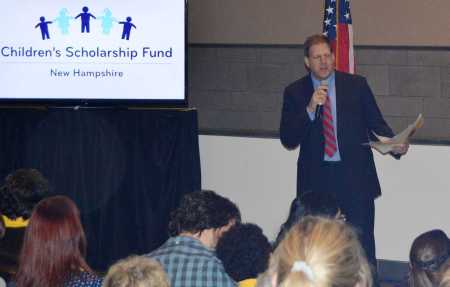
NH Gov. Chris Sununu speaks at a rally for school choice. (Credit: Union Leader)

(Guest Post by Jason Bedrick)

In a week that’s already loaded with good news for school choice, Gov. Chris Sununu of New Hampshire decided to add some more with the signing of a town tuitioning bill. Check out this blog post at EdChoice for more info:

SB 8 clarifies that any town—not just towns that share a border with other states—may include non-religious private schools in their town tuitioning plans. Town tuitioning, a longstanding tradition in New Hampshire and other New England states, occurs when a district “tuitions out” students to public or private schools in surrounding towns and districts because their home district does not provide schools with the grades those students need.

An equivalent bill was sent to the governor’s desk last year; however, then-Gov. Maggie Hassan vetoed it, claiming that a failure to exclude religious schools violated the state’s Blaine amendment. The current bill excludes religious schools, freeing legislators to deal with that issue in a separate fight.

The exclusion of religious schools is a serious defect, but I noted earlier this week, Blaine’s days might be numbered. The Live Free or Die State already has a tax-credit scholarship program and the legislature is currently considering a universal ESA.


North Carolina Passes New Special-Needs ESA

June 28, 2017

harry-potter-excited

(Guest Post by Jason Bedrick)

In a week with so many wins for kids, the North Carolina legislature decided to add another. Today, NC legislators overrode the governor’s veto to pass a budget that included funding increases to the state’s school voucher program and created a new education savings account policy for students with special needs.

Eligible students can receive up to $9,000 annually, and students with the highest need (i.e., those with autism, development disabilities, moderate or severe intellectual disability, hearing or visual impairment, and/or multiple, permanent orthopedic impairments) can receive the ESA funds in addition to NC’s Special Education Scholarship Grants for Children with Disabilities, which are worth up to $8,000. Parents can use ESA funds for private school tuition, tutoring, textbooks, homeschool curricula, educational therapy, certain education technologies, various education-related fees (e.g., standardized tests), and student transportation. Funds are disbursed quarterly on prepaid debit cards after parents submit receipts for eligible purchases in the previous quarter.

All students with disabilities who are switching out of a district or charter school or who are entering kindergarten or first grade are eligible. In addition, students with disabilities are also eligible if they are in foster care, if at least one parent is an active-duty member of the military, or if he or she is enrolled part-time in a public school and part-time in a nonpublic school that exclusively provides services for children with disabilities.

With an ESA, parents like Liz Bradford can provide their children with the education that works for them:

The Parents for Educational Freedom in North Carolina, who worked tirelessly to pass the legislation, praised the passage of the ESA:

As a statewide education advocacy organization, PEFNC applauds legislators for their ongoing commitment to funding educational choice, and to ensure more of our state’s families have access to the educational options they desperately need. […]

With their vote to override the governor’s veto, North Carolina lawmakers continue to solidify our state’s status as a national leader in providing highly impactful and innovative educational options for children and families. Despite the governor’s opposition, the General Assembly is demonstrating our state’s ongoing commitment to initiatives and programs that contribute to improved educational outcomes for students.

For more information, visit the Exceptional Education for Exceptional Children website.

Parents interested in applying for the special-needs voucher can do so at the North Carolina State Education Assistance Authority website. Presumably they will also post application information for the new ESA once the program is implemented.


The Beginning of the End for Blaine?

June 27, 2017

ganges18762

(Guest Post by Jason Bedrick)

Yesterday, the U.S. Supreme Court ruled in Trinity Lutheran that the U.S. Constitution prohibits the government from excluding otherwise eligible religious organizations from benefitting from publicly funded programs merely because they are a religious organization. (I discussed the implications here.) However, Footnote 3 said:

This case involves express discrimination based on religious identity with respect to playground resurfacing. We do not address religious uses of funding or other forms of discrimination.

So, does the case have broader implications beyond playgrounds? Interestingly, Chief Justice Roberts “delivered the opinion of the Court, except as to footnote 3,” and two additional justices, Gorsuch and Thomas, concurred in the opinion but not in the footnote, explaining:

Of course the footnote is entirely correct, but I worry that some might mistakenly read it to suggest that only “playground resurfacing” cases, or only those with some association with children’s safety or health, or perhaps some other social good we find sufficiently worthy, are governed by the legal rules recounted in and faithfully applied by the Court’s opinion. Such a reading would be unreasonable for our cases are “governed by general principles, rather than ad hoc improvisations.” […] And the general principles here do not permit discrimination against religious exercise—whether on the playground or anywhere else.

Today, SCOTUS has indicated that its ruling in Trinity indeed does have implications beyond the playground. The Court has vacated the Colorado Supreme Court’s decision that struck down the Douglas County voucher program based on the state’s Blaine Amendment, and ordered the Colorado Supreme Court to reconsider the case “in light of [the] Trinity Lutheran” decision.

If Trinity Lutheran indeed does apply to school vouchers (Footnote 3 notwithstanding), then it could spell the beginning of the end for the odious Blaine Amendments.


Two Court Cases Plus Two Voucher Studies Equals Four School Choice Wins

June 26, 2017

giphy

(Guest Post by Jason Bedrick)

There’s so much good news for school choice today, it’s hard to know where to begin.

A Legal Victory in the Peach State

I woke up this morning to the news that the Georgia Supreme Court had unanimously ruled that private donations to private nonprofit scholarship organizations that help children attend private schools are (shocker!) private funds, even if the donors receive a tax credit:

We also reject the assertion that plaintiffs have standing because these tax credits actually amount to unconstitutional expenditures of tax revenues or public funds. The statutes that govern the Program demonstrate that only private funds, and not public revenue, are used.

I discuss the case and its implications in greater detail here.

SCOTUS Strikes Down Discrimination Against Religion — But Saves Blaine for Another Day

A couple hours later, the U.S. Supreme Court ruled 7-2 in Trinity Lutheran v. Missouri that it is unconstitutional to exclude religious organizations from benefiting from secular aid programs that are otherwise neutral with respect to religion. As Neal McCluskey explains, the court didn’t go as far as many school choice advocates would have liked, but it is unambiguously a step in the right direction. Writing for the majority, Justice Roberts wrote:

It is true the Department has not criminalized the way Trinity Lutheran worships or told the Church that it cannot subscribe to a certain view of the Gospel. But, as the Department itself acknowledges, the Free Exercise Clause protects against “indirect coercion or penalties on the free exercise of religion, not just outright prohibitions.” […] As the Court put it more than 50 years ago, “[i]t is too late in the day to doubt that the liberties of religion and expression may be infringed by the denial of or placing of conditions upon a benefit or privilege.” […]

Trinity Lutheran is not claiming any entitlement to a subsidy. It instead asserts a right to participate in a government benefit program without having to disavow its religious character. The “imposition of such a condition upon even a gratuitous benefit inevitably deter[s] or discourage[s] the exercise of First Amendment rights.” […] The express discrimination against religious exercise here is not the denial of a grant, but rather the refusal to allow the Church—solely because it is a church—to compete with secular organizations for a grant. [citations removed]

The Court made sure to note that it was not overturning Locke v. Davey, in which the Court held that it did not violate the Free Exercise Clause for the state of Washington to deny funding to a student who was attending a post-secondary religious school to pursue a “devotional theology degree.” Although the “selective funding program” generally allowed students to attend both religious or secular colleges, the funds couldn’t be used to pursue a purely religious education for the purposes of becoming a religious minister. In Trinity, SCOTUS clarified that “Davey was not denied a scholarship because of who he was; he was denied a scholarship because of what he proposed to do—use the funds to prepare for the ministry.”

Left open is the question of whether the state can prohibit families from using school vouchers at religious schools. If the voucher program is intended to give parents more choices among schools that teach reading, math, science, etc., then seemingly it shouldn’t matter whether school that teach those subjects have a religious affiliation. Indeed, Justices Gorsuch and Thomas clearly indicated they wished the majority had gone further (“the general principles here do not permit discrimination against religious exercise—whether on the playground or anywhere else”), while Justice Breyer likened the playground resurfacing program at issue in the case to churches benefiting from police or fire protection, but saw no need to address the question of private school tuition. Tomorrow SCOTUS will announce whether it will consider the Douglas County, Colorado voucher case, which would give it the opportunity to answer that question.

Louisiana and Indiana Voucher Studies: Neutral to Positive Outcomes After a Few Years

I’ve already run long and I know that others will be writing about them soon, so I won’t dive deep into the Louisiana and Indiana voucher studies today. In short, they each find that the negative impacts on test scores that voucher students experience in the first couple years of participating in a voucher program disappear by the third year. Indeed, Indiana finds some positive effects in years three and four.

Given that states spend significantly less per pupil on voucher students than at district schools, performing as well or better after just a few years in the program should be exciting news for choice supporters. However, I confess that I am uneasy. Both Indiana and Louisiana mandate that private schools administer the state test to voucher students and I am concerned about how that mandate might warp how schools educate children — a concern I have about both district and private schools. Test scores measure only a small slice of the value that parents want schools to provide their children, and as Jay pointed out yet again yesterday, there’s a disconnect between educational measures and life outcomes. It’s great if school choice improves test scores, but the ability to choose shouldn’t be predicated on raising test scores — especially if doing so creates perverse incentives that distort education.

In summary: Three cheers for the court victories and one cheer for the voucher studies.