
In the continuing “cue card check” scandal, this new photo was discovered.
In the continuing “cue card check” scandal, this new photo was discovered.
 1 Comment |
  teacher union | Tagged: Leo Casey; AFT; UFT; cue card check |
  Permalink
 Posted by Jay P. Greene
(Guest Post by Matthew Ladner)
Poor Leo, first he can’t get his leveraged buyout for public schools LLC off the ground due to the credit crunch. Then he bounced around in the rubber room.
Now he gets caught red-handed using NYC politicians as his Polly Prissypants.
1 Comment | teacher union | Tagged: Eric Cartman, Leo Casey, Polly Prissypants | Permalink
Posted by matthewladner
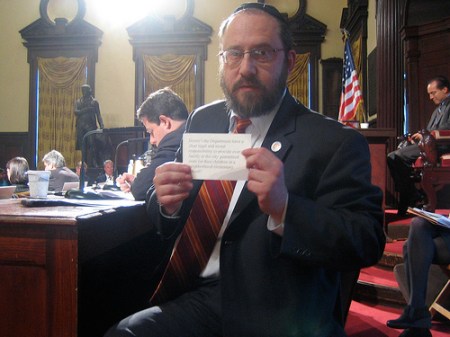
All images from GothamSchools, whose Elizabeth Green broke the story
(Guest post by Greg Forster)
Last week, the UFT got caught handing out cue cards to New York City Council members before a public hearing of the council’s education committee. The council members dutifully asked the questions they had been given, which pointedly invited anti-charter diatribes from the teacher-union and DOE witnesses.
The members then unanimously voted to make Grigori Potemkin their new committee chairman.
Internet wags are calling the scandal “cue card check.” ALELR has consulted his deep moles within UFT and offered an intriguing report on the union’s strategy for the Council’s next hearing.
The cue cards have to be seen to be believed:


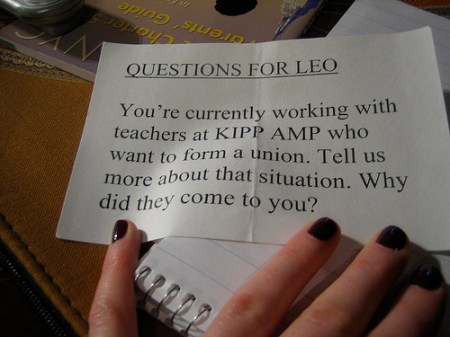
That’s “questions for Leo” as in our dear friend and Sith apprentice Leo Casey, who testified at the hearing. My pledge to you, the reader: from now on, every time Leo posts calumnies about Jay, I will post a link to this story.
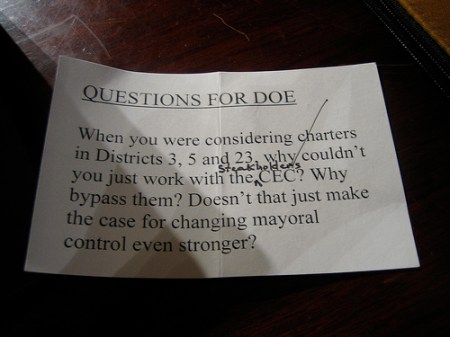
And that’s “questions for DOE” as in officials from the Department of Education. The cue cards were handed out by the UFT, but is it plausible that the department officials had no idea they were being asked scripted questions?
HILARIOUS UPDATE! When I first posted this, I didn’t look closely at the handwritten edit made to this cue card. Check it out – note the spelling. And this is from an organization of teachers!
This story doesn’t seem to have broken out of the local circuit yet, but it’s getting a whole lot of attention in the city media. The Daily News is leading the way, documenting the extent of UFT political contributions to the council members who got cue cards and covering Randi Weingarten’s attempts to deflect blame by claiming that a charter school organizer once did the same thing. (Not true, says the organizer – and who has more credibility here?)
But ALELR notes that props are not being given to Elizabeth Green of the blog GothamSchools, who broke the story and snapped all the pictures you see above (and more, which you can enjoy in all their glory by following the link).
Green wryly notes that the cue cards with accusatory anti-charter questions were handed out by “a representative of the city teachers union, which describes itself as in favor of charter schools.”
8 Comments | charter schools, journalism, teacher union | Tagged: Best of Greg, cue card check, Elizabeth Green, Greg Forster, Leo Casey, Mike Antonucci, Randi Weingarten, UFT | Permalink
Posted by Greg Forster
(Guest Post by Matthew Ladner)
A must read article from Ron Matus of the St. Pete Times.
4 Comments | teacher union | Permalink
Posted by matthewladner

(Guest post by Greg Forster)
I’ve argued before, against federalism cops and state-level ed reformers alike, that the biggest monkey wrench in the government school system is the local school board. The union demands that do the biggest damage to children – the uniform, performance-blind pay scale and the extraordinary obstacles to firing bad teachers – are enforced at that level. And while higher levels of government set the broad budget outlines, it’s the school boards that manage the budgets at the detail level – making them the primary people to blame for the tremendous wastefulness and zero accountability of the system.
And (as I argued to the federalism cops) that’s what we should expect, because local power is structurally more susceptible to these problems than state or federal power. If you run a scam at a high level, the scam is big and that means the suckers (that’s you and me) are more likely to 1) notice and 2) be willing to pay the price to stop it. But if, like the unions, you have your tentacles in thousands of tiny little school districts across the country, you can steal a little here and a little there and end up with a much bigger pile of swag, all while flying under the radar.
Well, yesterday Mark Steyn posted on NRO’s Corner about his experience serving on a school board subcommittee. Two stories he told got me thinking about a new aspect of the school board problem.
Story #1:
After one somewhat difficult meeting, I got back to find a telephone message from the reporter at the local paper: “Hi, Mark. I couldn’t make School Board but I have to file my story this evening. Did anything happen that I need to know about?”
Happily, no. And her non-attendance proved no obstacle to filing a bland happy-face report on the event.
Story #2 (the subcommittee was negotiating with a nearby town to build a joint high school):
On another occasion, I absentmindedly forgot it was a public meeting and launched a blistering attack on a neighboring town. As the evening ended, the nice lady reporter said to me, “Don’t worry, Mark. I won’t put any of those controversial things you said in the paper.”
School boards get a free ride from the relevant media. The broadcast media don’t have time to cover them – they’re too busy with more important stories, like whoever is the new Brangelina this week. And the local papers are at best too lazy to do their jobs (note that in Story #1 it was a “difficult meeting” about which the reporter filed a “bland happy-face report”) and at worst too cozy with the board members – who are, after all, the reporters’ neighbors and pillars of their communities – to report a big story even when it bites them right in their assignments.
4 Comments | journalism, teacher union | Tagged: Greg Forster, Mark Steyn, school boards | Permalink
Posted by Greg Forster

(Guest post by Greg Forster)
Jay points out that the president’s speech on education yesterday doesn’t resemble his legislative agenda. But it’s worse than that. There are things Obama could do to promose these good reform ideas even without legislation or budget changes, but won’t.
He calls on states to lift their charter caps. But what does he plan to do about charter caps? Even without extending federal authority over the states on charter policy, there’s plenty he could do, as Jay Matthews points out:
Will the Obama Education Department prepare and publicize a list of all the charter school cap laws in the country? Will Duncan call the governors, and legislators and school boards responsible for them and ask them to remove those restrictions on new charters, and find a way to get rid of bad charters?
Is the pope Muslim?
So on pretty much all fronts, the president’s “plan” for education is just symbolism.
But you know what? Symbols matter! The president is using his position in the spotlight to endorse choice and competition (as he did during the campaign) and rewards for performance, the two indispensable principles of sound educational reform. Even if he’s only doing it because Democratic constituencies other than the education unions expect it, it matters that the president has chosen to align himself with those constituencies rather than the unions. He could easily have taken the old line and kowtowed to the unions. But he didn’t, and that counts for something. So let’s give the president his due.
Now if only he had stopped his pals in Congress (who look an awful lot like his bosses these days) from kowtowing to the unions on vouchers.
Leave a Comment » | charter schools, politics, teacher pay, teacher union, vouchers | Tagged: Barack Obama, Greg Forster | Permalink
Posted by Greg Forster

You…administrator…bastards…still…can’t…fire me!!!!
(Guest Post by Matthew Ladner)
Leo over at EdWize asks “What is it about teacher voice that so frightens the denizens of the far right, that even the prospect of democratic teacher input into decision-making in the educational workplace should be met with such rhetorical ferocity?”
Two words: RUBBER ROOM!
UPDATE: Now Leo disavows any union responsibility for the rubber room. Ohhhhhhh sure…he’s shocked SHOCKED to hear someone suggest that the union’s making it prohibitively expensive to let a teacher go has anything to do with the rubber room. Round up the usual union baloney and meet me at EdWize…
14 Comments | charter schools, teacher union | Tagged: KIPP, KIPP teacher union, Knowledge is Power Program | Permalink
Posted by matthewladner
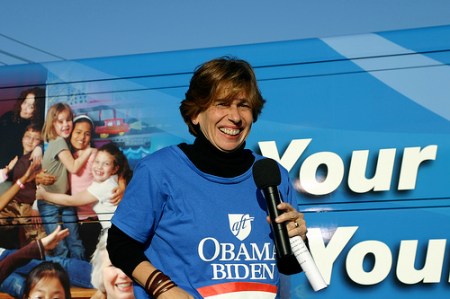
(Guest post by Greg Forster)
Randi Weingarten explained this week that, contrary to the outrageous slander that the unions are against education reform, she’s actually in favor of having the federal government create rigorous national academic standards for public schools, and will remain in favor of it as long as the Democrats are in power. (I’m paraphrasing.)
She writes: “Should fate, as determined by a student’s Zip code, dictate how much algebra he or she is taught?”
So the AFT now endorses the principle that a child’s education should not be determined by Zip code? When did that happen?
And if a child’s Zip code shouldn’t determine how much algebra he or she is taught, why should that determination be made in Washington instead? Apparently the amount of algebra you learn should be determined not by your Zip code, but by your international dialing code.
At least with Zip codes, some families can exercise school choice by moving to a different neighborhood. Yes, it’s an unfair system, since not all families are equally mobile; apparently Weingarten thinks the fair thing to do is to take away the freedom now enjoyed by some parents, so that there will be an equality of unfreedom.
Here we see the real modus operandi of the Left – achieve equality by leveling downward.
1 Comment | politics, residential school choice, school accountability, teacher union, vouchers | Tagged: Greg Forster, national standards, Randi Weingarten | Permalink
Posted by Greg Forster
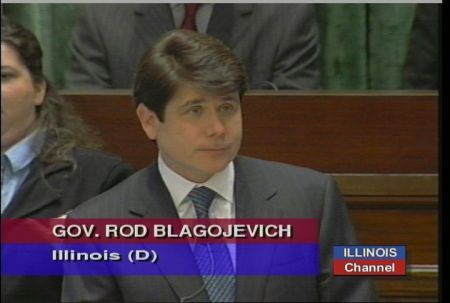
“At least they’re not as corrupt as I am” – Rod Blagojevich gives a dramatic last-minute speech defending the unions.
(Guest post by Greg Forster)
WASHINGTON – In an unexpected turn of events, yesterday morning the U.S. House of Representatives voted to impeach the nation’s teacher and school-staff unions. By the end of the day, the U.S. Senate had convicted on all charges, removing the unions from office.
In the bill of impeachment, the unions were charged with the “high crime and misdemeanor” of “destroying the futures of millions of American children in order to keep the gravy trains running on time.”
“Once we all got together and decided to put our selfish desire for re-election aside and make education policy on the merits, the rest was obvious, so we said, ‘Why wait?’ ” said Speaker of the House Nancy Pelosi (D – Ca.).
Senate Majority Leader Harry Reid (D – Nv.) added that universal vouchers, merit pay, the abolition of tenure, principal control over personnel rules and decisions, and objective evaluation of curricula would all be enacted by the end of the day today.
“They’re all no-brainers,” he said. “We’ve known all along, of course, but at last we can finally say it, and do what’s right for our children.” Pelosi added, “It’s so liberating!”
The sudden change is sending shockwaves through the education policy world.
“What are we going to do with ourselves now?” asked Robert Enlow, president of the Friedman Foundation for Educational Choice, at a press conference. “The battle’s over. I’ve just gotten word from the board that me and all my staff are fired. And nobody can get jobs in this economy.”
“I hear Wal-Mart is hiring,” said noted researcher Jay Greene at the same conference.
Congressional leaders attributed the change of direction to the accumulated power of the idealistic rhetoric of recently-inaugurated President Barack Obama.
“We’ve just heard so much about setting aside partisanship and doing the right thing for so long,” said Pelosi. “Two years of constant bombardment finally broke through our cynical shells. We all just cracked.”
The president was quick to issue a statement on the unions’ removal.
“I am committed to schools,” he announced. “We all must be committed to schools. We must hope for change without changing our hopes. We must bridge the divides without dividing the bridges.”
“Yes, we can!” the president added.
Leave a Comment » | politics, teacher union | Tagged: Greg Forster | Permalink
Posted by Greg Forster
(Guest post by Greg Forster)
On Monday the Boston Foundation released a study by researchers from Harvard, MIT and Duke, examining Boston’s charter schools and “pilot” schools using a random assignment method (HT Joanne Jacobs).
Pilot schools were created in Massachusetts in 1995 as a union-sponsored alternative to charter schools, which came to the state a year earlier. Pilot schools are owned and operated by the school district. Like charter schools, pilot schools serve students who choose to be there (though it’s easier to get into a charter school than a pilot school; see below). Like charter schools, pilot schools have some autonomy over budget, staffing, governance, curriculum, assessment, and calendar. Like charter schools, pilot schools are regularly reviewed and can be shut down for poor performance.
There are two main differences between charter schools and pilot schools. First, the teachers’ unions. Pilot schools have them, and all the shackles on effective school management that come with them. Charter schools don’t.
Second, some pilot schools are only nominally schools of choice, not real schools of choice like charter schools. Elementary and middle pilot schools – which make up a slender majority of the total – participate in the city’s so-called “choice” program for public schools, and thus have an attendance zone where students are guaranteed admission, and admit by lottery for the spaces left over. So while on paper everyone who goes to a pilot school “chooses” to be there, some of them will be there only because the city’s so-called “choice” system has frozen them out of other schools. The students compared in the study are all lottery applicants and are thus genuinely “choice students” – they are really there by choice, not because they had no practical alternatives elsewhere. However, the elementary and middle pilot schools are not “choice schools.” (Pilot high schools do not have guaranteed attendance zones and are thus real schools of choice.)
The Boston Foundation examined two treatment groups: students who were admitted by lottery to charter schools and students who were admitted by lottery to pilot schools. The control groups are made up of students who applied to the same schools in the same lotteries, but did not recieve admission and returned to traditional public schools.
As readers of Jay P. Greene’s Blog probably know already, random assignment is the gold standard for empirical research because it ensures that the treatment and control groups are very similar. The impact of the treatment (in this case, charter and pilot schools) is isolated from unobserved variables like family background.
The results? Charter schools produce bigger academic gains than regular public schools, pilot schools don’t.
The two perennial fatal flaws of “public school choice” would both seem to be at work here. First, public school choice is always a choice among schools that all partake of the same systemic deficiencies (read: unions). Choice is not choice if it doesn’t include a real variety of options. And second, public school choice typically offers a theoretical choice but makes it impossible to exercise that choice in practice. In this particular case, if each school has a guaranteed-admission attendance zone, the practical result will be fewer open slots in each school available for choice. (Other kinds of public school choice have other ways of blocking parents from effectively using choice, such as giving districts a veto over transfers.)
Charter schools are only an imperfect improvement on “public school choice” in both of these respects. Charters have more autonomy and thus can offer more variety of choice, but not nearly as much as real freedom of choice would provide. And with charters, as with public school choice, government controls and limits the admissions process.
But charters are an improvement over the status quo, even if only a modest one, as a large body of research has consistently shown.
There are some limitations to the Boston Foundation study, as with all studies. Pilot high schools are not required to admit by lottery if they are oversubscribed, while charter schools are. (Funny how the union-sponsored alternative gets this special treatment – random admission is apparently demanded by the conscience of the community when independent operators are involved, but not for the unions.) Of the city’s pilot high schools, two admit by lottery, five do not, and one admits by lottery for some students but not others. Thus, the lottery comparison doesn’t include five of the pilot high schools. It does include three high schools and all of the elementary and middle schools.
As always, we shouldn’t allow the limitations to negate the evidence we do have. Insofar as we have evidence to address the question, more freedom consistently produces better results, and more unionization consistently doesn’t.
3 Comments | charter schools, competitive effects, research reports, teacher union | Tagged: Boston, Boston Foundation, charter schools, Greg Forster, pilot schools | Permalink
Posted by Greg Forster
You are currently browsing the archives for the teacher union category.

 Jay P. Greene's Blog