FEC Drills Down the Data

February 21, 2011

(Guest post by Greg Forster)

If you want to drill down into state level data on school choice, check out the new edition of The ABCs of School Choice from my comrades-in-arms at the Foundation for Educational Choice.

Back when I was head of research for FEC, I used to put together the ABCs publication, and let me tell you – this new version is not your father’s ABCs. They’ve got a ton of new data, such as:

  • How many students used Arizona’s tax-credit scholarships in each year since the program began? How about the personal tax credit in Illinois or Ohio’s EdChoice voucher?
  • How many schools have taken Florida McKay vouchers in each year? How about Milwaukee vouchers?
  • What was the average dollar value of Georgia’s special needs voucher program in each year? How about Louisiana’s failing-schools voucher?
  • Et cetera?

Plus, as always, the ABCs gives you a detailed rundown on how each program works – the rules and regulations, the eligibility qualifications, legal issues, the whole story. Check it out.


Fordham Fears the Daleks

December 17, 2010

(Guest post by Greg Forster)

The Fordham Institute’s Gadfly, in an item signed by Janie Scull, picks up and recirculates the Gates Foundation’s drillandkillaphobic error – but with a subtle twist (see if you can catch it – I didn’t when I first read it):

Second, teachers who, according to their students, “teach to the test” do not produce the highest value-added scores for said students; rather, instructors who help their students understand math concepts and reading comprehension yield the highest scores.

Gates was originally pushing the line that the study found a negative relationship between “teach to the test” or “drill and kill” and outcomes. Not only is there nothing in the study to support that, the study actually finds the opposite.

Fordham is now slightly changing the claim so that it appears to say test prep is bad for students, without actually saying that. Read that sentence very carefully. Now read it again, and this time bear the following in mind: the study found a positive correlation between test prep and outcomes. Now, does this look like an honest characterization of the study to you?

I’ll admit that they had me fooled. I originally put up a version of this blog post saying that they were recirculating Gates’s erorr. Then I reread it and pulled that down. They’re not just recirculating the error, they’re weaseling it up to see if they can circulate it in a way that will pass muster. I haven’t seen such word-twisting since I watched the president of the United States explain “it depends on what the meaning of ‘is’ is.”

“I did not have a statistically significant relationship with that variable.”

Despite her efforts to remain technically correct, Scull does make an erroneous claim. She directly attributes the phrase “teach to the test,” in quotes, to students. In fact, as Jay pointed out, the phrase “teach to the test” and similar phobic phrases such as “drill and kill” do not appear in the study. The study found a positive relationship between “test prep” and outcomes.

This is worse than the New York Times and Los Angeles Times reporting the original error. Those papers simply picked up what Gates told them and reported that Gates said it. Sure, in a perfect world reporters would always check these things with independent researchers – but it’s not a hanging offense. (However comically hysterical some of them might get when they get called on it.)

The Fordham Institute is, or at least claims to be, an independent voice. And the Gadfly item did not attribute its claim to Gates, as the newspapers did. The Gadfly item states its partly erroneous, partly weaseled-up claim simply as a fact. That lends the intellectual prestige of the Fordham Institute to both the error and the Clintonian weaseling.

Jay has said before, and I agree, that Fordham can take huge piles of money from Gates without losing its integrity.

That’s why I have full confidence Scull and Fordham will be running a correction of this erroneous item.

As I wrote earlier this week, human beings are not daleks, so test prep and similar activities can’t be the be-all and end-all, but the fear of test prep has so far been much more destructive than its overemphasis. If we don’t get past drillandkillaphobia, we’ll never fix education.

[This post has been edited since it was first published, as indicated in the text.]


Panic on the Streets of Florida!

December 16, 2010

(Guest Post by Matthew Ladner)

Florida governor-elect Rick Scott is making it clear that he is deadly serious about the next wave of Florida K-12 reform.  Worrying about tenure reform is soooo 5 months ago, because Governor-elect Scott mentioned the possibility of letting parents control education funding through Education Savings Accounts. The Goldwater Institute study cited in the paper will be coming out in the not-so-distant-future.

Reactionaries have already started howling.  Mother Jones hates the idea, and started spouting conspiracy theories interrupted only by occasional name-calling. Why wait to actually read a plan when you can go ahead and start complaining about it in advance? Some of the Florida papers have been almost as silly, having apparently learned nothing from having opposed Governor Bush’s reforms only to watch with sheepish silence as Florida shot up the NAEP ranks.

Someone even placed a call to Little Ramona, who as usual these days sings straight out of the AFT hymnal.

This particular rant takes the cake so far. Wow, I mean W*O*W. Check it out:

After a half century of broadening the wealth gap and decimating the middle class, there are many people who would prefer a return to near feudal conditions, when religion, educational disadvantages and abject poverty were used to more easily control the lower classes. A massive expansion in vouchers would be a giant step in that direction and it should be no surprise that billionaire members of the ruling class (like Scott) are lending their support.

When does my “ruling class” membership card arrive in the mail?  I mean really, feudalism gets such a bum rap these days. We don’t need feudalism-we need Neo-Feudalism! You know, the Dead-Hand-of-Clericalism grasps the Invisible-Hand-of-the-Market around the neck of the working class and squeezes!

Oi vey

Stay tuned for the study…I’m afraid the reality will seem terribly reasonable in comparison to the fever dreams of opponents.


Burke and Ladner respond to the Think Tank Review Project

December 6, 2010

(Guest Post by Matthew Ladner)

Lindsey Burke and I respond to a critique of our work by the Think Tank Review project. Perhaps my favorite part is where the reviewer chides us for failing to do a literature review but failed to notice that Dan Lips and I had refuted her main contention over a year ago in Education Next. The main point of the review is an attempt to cry foul over Florida’s 4th Grade NAEP scores due to the 3rd grade retention policy.

I’ve changed my mind, this is my favorite part:


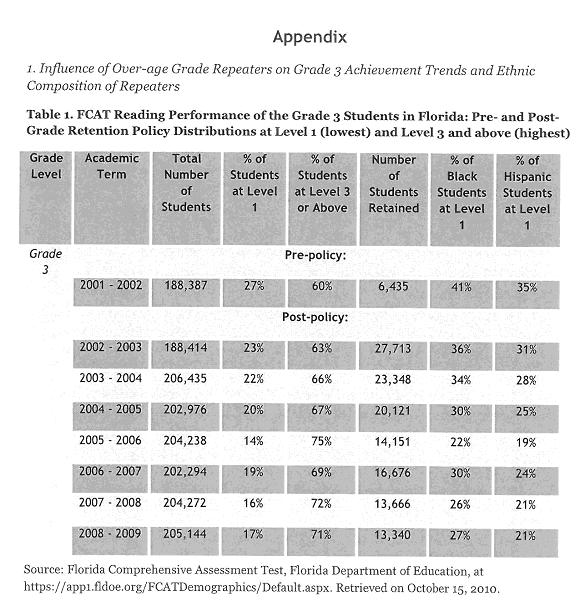
This page comes directly from the review. Notice that by the information gathered by the reviewer herself, the percentage of Florida students scoring FCAT 1 (the lowest possible score and the score making a student eligible for retention) in 3rd grade fell from 27% in 2001-02 to 17% in 2008-09. That’s almost a 38% decline.

Likewise, the percentage of African-American students scoring FCAT 1 fell from 41% to 27%, and the Hispanic rate fell from 35% to 21%. Notice that the African-American rate of scoring FCAT 1 now matches the overall rate in 2001-02 had been.

This is called “radical success.”

Notice also that the number of students actually being retained drops by more than half between the first year of the policy and 2008-09. Despite that fact, Florida’s 4th grade NAEP scores continued to climb. If Florida’s NAEP improvement were driven by retention, scores ought to have peaked early in the decade, and then fallen off. Instead, they continued to rise throughout the decade, even as retention declined.

Oh, and Florida’s reading scores improved by almost a grade level before the retention policy even passed. I could go on, point out the practice of mid-year promotions further weakens the “it was all retentions” theory, and/or blather at some length about the regression discontinuity analysis that Jay performed, which strongly points to something other than aging going on with this policy. Click the link if you want to read about it.

The bottom line: these policies worked. The percentage of Florida students scoring below basic on 4th grade reading dropped from 47% to 27% between 1998 and 2009. No one knows exactly how much of which policy moved the needle, but there is a simple solution to this: do all of the policies at the same time.

If Florida lawmakers had mandated in 1999 that students stood off the side of their desks to do jumping jacks to start each school day, and childhood illiteracy dropped like a rock off a cliff, I would be advocating for other states to do the same. At least until such time that someone established that it didn’t add any value.

In some offline conversations I have had with the Think Tank Review people, they seem to think that other states should be “cautious” until we know exactly how much improvement there has been after hair-splitting, and what causes what.

I disagree. In my view, that’s like getting into an argument about whether to use the sprinkler system, the firehose or the buckets of water when kids are running around with their hair on fire. Florida used all the approaches at once, and got great improvement.

Governor-elect Scott seems to busily readying Florida Reform Version 2.0. Somehow I doubt he will be much persuaded by an attempt to muddy the water on Version 1.0.

All is not lost, however.

I will be adding the above table from their study to my Powerpoint, given how well it makes the case for Florida’s reforms.


What Doesn’t Work Clearinghouse

October 4, 2010

The U.S. Department of Education’s “What Works Clearinghouse” (WWC) is supposed to adjudicate the scientific validity of competing education research claims so that policymakers, reporters, practitioners, and others don’t have to strain their brains to do it themselves.  It would be much smarter for folks to exert the mental energy themselves rather than trust a government-operated truth committee to sort things out for them.

WWC makes mistakes, is subject to political manipulation, and applies arbitrary standards.  In short, what WWC says is not The Truth.  WWC is not necessarily less reliable than any other source that claims to adjudicate The Truth for you.  Everyone may make mistakes, distort results, and apply arbitrary standards.  The problem is that WWC has the official endorsement of the U.S. Department of Education, so many people fail to take their findings with the same grains of salt that they would to the findings of any other self-appointed truth committee.  And with the possibility that government money may be conditioned on WWC endorsement, WWC’s shortcomings are potentially more dangerous.

I could provide numerous examples of WWC’s mistakes, political manipulation, and arbitrariness, but for the brevity of a blog post let me illustrate my point with just a few.

First, WWC was sloppy and lazy in its recent finding that the Milwaukee voucher evaluation, led by my colleagues Pat Wolf and John Witte, failed to meet “WWC evidence standards” because “the authors do not provide evidence that the subsamples of voucher recipients and public school comparison students analyzed in this study were initially equivalent in math and reading achievement.” WWC justifies their conclusion with a helpful footnote that explains: “At the time of publication, the WWC had contacted the corresponding author for additional information regarding the equivalence of the analysis samples at baseline and no response had been received.”

But if WWC had actually bothered to read the Milwaukee reports they would have found the evidence of equivalence they were looking for.  The Milwaukee voucher evaluation that Pat and John are leading has a matched-sample research design.  In fact, the research team produced an entire report whose purpose was to demonstrate that the matching had worked and produced comparable samples. In addition, in the 3rd Year report the researchers devoted an entire section (see appendix B) to documenting the continuing equivalence of the matched samples despite some attrition of students over time.

Rather than reading the reports and examining the evidence on the comparability of the matched samples, WWC decided that the best way to determine whether the research met their standards for sample equivalence was to email John Witte and ask him.  I guess it’s all that hard work that justifies the multi-million dollar contract Mathematica receives from the U.S. Department of Education to run WWC.

As it turns out, Witte was traveling when WWC sent him the email.  When he returned he deleted their request along with a bunch of other emails without examining it closely.  But WWC took Witte’s non-response as confirmation that there was no evidence demonstrating the equivalence of the matched samples.  WWC couldn’t be bothered to contact any of the several co-authors.  They just went for their negative conclusion without further reading, thought, or effort.

I can’t prove it (and I’m sure my thought-process would not meet WWC standards), but I’ll bet that if the subject of the study was not vouchers, WWC would have been sure to read the reports closely and make extra efforts to contact co-authors before dismissing the research as failing to meet their standards.  But voucher researchers have grown accustomed to double-standards when others assess their research.  It’s just amazingly ironic to see the federally-sponsored entity charged with maintaining consistent and high standards fall so easily into their own double-standard.

Another example — I served on a WWC panel regarding school turnarounds a few years ago.  We were charged with assessing the research on how to successfully turnaround a failing school.  We quickly discovered that there was no research that met WWC’s standards on that question.  I suggested that we simply report that there is no rigorous evidence on this topic.  The staff rejected that suggestion, emphasizing that the Department of Education needed to have some evidence on effective turnaround strategies.

I have no idea why the political needs of the Department should have affected the truth committee in assessing the research, but it did.  We were told to look at non-rigorous research, including case-studies, anecdotes, and our own experience to do our best in identifying promising strategies.  It was strange — there were very tight criteria for what met WWC standards, but there were effectively no standards when it came to less rigorous research.  We just had to use our professional judgment.

We ended up endorsing some turnaround strategies (I can’t even remember what they were) but we did so based on virtually no evidence.  And this was all fine as long as we said that the conclusions were not based on research that met WWC standards.  I still don’t know what would have been wrong with simply saying that research doesn’t have much to tell us about effective turnaround strategies, but I guess that’s not the way truth committees work.  Truth committees have to provide the truth even when it is false.

The heart of the problem is that science has never depended on government-run truth committees to make progress.  It is simply not possible for the government to adjudicate the truth on disputed topics because the temptation to manipulate the answer or simply to make sloppy and lazy mistakes is all too great.  This is not a problem that is particular to the Obama Administration or to Mathematica.  My second example was from the Bush Administration when WWC was run by AIR.

The hard reality is that you can never fully rely on any authority to adjudicate the truth for you.  Yes, conflicting claims can be confusing.  Yes, it would be wonderfully convenient if someone just sorted it all out for us.  But once we give someone else the power to decide the truth on our behalf, we are prey to whatever distortions or mistakes they may make.  And since self-interest introduces distortions and the tendency to make mistakes, the government is a particularly untrustworthy entity to rely upon when it comes to government policy.

Science has always made progress by people sorting through the mess of competing, often technical, claims.  When official truth committees have intervened, it has almost always hindered scientific progress.  Remember that  it was the official truth committee that determined that Galileo was wrong.  Truth committees have taken positions on evolution, global warming, and a host of other controversial topics.  It simply doesn’t help.

We have no alternative to sorting through the evidence and trying to figure these things out ourselves.  We may rely upon the expertise of others in helping us sort out competing claims, but we should always do so with caution, since those experts may be mistaken or even deceptive.  But when the government starts weighing in as an expert, it speaks with far too much authority and can be much more coercive.  A What Works Clearinghouse simply doesn’t work.


Run to the Hills!

September 30, 2010

(Guest Post by Matthew Ladner)

From Education Week:

After five years of providing critical reviews of education-related reports by nonacademic think tanks, education professors Alex Molnar and Kevin G. Welner hope to expand their own reach with a new, broader research center.
 

The new National Education Policy Center, based at Mr. Welner’s academic home, the University of Colorado at Boulder, will consolidate his Education and the Public Interest Center and Mr. Molnar’s Education Policy Research Unit, previously at Arizona State University. It will review existing research, conduct new research, and, for the first time for both groups, make policy recommendations.

The story goes on to print claims from these guys that they are independent from the unions, quotes Little Ramona taking pot shots at think-tanks, etc.

It’s would be easy to cry foul that the NEA is simply renting the credibility of academic institutions to produce propaganda. They gave Molnar’s outfit a quarter of million dollars a year at Arizona State. Overall, however, I don’t really have a problem with them doing so. Think-tanks always face scrutiny when releasing reports, and more scrutiny is better than less. As Rick Hess notes in the story:

“It’s a free country; it’s fine for them to look at research produced by think tanks that hold other views and try to critique them,” said Frederick M. Hess, the director of education policy studies for the right-leaning American Enterprise Institute, in Washington, and the author of a blog for Education Week’s website. “It’s only problematic when they try to pass themselves off as objective, even-handed arbiters of good research.”

The story goes on to say:

Washington think tankers, from Mr. Hess of the AEI to Jack Jennings, the founder of the CEP, and Kevin Carey, the policy director for the center-left think tank Education Sector, said the Think Tank Review Project’s analysis has been a mix of “valid observations” and “conclusions flawed to the point of being nonsensical.”

There is a reason why think-tanks, political scientists and economists do a great deal of the relevant education research these days: we walked into a vacuum left by the Colleges of Education. Don’t take my word for it: Arthur Levine, former President of the Columbia University Teachers College,  issued a no-holds barred critique of doctoral-level research in the nations colleges of education. Levine surveyed deans, faculty, education school alumni, K-12 school principals, and reviewed 1,300 doctoral dissertations and finds the research seriously lacking. Just how bad is the quality of doctoral-level research in colleges of education? Levine doesn’t pull any punches:

In general, the research questions were unworthy of a doctoral dissertation, literature reviews were dated and cursory, study designs were seriously flawed, samples were small and particularistic, confounding variables were not taken into account, perceptions were commonly used as proxies for reality, statistical analyses were performed frequently on meaningless data, and conclusions and recommendations were often superficial and without merit.

Cleaning this up would be a task for Hercules, so Welner and company may be making a rational decision to try to diminish those who replaced them in serious policy discussions.  Think tank research is always subject to criticism and Welner and company are free to join in the fun.


Sweet are the Uses of Adversity

September 23, 2010

(Guest Post by Matthew Ladner)

Jay has lost that loving feeling after the failure of the merit pay plan in Nashville. Mike Antonucci quite rightly points out that “If we want to evaluate teachers on their performance, we should be prepared for performance pay programs to be evaluated on their performance.”

It was worth trying, but it merit pay didn’t work, so should move on to more promising reform strategies, right?

WRONG MOR-TONE!!!!!

What this study seems to show is that the Nashville program didn’t work. That’s valuable information, and we might want to figure out why a program in Little Rock found positive results, while the one in Nashville did not. Inch by inch, we just might figure something out.

Greg and I have each noted in different ways that getting this figured out is a very tricky business. We agree that maximizing competition within the system is key to sorting out the incentives properly. The Nashville study seems to reinforce the view that this about drawing the right people into the teaching profession rather than dangling a carrot out in front of your current teachers. This subject however deserves careful study across multiple programs over a long period of time.

When results by teacher vary so profoundly, it strikes me as inconceivable that we cannot develop a system to treat teachers like professionals. A profession that offers summers off and high job security but has a union negotiated pay scale that incrementally rewards you for getting old doesn’t seem likely to garner as many highly capable people as needed into the profession.

A Nashville pilot program dangling out a $15,000 carrot doesn’t seem likely to get the best and the brightest out of Vanderbilt to forego that MBA and go into teaching. It didn’t seem to motivate the teachers who were already there either.

I don’t know the answers. I do know that we need a lot of people trying a lot of different things and sharing their results and experiences-that’s the primordial soup of innovation. Schools run by the teachers like law firms, parent and student satisfaction measurement models, hybrid model schools with rolling thunder value added assessment systems, and whatever else we can come up with- bring it on.

How about a 33 year old hedge fund manager turning out killer content from a closet? Yes please!

The same logic applies for merit pay- we need experimentation and study. There were many failed attempts to build a plane before the Wright Brothers, and even the Wright Brother plane was more likely to get you killed than fly you to another city, state or country.

We all need to take a deep breath, keep our expectations reasonable, and learn from failures like the Nashville program.


Merit Pay Bust

September 22, 2010

For some time now I have expressed disillusionment with merit pay as an ed reform strategy. In a paper Stuart Buck and I produced last spring for a Harvard conference on performance incentives we wrote:

All of this leads us to measured skepticism about the merit of merit pay, unless coupled with other reforms such as competition between schools. After all, merit pay boils down to an attempt to recreate a market system within a tightly controlled state monopoly. This is an objective fraught with peril. Even if wise and benevolent state actors manage to get the incentives right at a particular moment in time in a particular place, their actions can always be undone by immediate successors. Those successors may well be more influenced by the powerful special interests that want to block merit pay, loosen the standards, or even to call a system “merit pay” while rewarding behavior that has no relation to actual achievement.

Now we have additional reasons for skepticism.  A well-designed random-assignment experiment led by Vanderbilt’s Matt Springer found:

While the general trend in middle school mathematics performance was upward over the period of the project, students of teachers randomly assigned to the treatment group (eligible for bonuses) did not outperform students whose teachers were assigned to the control group (not eligible for bonuses).

Keep in mind that this experiment only tests whether financial incentives increase teacher motivation, resulting in higher student achievement.  It does not address whether merit pay might change the composition of the teacher labor force, attracting and retaining more effective teachers.

Still, color me even more skeptical about the promise of merit pay as an ed reform strategy.  It may well be that the current crop of teachers we have believe that they are doing their best, so offering them money for trying harder doesn’t result in a significant change in effort.  And given the political and organizational barriers to merit pay, I hold out little hope that a well-designed program can be sustained long enough to effect the composition of the teacher labor market.

In the last week, I hope ed reformers have learned that we can’t really improve the school system by maintaining the same centralized system while trying to sneak a reformer into the control-room (a la Michelle Rhee).  And I also hope we’ve learned that we can’t tinker with the incentives within that same centralized system ( a la merit pay).  The key to effective reform is decentralization of control via school choice, including charters, vouchers, tax credits, weighted student funding, etc…
(edited for typos)

New Heritage Brief on the Racial Achievement Gap

September 18, 2010


(Guest Post by Matthew Ladner)

Back in 1997, Professor Lawrence Stedman wrote:

Twelfth-grade black students are performing at the level of middle school white students. These students are about to graduate, yet they lag four or more years behind in every area including math, science, writing, history, and geography. Latino seniors do somewhat better than 8th-grade white students in math and writing but, in other areas, are also four years behind white 12th graders…. Schools and society remains divided into two different worlds, one black, one white, separate and unequal.

Thirteen years later, sadly not much has changed with the national numbers, but some states have proven that far-reaching policy changes can reduce achievement gaps.

Lindsey Burke and I sing a new duet celebrating Florida’s reduction of the racial achievement gap  in a new Heritage brief.  Let’s just say the evidence from Florida is fairly compelling:

From the brief:

If trends since 1998 were to hold nationally, it would be about 33 years before we could expect Hispanics to close the gap with their white peers. In Florida, however, black students could catch up in half that time, and Hispanics could exceed the national average for white students as early as 2011.

This is just the sort of progress that the “Broader-Bolder” crowd would like us to believe is not possible without a vast expansion of the welfare state.

OOOOOOOOPS! Do you think we’re stupid Hans? It is accountability with teeth, real transparency and expanded parental choice that is making this happen. Cue the slo-mo fall scene-and please try not to make too big of a mess on the sidewalk.


American Legislative Exchange Council releases Report Card on American Education

September 1, 2010

(Guest Post by Matthew Ladner)

The American Legislative Exchange Council released the Report Card on American Education: Ranking State K-12 Performance, Progress and Reform today coauthored by yours truly, Andy LeFevre and Dan Lips. Follow the link and check out our rankings of state NAEP performance based on the overall math and reading scores and gains of general education low-income children, and our “poll of polls” grades for K-12 policy in each state.

Former Florida Governor Jeb Bush penned the foreward. After losing a bet Stanford Political Scientist Terry Moe gave the book a very kind endorsement:

Everyone interested in education reform should read this book. Using a method that—by focusing on the achievement of low-income children—allows for apples-to-apples comparisons across the states, the authors present a treasure trove of eye-opening performance data and arrive at a ranking of state performance that reveals both surprising success and shocking failure. The book is well worth reading for the data alone. But it also offers a good deal more, from research summaries to methodological clarifications to model legislation—and concludes with an insightful discussion of the high-powered reforms that have helped some states out-perform others, and that offer the nation a path to improvement. I should add, finally—and with genuine admiration—that the book is beautifully written and a pleasure to read: something I can rarely say about a data analysis.

JPGB readers will of course realize that this is quite a tribute to Andy and Dan, given your painfully intimate knowledge of my garbled writing. Thanks also to Jeff Reed and Dave Myslinski from ALEC (Jeff is now rocking and rolling at the Foundation for Educational Choice), Jay and my Goldwater Institute comrades.

Check it out and let me know what you think. Be nice though: today is my birthday, which makes me even more emotionally volatile than usual.

UPDATE: Here is a link to the PDF.