Jason Riley: The Next Step is Education Savings Accounts

March 1, 2017


(Guest Post by Matthew Ladner)

Jason Riley weighs in on ESAs, federalism and parental choice in his Wall Street Journal column today:

After years of federal overreach through No Child Left Behind, Common Core and Obama administration “guidance” on lavatory usage, the states—where Republicans now occupy 33 of the 50 governors’ offices—are not only reasserting local control of K-12 education but reimagining it.

In addition to this charter progress, education reformers see prospects for more private school choice in the form of education savings accounts, or ESAs, which they describe as the next step in school choice. Under an ESA system, money that would otherwise go to funding a child’s public-school education is instead placed into a restricted-use bank account, from which the family can withdraw to spend on a variety of education-related services. Like vouchers, ESAs allow the money to follow the child. But ESAs don’t limit education options in the way that vouchers do. Instead, families can use money in the account for tuition, textbooks, tutoring, test preparation, transportation, Advanced Placement courses, online learning and even college savings accounts.

Jason Bedrick, a policy analyst at the research organization EdChoice, told me that along with allowing families to tailor spending to the education needs of their children, ESAs can control costs. “Moving from a coupon or voucher model to a bank-account model helps guard against tuition inflation like we’ve seen in Pell Grants,” he said. With ESAs, “there’s no price floor. If you’ve got a $5,000 voucher, no school is going to charge less than $5,000. With an ESA, there’s a lot more competition because private schools are not just competing against each other and against public schools but also competing against other sorts of education opportunities.” In other words, a parent with an ESA has the ability to hold both public and private schools accountable.


Spontaneous Order, Foreign Aid and K-12

February 28, 2017

(Guest Post by Matthew Ladner)

Annie Lowrey’s NYT magazine article The Future of Not Working is well worth reading. The article describes a Silicon Valley funded experiment with a universal basic income in Africa. Personally I’m skeptical of the notion that human labor is going to become obsolete, and I am even more skeptical of the idea of a universal basic income when we currently stand tens of trillions short on previously made commitments. Nevertheless, this article is well worth reading to the very end, as it contains a powerful insight. With the benefit of modern cell phone banking account technology, this group has been giving aid in the form of small cash payments instead of whatever the aid organizations happen to want to give out. This allows people to work things out for themselves:

The residents of this village had received money in 2013, and it was visibly better off than the basic-income pilot village. Its clearings were filled with mango plantings, its cows sturdy. A small lake on the outskirts had been lined with nets for catching fish. “Could you imagine sitting in an office in London or New York trying to figure out what this village needs?” Bassin said as he admired a well-fed cow tied up by the lakeside. “It would just be impossible.”

Many popular forms of aid have been shown to work abysmally. PlayPumps — merry-go-round-type contraptions that let children pump water from underground wells as they play — did little to improve access to clean water. Buy-a-cow programs have saddled families with animals inappropriate to their environment. Skills training and microfinance, one 2015 World Bank study found, “have shown little impact on poverty or stability, especially relative to program cost.”

All across the villages of western Kenya, it was clear to me just how much aid money was wasted on unnecessary stuff. The villagers had too many jerrycans and water tanks, because a nongovernmental organization kept bringing them. There was a thriving trade in Toms canvas slip-ons: People received them free from NGO workers and then turned around and sold them in the market centers. And none of the aid groups that had visited the villages managed to help the very poorest families.

The article goes on to explain that cash payments have been abjured in aid programs in the past. It would deprive beneficiaries of the “benevolent guidance” of very well-meaning people, and would also require fewer such people. It however seems entirely obvious that the Kenyan villagers in this article know their own needs much better than the distant would-be do-gooder, and that they are far more capable of making good use of resources. All of this very much brings to mind the Douglas Carswell quote (via Matt Ridley):

The elite gets things wrong, says Douglas Carswell in The End of Politics and the Birth of iDemocracy, ‘because they endlessly seek to govern by design in a world that is best organized spontaneously from below.’ Public policy failures stem from planners excessive faith in deliberate design. ‘They constantly underrate the merits of spontaneous, organic arrangement, and fail to recognize that the best plan is often not to have one.’

Education Savings Accounts anyone?


Good Listen/Reads

January 26, 2017

(Guest Post by Matthew Ladner)

Jay goes full podcast with Nick Gillispie, putting the Secretary of Ed debate in context and revealing an “anarcho-socialist” youth. Congrats on keeping the more desirable half btw! Reason also covered the ESA push in Texas:

Andy Smarick presses the attack on the massive failure of the SIG program and sees an opening for choice. Mike Petrilli asks you to please ignore the evaluation disasters as he courts the technocratic tribe on the bossy nature of the Louisiana voucher program.

Finally the most interesting thing you will read this month just might be “What Do You Do if a Red State Moves to You?”  Editorial comment on the latter: there are obviously disturbing trends afoot but democracy is designed to develop compromises that people can live if not love. If the Presidency devolves into whose team gets to make imperial diktats from on high to govern by pen and phone expect unending backlash from all sides of every issue.


The Mythbusting Never Ends

January 12, 2017

neverending-story-book-replica-img-book-1975919790

(Guest post by Greg Forster)

OCPA’s Perspective carries my latest under the somewhat discouraging title “Ed Choice Mythbusting Never Ends.” At least I’ll never be out of a job:

The funniest thing in the article is where McCloud mocks the emergence of Education Savings Accounts (ESAs) and then complains about precisely the problem ESAs solve. After making fun of the choice movement for switching from vouchers to ESAs—because apparently it’s a bad sign if you’re willing to move from a good idea to a better one—McCloud asserts that “vouchers would inflate the cost of private education.”

Indeed, vouchers do inadvertently raise private school tuition. That is one reason the movement is switching from vouchers to ESAs, which allow parents to buy education services without creating an artificial tuition floor for schools. It’s also true that even ESAs raise economic demand for education services in general—but that’s just another way of saying they empower parents to pay for those services!

McCloud’s article provides a public service in one respect: It collects almost all the school choice myths in one place. Maybe I don’t mind so much if the defenders of the status quo make my job easy after all.

As always, your thoughts are appreciated!


The Florida Legislature Renames Florida ESA for Senator Gardiner over his humble objection

October 20, 2016

(Guest Post by Matthew Ladner)

In this time of cynical politics it is refreshing to see something as fantastic as this floor debate in the Florida Senate.  Earlier this year the sponsor of a bill to expand Florida’s ESA program for special needs children offers an amendment on the floor to rename the program after Senate President Gardiner, a special needs father and advocate and the original sponsor of the legislation. Gardiner objected and appealed to the Senator to drop his amendment, noting that he had promised to send the bill over to the Florida House without amendment.  Not to be thwarted, the Senators secure a release from this promise from the Speaker of the Florida House, and then the Senate co-sponsors the amendment 39-0.

There is still some good in this world Mr. Frodo- and it is worth fighting for.

UPDATE: I am told that after all of this Senator Gardiner still refused to allow the program to be named after him, so the legislature named it after his family instead.


The Agony and the Ecstasy of the Nevada ESA Ruling

September 30, 2016

(Guest Post by Matthew Ladner)

I’ve read a few school choice related Supreme Court decisions over the years, but I’ve never seen anything quite like the ruling that the Nevada Supreme Court made yesterday. To this untrained reader, it appears to be a determined exercise in cutting the baby.

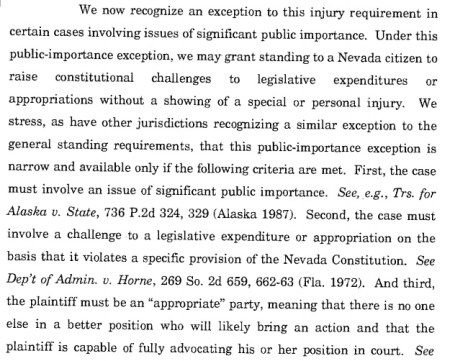
The decision reads very cleanly until the matter of standing arises. Standing involves being able to demonstrate some personal harm, and the Court implicitly acknowledges a lack of harm on the part of the plaintiffs by creating an exception to standing out of whole clothe in the ruling:

nv-ruling-1

So…..I am inferring from this that under the standing requirements that existed for every previous case in the history of the state of Nevada, that the Nevada Supreme Court would have felt compelled to acknowledge the obvious truth that the plaintiffs had claimed harm when in fact none actually existed. I’m no lawyer, and I don’t play one on television, but I’m also astonished that the Court felt free to willy-nilly change standing requirements unilaterally and in the late stages of an important case.  If you can explain to me how this makes the least bit of sense, and it not entirely arbitrary and capricious, please feel free to educate me in the comments.

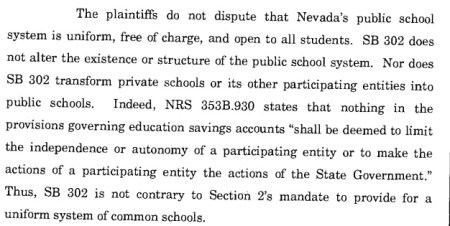
Having performed this incredibly one sided act of mental gymnastics, the court moves on to consideration of constitutional issues. First up, our old friend the “uniformity clause.” Quite rightly, the Court squashes this bug of a claim under their boot:

nv-ruling-2

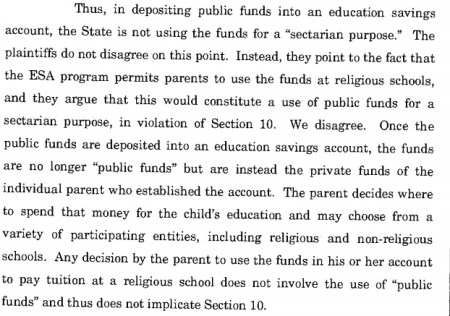
Jolly good, moving on to sectarian purpose Blaine claim. This is where the Court makes a potentially very far-reaching conclusion:

nv-ruling-3

Note that this was an argument that Nick Dranias and I made in our paper for the Goldwater Institute that made the case for the Arizona ESA as a replacement for the voucher program for children with disabilities: that once a set of mutual benefits between a parent and the state had been realized that funds deposited into an account were private rather than public funds. Jason does a great job of expounding on this point in his Cato post on the decision and how this precedent is followed in other policy areas. No one can claim that a state worker cannot use their salary to pay for Catholic school tuition for instance- as the check from the state is exchanged for the labor of the worker and thus becomes private funds. Likewise in an ESA, the state realizes the benefit of paying for a traditional education for the child, and the parent realizes the benefit of flexibility under the rules of the account.

The Arizona ESA decision implicitly recognized this argument, but the Nevada decision explicitly embraces it.

After that we get back into agony, with the court sifting through a complex mess of requirements and dates of bills passing. Basically in the end the court emphatically holds that ESAs are constitutional, but finds that the way the legislature funded the ESA program was itself not constitutional. Basically the program exists but currently has no funding.

So where does this leave things?  It leaves the 7,000+ students who applied for NVESA out in the cold. As the Wall Street Journal noted today, a looming special session on building a football stadium for an out of state billionaire also represents an opportunity to fund the educations of thousands of Nevada children.

Let’s see what happens next.