Use the Force MOOC! A 2013 retrospective

December 26, 2013

(Guest Post by Matthew Ladner)

The after-Christmas but before New Year period is always dominated by “Year in Review” retrospectives, so why not join in on the fun? Here at the Jayblog we dig new options for students and parents, so let’s take a look back at 2013.

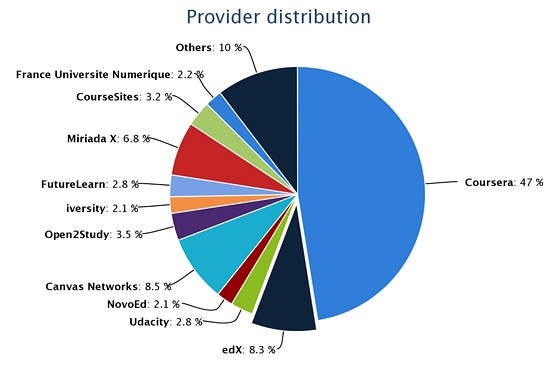
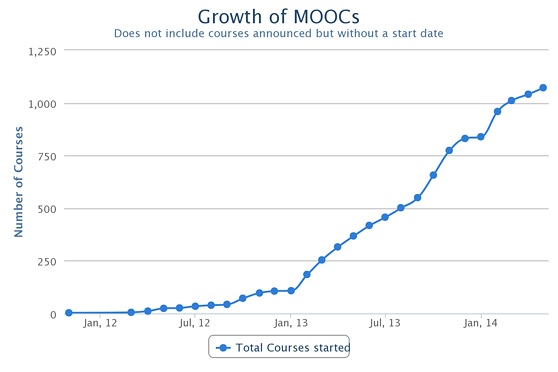
Digital learning continues to surge. No one has yet established the free online degree that some nutball predicted in 2009, but events are moving in that direction. Dhawal Shah of EdSurge leads us off with a review of the progress of Massive Open Online Courses (MOOCs) in 2013. Shah includes MOOCilicous charts like:
MOOC 1


and…

MOOC 2and…

MOOC 3

All of this is quite impressive given the first MOOC rolled out in 2011. Shah provides analysis and 2014 predictions, so go read the article. Events seem to be conspiring to take a very sharp pin to a higher education tuition bubble. One cannot help but wonder how long we will go on debating public funding for online high-school courses when, ahhh, Stanford is giving them away for free and you can, well, get college credit for them.  The logical side of Kevin Carey’s brain (the one that writes about higher education) turned in a useful refutation of the hand-wringing over MOOC completion rates.

Remember where you heard it first- the day is coming when more people will be watching university lectures online than Baywatch reruns.

Please note: I did not say it would be any time soon…

On the K-12 front, the National Alliance for Public Charter Schools published an evaluation of state charter school laws finding widespread improvement between 2010 and 2013. Bottom line: break out the bubbly. Thirty-five states improved their laws, only one law regressed. Seven states “essentially overhauled” their laws with major improvements-Hawaii, Rhode Island, New Mexico, Indiana, South Carolina, Louisiana, and Colorado. Ten more states-Florida, Illinois, Massachusetts, Michigan, Missouri, Nevada, New Jersey, New York, North Carolina, and Ohio made “notable improvements” in their charter law.

Here at Jayblog we have our annual measure of success in the private choice movement the Forster vs. Mathews school choice dinner bet. Greg either doubled or tripled the standard in 2011, and followed up by easily surmounting it once more in 2012.

In 2013, ooops Greg did it again!  Three-peat!  Two new states (Alabama and South Carolina) joined the school choice ranks, North Carolina went BIG on reform, including two new voucher programs, Ohio and Wisconsin passed new statewide programs, Arizona, Georgia, Iowa, Indiana and Utah improved existing programs.

So 2013 was a fine year overall for choice, grading on the curve of comparing it to past years. Compared to the needs of the country, this is all still painfully slow, so…


The world as you knew it at the end of the 20th Century…

August 15, 2013

(Guest Post by Matthew Ladner)

Derrell Bradford hits TEDx on digital disruption, choice and education:


Being a Luddite is an Act of Absurdity

July 12, 2013

Pulp-O-Mizer_Cover_Image

(Guest Post by Matthew Ladner)

Very rich unintentional hilarity on MOOCs and the devastation that they will bring.

Go read it now, and when you have stopped laughing and have dried the tears from your eyes, a little Danny Devito refresher course in creative destruction might be in order:


The Way of the Future: Georgia Tech and Udacity Announce $7,000 MOOC Masters Degree

May 15, 2013

(Guest Post by Matthew Ladner)

Georgia Tech has partnered with Udacity to provide a $7,000 Masters Degree in Computer Science to 10,000 students. Check it out here. At one-sixth of the usual price for such a degree we are officially moving closer to this prediction:

Imagine if students in Bangladesh could earn a Princeton math degree, or a theology degree from Notre Dame for free, or more accurately for the time, computer and internet cost. The marginal players of the American academy would squeal as they are forced to reinvent themselves from making buggy whips, but this is a small price to pay for bringing opportunity to the world.

The only question in my mind is how long it will be until an elite player has the necessary vision to defect from the comfortable cartel. Several universities have the means to do this, and could receive philanthropic help to do so. Attention Oxford and Cambridge: it wouldn’t require an American university to pull this off. A British university could put out a low-cost version of this, and unlike their American counterparts, they aren’t swimming in resources.

Georgia Tech’s move does not qualify it as the defector, but things are moving quickly and in this direction. The loud noise that just shook the windows was the sound of the higher education cost bubble popping.


Panic on the Streets of Motown

April 20, 2013

Michigan Skunk Works tries to create better and cheaper schools…errr….I mean UX restores artwork in underground workshop…

(Guest Post by Matthew Ladner)

Just to take the UX theme a bit further, you can get a pretty good insight into much of what is wrong with our education policy discussion by reading this article from the Detroit News:

Education reform group forges voucher-like plan for Michigan

Proposal would create ‘value schools’ to operate at lesser cost than  now

From The Detroit News: http://www.detroitnews.com/article/20130419/SCHOOLS/304190361#ixzz2R1FbwpN1

Only in education could having a group of people working to design a more effective and cost-efficient service be viewed as some sort of dark conspiracy. I mean the Trial Urban District Assessment of NAEP reveals that a full 7% of Detroit 8th graders can read at a Proficient level- only 93% to go. Why would anyone want to seek a better return on the annual investment for the almost $20k per student spent in DPS? Perhaps when the people of Michigan evolve from their cheap skate tendencies and spend $40,000 per student per year they will get that proficiency rate up to 14%.

Or perhaps not.

Notice the use of the term “voucher-like” when in fact the Michigan constitution prohibits public funds following a child to a private school rather completely. I guess it is “voucher-like” however in that vouchers clearly deliver superior academic results for less money. Other than that this plan sounds like an interesting combination of digital learning, charter schools and education savings accounts. Sadly the Pascal Monnett types of the Motor City will quickly be trying to find ways to undermine them.

HT: RedefinED twitter feed.


Chingos Strikes Again

February 22, 2013

Yesterday, I blogged about a new study by Matt Chingos and Marty West about pension reform in Florida.  Now I see that Matt has struck again with a great study about on-line learning in the current issue of Education Next.  Matt, along with co-authors William Bowen, Kelly Lack and Thomas Nygren, conducted a random assignment evaluation of an online statistics course that was offered at six universities.

Students were assigned by lottery either to a traditional course or a course where the bulk of the instruction was provided by inter-active software supplemented by weekly discussion sections.  The bottom line is that students did no better or worse in measured learning outcomes regardless of whether they received the course in the traditional way or via the internet.  The authors suggest that these results should temper wild claims about improved learning from online instruction as well as wild accusations that online fails to deliver.  They seem to be equally effective.  But the authors add that online delivery has significant potential to reduce the cost of delivering education and may have significant benefits for retention of students.

Here’s their conclusion in their own words:

In the case of online learning, where millions of dollars are being invested by a wide variety of entities, we should perhaps expect that there will be inflated claims of spectacular successes. The findings in this study warn against too much hype. To the best of our knowledge, there is no compelling evidence that online learning systems available today—not even highly interactive systems, which are very few in number—can in fact deliver improved educational outcomes across the board, at scale, on campuses other than the one where the system was born, and on a sustainable basis….

We do not mean to suggest that ILO systems are a panacea for this country’s deep-seated education problems. Many claims about “online learning” (especially about simpler variants in their present state of development) are likely to be exaggerated. But it is important not to go to the other extreme and accept equally unfounded assertions that adoption of online systems invariably leads to inferior learning outcomes and puts students at risk. We are persuaded that well-designed interactive systems in higher education have the potential to achieve at least equivalent educational outcomes while opening up the possibility of freeing up significant resources that could be redeployed more productively.

They also consider the implication of this higher education study for online instruction in K-12:

Extrapolating the results of our study to K–12 education is hardly straightforward. College students are expected to have a degree of self-motivation and self-discipline that younger students may not yet have achieved. But the variation among students within any given age cohort is probably much greater than the differences from one age group to the next. At the very least, one could expect that online learning for students planning to enter the higher-education system would be an appropriate experience, especially if colleges and universities continue to expand their online offerings. It is not too soon to seek ways to test experimentally the potential of online learning in secondary schools as well.

You can read the full article here.

[Edited to correct omitted co-author and for clarity]


The Strange World of the Future

February 5, 2013

(Guest Post by Matthew Ladner)

Good timing Greg- saw your post on a long flight. How is this?

Pulp-O-Mizer_Cover_Image


The Way of the Future: Unbundling K-12

December 3, 2012

https://i0.wp.com/photo.epg.co.kr/photo/movie/28269/282696.jpg

(Guest Post by Matthew Ladner)

We have a new contender in the education reform race: Michigan! Very interesting proposal.

Michigan has an iron-clad constitutional prohibition on public money going to private schools, so it is hilarious to see some of the usual suspects in the above article calling this a “voucher proposal.” Nevertheless, this raises some interesting questions. Is a student taking a Massachusetts Institute of Technology (public institution) class online through EdX (a private 501 c3) taking attending a “private school?”

What if they are taking a Harvard course through EdX? What about a University of Michigan course through Coursera?

Luckily it doesn’t much matter because they are free and don’t require much in the way of public funding.  It would be highly desirable to allow students to use public money to pay for the $89 testing fee in order to receive college credit, especially for children of limited means, but not necessary. Presumably Michigan is going to develop their own system of end of course exams in order for purposes of transparency and accountability. College credit will be a bonus.

Note that while the usual conspiracy theorists have already donned their tin-foil hats about evil profit driven plots that for-profit providers while they will in fact be in direct competition with brand names like Stanford and Princeton who will be providing courses free of charge.

Let me also note that rather than providing $2500 per semester of early graduation, it would make more sense to put all education funding into an Education Savings Account and let the providers compete on both the basis of quality and cost.  A greatly reformatted system of in-person schooling customizing their offerings to meet individual needs would result. All providers would need to compete on the basis of quality and cost, updating the 19th Century Prussian factory model of schooling in the process.

This however is simply an optimizing detail-congratulations to Governor Rick Synder and his team of visionaries for reimagining K-12 education for the 21st Century.

HT: Adam Emerson.


Appetite for Disruption

November 5, 2012

(Guest Post by Matthew Ladner)

Be sure to take time out of your busy schedule of fretting about tomorrow’s election by reading the New York Times article “Year of the MOOC.” Word Press is acting up, so here is the link:

http://www.nytimes.com/2012/11/04/education/edlife/massive-open-online-courses-are-multiplying-at-a-rapid-pace.html?pagewanted=1&_r=0&ref=business

Interesting bits: survey of students finds a majority of students judged MOOCs to be of higher quality than a regular course, and an overwhelming majority found it to be of better or equal quality:

And in a vote of confidence in the form, students in both overwhelmingly endorsed the quality of the course: 63 percent who completed Dr. Agarwal’s course as well as a similar one on campus found the MOOC better; 36 percent found it comparable; 1 percent, worse.

The story also concludes on the right note: the best is yet to come.


University of Texas System to Join EdX

October 16, 2012

(Guest Post by Matthew Ladner)

The University of Texas system will be joining EdX today. This makes the lineup the Massachusetts Institute of Technology, Harvard University, the University of California Berkeley and the nine universities of the University of Texas system (it is not clear whether the six health institutions of the UT system will eventually participate). The Texas schools plan to concentrate on general education and introductory courses in developing Massive Open Online Courses.

This is interesting for a number of reasons. First, because EdX has set up a system for third-party administered final exams. EdX not only includes not only two of the nation’s premier private institutions, but also the flagship institutions of the nation’s largest and second to largest states.

Given that the Chronicle of Higher Education story linked to above notes that the UT system is actually paying $5m to join EdX,  they must have obviously considered the decision carefully. I cannot imagine an intellectually coherent argument that any of the UT system schools could muster to deny students credit for successfully completed EdX courses, so the UT system seems to be embracing the future with both arms.

Second, how ironic is it that this announcement comes on the heels of the Supreme Court arguments over UT Austin’s affirmative action policy? Soon people from all over the globe will be taking University of Texas courses, making the scarcity of university spots underlying such policies potentially obsolete, almost certainly less severe.

Finally, the University of Texas system pioneered a system for measuring value added measures under the leadership of UT Board of Regents Chair Charles Miller using a broad test of cognitive skills. To the suprise of approximately no one who graduated from UT Austin that I know, the flagship did not lead the way in value added.

A refinement of this system may allow for a formal evaluation of MOOCs and student learning. I’m willing to bet that they improve student learning.

EDITED TO CORRECT HYPERLINK