Kaya Henderson Steps Down in DC

June 30, 2016

(Guest Post by Matthew Ladner)

Kaya Henderson has announced her resignation after a five year run at the helm of DCPS.  I have never met Henderson but she has a very good reputation and served in a very difficult job with dignity. The WaPo notes the improvement in DCPS, but also the large achievement gaps in student performance.  This is only part way to understanding what is going on DCPS in my view, as what is most disturbing about DCPS trends is not just the achievement gaps, which are stunning in scope, but rather the relative stagnation in scores among disadvantaged district students.

This is in stark contrast with the trends in DC charters, where low-income students have been making gains far above the national average despite receiving far less funding per pupil than DCPS. It certainly is not Kaya Henderson’s fault that gentrification has taken off in the District, but we should understand clearly that the improvement in DCPS is overwhelming seen among already advantaged students.

Addressing the needs of the District students not born on third base should constitute the top priority of the entire DC community.  At the moment this is an area in which charters are making enviable progress and where DCPS continues to flounder. Every system is perfectly designed to achieve its results, and this goes well beyond any individual.


NYT piece on Detroit Charter School Missed…

June 29, 2016

Credo quote

(Guest Post by Matthew Ladner)

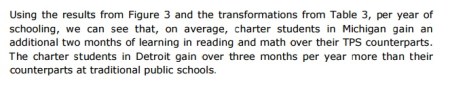
So the Credo Michigan report includes the above conclusion. It’s on page 15.

It looks like Detroit charter school students learn a great deal more per year than the comparison group, which is the exact opposite conclusion that this slanted piece was trying to push by citing this particular study. In fact they called this study “gold standard” (which it isn’t) but then went on to entirely misrepresent the study’s conclusion.

Instead as Jay has ably detailed, the NYT reporter deftly avoided this meta conclusion while discussing the results of a single CMO operating in Detroit.

You would think that one of these days these Alinsky types are going to figure out just how easy it fact check them now that there is this thing called “the internet.”


Is Political Control Over Charter Schools Wise?

June 29, 2016

democracy-is-two-wolves-and-a-sheep-voting-on-whats-for-dinner

(Guest Post by Jason Bedrick)

In a recent essay, Andy Smarick proposed democratically controlled charter authorizers:

If a city has a large charter sector, state government could create a new authorizer with an elected board (or require existing authorizers to move to elected boards). That democratically controlled authorizer would then have a performance contract with each of the city’s public schools, including those operated by the district.

Smarick’s “middle path” approach is an interesting idea that’s worth consideration, but education reformers should have serious reservations about it. In particular, it’s not clear what the problem is that this approach is trying solve or why this approach wouldn’t lead to the same problems that political control over traditional district schools has caused.

Smarick’s case rests on the claim that “communities” are “demanding more democratic control.” But are they? Which communities? Or, more precisely, which voices in those communities? After all, it’s exceedingly rare that everyone in a given community speaks with one voice. And what are these voices saying? Smarick name-checks a few cities but cites no evidence that would answer any of these questions. He merely asserts that “authority that is both local and democratic has also been in demand.” Okay, sure, maybe. But it’s still not clear why ed reformers should accede to these (anonymous) demands.

Smarick continues:

A community’s voters want to have a say over what types of schools exist, what constitutes “good schools,” who runs them, how an area’s culture and traditions are passed on, and much more. Decisions are more reflective of the public’s will when these issues are litigated through the democratic process. Additionally, we can have faith that the discussion is transparent, that people feel agency, and that the results—even if imperfect—will be durable and respected.

Are any of these claims necessarily true?

  • Is it true that democratic control is necessary for communities to pass on their culture and traditions? Aren’t most mediating institutions — churches, private schools, non-profits, sports leagues, museums, farmer’s markets, small businesses, professional organizations, etc.  — decidedly not subject to political control? And to the extent that some of these organizations employ some measure of democratic decision-making, isn’t it only the members of those organizations (and not the community at large) that have the right to vote?
  • Is there such a thing as “the public will”? At best, this means merely the will of the majority, which often comes at the expense of the will of the minority (or several types of minorities). Moreover, as Terry Moe and others have detailed, political control often means control by well-organized special interests like teachers unions. In any case, political control entails citizens fighting against each other to have their preferences reflected rather than each being able to have their preferences met in a market. To the extent that a “public will” exists,  it is multi-faceted, hence a system of decentralized choices better reflects the public will than a centralized system.
  • Is it true that there is more transparency when institutions are subject to political control? Forget Clinton’s emails — elected school boards regularly lack transparency.
  • Do people feel more agency in political systems? Perhaps the majority does, but do the minorities? Wouldn’t those minorities prefer options that weren’t subject to majority control?
  • Is it true that political decisions are “more respected and durable”? 2016 is an odd year to be making that argument.

On Twitter, Smarick claimed that a democratically controlled charter board’s “incentives [and] ability to interfere [with] schools drop dramatically when board authorizes but does not operate schools.” Possibly. But as Jay pointed out yesterday, traditional school boards don’t “operate” the district schools either, yet there is plenty of room for mischief. After all, Smarick himself argued that these boards should decide what “types” of schools exist and what constitutes a “good” school. That’s an awful lot of control.

As Smarick himself recognizes, elected boards shift power away from families to “the community” (i.e., whichever group can seize political control). As he explained:

Today’s decentralized systems of choice empower families and enable a wide array of options, but they inhibit the community’s ability to shape the contours of the local school system.

It seems that Smarick — who is generally quite conservative — is embracing the progressives’ preference for political control over mediating institutions that Yuval Levin has so insightfully described:

Progressives in America have always viewed those mediating institutions that stand between the individual and the government with suspicion, seeing them as instruments of division, prejudice, and selfishness or as power centers lacking in democratic legitimacy. They have sought to empower the government to rationalize the life of our society by clearing away those vestiges of backwardness and putting in their place public programs and policies motivated by a single, cohesive understanding of the public interest. This clearing away has in some cases consisted of crowding out the mediating institutions by taking over some of their key functions through direct government action. In other cases, it has involved turning elements of civil society and the private economy into arms of government policy — by requiring compliance with policy goals that are foreign to many civil-society institutions or consolidating key sectors of the economy and offering protection to large corporations willing to act as public utilities or to advance policymakers’ priorities.

I hope that Smarick will reconsider his support for empowering the government at the expense of school autonomy and families’ preferences. Perhaps the angel on his right shoulder will whisper Yuval Levin’s counsel into his ear:

Conservatives have always resisted such gross rationalization of society, however, and insisted that local knowledge channeled by evolved social institutions — from families and civic and fraternal groups to traditional religious establishments, charitable enterprises, private companies, and complex markets — will make for better material outcomes and a better common life. The life of a society consists of more than moving resources around, and what happens in that vital space between the individual and the government is at least as much a matter of character formation as of material provision and wealth creation.

As I noted above, I do believe that Smarick’s proposal merits serious consideration. Although I don’t think he has made a strong case for a democratically controlled charter board, I do think he’s onto something when he says that there is strong demand for democracy, at least in some quarters. That said, I think the more viable “middle path” is down a different road. There are numerous mediating institutions in society that engage in democratic decision-making, but only members have a vote. Instead of giving a vote to everyone in the community — wolves and sheep alike — perhaps charter schools could give a vote to parents of students who are enrolled there. This way, parents who want democratic agency can enroll their children in democratically run charters, while other parents can choose schools that have different missions, and in no case will outside special interests be able to seize control.

I’m sure there are other arrangements that could also achieve the balance that Smarick seeks. But please: don’t give power to the wolves!


NYT Hatchet Job on Charters

June 29, 2016

The New York Times has a front page piece on charter schools in Detroit that is so factually mistaken, misleading, and tendentious that it requires a response.  The heart of the piece is the claim that Detroit has experienced a dramatic increase in charter schools, but those new schools are no better or often worse than the traditional public schools.  As the article puts it: “But half the charters perform only as well, or worse than, Detroit’s traditional public schools.”  Expanding options without increasing quality, the article asserts, is just creating chaos without benefit.

If inferior test score gains by charter schools is the heart of the piece, you would think that the article would present evidence supporting that claim.  It does provide some sad anecdotes, but the plural of anecdote is not data.  It also mentions the low level of academic achievement in Detroit schools, including its charters, but the level of performance does not distinguish between the difficulties that children bring to school and the success or failure of schools to improve student performance.  Many Detroit kids have a lot of problems that hinder their progress in school.  We shouldn’t condemn schools for trying to help kids who face those challenges.  If we are going to judge schools it should be based on their record of improving outcomes for students.  Even modest improvements should be lauded in the face of serious challenges.

The closest the NYT comes to citing any evidence on the “value added” of Detroit charters is to mention an evaluation of a few charter schools run by one charter management organization:

The Leona Group, the Arizona-based for-profit operator that runs it, also runs some of the worst-performing schools in Detroit. Stanford University’s Center for Research on Education Outcomes, considered the gold standard of measurement by charter school supporters across the country, found that students in the company’s schools grew less academically than students in the neighboring traditional public schools.

Astoundingly, the reporter doesn’t bother to share what those same Stanford researchers found about all charter schools in Detroit.  They concluded that students enrolled in Detroit charter schools were significantly outpacing a demographically similar set of matched students who remained in traditional Detroit public schools.  And they found that Detroit charters contributed to test score growth even more than charters elsewhere in Michigan:

Charter students in the city of Detroit (27% of the state’s charter students), are performing even better than their peers in the rest of the state, on average gaining nearly three months achievement for each year they attend charter schools.

And on the specific claim the article makes that “half the charters perform only as well, or worse than, Detroit’s traditional public schools” this is what the Stanford study has to say: “In reading, 47 percent of charter schools perform significantly better than their traditional public school market, which is more positive than the 35% for Michigan charter schools as a whole. In math, 47 percent of Detroit charter schools perform significantly better than their local peers, the same proportion as for the charters as a whole statewide.”  The study found that only 1% of Detroit’s charters performs significantly worse than the traditional public schools in reading and only 7% in math. (See Table 7 on p. 44) To claim that half the charters perform the same or worse than traditional public schools is a grotesque distortion of the study’s findings.

Look, I don’t accept the Stanford CREDO study as “the gold standard” in charter evaluations.  But if the reporter cites that research to demonstrate that one charter management organization has sub-par performance, it is journalistic malpractice not to mention the positive overall results.  And those positive overall results contradict the very foundation of the entire article.

Besides a few anecdotes and a mis-reporting of the CREDO study, the article mostly consists of scary words like “chaos” and “glut.”  Imagine if the article were about phone providers instead of schools.  Would anyone find it persuasive to wring one’s hands over the glut of phone companies after Ma Bell was broken up, causing “chaos” in the telephone market?  I understand there are differences between phones and schools, but reporting should be based on evidence of outcomes rather than just invoking scary words.

This same NYT reporter, Kate Zernike, committed a similar hatchet job on Paul Peterson’s voucher research back in 2000. Never mind that the positive findings she challenged were later vindicated by research showing significant increases for voucher students on high school graduation and college attendance rates.  It appears that one of the perks of being a NYT reporter is that you don’t have to get the facts right, you are free to slam policies that their liberal readers tend to dislike, and you never have to say you’re sorry when you’re shown to be in error.


Remarks to the Arizona Chamber of Commerce: More Than This

June 20, 2016

Friedman award

(Guest Post by Matthew Ladner)

The Arizona Chamber of Commerce and Industry held an awards breakfast last Friday, where they recognized a number of worthy recipients including friends serving in the legislature like Senator Debbie Lesko and Senator Steve Pierce and Representative Paul Boyer.  They also however chose to recognize a rather dubious character with whom you will be all too familiar by bestowing upon him the Milton Friedman Award, Obviously I was deeply touched to receive an award named after one of my heroes.

At the request of the Chamber, I prepared the following remarks:

I am deeply touched to receive this honor, but I must say that I feel a bit like Jack Ryan. You may recall the scene in the Hunt for Red October when Ryan exclaims “Me?!? I’m just an analyst!”

Arizona is sailing into history!

While I am deeply appreciative of the award, it is I should honor you. The groundwork for what I am about to describe was already in place when I arrived in Arizona in 2003. You as long-time business and civic leaders in Arizona should take great pride in what I will relate.

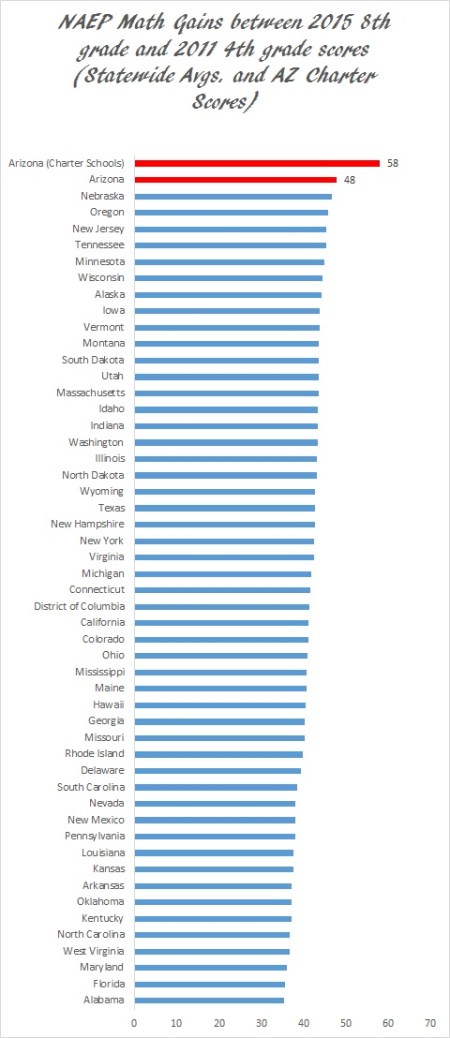
It was recently reported that Arizona ranks number two in job growth. I am happy to relate to you that Arizona ranks number one in K-12 academic gains.  The National Assessment of Educational Progress gives academic exams to 4th and 8th graders in all 50 states every two years. When you follow the academic progress of 4th graders in 2011 to when they became 8th graders in 2015, you find that Arizona students made more progress than any other state. Given everything this state endured during the Great Recession, this is a remarkable tribute to the resiliency of our students, educators and policymakers.
NAEP Math cohort gains with AZ charters

This progress is across the board and includes both district and charter schools. In addition our charter school students did something truly extraordinary. On the same 2015 National Assessment of Educational Progress, Arizona’s charter school students scored comparably to the highest performing states like Massachusetts and New Hampshire. This is all the more impressive when you consider that Arizona charter schools are funded far more modestly, and have student bodies far more diverse, than the schools in New England.
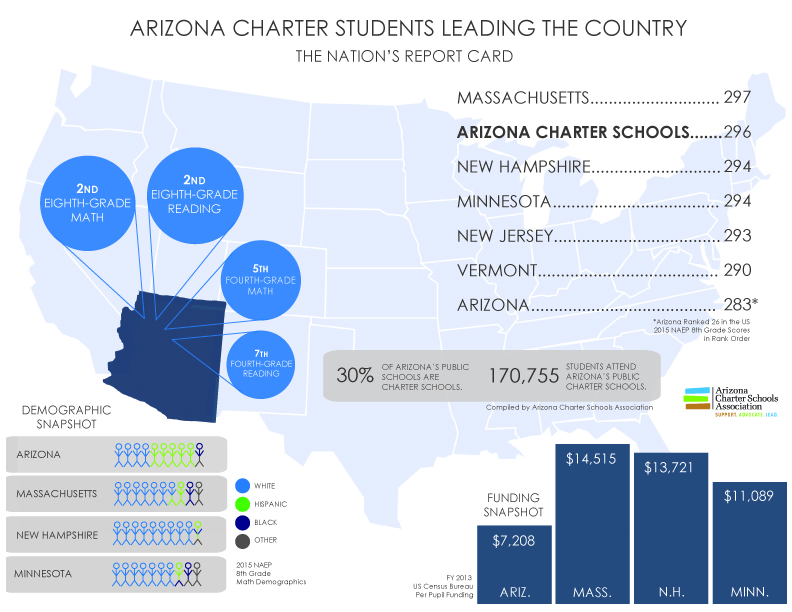
These results are remarkable. How did this happen? What is the secret sauce? There is no single explanation and there are many ingredients in the Arizona K-12 reform gumbo. You made the mistake however of giving me an award named after the great Milton Friedman and then the even larger mistake of giving me the microphone, so I am going to talk about parental choice. It seems clear to me that parental choice has been a major contributor to Arizona’s improvement.

Parental choice is controversial. Some people believe that parental choice is about some schools being “good” while others are “bad.” Those who believe this however are mistaken. Parental choice is about the fact that every single child deserves to have access to a school that is a good fit for them. Good fits between students and schools are very powerful, and we cannot replace it with any other source of improvement.  Without giving parents the ability to match the needs and interests of their child with the particular strengths of a school, the public education system will never reach full potential.

During the campaign, Governor Ducey quite rightly placed an emphasis on Arizona students sitting on wait lists at our high demand district and charter schools of choice. These students only have one shot at their K-12 education, but they find themselves stranded by the inadequacies of our policies, waiting for the opportunity to attend their good fit school. Meanwhile the sand continues to run through their hourglass. 

Our challenge includes this, but it is also more than this.

Tens of thousands of Arizona students sit on wait lists, but hundreds of thousands of Arizona parents never even considered some of our highest performing district and/or private schools. These schools may have been great fits for the needs of their children, but they didn’t even cross the radar screens of these parents for consideration. Why not? Because they have effectively been priced out of consideration. Parents either cannot afford the high price of real estate for the district schools, or else cannot afford to pay tuition in addition to their taxes. Many sadly see these schools as being for someone else, but not for them. It doesn’t however have to remain this way. We have it in our power to make our educational opportunities more inclusive. The blessings of liberty should not remain the privilege of the few, but rather the birthright of all.

I fell in love with Arizona because of our innovative spirit and I believe that we have been richly rewarded for it. If Dr. Friedman were still with us, I believe he would be proud of what we have done, and would encourage us to do more. Arizona is a state with big horizons, where the sky is the limit. May we always remain so.

I genuinely am deeply appreciative of both the award, and the opportunity to work with great people on these issues in Arizona.


Fordham’s Economics Malfunction

June 9, 2016

68773636

(Guest Post by Jason Bedrick)

Yesterday, Checker Finn and Brandon Wright of the Fordham Institute published an essay highlighting three “market malfunctions” in the charter school sector. What they highlighted instead were primarily government malfunctions.

The first “market” malfunction they identify is the apparent lack of congruence between supply and demand:

As rapidly as it’s grown (6,800+ schools at last count), the supply of charters has not keep up with demand in most places. (Estimates of the total waiting list go as high as a million kids.) All sorts of political, budgetary, and statutory obstacles have limited the number, size, and locations of charter schools.

Political, budgetary, and statutory obstacles… these are market malfunctions?

Skipping number two for a moment, their third supposed “market” malfunction is the problem of what they call “distracted suppliers”:

Many charters are strapped for funds. They feel overregulated by their states, heckled by their authorizers, and politically stressed, so the people running them often struggle to keep their heads above water (which includes keeping enrollments up). They have little energy or resources to expend on becoming more rigorous or investing in stronger curricula and more experienced instructors.

Strapped for funds when the law prevents them from charging their customers anything. Overregulated by their states. Politically stressed.

Again, my Fordham friends, these are market malfunctions?

Their second concern is the closest they come to identifying a market malfunction: weak consumer information.

Even where parents are mindful of school quality and try their best to be discerning, consumer information in this marketplace remains incomplete, hard to access, and difficult to understand. State report cards are ubiquitous yet lacking. Even when they adequately display academic achievement in tested subjects, they cannot begin to convey all the other information that goes into a sound school choice. What, for example, does the school truly value? Are its classrooms quiet and orderly or lively and engaged? How does it handle character development? Discipline? Disabilities? Do students and teachers like it there or flee as soon as possible? The list goes on.

Yes, the market (as well as the government) has failed thus far to provide bountiful, accessible, and high-quality information about most schools. I’ve explained how the market could accomplish this (e.g., a combination of private certification, expert reviews, and consumer reviews) and there are some organizations already trying to fill this gap (e.g., GreatSchools), but there’s still much more to do.

Of course, one reason that there are so few third-party organizations providing such information is that the government crowds them out, both by providing their own scorecards (which Finn and Wright find wanting) and by operating a massive system of “free” district schools that crowd out private alternatives.

So again: you call these market malfunctions?


Competition and Core Knowledge-Let’s Keep an Eye on a North Phoenix Neighborhood

June 3, 2016

(Guest Post by Matthew Ladner)

So I have been reading with interest the comment section discussion on Jay’s missed the point piece, which inspired me to follow up on a post I wrote in 2012. Your humble author took the above photograph of Shea Middle School in Arizona’s Paradise Valley School District. This was the neighborhood I used to live in, and I was zoned to send my children to this school (they were elementary age at the time). In the 2012 piece I relate circumstantial evidence that leads me to believe that the 9000 pt font banner you see in the photograph was prompted by the announcement of both a BASIS and a Great Hearts school opening in the area.

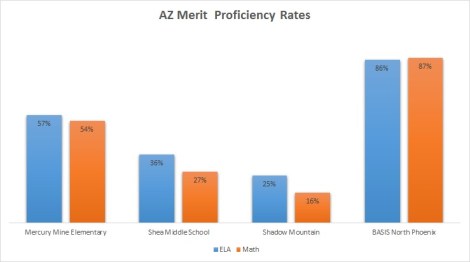
The following chart, making use of the AZ Merit results, gives a flavor of why long before the banner hung that my wife and I had already decided that we would explore other options for middle and high school.

MM Shea SM

Mercury Mine Elementary School feeds into Shea Middle School, which in turn feeds into Shadow Mountain High School. These schools are all within easy walking/biking distance from each other, with the middle and the high school being literally next door.  Mercury Mine had a larger number of open enrollment transfers attending when my children attended, which speaks well of the school’s reputation (the neighborhood had a larger number of empty nest residents so transfers were welcome.)  These schools operate in a relatively advantaged area overall, but the slippage over time from elementary to middle to high school scores is evident in both the AZ Merit and the older AIMS data. An examination of parent reviews in Great Schools failed to convince me that my lying eyes were leading me astray in examining test scores. I cast no aspersions here-I’m entirely confident that these schools have a great many dedicated people working very hard in them, but as a parent the trend you see in the chart above was gravely concerning.

So in 2012, BASIS opened a new school within walking/biking distance. What does that look like?

MM Shea SM Basis

BASIS has a dedicated band of internet detractors who complain that BASIS does this/that/and the other thing to pick and choose their students. Some of the enormous difference in scores you see here may indeed be due to factors other than great instruction and hard work by students, but as you can see there is a lot of room to give. Such arguments are ultimately moot without a random assignment study (which we lack) and the discussion is off mission. My intention in showing you this chart is to suggest why neighborhood school leaders seemed to be freaking out in the email to parents referenced in the 2012 post. Er, wouldn’t you?

Now this brings us back to Shea Middle School, which proudly and loudly adopted Core Knowledge starting in 2013.  Due to changes in the testing regime during this period, it is difficult to assess the overall direction of scores, but let’s stipulate that neither Core Knowledge nor the advent of competition proved to be a wonder cure than instantly transformed Shea Middle School overnight. That is not how the real world works after all. It could be the CK and competition will lead to incremental gains over time. Alternatively, maybe the losses to competition come to be viewed a sunk cost and the district schools fail to realize the potential of the curriculum.

Have a good summer- I’ll update this next year with new data and we’ll see how this little neighborhood experiment goes.

Disclosure: your humble author formerly served on the board of BASIS, and sends two of his three children to Great Hearts schools (although not the one mentioned in the post).


Little Ramona is Still Hillbilly Nuts

April 15, 2016

(Guest Post by Matthew Ladner)

Classic Little Ramona today in Salon where she conjures up a huge conspiracy between the Koch Brothers, ALEC and southern segregationists to overthrow Brown vs. Board.  Mostly standard baloney.  You can’t “re-segregate” if you never de-segregated in the first place, the public school system everywhere (not just in the South) is highly segregated by both income and race due to attendance boundaries and segregated housing patterns, etc.  This line is however is worth noting:

Now the media celebrates all-black schools and ignores the fact that they are segregated. The subtext is: Look at this! An all-black school with high test scores! Isn’t that great?

Couple of things:

The students attending the sort of high performing charter schools Ravitch dislikes attend the school through the voluntary choice of their parents. In the event that the school had more applications than seats, the law requires schools to hold a random lottery for admission.

Let’s compare this to what would happen if these same black children tried to transfer to a suburban district school. Now I want to take care to note that many school districts do participate in open-enrollment, some even if state law does not require it. However if you look into the details of open-enrollment it tells you something more than a little disturbing. Even if the law requires consideration of such a transfer, they universally allow schools to determine whether or not they have space for transfers. In 1999 I interviewed the Superintendent of a fancy inner ring suburb near Detroit and asked him why his district chose not to participate in the open-enrollment program. The man literally told me “I think historically the feeling around here is that we have a pretty good thing going, and we want to keep the unwashed masses out.”

I mean there is just no way to see that statement in any sort of racial or segregationist context is there? In addition to what amounts to voluntary participation, open enrollment laws typically do not require admission lotteries- which leaves it wide open to picking and choosing.

So back to that all-black charter school- it is absurd to even imply that a school whose enrollment is driven by voluntary association and random admission lotteries equates to the old southern hillbilly governor standing at the school-house door with a baseball bat scenario. The tools used by districts on that front are more subtle than a baseball bat these days, and thus far more effective. But I digress- should we celebrate an all-black charter school with high test scores?

I don’t see why not-we have far too many all-black district schools with low-test scores after all. Those kids are in those low-performing district schools in part because they were excluded from other opportunities, whereas the charter students were included in a new education opportunity that would not exist if Ravitch had her way.  Nice try Big Sister, but war is not peace, freedom is not slavery and ignorance is not strength.


Do What We Say, Not What We Do

April 14, 2016

(Guest Post by Matthew Ladner)

Randi was in full “make stuff up” mode today, making the video above all the more welcome. After a few paragraphs of feverish conspiracy mongering regarding charter schools being a “coordinated national effort to decimate public schools” (er, Randi, charters are public schools…)  Randi stated “To make matters worse, many charters cherry-pick their students, leaving cash-strapped public schools with higher populations of students with special or high needs, further tipping the scales.”

Evidence? She don’t need no stinking evidence!

In addition to the points made by the video about magnet schools and charter school admission lotteries, it is worth noting that district schools routinely “cherry pick” by family income through attendance boundaries encompassing high-priced real estate.


DC Schooling: Start Over

April 5, 2016

(Guest Post by Matthew Ladner)

Lindsey Burke and I hit the pages of the Washington Times today to argue that school finance in the District puts the least amount of resources into the mechanisms that produce the best results:

The Urban Institute has demonstrated that the D.C. private school sector is in deep decline, despite the existence of the Opportunity Scholarship Program. Studies have established that charter schools impact private school enrollment most heavily of all sectors.

From an equity standpoint, it’s difficult to justify the District’s school finance system. The system routinely provides $29,000 for high-income students attending regular public schools. It provides $14,000 for high-income students attending charter schools but only a maximum of $8,381 for some low-income students who would like to attend a private school system that improves the chances for graduation by approximately 21 percentage points.

Clearly, the K-12 status-quo gives the most to the kids starting with the most. This pattern is clear, whether discussing academic gains or dollars invested. We have clear success in the charter school and Opportunity Scholarship programs, but these programs receive substantially fewer dollars per pupil. D.C. has most certainly been better off with them, but they alone have not been enough. Tentative steps and half measures will not address the deeply disparate opportunities awaiting the District’s students.

Instead of attempting to restructure or “reform” DCPS, policymakers should free District parents to reform education from the bottom up. To that end, Congress, which has jurisdiction over D.C., should reconfigure all education funding in the District of Columbia and establish an all-Education Savings Account district.

Jayblog readers of a certain regularity will recall that gentrification has been driving NAEP improvement in DC, that the main thing that the DCPS has seemed to figure out how to do with their $29,000 per pupil revenue has been to educate very advantaged children to very high levels and that only  charter schools show the only impressive NAEP gains for low-income children. Despite gentrification and the attendant improvement, DC ranks a single point above the lowest rated district in comparisons in the Trial Urban District NAEP. As a result of all of this Washington DC shows truly stunning achievement gaps. Oh and by the way along the way private schools are dying off under the proliferation of charter schools. DC charter schools are a universal choice program-open to all students- while Opportunity Scholarships only apply to a small number of low-income children.

If you like a system that gives the most to those starting with the most, stand pat. If six years worth of average progress between White and Black students doesn’t bother you overly much, look the other way. If you can somehow justify giving half the money per pupil to charter school kids despite the better results they produce for low-income kids, steady as she goes. If you have no problem in shorting low-income kids going to a quickly dying sector of private schools by an even wider margin despite the fact that these students graduate at a much higher rate, don’t rock the boat.

Otherwise schooling in the District needs a complete reboot from today’s morally indefensible and financially unsustainable system.