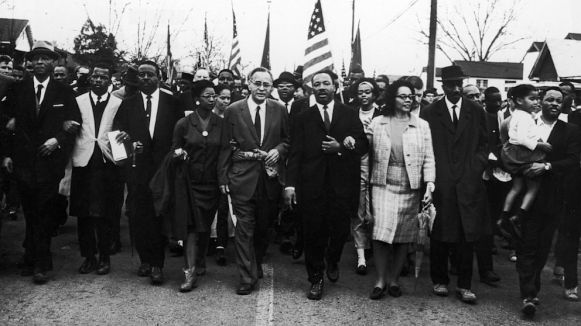
Conscience Asks the Question, ‘Is it Right?’

April 9, 2010


gty_martin_luther_king_nt_130823_16x9_992

(Guest Post by Matthew Ladner)

Charles Miller, former Chairman of the University of Texas Board of Regents, sent out the following email to hundreds of people on Easter Sunday, which was also the 42nd anniversary of the assassination of Rev. Martin Luther King Jr. We reprint the email here with Mr. Miller’s permission:

Early in the Obama administration I was surprised and deeply disappointed by their decision to kill the “DC Voucher” Program.  I wrote most of the piece below at that time and the decision brought me back into the public K-12 debate.  The U.S. Senate recently voted 55-42 to confirm that decision, essentially on a party line vote, so I am sending this to go on record about something I think is horrendously wrong. –Charles Miller
————————————————————————————————————————————————–
April 4, 2010

What Martin Luther King Said About Speaking Out

“Our Lives Begin to End the Day We Become Silent About Things That Matter”
(Martin Luther King)

The Obama administration, through stimulus funding, the Race to the Top program, its presentation of budgets and proposals for reauthorization of NCLB/ESEA , has moved fast and furiously in the public education policy arena.  It seems very unlikely to me that high aspirations—and hasty action— equate to effective public policy.  In fact, these efforts seem to amount quite clearly to an overreach–strategically, systemically, politically, and culturally

However, what bothers me the most personally is what I consider the most unprincipled action in public education policy since the existence of segregated schools:  The willful decision by the Obama administration, supported by the Democrats in Congress, to kill the D.C. Opportunity Scholarship Program, also called “D.C. Vouchers”

The Obama administration has tied its education policy declarations to a mantra of being non-political and non-partisan, choosing instead a policy focus only on “what works”.  This principle has been repeated incessantly.

However, the D.C. Opportunity Scholarship Program (OSP) is a successful program.

The Department of Education’s official evaluation using rigorous “gold standard” experimental evaluations determined that the OSP has produced significant achievement gains.

The OSP is serving those families and children most in need in one of the worst school districts in America.  Average income of participating families  is less than $24,000 annually and more than 85% of participating students would otherwise be attending a failing school under NCLB guidelines.

D.C. residents polled by three unaffiliated firms in ’07, ’08, and ’09 showed between 66 and 75% support for the OSP.  The D.C. superintendent and the Mayor support the program.

The decision to kill the program is contradictory to anything the administration claims to be its guiding principle.   The cost of the successful OSP is financially very small by comparison to any K-12 standard while at the same time there has been a gigantic increase in education spending nationally— to support status quo systems which are widely considered failures. Strong evidence of success, academically and financially, clearly makes the decision to kill OSP unprincipled.

The reason for killing OSP is the intense opposition of national teachers unions to a voucher program of any kind, anywhere, anytime—even if it is academically successful, financially responsible and so popular with the community served that there are long waiting lists.

If this successful program had been able to be replicated—a fear obviously driving the decision to kill OSP—the number of students from the most disadvantaged families whose life prospects could have been enhanced could be quite large.  This consideration makes the decision to kill OSP even more egregious, although even helping a small set of students is the principled thing to do.

Notably, from the Washington Post, “Duncan had the temerity to admit that OSP students ‘were safe and learning and doing well…but we can’t be satisfied with saving 1 or 2 percent of children and letting 98 or 99 percent down’.”

The effect of the decision to kill OSP on the lives of the students who could have benefited from its continuation is extremely negative.  There is no way to avoid this conclusion. If a social scientist extrapolated the trends of two sets of students, one in OSP and one in a typical DC school, the loss of life opportunities would be stark for the typical set of students.

The inescapable conclusion I reach is that killing OSP is a despicable and unconscionable decision made for political purposes and with cynical disregard for the lives of the children affected.  “Obama could have stood up for these children, who only want the same opportunities that he had and that his daughters now have.  Instead his education secretary, Arne Duncan, proffered an argument that would be funny if it weren’t so sad:  Scholarships for poor students aren’t worth supporting because not enough of them are given out” (Washington Post, 3/8/10)

This when joblessness for 16-to-24-year-old black men has reached Great Depression proportions — 34.5 % last October and estimated to having exceeded 50% by last year end.

The other conclusion I reach is that policy advocates or officials who turn their face away or avoid taking a strong stand against the decision to kill OSP because it is not pleasant or not convenient to their own activities have a hand in the ignoble results of the decision.  “In the end, we will remember not the words of our enemies, but the silence of our friends” (Martin Luther King)

So, for me personally, I can’t justify supporting such an administration or its policy makers even if some of their other policy choices are more productive, nor can I see believing anything they say or trusting anything they do.  It can no longer be acceptable to be principled just some of the time.   No Mas.

“Cowardice asks the question, ‘Is it safe?’  Expediency asks the question, ‘Is it politic?’  Vanity asks the question, ‘Is it popular?’  But conscience asks the question,  ‘Is it right?’  And there comes a time when one must take a position that is neither safe, nor politic, nor popular, but one must take it because one’s conscience tells one that it is right.”  (Martin Luther King)

Charles Miller


Florida School Choice Rally

April 8, 2010

(Guest Post by Matthew Ladner)

Another video of the largest parental choice rally in history. A final vote on the Step Up for Students expansion is expected today:

UPDATE The Florida House has passed the tax credit expansion with a strong bipartisan majority, gaining  the support of 20 of the 43 House Democrats present, including the support of the ranking Democrat on the Education Policy Council. It also was supported by 11 of 18 Black Caucus members voting.


Wyoming Kids are Either Going to Be Brain Surgeons, or Movie Stars!

April 8, 2010

(Guest Post by Matthew Ladner)

So back in 2006, I wrote a daily email for the Goldwater Institute commenting on Wyoming’s plan to lavish money on their K-12 schools. Titled “Oil Millions Didn’t Make Jethro Smart” I focused on the following statement from Wyoming State Superintendent of Public Instruction Bill McBride:

Wyoming’s state coffers have been filled by the booming natural gas market. Last year the state had a $1.8 billion surplus. The state government has poured much of this windfall into its public K-12 education system.

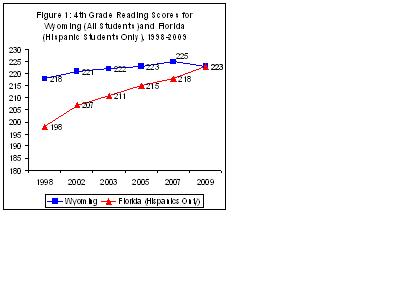
Jim McBride, the state’s superintendent of public instruction, has offered some rather startling predictions saying, “We probably will have the nation’s No. 1 graduation rate, maybe college attendance rate. We probably will have the highest NAEP scores.”

They got the spending part down, spending a cool $16,000 + per student in 2006-07. How is the academic part working out?

Well, not so great actually…So just in case you are reading this on your phone, that would be Wyoming’s statewide average as the flat blue line being all students in Wyoming, and the red line being Hispanics in Florida. Back in 2006, I wrote:

Jethro Bodine of Beverly Hillbillies fame, flush with petrodollars, often predicted he would be either a movie star or a brain surgeon. That never worked out either.

I’d be willing to bet that Mr. McBride is a patriotic American who loves Wyoming and wants what is best for the kids of his great state, so I don’t mean to ridicule him as a person. This idea that we should simply throw money at schools however is demonstrably WRONG and deserving of scorn. If we really want to help children, it means doing the tough work of improving the productivity of the resources in the system.


Education Reform and Colored Maps

April 5, 2010

 (Guest Post by Matthew Ladner)

I read Paul Johnson’s book Modern Times as an undergraduate, and I’ll never forget his description of the Age of Colonial Empire.

Johnson said that while indeed there were vast fortunes to be made for some, that Empire also entailed enormous costs.

In the end, he said, European Empires were about colored maps.

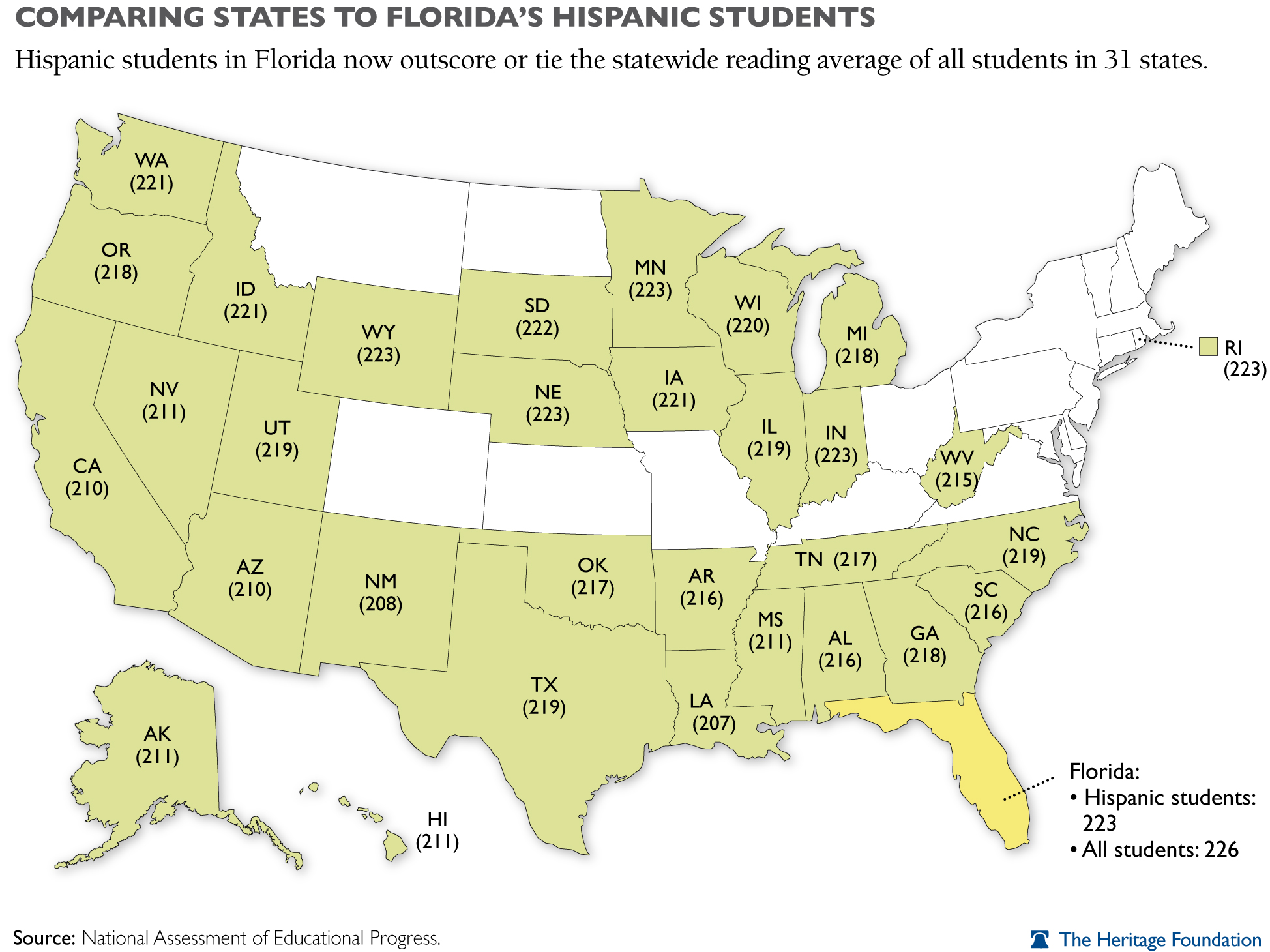
Well, here’s a colored map for you- 4th grade reading scores for Hispanics in Florida compared to statewide averages in other states, via our friends at the Heritage Foundation.

That’s quite an empire that Florida’s Hispanics are creating, don’t you think? Daniel Patrick Moynihan used to joke that high performance on NAEP was directly correlated with proximity to the Canadian border, but notice the long list of predominantly Anglo states on the map: Iowa, Minnesota, Oregon, South Dakota, etc. etc. etc.

Notice also the presence of some states that have been very proud of their K-12 reforms in the past: North Carolina and Texas for instance. Oh, and one of the winners of the Race to the Top, Tennessee. I don’t need to write a sardonic comment, because you’ve already thought of one on your own. Feel free to share it in the comments section.

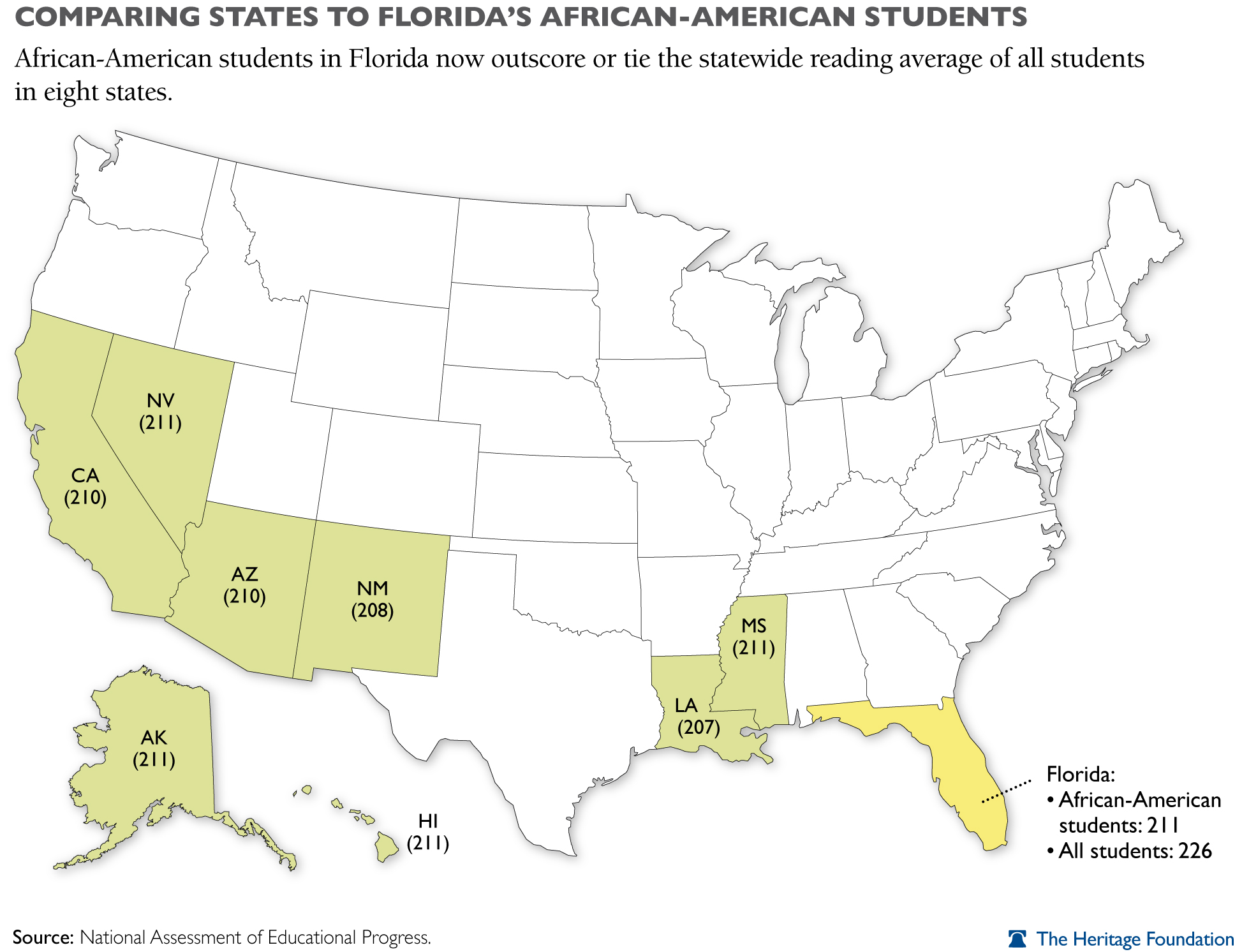
Here’s another smaller, but rapidily growing empire:

Florida’s African Americans tied or outscored two statewide averages on the 2007 NAEP, but their empire extended to 8 states in 2009. The Deep South may want to pull their heads out of the sand, because they are next on the list unless they pick up their games.

Yes, I’m looking at you Alabama, Arkansas, South Carolina and Tennessee. Florida’s African American students have their hands on the Risk dice and are ready to invade you with their plastic armies. Florida’s Free and Reduced Lunch Eligible kids already outscore your statewide average for all students in your states.


Random Pop Culture Apocalypse: Video Mix Tape

April 3, 2010

(Guest Post by Matthew Ladner)

So Mrs. Ladner once again took the Ladner children to visit their relatives in New Mexico, and once again, rather than pile up pizza boxes and watch a bunch of college basketball, I have taken off to hang out in NoZo at the Raven Cafe in Prescott.  When this happened last year, a mocha overdose resulted in the first Random Pop Culture Apocalypse post on cover songs.

As my blood caffeine level once again reaches dangerous levels, I’ve decided to make a tradition of this. This year’s model: mix tapes.

Just to begin with a “in my day we had to walk to school 5 miles in the snow uphill both ways” story, it used to be difficult to make a mixtape. Back when they were actually tapes, that is. I remember going to libraries to check out cds, raiding the collections of my friends, buying used cds, recording the one song I wanted and then selling it back at a loss, etc. etc. etc.

Ah, and then Napster came along. The great thing about Napster was that they had all kinds of random stuff that you couldn’t buy, like Sammie Davis Jr. singing the theme song to Shaft (I love Sammie, but it sounds like a SNL spoof) or Ozzy Osbourne goofing around in the studio and covering the Bee Gees Staying Alive with Dweezil Zappa. Now the mashup artists are doing cool stuff.

High Fidelity memorably included a discussion of the dos and don’ts of mixtaping. In my opinion, the key to a good mixtape is awkward transitions between songs. Often this can be achieved by juxtaposing songs from completely different genres, but this is not always the case. For instance, I had the following two songs on a mixtape from the mid 1990s:

Followed by:

Ah Rednex, it’s so hard to find a good Swedish electronica/hillbilly band these days! But I digress. Electronic music that takes itself seriously followed by purposely absurd electronic music = awkward mixtape transistion, a delight to be savored.

Mixtapes can tell stories by matching particular songs. I found an old mixtape I made back around 1998, which contained two songs which spoke to a certain political scandal of that era. First the desperately pathetic intern begs for affection:

The male, a practiced liar with an air of menace, responds:

For some reason I used to like to pair Rancid:

with ABBA:

Well, it made sense to me at the time. Still does. Here’s another awkward pairing  of the beautifully elegant Stacey Kent:

with the delightfully inelegant Joan Jett:

So you get the idea, now it is your turn. Post your favorite video mixtape pairings in the comment section, and tell me why it works for you. Person submitting the best pairing wins a JPGB No-Prize.


Gibbons Throws the B.S. Flag on RTTT Scoring

April 1, 2010

http://www.bigkidcollectables.com/catalog/senanigans.jpg

(Guest Post by Matthew Ladner)

Things that make you go HMMMMMMMMM….


Newscast from the Florida Rally

March 25, 2010

(Guest Post by Matthew Ladner)


The World Turned Upside Down: Vouchers Pass Illinois Senate

March 25, 2010

(Guest Post by Matthew Ladner)

Senator Meeks’ voucher bill for Chicago just passed the Illinois Senate 33-20.

Color me amazed.


Progress on the Achievement Gap

March 25, 2010


(Guest Post by Matthew Ladner)

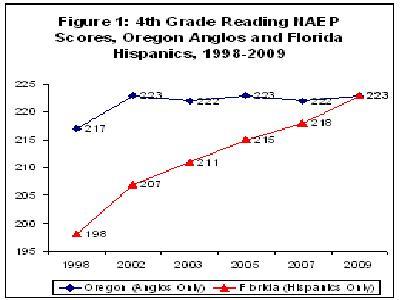
Loyal JPGB customers may recall one o f the earliest posts about how I went on an adventure in Oregon, noticed that everyone looked Anglo and wealthy, and asked What’s the Matter with Oregon? when I looked at their NAEP test scores.

Well, by way of update, Florida’s Hispanic students tied the statewide average for Anglo students on 4th grade reading in 2009. In fact, the exceeded or tied Anglo students in five states: Louisiana, Nevada, Oklahoma, Oregon and West Virginia.

Florida’s Hispanics scored within a couple of points of Anglo students in huge number of states, including Iowa and Maine.

My first reaction?

BOOOOOOOOM!!!!!!!!!!!!!!!!

My second reaction: somebody travel out to Oregon and wake up the policymakers. It’s a beautiful state you’ve got out there, but granola and illiteracy don’t mix terribly well.


Florida on the March!

March 24, 2010

(Guest Post by Matthew Ladner)

To go along with Florida’s great news from NAEP, comes this from Florida parental choice champion John Kirtley:

Today 5,500 low income parents and children travelled to the distant Florida capitol of Tallahassee to show their support of parental choice, and their support of our bill to dramatically expand the tax credit scholarship program for low income children.  Some of them took buses all night long to attend our rally, and their numbers set a national record for a parental choice rally. We conducted a headcount as they stepped off ninety eight 55-passenger buses this morning, and the total was 5,115. Another 406 arrived in cars for a grand total of 5,500. 
                                                                                                                                                                                       
But the numbers weren’t the only story. The lineup of speakers who endorsed our the bill included the acting president of the national Southern Christian Leadership Conference, the civil rights organization founded by Dr. Martin Luther King, Jr. Also endorsing the bill was the President of the Florida State Hispanic Chamber of Commerce, and a group of South Florida Hispanic public school teachers. This is far from the typical story line for a rally supporting parental choice, and shows that in Florida this learning option for low-income students has achieved critical levels of bipartisan support.

Here is what Rep. James Bush, representing the Southern Christian Leadership Conference, told the crowd: 

It is no coincidence that the first African-American to live in the White House is a man with an Ivy League degree, and just last summer President Obama made a powerful point about our history. There’s a reason, our President said, the story of the civil rights movement was written in our schools.  There’s a reason, he said, that Thurgood Marshall took up the cause of Linda Brown.  There’s a reason, he said, why the Little Rock Nine defied a governor and a mob. It’s because, President Obama told us, there is no stronger weapon against inequality and no better path to opportunity than an education that can unlock a child’s God-given potential.

I say to you today that the Tax Credit Scholarship program is one of the keys we use to unlock that potential. It is one way we can reach some of those children who go to bed hungry at night. It is one way we show that an empty pocketbook doesn’t have to mean an empty bookshelf – that all our learning tools need to be on the table for all our children.

I am here today as a messenger of the Southern Christian Leadership Conference, and I am here to proudly proclaim that the organization created by Dr. King believes that a scholarship for low-income children is one way to break the cycle and close the gap. I am here, standing before this inspiring sea of hopeful faces, to announce that the Southern Christian Leadership Conference endorses Tax Credit Scholarships and endorses the bill this year that will expand them. This is our future. God bless you all.

Florida Senate approved a major expansion of the Step Up for Students tax credit by a vote of 27-11. One quarter of the Democrats voted in favor.