Actually, a full-blown train-wreck is not inevitable there is still time to reauthorize ESEA, even if they wait until after the election. Seeing states engage in what could either be described as civil disobedience or lawlessness does send a clear signal that Congress and the administration need to deal with the 2014 event horizon, and that the Safe Harbor loophole is insufficient.
Closer…..move a little closer….a little more….GOTCHA!
Reauthorization beats waivers, and waivers beat the status-quo, which runs the risk of a great cut score dummy down. Washington would be awfully dull without some brinkmanship every now and then, so let’s see how they work this out. Something that would allow states with a system to nudge improvement out of their schools (which NCLB is doing very little of) to run their own testing systems still seems like a sensible idea to me.
However, if Kitzhaber is truly able to streamline decisions and pass substantial reform while keeping his appointments apolitical, Oregon may see relief for a system that, as lobbyist for the Confederation of Oregon School Administrators Chuck Bennett described, is “wallowing in mediocrity.”
Wallowing in mediocrity may be a bit too kind to describe Oregon’s academic progress, or lack thereof. Win or lose, Kitzhaber has taken a bold step to assume responsibility for progress in Oregon schools.
The National Center for Education Policy, having put out a “review” whose central thesis was refuted in its own appendix, have decided to try again this time by “reviewing” a powerpoint presentation that Governor Bush made in Michigan. Oh well, I guess it is time to lop off another limb.
Btw, I am not making this business up about them reviewing a powerpoint they didn’t see presented. Perhaps Governor Bush should make sure to spell-check his emails, because they may be up next for a “review.”
Madhabi Chatterji to very likely be the cause for much or most of the NAEP gains—but not in the positive learning sense that Mr. Bush is arguing. Chatterji demonstrates that by screening for low reading scores and then holding these students back a year, the state is able to initially exclude low-scoring students from the fourth-grade NAEP. Then, once these students are promoted to the next grade, the state is able to give the fourth-grade test to a group of students who would otherwise be fifth-graders. That is, these students have another year of learning under their belts. Further, these retained students are disproportionately from minority groups, meaning that the retention policy simultaneously falsely inflates overall scores while creating a misleading impression that the achievement gap is closing.
Ooooops…I still have the Appendix from the previous “review”:
If retention is causing “much or most” of the improvement in 4th grade scores, why have 3rd grade scores improved so much? Why did reading scores improve by a grade level worth of progress before the retention policy went into effect? Why have scores continued to climb even as retentions have substantially declined?
NEPC response:
The fact that Mathis doesn’t address any of this, but simply reasserts the flawed conclusion (the new reviewer at least attributes it to Chatterji rather than claiming it as his own this time- but should credit Haney instead continuing to rip him off) as valid tells you what you need to know about these guys. They are out to muddy the water if they can, not to engage in a serious debate.
It seems painfully obvious that the reviewer neither watched Governor Bush’s presentation in Michigan, nor even a video of it. Much of the review reads like an ed-school graduate student trying to get their comprehensive exams past a committee including David Berliner and Gene Glass: I cited you! I cited you! The poor chap seems to think that things these guys wrote in the past about programs in other states serves as proof positive about programs in Florida (they don’t) and that a consensus among left wing ed school profs constitutes evidence (it doesn’t).
“Unfortunately, if research is our guide, the effect of the Florida reforms will likely prove to be a more inequitable and inadequate educational system,” Mathis wrote. Mathis should have said “Unfortunately, if the nonsense that passes for ‘research’ in my ideological tribe is our guide, the effect of the Florida reforms will likely prove to be a more inequitable and inadequate educational system.”
That’s an awfully tart statement. You were just thinking “Can he back that up with evidence?” Glad you asked!
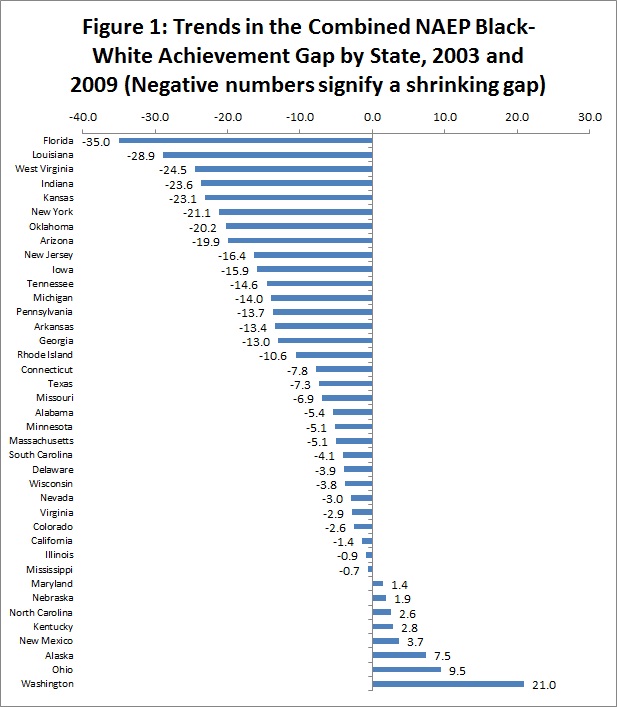
It just so happens that I have been digging into the NAEP data to look at achievement gap trends by state. I combined all four major NAEP exams (4th grade reading, 4th grade math, 8th grade reading, 8th grade math) for the entire period that all 50 states participated (2003-2009). Anyone can go and look these numbers up for themselves, and here is a little sneak peek:
If you guessed that Florida made more progress than any other state in narrowing the Black-White achievement gap on the combined NAEP exams, give yourself a gold star. If you don’t believe it, go look the numbers up for yourself. White students made gains, but Black students made bigger gains. This is really the only good way to narrow an achievement gap, and it is the way it happened in Florida. The same is true of the Hispanic-White gap- Florida led the nation, and bettered the national average by a factor of almost six. Florida achieved the second largest narrowing in the gap between poor and non-poor students, and between children with disabilities and without them.
However, following the example of Arthur, King of the Britons, we’ll call it a draw.
UPDATE Commentor Chan S detected a computational error in the Black-White achievement gap which underestimated Florida’s progress in reducing the gap. After double checking the figures, I’ve included a corrected chart.
In 1916, legendary Georgia Tech coach John Heisman had a score to settle with Cumberland College. His engineers led 126-0 at halftime, inspiring Heisman to tell his players “We’re ahead, but you just can’t tell what those Cumberland players have up their sleeves. They may spring a surprise. Be alert, men.”
The final score: Georgia Tech 222, Cumberland College 0. The Atlanta Journal reported, “As a general rule, the only thing necessary for a touchdown was to give a Tech back the ball and holler, ‘Here he comes’ and ‘There he goes.’ ”
DC (1) Opportunity Scholarships reenacted, expanded
Florida (2) McKay Scholarship expansion, Step Up for Students Tax Credit Expansion
Georgia (1) Tax credit expansion
Oklahoma (1) New tax credit, (major fix of special need voucher)
Indiana (3) New statewide voucher, expansion of tax credit, new tax deduction
Louisiana (1) Tax deduction expansion
Wisconsin (2) Milwaukee Expansion, New Racine Program
Iowa (1) Tax credit expansion
North Carolina (1) New special needs tax credit
Ohio (3) Cleveland expansion, Ed Choice expansion, Autism to Special needs expansion
Most legislative sessions are winding down this year, but we could see some additions to the list. There are too many great stories to cover here, from the heroic struggle to save the DC Opportunity Scholarship Program, to Colorado’s turning a court defeat based upon “local control” on its head, and Wisconsin emerging from years of toil and struggle to enact an amazing expansion, to Arizona lawmakers embarking on an experiment in liberty to give parents control down of the education of their child down to the last penny.
Lots of important reforms outside of private choice as well- major tenure reforms, charter caps lifted, some pathbreaking expansions of digital learning. It will take time for the smoke to clear just to see what actually passed, much more before we will have any clue about results.
A few states have taken what I would describe as deep reform dives-embracing a broad set of reforms making truly historic changes. Florida of course has long been in the lead here, and Florida had a fantastic education reform session this year, reforming tenure, expanding digital learning and passing a truly amazing law to expand high quality charter schools.
Indiana however may be the pupil that has exceeded the master.
Indiana adopted critical Florida reforms, like grading schools A-F and social promotion curtailment, last session. During this session, Indiana’s reformers went far beyond enacting the most far reaching choice programs. Go and read the transcript from Governor Daniels speech at AEI. After detailing Indiana’s far reaching collective bargaining, teacher quality and parental choice reforms, Daniels sort of casually mentions:
And here’s another little calendar quirk that we just moved the school board elections from the spring to the fall. So test from the fall to the spring, elections from the spring to the fall, what’s up with that, you want to know? Well, spring is when we have primaries, nobody votes. It’s a lot easier to dominate, for a small or for an interest group to dominate the outcome and elect a friendly school board in the sparsely attended primary elections. And so now they will have more of the public at least eligible or at least on hand to take part in those elections, we’ll see if it makes a difference.
Now this, ladies and gentlemen, is comprehensive education reform: grading schools A-F based on student proficiency and gains, curtailing social promotion, tenure reform including the mandated use of student performance as a part of formula, throwing out the 900 page collective bargaining agreements, and what will be the nation’s largest system of parental choice. Oh, and by the way, we are going to take a shot at massively increasing democratic participation in school districts while we are at it, just for fun.
Govenor Daniels described these reforms as “mutually reinforcing” in his AEI speech. When I heard that line, I literally gasped and thought to myself: he really gets it!
Indiana lawmakers have not however suspended the law of unintended consequences. Many challenges known and unknown attend such profound change, and the hardest work lies ahead. Among the known challenges: Indiana has term limits, and these far reaching reforms come in the twighlight rather than the dawn of the Daniels terms of office. Seeing this business through will be an enormous challenge for the next crop of Indiana policymakers, if they choose to accept it.
Ok, enough of the grim warrior business. If you can’t pause to celebrate victory, you won’t last the season. This has easily been the best year for K-12 reform, and the best is yet to come.
The struggle in Oregon is a microcosm of a greater battle going on within the Democratic Party between the Waiting for “Superman” liberals and teacher unions. Progressives can either have education progress or a lockstep alliance with education reactionaries, but they cannot have both. The opening of the article makes this point well:
Last week, Gov. John Kitzhaber and his allies rammed a dozen education bills through roadblocks erected by the 48,000-member Oregon Education Association.
A coalition of Kitzhaber, House Republicans, a few Democrats willing to buck the teachers’ union, and newly emboldened interest groups handed the OEA its biggest policy setbacks in years.
“There is a strong desire for real movement forward on education, and people were willing to break a few eggs to get there,” says Rep. Chris Garrett (D-Lake Oswego), one of three Democrats who voted “yes” on HB 2301, a controversial online charter-school bill that catalyzed the breakthrough.
Arizona established “Clean Elections” by a ballot measure in reaction to political scandals. The system went far beyond public financing for candidates, forcing candidates for Arizona offices to choose to run “clean” or “traditional.” If you ran “clean” you not only get money from the state from your campaign, the Clean Elections system would match funds raised by any traditional opponents.
In other words, the system skewed heavily against privately financed candidates, and created a huge disincentive for anyone to donate to a campaign in which a “clean” candidate had entered. More than anything else, the system worked as an incumbency protection racket. As an incumbent, you already had a certain amount of name identification. If you faced a challenger who needed in essence to spend money in order to acquire name identification, you could simply run “Clean” and quash them. As long as you hadn’t been arrested for robbing a liquor store, you were fine. If the liquor store you robbed were owned by a member of the opposite political party, you were probably still fine. Who in their right mind would donate money to a traditional candidate under such circumstances?
The Clean Elections system certainly played a role in Janet Napolitano’s initial election victory, but also probably helped secure oversized Republican majorities in the legislature. Regardless of which party did a better job of using and abusing this system, by suppressing free political speech it was wrong. Over the last few years, the scales fell from the eyes of many former supporters I spoke with, who eventually gave up notions of trying to “fix” Clean Elections and quietly hoped that it would die. Some Republicans who had become expert at gaming the system privately complained about the suit.
Fortunately, the United Supreme Court struck down this free-speech suppressing nonsense. “If the matching funds provision achieves its professed goal and causes candidates to switch to public financing, . . . there will be less speech: no spending above the initial state-set amount by formerly privately financed candidates, and no associated matching funds for anyone. Not only that, the level of speech will depend on the State’s judgment of the desirable amount, an amount tethered to available (and often scarce) state resources,” the majority ruled. “The whole point of the First Amendment is to protect speakers against unjustified restrictions on speech, even when those restrictions reflect the will of the majority. When it comes to protected speech, the speaker is sovereign.”
Congrats to the Goldwater Institute and the Institute for Justice for this very important victory. Keep it up and someday political speech may enjoy as much 1st Amendment protection as pornography!
Oregon had an interesting election in 2010, splitting control of the House evenly between Democrats and Republicans. Earlier this year I had the opportunity to testify before the House Education committee on the Florida reforms, which was an interesting experience as the committee had co-chairs.
Once I was finished, the lobbyist from the Oregon Education Association testified that she had done some “homework” over the weekend, and had calculated A-F grades for Oregon schools. She claimed that (gasp) many Oregon charter schools would get a grade of F.
I found this very interesting, as she had no access to student learning gain data for any of these schools, and learning gains make up half of a school’s grade under the Florida formula. Oh well, why let your credibility get in the way of a good story?
Representative Matt Wingard, the Republican co-chair of the House Education committee, is a dogged supporter of education reform. Rep. Wingard discussed the Florida reforms on this newscast:
While these gains are incremental rather than revolutionary, trust me when I tell you that they were not easily achieved. Many people take open enrollment laws for granted or think of them as weak tea while failing to appreciate the huge impact they have had in shrinking dysfunctional districts such as Detroit and Tucson.
Congratulations to Rep. Wingard for getting the reform ball rolling in Oregon.
Greg continues to pound away on Jay Mathews even though JM is already lying on the canvas comotose. I’ve lost count, and we aren’t finished yet. Yesterday the Wisconsin legislature sent a budget to Governor Scott Walker that expands the Milwaukee Parental Choice Program in three important ways: removing the participation cap, lifting the income cap to include some middle income families, and allowing students to attend suburban private schools.
Jay’s suffering is not done yet. Wisconsin is very near to expanding the size and scope of the Milwaukee program, and creating a new program in Racine, and there is more game to be played in Big-10 country.


 Posted by matthewladner
  (Guest Post by Matthew Ladner)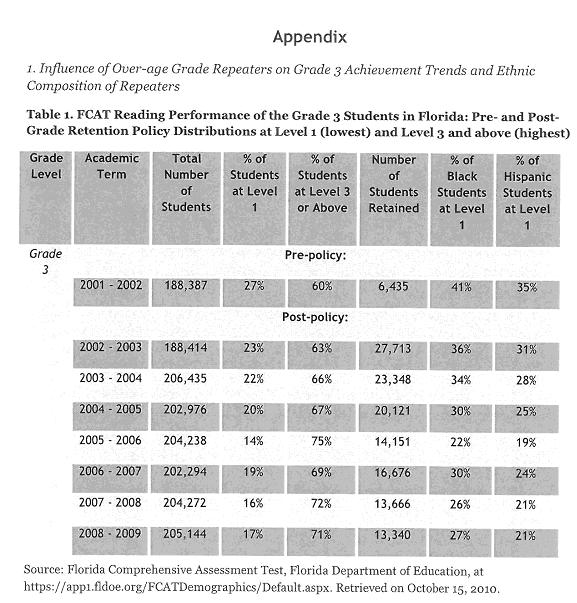


 (Guest Post by Matthew Ladner)


 Jay P. Greene's Blog