
(Guest Post by Matthew Ladner)
Derrell Bradford hits TEDx on digital disruption, choice and education:
(Guest Post by Matthew Ladner)
Derrell Bradford hits TEDx on digital disruption, choice and education:
 1 Comment |
  charter schools, Digital Learning | Tagged: Derrell Bradford, Tedx |
  Permalink
 Posted by matthewladner
 (Guest Post by Matthew Ladner)
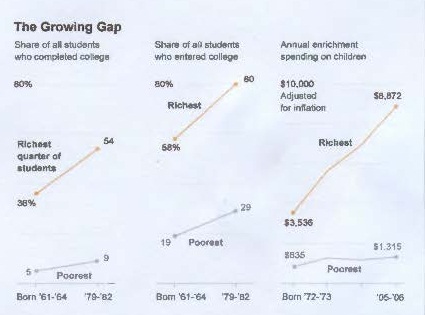
The New York Times published the above chart last December here’s a link if you would like a better look. It basically shows that both college attendance and completion and private enrichment spending have been increasing at a much faster rate among wealthier students.
I find the enrichment spending trend particularly interesting for a couple of reasons. First, like Collin’s grit measure, it seems like an example of something that has been lurking in the error term of our limited understanding of K-12 trends. I’m not sure how the authors define “enrichment spending” but $8,900 per year for well-to-do kids is striking. How much does this matter? I’m not sure but I think it ought to be rigorously researched. It could matter quite a bit.
Four states have average family incomes for a family of four above six figures and one cannot help but wonder how much more this trend influences academic trends than in other states. Washington DC has been gentrifying strongly and has also had a large increase in the economic achievement gap despite large gains for low-income kids. Could this trend be partially explained by this phenomenon?
What, if anything, is to be done about this? A vast increase in K-12 spending aimed at the cultural enrichment of poor children is not in the cards given the rotten state of state and federal finances, and it is just as well given the fact that the relationship between spending and outcomes is already hazy to say the least in the public school system. Just as a reminder, in the insightful words of Paul Hill:
Money is used so loosely in public education – in ways that few understand and that lack plausible connections to student learning – that no one can say how much money, if used optimally, would be enough. Accounting systems make it impossible to track how much is spent on a particular child or school, and hide the costs of programs and teacher contracts. Districts can’t choose the most cost-effective programs because they lack evidence on costs and results.
The country is broke and even if we did raise taxes to punishing levels to fund this stuff no one should feel the least bit confident that enrichment spending would actually work if funnelled through the existing system. Jay’s idea about supplementing private summer camp attendance might be a better idea but again public finances are a total mess. This is currently in the private realm and it is necessary to keep it that way.
This would seem to leave us with at least few possibilities. Better use of technology may enhance the efforts of both public and private enrichment efforts. Khan Academy is doubtlessly one of the most powerful remedial education tools ever developed. It is free of charge and has branched out into the fine arts, and it is hardly alone. Sandra Day O’Connor has an online civics project for instance but I suspect that these efforts will require some concerted effort to realise their full potential. Putting them up online is a first crucial step, but one cannot help but to fear that their impact might be reminiscent of public libraries absent a sustained effort to get children to use them.
Fareed Zakaria summarizes the current debate on inequality, social mobility and schooling, but misses the crucial point. The problem isn’t that we spend so little on the schooling of poor children but rather that we get so little for the massive amounts spent. American Black and Hispanic students score closer to the average score in Mexico (a nation that spends a fraction of what we do per pupil and which suffers from a much greater poverty problem) than to top performing scores. Using various policy mechanisms to increase ROI for K-12 spending runs you straight into reactionary resistance but it easily represents the most promising avenue for improving the prospects for disadvantaged children.
Oh, and by the way, as the New York Daily News kindly points out it does work.
4 Comments | money myth | Tagged: charter schools, enrichment spending, Fareed Zakaria, iCivics, Khan Academy, PISA, Sal Khan, Sandra Day O'Connor, social mobility and schooling | Permalink
Posted by matthewladner
 (Guest Post by Matthew Ladner)
So purely in the interests of keeping your fighting skills sharp just in case some Common Core supporting crazy old man in a brown robe intrudes on the anti-Common Core cantina, note that a second state after Kentucky released Common Core test results. The results look eerily similar to what happened in Kentucky.

Those guys over there! They said something about cut scores!
Hat tip to Gotham Schools, here is what happened in Reading:
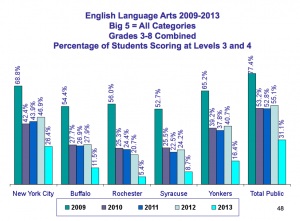
The math chart looks pretty similar. Proficiency rates, in short, crashed across New York and are now far closer to the proficiency rates of NAEP.
How did the old New York tests compare to NAEP? High middle and high in 4th and 8th grade reading respectively:
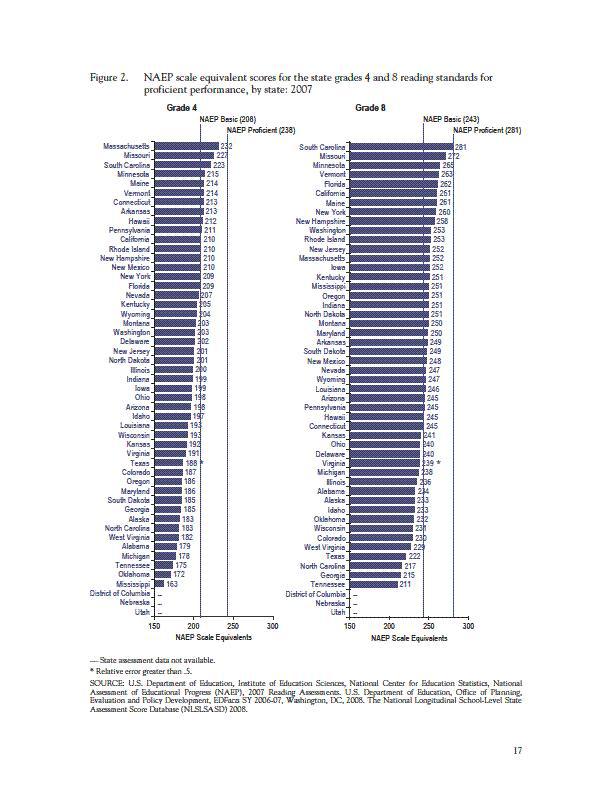
Note that neither Jay nor Greg have ever to my knowledge based any argument on the notion that Common Core standards were low or that the tests would be simple. Your humble blogger noted some years ago that even if the tests start out well, that he’d like to hear the plan for keeping them that way. I’ve heard realistic plans for states to pull out if (yes I heard you yell “WHEN!!!” all the way from the Raven Coffee Bar in Prescott Arizona-try the London Fog btw) the bad guys take them over but nothing yet on a broad strategy.
I’m, umm, not famous for paying close attention but my ears do remain open on that front.
Anyway the dummy down narrative however should be (at least for the time being) mothballed, as it is starting to look increasingly unsupportable by that pesky empirical reality stuff. Forewarned is forearmed, and you wouldn’t want to end up like, well, you know…

21 Comments | school accountability | Tagged: common core, New York Common Core tests | Permalink
Posted by matthewladner
 (Guest Post by Matthew Ladner)
Rick Hess interviews Tony Bennett about the grading flap. Odd that a few critically important details were left out of the AP story. Perhaps the reporter would like to come by and explain why 13 schools who lacked 11th and 12th grade students should have received zeroes for graduation rates and Advanced Placement work.
What if Tony had let those zeroes stand? Do you think for a moment that some of these same critics would have failed to howl at injustice of it all?
Me neither.
19 Comments | Uncategorized | Tagged: Indiana School Grading Controversy, Tony Bennett | Permalink
Posted by matthewladner

(Guest Post by Matthew Ladner)
So in April I wondered whether 2013 would offer up anything to challenge a random collection of old movie favorites I had recently seen on the big screen. It wasn’t looking good, but the Prescott Film Festival just scored, even if it was kind of cheating with a 2012 film.
The Prescott Film festival had what they advertised as the only Arizona screening of Josh Whedon’s Much Ado About Nothing this weekend (Phoenix is not just a physical desert) so I eagerly bought a ticket. Actress Emma Bates, who played Ursula, was on hand for Q and A after the film. Here’s the trailer:
.
So the back story on the film is that Whedon has had actors over to his house on Sundays for years to read Shakespeare. He had a short break between shooting and post-production for The Avengers and instead of going on a trip to celebrate his 20th wedding anniversary, Whedon’s wife talked him in to shooting Much Ado About Nothing. Whedon summoned his friends, including veterans from Buffy, Angel, Firefly and the Avengers, assigned parts, and shot the entire film at his own house in 12 days. Bates related that Whedon’s wife is an architect and that she had in fact designed their house with shooting Much Ado About Nothing in mind. When you see the flick, you won’t doubt it.
I generally have a bias against American film actors trying to pull off Shakespeare. I watched the old Julius Caesar recently, and while Heston made a pretty good Marc Anthony, enduring Jason Robards playing Brutus with a midwestern deadpan accent was, well, brutal. I don’t think there was a single Brit in the bunch for this Much Ado but it didn’t matter because these guys were rolling with it and having fun. Sean Maher in particular was very good:

But maybe it was because the last American actor I saw play his role was:

Whether you love Whedon or Shakespeare, this movie is well worth the watch.
5 Comments | Pass the Popcorn | Tagged: Emma Bates, Josh Whedon, Much Ado About Nothing, Pass the Popcorn, Prescott Film Festival, Sean Maher | Permalink
Posted by matthewladner

(Guest Post by Matthew Ladner)
George P. Mitchell, the Texas wildcatter who revolutionized global energy and (among other things) winner of the last Al Copeland Humanitarian Award, has died at age 94. Rest in Peace big guy- you done good.
1 Comment | Al Copeland Humanitarian Award | Tagged: George P. Mitchell | Permalink
Posted by matthewladner

(Guest post by Jonathan Butcher)
A few months ago, I grabbed my tennis shoes and went to my son’s last P.E. class of the year, which happened to be a “parent participation” day. This P.E. class is a program for homeschool students, so children of all ages and backgrounds were there to have relay races and play dodge ball.
I had the chance to run around that day with Jordan Visser, a young man I met about a year ago when his mom, Kathy, signed him up for one of Arizona’s education savings accounts. Regular readers of this blog will recognize his name and story from this post.
Jordan is a quiet kid, but he’s got a big smile and plays as hard as any of the other boys. From the video available on the link above, you will learn that Jordan has mild cerebral palsy and has a hard time with is balance—or at least, he did at one time. Since he’s been using the savings account, he’s seen specialists and used therapeutic horseback riding lessons to help his motor coordination, paid for with the education savings account. The account has also helped Jordan’s parents find individual tutors to help with subjects like math and reading.
Now, having run alongside him in a relay where we grabbed a sponge out of a bucket, squeezed it into a cup, then handed it off to the next person, let me be the first to say Jordan’s quality of life has dramatically improved. If you didn’t know Jordan’s story and were watching the PE class from the sidelines, you wouldn’t be able to tell the difference between Jordan and the other kids who were soaking wet and laughing.
Vouchers and tax credits have helped children like Jordan, along with students in failing schools and from low-income households, all over the country for more than 20 years. Education savings accounts use a student’s funds from the state formula to give families the same great educational choices as vouchers and scholarships—and more. The flexibility that parents have to meet their child’s unique needs with an account is unprecedented. Parents can buy online classes, pay private school tuition, buy textbooks, and save for college, to name just a few possible uses.
Lindsey Burke and I wrote a special report that was released today explaining the benefits of the accounts’ flexibility. We also propose ways in which vouchers and scholarships can be enhanced by education savings accounts:
Jordan’s education savings account changed his life, and it didn’t take an increase in funding, school turnaround plan, or district consolidation. Let’s keep school choice out front and give all parents the flexibility to help their children, whatever their needs are.
Leave a Comment » | Education Savings Accounts | Tagged: Education Savings Accounts, Jonathan Butcher, Lindsey Burke | Permalink
Posted by matthewladner
(Guest Post by James Shuls)
What does it mean to support public education? To some, it means supporting the traditional system of education, whereby students are assigned to a local school based on where they live. In my new essay, Redefining Public Education, I discuss why this notion is completely and utterly wrong. Public education is not a system; it is the idea that all students should have access to a quality education at public expense.
Check out the full essay below:
Leave a Comment » | Uncategorized | Permalink
Posted by matthewladner

(Guest Post by Matthew Ladner)
This one slipped past me but not the eagle-eyes at School Reform News– Missouri joins the school choice fraternity with a tax credit for special needs children. If I have the count correct the record for 2013 now looks like:
Alabama new tax credit programs
Arizona ESA expansion
Indiana voucher program expansion
Indiana tax credit program expansion
Iowa tax credit expansion
Missouri special needs tax credit program
North Carolina statewide low/middle-income voucher
North Carolina special needs voucher
Ohio new statewide low-income voucher
South Carolina new tax credit program
Utah special needs voucher program funding increase and formula funding
Wisconsin voucher program expansion
That looks like three new states: Alabama, Missouri and South Carolina along with some important program improvements/new programs and big goings on in North Carolina. Although there could be spirited debate about the best year for school choice before 2011, the top three years ever are clearly 2011, 2012 and 2013 (not necessarily in that order).
7 Comments | tax-credit scholarships, vouchers | Tagged: Forster Mathews school choice bet, Greg Forster, Jay Mathews | Permalink
Posted by matthewladner

(Guest Post by Matthew Ladner)
North Carolina legislators have passed measures to provide school choice options to low and some middle-income students and another measure for all special needs children. Data from the Census Bureau indicates that these were wise decisions and should in fact be followed by more improvements.
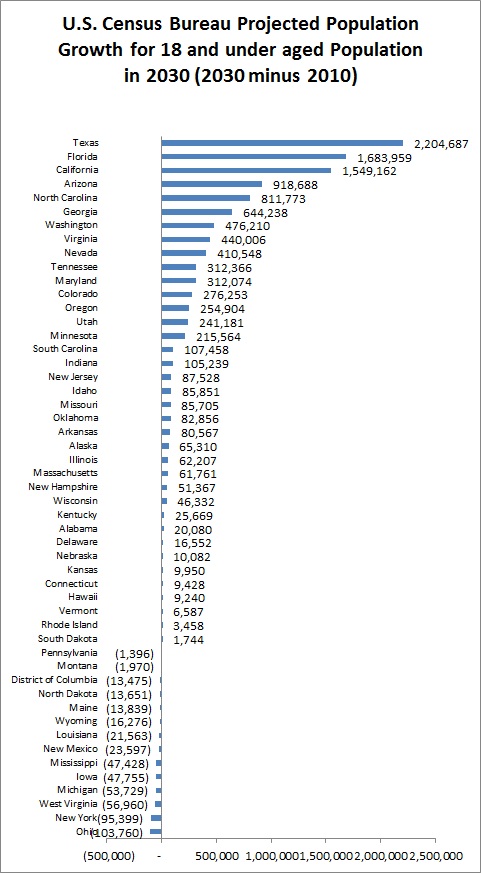 The Census Bureau projections show that the school age population of North Carolina is set to expand substantially over the next couple of decades, with an increase of over 800,000 people aged 18 or less by 2030. For a little perspective, this is a school aged population greater than the total K-12 enrollment of Alabama and a bit below that of Colorado. How and where will they be educated?
Mind you that the largest private school choice program in the nation, the Step Up for Students Tax Credit in Florida, will educate around 60,000 students this fall. Along with the McKay program for children with disabilities, private K-12 choice in Florida is poised to pass the 100,000 student threshold in a few years after a decade and a half of admirable and concerted effort.
North Carolina however has 800,000 new students on the way. If these laws are going to help to make a dent in that figure, a concerted effort to refine and improve the laws will be needed. Formula funding would allow the programs to grow naturally along with the demand of parents and the supply of private schooling. Funding per pupil amounts must be generous enough to spur the supply of new private space. Quite frankly few choice bills have been designed well enough to pull this off, North Carolina lawmakers should make certain that their laws will spur new private school supply.
If North Carolina choice advocates can achieve all of these things, they will set up an incremental process of expanding private school supply which is similar to the increase in charter school space in states with well designed laws. A state in North Carolina’s growth situation could easily accommodate a robust increase in charter and private schools and would still need to invest hundreds of millions of dollars annually in new district schools to accommodate student population growth.
North Carolina could also accommodate a greater number of students through their choice programs by broadening the use of their programs through an Education Savings Account model. This would allow parents to choose between a variety of education service providers including private schools, online programs, MOOCS, certified private tutors, community college and university courses to build a customized learning experience. By allowing parents to save some funds for future higher education expenses, it might be the only way to preserve a public funding mechanism for North Carolina colleges and universities in the face of nationwide pressures to decrease state funding.
State lawmakers can’t charge tuition to prisoners to keep the jails open, but undergraduates on the other hand…
North Carolina budgets, like all states, will continue to face severe strains from health care spending as we continue to fumble our policies and our population ages. A crush of new K-12 students will simply add to the burden, and the way we are approaching K-12 is serving far too many students very poorly at levels of spending which will prove unsustainable. We need to figure out ways to educate students better and more efficiently. A decentralized process allowing parents and students to figure out how to make best use of scarce funds represents the best way forward.
North Carolina lawmakers chose wisely in passing among the broadest school choice measures in the country. Sincere congratulations are in order-North Carolina is now ahead of the pack. The hardest work however lies ahead.
1 Comment | vouchers | Tagged: Education Savings Accounts, North Carolina school vouchers. North Carolina public education, North Carolina university funding, School Vouchers | Permalink
Posted by matthewladner

 Jay P. Greene's Blog