Greene ends his second post with a sage observation that ought to be pinned to the wall in every government office, every executive suite of every foundation, and every advocacy group:
‘Whether your preferred policy solution is based on standards and accountability, parental choice, instructional reform, or something else, the better approach to reform is gradual and decentralized so that everyone can learn and adapt. Your reform strategy has to be consistent with the diverse, decentralized, and democratic country in which we live. You won’t fix everything for everyone right away, but you should avoid Great Leaps Forward. Seek partial victories because with the paradoxical logic of ed reform politics total victory ultimately leads to total defeat.’
The debate on the floor revealed that we choice advocates have a lot of work to do. A pernicious and false idea that came up is one that we are guilty of helping to spread- that we “already have school choice in Arizona.” Arizona scores relatively well on choice when compared to most other states. We have inter-and intradistrict choice, one of the strongest charter school laws, tuition tax credits and the ESA program. Arizona is parental choice nirvana, right?
Wrong.
A few years ago I tried to help a woman who lived in south Phoenix find a different school for her children, two of whom had been sent to the hospital as the result of brutal attacks by fellow students. I put her in touch with a person who has helped parents in her situation for many years. It was an eye-opening experience.
Let’s start with open enrollment. This mother found the doors shut in her face. Let’s just say that it seemed that the fancier districts were not overly interested in kids from south Phoenix and leave it at that.
What about charter schools? Even South Phoenix charter schools with lousy academics, but where you might hope your daughter might avoid getting a pencil stabbed through the back of her neck, had long waiting lists. The Great Hearts charter schools alone had a wait list of 10,000 kids last year.
Well you can always apply for a tax credit scholarship. Except…scholarship groups have thousands more applicants than they can possibly help.
For this mother, it almost may as well been 1993- the year before Arizona passed its charter school law.
The ESA expansion that failed yesterday would have made students living in areas like south Phoenix and south Tucson eligible to participate in the ESA program. The expansion would not have cured the world’s pain nor dried every crying eye, but it could have provided a lifeline to thousands of families like the one described above.
It would be easy to be angry at the people who voted against this expansion, but the truth is that people like me need to look in the mirror and ask how we can do a better job of explaining why this is so important.
School districts say that even though state funding doesn’t cover the costs of special-needs students, they don’t necessarily save that money if a student leaves the district. The Scottsdale district says it pays about $10 million to $12 million more than it gets from the state and federal government to educate its special-needs students.
“If every student with special needs left, then maybe we would save that $12 million, but at the same time, it’s pretty implausible,” said Daniel O’Brien, chief financial officer of the Scottsdale district. He added that the schools would still have students with all kinds of other needs who may not qualify for ESAs, and they would still need to educate those students.
Did you follow that? Scottsdale says that they use $10m to $12m in general education funds above and beyond what it receives in state and federal funding for special needs children. I certainly agree that it is utterly implausible that all special needs students will choose to leave the Scottsdale district, but that whole line of thought misses the most important point: if a child leaves with their “inadequate funding” then you have no cause to cry about it. You still have the $10m to $12m in the bank- now you just have more options with what to do with some of it- you might want to spend more on your remaining special needs kids, you may want to do a slightly smaller transfer from general ed to special ed, but either way the district wins.
Notice also that 90% of what the Scottsdale Unified would have received for Jordan Visser seems to be serving his needs quite well.
For the past three years, Ms. Visser has educated her son, Jordan, who has cerebral palsy, at their Scottsdale, Ariz., home. He has a packed schedule of one-on-one instructional sessions with a specialist, physical-education classes, music lessons, horse-riding therapy and other programs—all of which she pays for through a state-funded program informally known as the “education debit card.”
A local Arizona political news service, the Yellow Sheet Report just happened to stumble across an obscure spreadsheet and discovered that parents have not spent all the money in the ESA program. Tim Ogle, executive director of the Arizona School Boards Association, told the Yellow Sheet “Now we have these individuals whose education is not being accounted for by the state, and also you’ve got over $2 million of public money unaccounted for, so both educational lack of oversight and financial lack of oversight [exist], and that’s why the empowerment account idea is so flawed philosophically.”
The Yellow Sheet did note that parents have a number of options in how to spend ESA funds, including rolling funds over from year to year. The blurb even noted that in the end if you graduate from high-school and fail to spend the funds in a timely fashion on higher education expenses, that the funds revert back to the state. Why they persisted to write about this story at this point might have something to do with an admiration for Mr. Ogle, or his point of view, or might have something to do with the fact that there are only a few days left in the session with some ESA bills still under consideration. Or some combination thereof. I’m just not sure. In any case, these funds are hardly “unaccounted for” in any sense. They simply have not been spent yet.
Rather than some sort of deep, dark secret uncovered by a sleuthing alphabet souper, Lindsey Burke openly discussed the use of funds in a Friedman Foundation study in August of 2013. Alphanauts don’t read FF stuff as much as they should, so I’ll try to help out. The study linked to above has a section called Do Parents Consider Opportunity Costs with ESA Funds? on Page 13. Burke wrote:
Enabling families to save unspent Empowerment Scholarship Account funds provides a powerful financial accountability feature. Whereas traditional school vouchers must be spent in their entirety, ESAs foster demand-side pressure for education providers to offer more cost-efficient educational services by creating an incentive for parents to shop for education services based in part on cost. During the first quarter of Fiscal Year 2013 (the 2012-13 school year), 244 students were awarded ESAs. Of those, 115 students were active ESA participants from the 2011-12 school year, and 187 were active during the first quarter of Fiscal Year 2013, bringing total student ESA enrollment to 302 during the first quarter of the 2012-13 school year. Arizona awarded $1,302,863 to ESA recipients during the first quarter of 2013, of which parents spent $964,991 and saved $337,871. The ADE notes that $1,239,057 will be distributed to participating families during the second quarter of 2013, and estimates total ESA spending to be just short of $5.2 million for the year.
During Fiscal Year 2012, $671,012 in ESA funds remained unspent; during the first quarter of Fiscal Year 2013, approximately $337,871 in ESA funds was unspent. This suggests families are saving and rolling over a significant portion of the ESA funds, in anticipation of either near-term or long-term future education-related expenses.
The law allows parents to save funds in two different ways- first by making a contribution to a Coverdell Savings Account, which can be invested and earn interest under federal guidelines. Second, parents can roll unused funds over, and use them for the child’s K-12 or higher education expenses. All the allowable uses of ESA funds relate to either K-12 or higher education, all funds are accessed through a use-restricted debit card, and all receipts have been monitored and approved by the Arizona Department of Education officials. If a parent makes an inappropriate purchase with funds, they can be required to refund the money, find themselves kicked out of the program, or referred to the authorities for criminal prosecution. As mentioned earlier, unused funds eventually revert back to the state. The program had technical challenges to allowing parents to invest funds in a college savings account program in the first year, but those were eventually overcome, and the amount rolled over from year to year declined.
So if parents “saving” in their “Education Savings Account” is some sort of faux pas, then the fund balances run by Arizona school districts represent an epic level crime against humanity. The AZ Superintendent of Public Instruction puts out a handy financial report every year, and if you are really nerdy and find the second volume online you’ll find hundreds of millions of dollars of unspent funds in school district accounts. It appears for instance that the Tucson Unified District received $522 m in the year covered, only spent $507m, and had $80m or so sitting in the bank.
!!!Quelle Horreur!!!
Tucson received $522m in revenue and only spent $126m on teacher salaries. Plus the reading scores down there deserve to be put on trial in the Hague. Now that I think about it, the state’s preschool program famously had piled up $400 million in the bank before they started furiously buying billboards to tell everyone how great they were when state lawmakers proposed using the money to keep the state’s lights turned on during the housing meltdown. Hmmm, but wait must stay focused could….write….about…this…for…hours!
Policymakers designed the ESA program to allow parents to save money for future education expenses, whether K-12 or higher education related. It’s silly to cry foul when they do so.
Common Core critics must keep in mind that policy debates are won by proposing better solutions. The Core standards were adopted with a big federal boost and little public debate, but adopted they were. Teachers and school leaders have been implementing the standards since 2010, and opponents can’t wish this away any more than Obamacare critics can wish away the new landscape produced by the Affordable Care Act.
So Texas once had a system of testing and accountability that was the envy of the nation. Texas boasted the highest Hispanic scores on NAEP in the nation not so long ago for instance. The Texas system served as the basis for the No Child Left Behind Act that required testing in grades 3-8 and once in high-school in return for federal education dollars.
The Texas system grew long in the tooth over time. Other states developed better standards and better testing systems and embraced more parental choice while Texas seemed to rest on its laurels. The Houston Chronicle revealed statistical hocus pocus that greatly inflated the number of highly rated schools committed by the Texas Education Agency. Gnomes in the basement of your state education agency can wreak havoc with any centralized system. Still, a system that gets you into the upper-left quadrant of the above chart (relatively low spending increase per pupil, relatively high gains on NAEP) was probably doing something right, especially if you are absorbing a Wyoming public school system sized cohort of additional students every year.
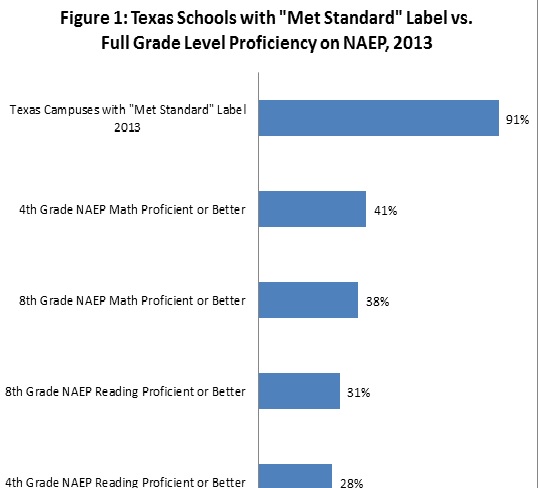
A toxic mixture of reformer overreach, devious alphabet soup group plotting and populist uprising has left this once proud system as a complete train-wreck. I will attempt to summarize this wreck in a single chart:
So only a large minority of Texas students can do grade level work on NAEP in any given subject, 91% of schools got a “met standard” label under the new “pass/fail” accountability system currently used during this brave new world of accountability chaos. This is an accountability system the reminds me of:
These labels are supposed to be transitional, but there will doubtlessly be efforts to codify them into statute during the 2015 legislative session. I could go on at some length about what a mess that the high-school end of course exam system has become, but I will spare you. Go and read the Dallas Morning News series linked to in the previous post if you’d like a detailed blow-by-blow on who all is to blame on this, but my own take is that there is plenty of blame to go around on both the reformer and alphabet soup side. The parents involved had genuine grievances regarding the testing system, but also must share in the blame for what is now a bad joke of a system.
Texans need to engage in a vigorous debate over what it is that they desire out of their system of academic testing and transparency. If the answer is “nothing really we just want to go through the motions of having such a system” then the legislature can codify pass/fail and further dummy down the high-school testing system. Trophies for everyone, a long era of academic stagnation awaits.
If not, then reformers might need to persuade parental activists to exercise greater responsibility to go along with their influence. Hopefully the Texas reform tribe has grown sadder and wiser as well.
Teachers and parents had been lobbying for a change in the promotion policy since last year, when the state adopted new exams aligned with more rigorous academic standards known as the Common Core. Test scores across the state plummeted; in New York City, 26 percent of students in grades three through eight passed the English exam, while 30 percent passed in math.
Responding to the outcry, the State Legislature this month mandated that school districts take into account multiple measures in deciding which students to promote, and it barred schools from including test scores on student report cards.
Finally got rid of those test scores on student report cards. Whew- what a relief! I read somewhere that the Republican candidate for Governor in New York has joined the testing opt-out movement, which is also charming.
Meanwhile in Indiana, well, go read about it for yourself. Given that the federal government requires student testing in Grades 3-8 and once in high-school as a condition to receive federal funds, it might be a really good idea for Common Core opponents to give some thought to what it is they favor in addition to what they oppose. A constructive vote of no confidence is a much better idea than what is starting to look like:
Here in Arizona, Governor Brewer requested $13m for a new assessment tied to the standards that the State Board adopted in 2010. The legislature appropriated $8m. What happens next? Your guess is as good as anyone’s.
It might be easy to attribute this to Common Core, but you take a look at fiercely independent but still chaotic Texas and then you realize that it’s not so simple. I highly recommend reading the Dallas Morning News series How the Texas Testing Bubble Popped. The series has three parts (I, II and III) and is well worth reading. Towards the end of part III the DMN series says:
While test opponents elsewhere are looking to Texas for clues about how to pop the testing bubble back home, it’s not a model that will be easy to replicate.
The battle over testing in Texas pulled together an incredibly broad-based and narrowly focused coalition that managed to avoid the political battles that afflict many other issues.
School superintendents started tilling the field in 2006.
What had seemed unified business support for the tests publicly fractured, giving some legislative leaders political cover to join the rebellion.
TAMSA brought in mostly white, suburban moms from high-achieving schools who were politically and geographically diverse.
Mind you that Texas had a 30 year bipartisan elite consensus on testing that gave birth to No Child Left Behind. The elite consensus got steamrolled in 2013. I had something close to a second or third row seat to the debacle. Governor Perry threatened to veto HB 5, but wound up having a signing ceremony despite the fact that the legislature had acceded to few if any of his demands. Governor Perry already had a special session called that could have addressed the topic. Texas is however a democracy, and the demos appeared to be speaking loud and clear regarding the end of course exams system. We all have times where we want the trustee model to triumph over the delegate role, but you get some of both in life.
So when you factor out the unique Texas strangeness out of the Lone Star State accountability collapse (which may have only started rather than finished btw) it looks to me that the future of testing in the United States is going to be a battle for the hearts and minds of suburban parents. The Dallas Morning News opines that what happened in Texas is unique and complicated. Perhaps so, but it may be the case that it is simple: when the Alphabet Soup crowd successfully recruit suburban parents to wreck shop on state testing systems, well it kind of reminds you of Hudson’s post-crash tactical assessment from the American film classic Aliens:
So where is this all headed? I have no clue. Circa 1980, public schools largely stood as transparency free zones where real estate agents based their highly sought after expert opinions on public school quality on the percentage of kids they saw running around on the playground that were white. This was the school system that I grew up in. Personally I’d prefer not to go back, just in case you were wondering, but it is not going to be up to me.
I was already madly in love with Alaska after having visited in 2006. Now United States Senate candidate Mead Treadwell (great guy) had me up and gave me some great advice. My flight left at something like 2:30 am (they like to have planes leave Alaska late and fill up in the lower 48 early) and so Mead advised me to go up to Talkeetna and recruit some climbers to do a flight seeing tour of Mount McKinley. The first guy I found had a ZZ-Top style beard and was from Vermont, and then I found two yuppies from Boulder who were heading up to camp and climb for a week. We landed on the glacier and the whole scene looked like another planet, let’s call it “Hoth.”
The pilot reassured us that we had picked the right time to come (May) because the cold had snapped but the Grizzlies were still hibernating. Best $100 I ever spent.
I recall a discussion I had as an undergraduate where my professor made the point the people who dropped bombs on cities in World War II would have had a much more difficult time emotionally looking the same people in the eye and killing them with a knife. Parents for Educational Freedom in North Carolina is determined to make their attackers look their victims in the eye in this 1 of 4,500 campaign.
Shakespeare’s Cassius told Brutus “There is my dagger and here my naked chest. Inside it is a heart more valuable than Pluto’s silver mine and richer than gold. If you’re a Roman, take my heart out. I, who denied you gold, will give you my heart.”
I don’t expect that those who brought this suit will share the reluctance of the noblest Roman of them all. They fear having someone deny them gold and they seem out for blood. Hopefully the courts will stay their hand.
HB 2506 made it through the Kansas House and Senate last night and contains some significant education reforms, including a scholarship tax credit program, curbs on teacher tenure abuse and alternative teacher certification. Congratulations to Kansas lawmakers and education reformers. The “never say die” crew at the Kansas Policy Institute Dave Trabert and James Franko have earned a:
BOOOOOOOOOOOOOOOOOOOOOOM!!!!!!!!!!
for their dedicated, determinedly fact-based efforts to improve Kansas education outcomes.


 Posted by matthewladner




 Jay P. Greene's Blog