I read this morning that Neerav Kingsland is stepping down as CEO of New Schools for New Orleans and will be taking on a new role of helping to spread the Recovery School District model. New Orleans’ loss is the nation’s gain- RSD is an incredibly exciting model which ought to be emulated widely.
The basic idea of the RSD is that school buildings are a crucial educational asset and that we ought to be getting them into the hands of people who will run quality based choice schools. When done well, as in New Orleans, you are constantly chopping off the left end of the bell curve in terms of academic outcomes. Charter operators get a certain agreed to period to operate, their outcomes are assessed, and if they don’t do well their charter is not renewed and the RSD puts out an RFP so other CMO can compete for the right to educate the students and use the school building.
Accountability is no illusion here- if you stink, you are gone baby gone. I mean its not Kathy Visser accountability where parents can hire and fire their own teachers, tutors and therapists but in terms of accountability for providers it is probably the next best thing. The attraction of the RSD model is obvious, at least for the period where the RSD is run by people who are going to do the tough and emotionally draining work of shutting down low performing schools.
Now as a little thought experiment, ask yourself the following question: if the New Orleans RSD were using, say, Stanford 10 rather than the Louisiana state test to measure achievement and academic progress in order to perform their functions, would there be any less accountability in the system?
I don’t think so either. And when you are dealing with private schools, national norm reference tests are already widely administered and have a much lighter touch on the curricular choices of schools.
I will never forget where I was when I heard him say it: I was driving through a high-desert forest near Prescott Arizona. The nation was in the midst of a full financial meltdown. I had the radio on, and one of the Sunday Morning Talk shows playing, Face the Nation if I recall correctly. That’s when I heard Representative Barney Frank, Chairman of the House Financial Services committee state without the slightest hint of shame:
The private sector got us into this mess. The government has to get us out of it.
I nearly ran my vehicle into a tree.
I could pain you dear readers with a blow by blow of just how completely culpable federal policy in general and Mr. Franks in particular were in the meltdown. Others however have performed that task. A delightfully short summary however was to be found in the comments section of a Vanity Fair article by Joseph Stiglitz. Dr. Stiglitz had written a long article for the magazine whose purpose was to absolve Freddie and Fannie and other elements of federal housing policy from blame for the financial crisis. One comment put the matter succinctly:
Let me get this straight: the creation of the sub-prime mortgage market had nothing to do with the sub-prime mortgage financial meltdown?
Now don’t get me wrong- there are private sector villains in this sordid tale (did for instance the credit rating agencies sign a pact with the Devil to survive what ought to have surely been a death-blow to their credibility?) but these private actors respond predictably to bad incentives created by federal policy. A few decades of nudging banks in the direction of making dodgy loans coupled with creating entities dedicated to buying them up eventually turned ya-hoo mortgage brokers into funny money printers. Can anyone truly be shocked that people making huge fees off absurd loans that they could quickly offload onto someone else’s balance sheet failed to resist the temptation to do so?
It would be delightful if the federal government could distort the mortgage market for decades in the interest of creating a more just society without creating unintended consequences. It would also be delightful if we could bottle the tears of unicorns as a cure for cancer, depression and baldness. The law of unintended consequences is a terribly powerful force. The beginning of policy wisdom is to fear its awful power. Central planners tend to assume rational technocratic adjustments being made to policies and seem shocked, shocked when they wake up and find that pesky politics has taken over.
The “Break in Case of Emergency” glass box in Congressman Franks mind contained a piece of paper that read “If it hits the fan, pretend the government had nothing to do with it and call for more government.” That makes him worthy of a Higgy in my estimation.
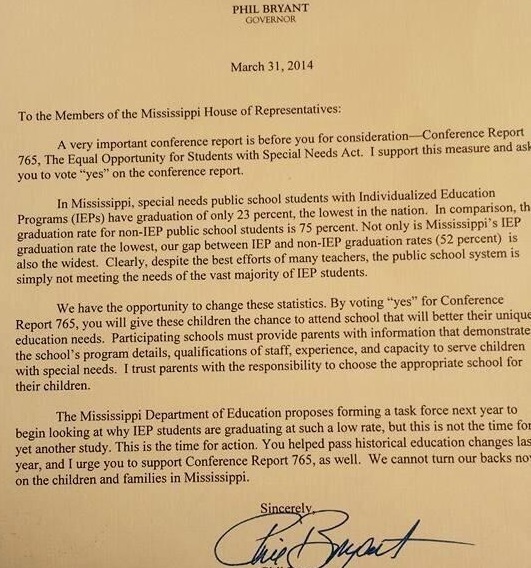
Down the stretch they come in Mississippi, and Governor Phil Bryant weighs in with a powerful case for reform. The bill will pass or die in the next two days, so stay tuned….
This came up in a discussion of the Arizona ESA court ruling. Broad misunderstandings of the program were on display, especially regarding the term “accountability.”
Sigh. Let’s start with the basics. The dictionary defines the word accountability as:
the quality or state of being accountable; especially : an obligation or willingness to accept responsibility or to account for one’s actions.
Standardized testing is widespread in education, but “accountability” is scarce indeed. So in my state more or less every public school student takes the AIMS test, but you would struggle to find anyone who is held “accountable” for the results. Forty percent of 4th graders in Arizona scored below basic on the 2013 NAEP reading test, but good luck finding a policymaker, superintendent, teacher or parent who was held “accountable.” Strangely enough, no one accepted responsibility for this sad state of affairs, making this a very unique form of accountability one where no one is ever held responsible.
So what Mike and Michelle seem to actually be talking about is academic transparency to the public. Arizona’s ESA program is indeed lacking in any form of academic transparency to the public. There are a variety of forms this could take, some much more sensible than others, and Arizona policymakers would do well to pick one of them. If they don’t pick one of the reasonable models, one must assume that an unreasonable model will be imposed sooner or later. I’ve testified on a number of occasions at the Arizona legislature that policymakers should embrace transparency in the program. I will keep on doing it in the future.
Now let’s discuss the difference between faux and vrai accountability.
Kathy Visser, the mother of Jordan Visser, an ESA student featured in the above video, testified before the Arizona legislature regarding accountability recently. She more or less noted that for all this shallow talk of “accountability” in this particular hearing (holding the same flawed understanding of the term displayed by Fordham) that there is in fact accountability in the ESA program. Everyone who educates Jordan is directly accountable to her.
Good luck getting that level of accountability in the public school system.
I followed up with Ms. Visser in a subsequent conversation. She experienced a number of difficulties in the public school system that are sadly common for special needs families. She had an open enrollment request denied without explanation with a public school official going so far as to hang up the phone on her. She consulted a specialized attorney who helps special needs families, but found the $15,000 retainer financially out of reach. Fortunately the attorney told her about the ESA program.
Ms. Visser first tried a private school for Jordan. She related that Jordan did not have a terrible experience in the private school, but that she decided to try the customized education approach with private tutors and therapists featured in the video above. Ms. Visser agreed that with a school voucher like the McKay Scholarship Program, she would have been able to hold the public schools accountable for the services they provided Jordan. With an ESA, she can hold all providers accountable private schools, tutors, therapists, you name it.
That my friends is true accountability, you know, the kind where people actually get held responsible for their results. Not the largely phony kind of accountability where states administer dummied down academic exams with massive item exposure, dropping cut scores, and all sorts of statistical games and tricks and other problems that I have read about in Fordham reports with most states obscuring things further behind fuzzy labels whose scale almost no one understands.
The type of “accountability” that Fordham is talking about however has proven to be baloney in most states for decades now. Even in states with the most useful testing systems, like Massachusetts and Florida, you won’t find any parents wielding the type of authority exercised by Kathy Visser. It’s long past time for us to recognize the difference between genuine accountability and mere bullshit accountability.
UPDATE: In the interest of fairness please note that Mike did say he supports the ESA program in the podcast and expressed that we should let this experiment play out. My point is not to claim that the ESA program is perfect (it isn’t) but rather that our notions of what constitutes “accountability” badly need a reboot.
In Mediocre May Be Closer than it Appears, Jonathan Butcher cross listed the Arizona Board of Regents Report showing massive, widespread failure of the Arizona High School Class of 2006 to graduate from college by 2012 with the state’s A-F grading system. He found that 75 percent of graduates of A rated schools did not complete a BA in six years.
Outside of a few islands of excellence, how close is mediocre in AZ? Try 2:40 through 2:45 close:
Note for the record that there have been conversations about raising the standards of the grading system, but right at the moment we have no idea even what test the public schools will be using for accountability purposes next year. The AIMS statue is long overdue for demolition so that the townsfolk can beat it with their shoes, but we sadly have a few things to sort out before making adjustments to the grading system.
Meanwhile, T-Rex will continue to feed on T-Gen employees, blood sucking lawyers and unfortunate kids who are not getting the education they need to succeed in life.
The school choice tribe has been getting a great deal of grief in Arizona, as if we were the cause of the funding declines here in our pleasant patch of cactus. Despite rumors to the contrary, we did not induce the housing crash to go on a rampage to gleefully cut public school budgets. Charter schools for instance have never received as much total funding per pupil as the district schools and they have had to suffer along with the districts. Say what you will about Arizona conservatives in the legislature, but it is a simple mathematical fact that last year’s Medicaid expansion will do more to constrain growth in K-12 district spending once the temporary federal bonus money runs out than the ESA program ever will.
It’s also worth noting that public school groups went to the ballot with an initiative that would have prevented cuts. The accounts I have heard of the enterprise had prominent business leaders abandoning the effort in disgust during the formative stage. Various interests, most notably the road construction guys, log-rolled their way into the package and well-meaning but inexperienced people played prominent roles in the campaign. It wasn’t exactly a shock when the voters soundly rejected the measure. A lack of confidence that the money would make it into the classroom seemed decisive.
I can see why people might suspect that school choice sleeper agents infiltrated this effort in order to sabotage it from the inside, but I can assure you that this did not in fact happen.
A grand bargain might look something like this: a revamp of the state’s tax system to ditch the income tax and replace it with consumption taxes. This would address the fact that two large groups- Snowbirds and undocumented immigrants-have ways of avoiding income taxation but still consume state services. You could hope to get this to be pro-growth and thus pro-revenue. If anyone in Arizona thinks they don’t need a top-notch tax system to compete, look over there, I saw Texas holding hands with your girlfriend. She was gazing admiringly into his eyes with a blissful expression on her face while gently brushing his cowboy hat.
The second part of the grand bargain would be to tie increased funding to quantifiable improvement. Florida’s program to provide a $700 bonus to schools and teachers that get a child to pass an Advanced Placement exam for instance seems like a great idea for a state in which only 19% of the Class of 2006 earned a BA degree. I think many Arizonans would be willing to invest more in public education. I am potentially one of them, and I am potentially willing to pay higher taxes to do it, but many of us are not willing to simply pay more for the same bad results. Some pilot programs that show improvement associated with increased funding could be the only realistic place to start. At the moment, many don’t want to put more water into what they regard as a leaking bucket.
Finally there are some fundamental questions that the public school groups need to confront. Such as: why can charter schools receiving $1600 less per student often crush the results of nearby district schools with more money and similar student demographics? Two main reasons: charter school kids are all there by choice and have bought in to the culture of the school. Second these schools efficiently remove ineffective instructors from the classroom in a way that most district schools do not.
The hour is later than most realize and we do need to embrace improvement strategies beyond expanding choice. Everything should be on the table and we need to get serious.
So how do private school students do in Science compared to public school students. I wasn’t sure, so I went to the NAEP data explorer to find out.
Private school students outscore public school students, but private school students tend to be more affluent than public school students, and there can be differences in special need and language profiles. Fortunately the NAEP data explorer allows you to take such factors into account. To maximize the comparison, we will only look at the NAEP science scores of children eligible for a Free or Reduced priced lunch under federal guidelines, and who have neither a special education nor an English Language Learner designation. This is about as close to apples to apples comparison you can hope for in NAEP data.
So NAEP changed the framework of their Science exam in 2009, making the 2009 and later exams incomparable to those given before 2009. The comparison of general education poor children between public and private schools is sporadically available in both NAEP science frameworks. You can’t compare old NAEP science to new NAEP science, but you can compare public and private school scores within each year. So let’s start with 4th grade:
Private school generic poor children outscored their peers in the public schools 2 out of 3 tries. Let’s look at 8th grade scores:
Private school generic poor children outscored their peers three out of four times in 8th grade. Let’s have a look at 12th grade science:
So for those of you scoring at home, in 8 possible comparisons, private school general education poor children outscored six times. It was close (within the margin of sampling error) a few times but every time the result was lopsided it was lopsided in favor of the private school children. Quite frankly science scores should be higher in both public and private schools for low-income kids, but the available evidence does show an overall private school advantage. Unless you happen to be Stephanie Simon working through a sizable case of confirmation bias, in which case this is what you saw:
Taxpayers in 14 states will bankroll nearly $1 billion this year in tuition for private schools, including hundreds of religious schools that teach Earth is less than 10,000 years old, Adam and Eve strolled the garden with dinosaurs, and much of modern biology, geology and cosmology is a web of lies.
Gosh, a billion dollars-that sounds scary! At least until you think of it as less than 80 percent of the Dallas Independent School District’s budget. Still, this is an outrage! We should put a stop to it immediately!
Except…how is it that these kids at hillbilly flat-earther private schools keep managing to score about the same or more often better than their public school peers on the NAEP Science exams? Does the NAEP science framework ask a battery of questions on the Book of Genesis? Does learning how to play Duelling Banjos wire the mind for multiple choice science exams?
Um, no. Not so much. Private schools just do a better job teaching science overall. Ms. Simon has written a hyperbolic story about a crisis that does not exist. The available evidence suggests that if we eliminated all funding for choice programs that it would result in a net decrease in knowledge of science.
If Ms. Simon wants to pull the funding for private schools based on science achievement, the river needs to flow both ways and we will have to pull the funding for an even larger number of public schools on the same basis. In the meantime, if Ms. Simon doesn’t like private schools, she always has the option of not enrolling her children in one. As an added bonus, her kids can learn science on Khan Academy if she happens to choose one of the many that do a poor job of teaching science.
Congratulations to the crack legal eagles at the Goldwater Institute and the Institute for Justice and the State of Arizona for winning the case. It has been a great blessing to work with so many dedicated lawmakers, colleagues, parents and donors in Arizona and across the country that helped to bring this program to life.
To Senator Blaine, the Know Nothings, the KKK and anyone else involved in writing bigoted anti-Catholic language into the Arizona Constitution eat your hearts out. This is a small but crucial victory in a larger struggle against your disgusting legacy.
Most of all congratulations to the participating parents. Their stories can bring even the stoic to tears. The program upon which your family depends is safe from court assault now. Thank you for your unyielding support!


 Posted by matthewladner




 Jay P. Greene's Blog