Senate co-leader Jeff Klein, Senator Ruben Diaz, Assemblyman Karim Camara, Assemblyman Marcos Crespo, Assemblyman Mark Gjonaj, Assemblyman Luis Sepúlveda, and Assemblywoman Crystal Peoples-Stokes all also spoke. HT Whitney Tilson.
Antonio Salieri says”I am the patron saint of the Tufts RTF Department…”
(Guest Post by Matthew Ladner)
My Austin sources inform me that McConaughey has started the biggest celebration since the 2006 Rose Bowl. Now that Jay has been justly cowed by the overwhelming might of the UT Austin film brigade (former UT student F. Murray Abraham also won Best Actor by the way- HOLLA!) we can move on to other important business, like this interesting new study by Jason Bedrick about the New Hampshire tax credit program for the Show Me Institute. Unlike Jay’s Oscar smack, a 97% satisfaction rate is strong.
Ellen’s best joke from the Oscar’s last night was that the nominees had 1,400 films between them and six years of college. Two thirds of those years are held by last night’s Best Actor winner Matthew McConaughey, a graduate and unofficial roaming ambassador for the University of Texas at Austin.
So Jay and Greg, how long has it been since your eastern seaboard finishing schools for global technocrats graduates won a Best Actor Oscar? That’s what I thought- SCOREBOARD! Don’t bother bringing up those Nobel Prizes because we all know those things are totally overrated.
McConaughey snapped this pick on his iPhone and whispered to himself “Eat your heart out Krugman!”
Matthew McConaughey has slowly but surely become a more accomplished Dean Martin of the early 21st Century. Whether he’s getting into minor incidents with the Austin police for playing a bongo or winning an Oscar, dude is having fun whether you are or not. Keep it up MM and
Unlike the cries of pundits either desperate for attention or hoping to finally get their Wile E. Coyote ACME Curriculum in a Box scheme to somehow work from the top down this time, the battle on the left has some very real and tangible victims. So far the toll looks to include hundreds of children who will be losing the opportunity to attend a high-quality school. These are real parents, real children, and very high-quality schools being stripped away.
New York City does not lack for Democrats with a deep commitment to charter schools. Let’s see if they rise to the occasion for these kids.
In 1997, The Clarion-Ledger published an award-winning series of stories highlighting the problems facing special-needs students in Mississippi.
Among its findings: Parents had to battle public schools to get federally mandated services for their children; the state had few qualified teachers to provide an appropriate education to disabled students; and just 17 percent of special-needs children graduated high school.
On Feb. 2, the newspaper published another series on special education that found little has changed.
Nearly two decades later, parents of special-needs kids still battle school districts. Teachers and administrators still lack training. And despite six new state superintendents, countless different strategies and billions of dollars in federal funding since that first series ran, Mississippi’s special-needs graduation rate has risen just 6 percentage points.
Less than one in four students with disabilities leave high school with a diploma in Mississippi. It’s the worst special-needs graduation rate in the nation. Most states graduate 50 percent or more.
….
We support public schools, but we cannot support the systemic failure of certain students over the course of several decades without any signal from MDE that something will change.
For that reason, we believe SB 2325 and HB 765 offer a reasonable solution to a longstanding problem and the first glimmer of hope for thousands of parents.
Q: If the students who are left in public schools are the least likely to succeed, doesn’t it almost guarantee those schools won’t do well?
I’ve got two children in public school. I’ve not yet talked to any parent that sees their child as a funding unit for the public school system. None of us see our kids that way. It’s silly to make an argument like that: “Your child needs to come to this school because they’re a funding unit and we need to have that.”
The people who are leaving are the people that aren’t getting their needs met. If you’re happy, then you’re going to stay. If the school’s not working for your child for whatever reason, you should have no obligation to stay.
We had a bit of a fauxtroversy here in Arizona last week as some quarters got riled up over Superintendent of Public Instruction John Huppenthal’s decision to record a message for parents whose children attend D/F rated Arizona schools about the Empowerment Scholarship Account program. Superintendent Huppenthal serves as the legally designated administrator of the ESA program- it is quite a shock that he might work with private groups to raise awareness of the program. Quelle horreur! This is surely going to lead to the destruction of public education in Arizona right?
Well, no actually not so much. More on the NBC news show Sunday Square Off:
Both the Mississippi Senate and House passed ESA legislation for children with disabilities today. Check the FF for details, bills now head to conference. Congrats to Mississippi’s choice champions…not counting chickens yet but….can’t……….resist……..
!!!BOOOOOOOOOOOOOOOOOOOM!!!
Mississippi may be first to pass a new private choice bill in 2014. If so, who will be next?
Mike McShane hosted an event last week at the American Enterprise Institute, and I had the opportunity to serve on a panel with Mike, Andy Smarick and Kara Kerwin. During the discussion, Andy confessed that what he found the “disaggregation” of K-12 unsettling. This came up in the context of a discussion of Arizona’s ESA program and students like Jordan Visser:
“How do you assign a teacher of record?” I recall Andy asking. For Jordan, such a question is already antiquated. Should his tutor be classified as the teacher of record? Or the physical therapists? Mr. or Mrs. Visser? What if Jordan is taking a MOOC from Stanford is a few years? Should the state of Arizona attempt to hold Stanford “accountable” for what Jordan learns?
Personally I choose “none of the above.”
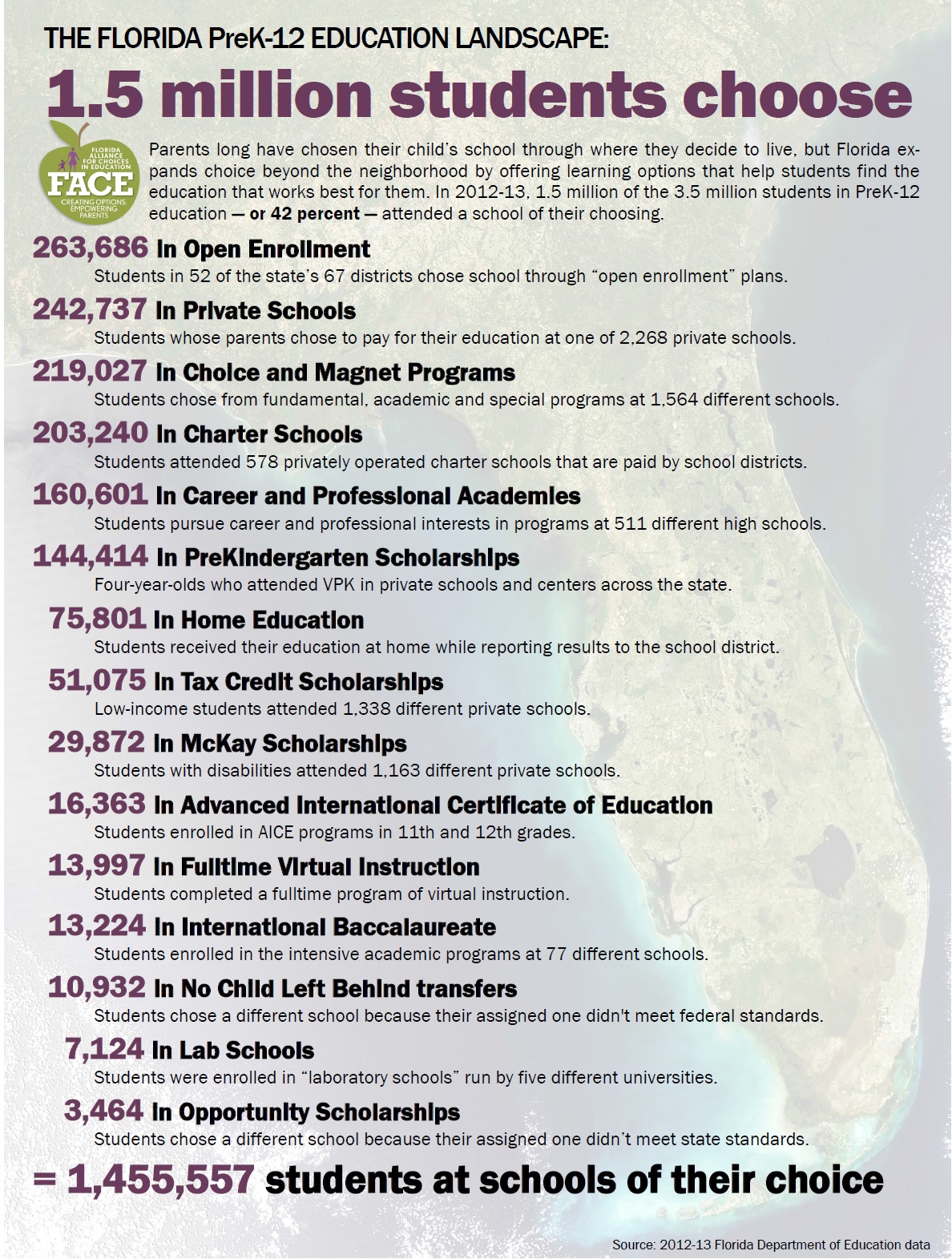
The trend towards disaggregation in K-12 predates Arizona’s still tiny ESA program. The ESA program can in fact simply be viewed as the best vehicle for managing a customization trend as a quasi-market mechanism that gets us as close as possible to realizing the benefits of markets while preserving the public funding of K-12. The disaggregation trend however has been moving out into the bloodstream for decades. Consider the following program data from Florida:
This is a snapshot of traditional “school choice as you knew it at the end of the 20th Century.” Most but not all of these choices are mutually exclusive such that they are something any one student does to the exclusion of others. You don’t expect to find many students for instance enrolled in a private school full-time and doing full-time virtual instruction, for instance. Most of these options are either/or propositions you are either sitting in this type of seat, or that type of seat. Major avenues of part-time education, such as dual college enrollment and virtual education, are not included, so we are just getting warmed up.
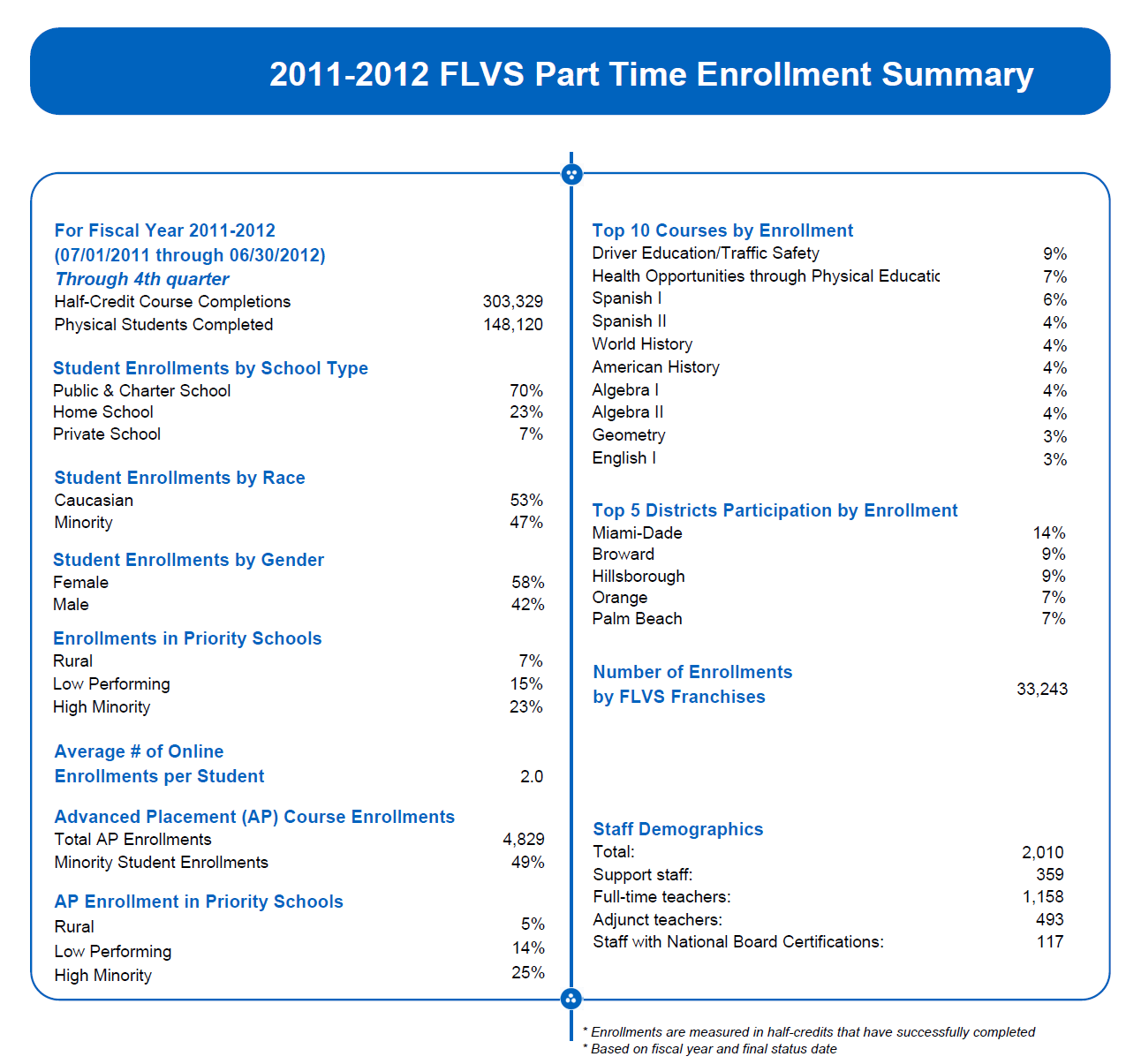
Let’s take virtual education on next:
The Florida Virtual School is not the only supplier of accredited virtual courses in Florida, so the 148,000 or so courses they provided in 2011-12 underestimates the strength of the trend. Nevertheless FLVS long ago begged the question: if a child takes an online Mandarin course from an approved online provider, just what, if anything, does this have to do with the results on the host schools’ accountability scores?
“I’ll take ‘Absolutely Nothing at All’ for a Thousand, Trebek!
Needless to say, FLVS found it necessary to develop alternative methods for measuring student achievement related directly to course content. High-school students have been taking classes at community colleges for decades with what appears to be an entirely understandable disinterest in sorting through just how much responsibility, if any, the Community College holds for what happens on the high-school students minimal skills accountability exam.
So what happens when we mix dual enrollment with virtual education?
Since we live in an age of wonders, we have over a thousand Massive Open Online Courses provided by some of the finest universities in the world available for free. Oh and the number of courses keeps growing. Did I mention that it has already been worked out for MOOC students to take third-party proctored final exams and receive college credit for them? Yes, right, that too. Has anyone thought through the fact that the $89 cost for a third-party end of course exam may prove incredibly attractive for both families but also to schools who don’t enjoy having a portion of their budget sent off to an online provider?
Let’s not get ahead of ourselves Trebek! I’ll take ‘Months that begin with Oct’ for five hundred…
So, let us imagine a 15-year-old taking a Calculus class from, say, the Massachusetts Institute of Technology. He or she successfully completes a third-party end of course exam, he or she either is or in the near future will be eligible for college credit from a large number of universities around the world. Obviously provision for this student to receive high-school calculus credit will need to be made as well if we are to maintain any semblance of sanity. Should authorities in Arizona disallow this because MIT’s Calculus course doesn’t precisely fit the state of Arizona’s state standards?
I’ll take “Seriously, you have got to be kidding me!” for a thousand Alex.
In short, the disaggregation genie is out of the bottle, and the trend looks set to accelerate in the coming years. As our system of education evolves it will be necessary to update our thinking regarding transparency and accountability: they are already out of date and will be increasingly so moving forward. It would be absurd to require Jordan Visser to take the AIMS test. The AIMS has nearly played itself out for the 19th Century factory model school system in Jordan’s home state and has nothing to do with Jordan. Regarding the ESA program, the public’s interest in transparency would be better served by collecting national norm reference exam data and having them analyzed by a qualified academic researcher. Regarding the broader education system, Texas has already moved to replace minimal skills tests with subject specific end of course exams at the high school level. If a student takes a Physics class, shouldn’t we be curious as to whether or not they learned any “Physics”?
Creative destruction usually kills outdated ideas before outdated organizations. Our notions about how to provide transparency in a changing K-12 world have been running behind schedule.


 Posted by matthewladner







 Jay P. Greene's Blog
