Pass the Popcorn: The Best of Enemies

September 28, 2015

(Guest Post by Matthew Ladner)

This weekend I had the opportunity to see the documentary The Best of Enemies about William F. Buckley and Gore Vidal. The documentary focuses on the decision of ABC News to hire the two rival public intellectuals to cover the 1968 Republican and Democratic Party Conventions.

I am going to fully confess my bias from the outset. In a disclosure that should shock no one, I went into (and left) the documentary as a fan of William F. Buckley Jr. I watched Firing Line growing up and enjoyed Buckley’s wit and flair. Perhaps a decade ago I read a collection of responses to reader inquiries in National Review and found it absolutely hilarious. Two of my favorite anecdotes- a reader complained that Buckley slouches in his chair on Firing Line, fails to comb his hair properly and could make a much better impression if he would take more pride in his appearance. WFB’s response fell something along the lines of:

If I was also attractive it just wouldn’t be fair.

Another reader wrote to renew his subscription to National Review despite a terminal prognosis, relating that he was not sure he would last to read all the issues. Buckley responded:

Not to worry-where you are going the pages of National Review are exfoliated from the wings of Angels!

Buckley always struck me as a happy warrior and an elegant and delightfully mischievous champion of his point of view. Going into the film I had very little awareness of Gore Vidal-I had seen him appear as a left of center pundit once or twice and knew he was an author of historical fiction that I had never read. I learned from the film that Vidal held a much more prominent status in the late 1960s.

ABC News decided to try to improve upon their third banana status as a news organization by inviting Buckley and Vidal to comment on the conventions. The Republicans held the first convention in Miami and from the start Vidal revealed his true purpose. He had no intention of bothering with the conventions, but rather focused his efforts on attacking Buckley. Vidal had spent months doing the equivalent of opposition research on Buckley, and came right out of the gate by accusing Buckley of wanting to drop atomic bombs on North Vietnam.

Vidal apparently viewed Buckley and his ideas as “dangerous” and a deep and personal antipathy developed. Although Vidal and Buckley shared a great deal in terms of background, education and debating style, they absolutely despised each other on ideological grounds. If Vidal however had an animating ideology that went beyond hatred for the Vietnam War and what now comes across as a rather boring promotion of alternative sexuality as a form of self-promotion, the film fails to make the case. Cross Madonna with the Boz, boost his IQ and send him to boarding school = Vidal as far as I can tell. In fairness to Vidal, he has had a lot of help over the last 50 years in making what may have seemed daring in 1968 seem like next year’s juvenile prank at the MTV Music Awards now. Nevertheless…yawn.

Matters came to a head at the Democratic Convention in Chicago. You may recall that Lyndon Johnson’s Vice President was heading for the nomination (although not the Presidency) and a huge anti-war protest attempted to storm the convention hall. Old-school Democratic Mayor Daley’s police commenced to beat back the protestors with clubs on live television. The protestors chanted “The whole world is watching!” but as divided as the country appeared at the time one wonders just how much of the world actually disapproved. The documentary air-brushes the “storm the convention” story element out of the narrative, and I wasn’t there so I won’t pretend to know what happened. Perhaps the Chicago Police gathered their forces and attacked the protestors to practice their softball swings, but I rather doubt it. The documentary also makes some effort to portray the “law and order” platform of the Nixon campaign as thinly veiled racism, but those hippies getting beat up by the police looked pretty pasty to the casual viewer.

Buckley and Vidal essentially provided color commentary to the melee. Vidal accused Buckley of being responsible and referred to him as a crypto-Nazi. Buckley lost his cool, informed Vidal that he had fought in World War II, used a derogatory term to describe Vidal referencing his sexual orientation and threatened to physically attack him if he described him as a Nazi again.

Time for a commercial!

Vidal got what he wanted and had consistently sought across both conventions- to get under Buckley’s skin and cause him to lose his cool. Buckley apparently regretted the incident until the day he died. Appropriately so.

Living well is the best revenge, and here Buckley clearly came out on top. The modern conservative movement that Buckley had founded reached an apex of influence under Reagan. Various “dangerous” Buckley ideas resulted not in the sky falling, but rather in a Soviet collapse. The sting of the defeat in the Vietnam skirmish ought to have diminished in winning the Cold War considerably.

Vidal outlived Buckley, with someone in the film speculating that hateful spite of Buckley may have prolonged his miserable existence. My lack of familiarity with Vidal was not terribly unusual for someone my age. Vidal’s later years became an oblivion of indifference as people stopped reading his books. After Buckley’s death, he wrote “Rest in Hell!” Vidal however had already entered the ninth circle for a narcissist- public apathy.

Despite the fact that almost 50 years have passed since 1968 the tumult captured in the film seems very current. The past is never dead, it is not even past.


With North Carolina expansions the book may be closed on 2015 private choice

September 23, 2015

(Guest Post by Matthew Ladner)

Jason has a useful rundown on the private choice action in 2015 over at Cato after North Carolina added some style points to Greg’s latest easy triumph over Jay Mathews. Very, very, very good year. It is still time to raise the bar on the bet.


Quinnipiac Poll Finds that Parental Choice is the most popular element of Andrew Cuomo’s K-12 Agenda

September 22, 2015

(Guest Post by Matthew Ladner)

Very interesting poll results– the unions seem to have convinced New York that Cuomo is wrong on K-12 reform- except on choice. On charters and tax credits New Yorkers seem to be resisting,


New Arizona Board of Regents Report on AZ High Schools

September 21, 2015

(Guest Post by Matthew Ladner)

The Arizona Board of Regents has released a new study utilizing the National Clearinghouse to track the college success by high school for the public school Class of 2008. Specifically they rank district and charter schools by the percentage of kids earning a BA in six years.

The statewide numbers did not improve much from the analysis of the Class of 2006- 19.4% finished a BA instead of 18.6%. University High- a magnet program in Tucson-comes out on top. As mentioned previously their program utilizes entrance exams, minimum grade point averages, etc. so while it is swell it does not qualify as a general enrollment school. Tempe Prep- the ur-Great Hearts prototype- ranked first among general enrollment schools, followed by Veritas Prep- the first of the Great Hearts schools to get a 12th grade cohort into the analysis. Among general enrollment schools, charter schools took 7 out of the top 10 spots, but let’s just say they could a spot more competition from the districts.

The Pew Center’s book The Next America presented polling data showing that the Baby Boom generation was wealthy but miserable. One of the two main reasons for their misery related to their twenty something year old children living in their basement. Er…welcome to the education reform movement!


The Age of (Relative) Efficiency and/or Austerity: It’s Already Started

September 16, 2015

(Guest Post by Matthew Ladner)

The early 1980s punk rock band Fear famously destroyed the set of Saturday Night Live (the gif above is from their SNL performance-SNL’s invitation to Fear to perform and bring some fans having been one of the greatest really terrible decisions of all time). In any case, Fear had a song called Let’s Have a War. Like most punk bands of the era Fear was out to frighten the parents of 15 year olds and draw attention to themselves with outrageous antics. The lyrics of Let’s Have a War (not to be confused with another Fear classic Bomb the Russians) as I recall went something along the lines of:

Let’s Have a War!

Jack up the Dow Jones!

Let’s Have a War!

It can start in New Jersey!

Ok Ladner where are you going with this? Right, so a refrain in the song:

It’s Already Started!

So out here in the Arizona cactus patch, the looming age of (relative) financial austerity and efficiency has already started. The people who work in the school system feel very grouchy about it, but where things stand today is much better than the recent past.

AZ NAEP

So let’s go back to the world of 1992 Arizona (blue columns). Arizona operated as a high-tax state in those days and the school districts were almost the only game in town (Arizona has always had a low rate of private school attendance).  The state had a majority Anglo K-12 population in those days, but unfortunately those Arizona Anglo students weren’t terribly skilled on average at reading English. Now mind you, they had proficiency rates 2.8 times higher than Arizona’s Hispanic student population at the time, but that provides little comfort.

What does this translate to today, in 2015, now that the class of 2000 have aged into the prime working years of their mid 30s? Let’s just say that many firms find it necessary to recruit nationally when searching for job candidates. No one was hoping for an overall reading proficiency rate in the low 20s in 1992, but we got it anyway.

Now let’s look at the 4th grade reading scores for the Class of 2021 (red columns). While these results leave a great deal to be desired, they are profoundly improved over the 1992 4th grade results. Arizona closed the gap for Anglo students with the national average, but failed to do so with Hispanic students.

Hispanics now constitute a plurality of Arizona K-12 students. A 17% reading proficiency rate constitutes a looming catastrophe for the Arizona of 2030 and beyond. Thus while we should recognize the fact that Arizona’s academic outcomes have improved greatly, we should also recognize that the state has a desperate need for still greater gains. Note however that all of those nasty policies that Diane Ravitch hates: standardized testing, charter schools, private school choice, etc. all started phasing in around 1994 in Arizona, and that the 2013 NAEP had the highest average scores in state history despite funding cuts and a large transition in student demographics. This does not constitute final glorious victory, but certainly progress.

Arizona is a relatively poor state with an unusually small working age population (lots of old retirees and young kids). Rapidly growing states tend to rank towards the bottom of state rankings of per pupil funding, and will do all the more so if lots of the state has either retired or is still in school. Arizona does have a large number of wealthy retirees, but let’s just say that many of them have other residences in addition to their get out of the cold spot, and this means they have the opportunity to avoid paying Arizona income tax.

The Great Recession was an elbow in the face to Arizona’s housing dependent economy followed by a swift kick to the head. (To you non-Gen X readers this is mosh-pit imagery consistent with the punk rock theme of this blog post). Once the federal stimulus money ran out real declines in per-pupil spending commenced. This document from JLBC shows that the inflation adjusted spending per pupil in the Arizona public school system dropped from $9,438 in 2007 to $7828 in 2014. 

Outrageous! Horrible! Get a rope!

Slow down on the lynch mob. The 2007 number basically represented the height of the property bubble and all of the funny money that it brought flowing into state coffers. Arizona had spent far less than that per pupil in the past, and the height of a bubble does not make for a good mental entitlement point. When the state had money, it increased K-12 spending. There has been joy before, there may be joy again, but the state can’t spend money it doesn’t have.

Of course we could raise taxes. This however is governed by a little thing called democracy. We had a governor’s election in 2014. One candidate promised to balance the state’s spending and revenues without raising taxes. The other claimed that he would not raise taxes but also campaigned on increasing K-12 spending. Arizona elected candidate A (Doug Ducey) by an overwhelming margin. A few years earlier, the school district industrial lobbying complex put a painfully convoluted ballot proposition to increase taxes for education spending on the ballot. The public rejected it by a huge margin. We have regular elections for state legislature. The voters have continued to elect a pretty conservative bunch and well, they had other options available to them.

Arizona voters did endorse a sales tax increase almost a decade and a half ago to increase the state’s base funding amount to inflation. The interpretation of this provision is currently a matter of legal dispute between the legislature and the industrial complex, but the resolution seems unlikely to result in a game changing amount of funding regardless of the outcome. Arizona doesn’t have a game changing amount of money to give to schools within the tax structure that voters have both explicitly and implicitly endorsed.

More importantly, Arizona’s 2013 NAEP scores were not only higher than 1992- they were higher than 2007. Between 2007 and 2013 Arizona NAEP trends: 8 point gain in 4th grade math, four point gain in 8th grade math, three-point gain in 4th grade reading, five point gain in 8th grade reading.  The proper term to describe an increase in outputs with decreased inputs: efficiency gain.

The folks working in the schools feel very grouchy. Unlike the risible bellyaching before the onset of the Great Recession (when spending increased and everyone had enrollment growth) they have a much more serious case to make in the current context. Running a school district in Arizona right about now is not an easy task- your per pupil funding has declined and your student count is more likely than not to be dropping. Tough decisions lie ahead on a worryingly large number of half-empty district facilities. You are having a tough time finding teachers as your Baby Boomers retire.

It’s already started in Arizona. Currently we are in year 5 of what you can either view as an age of austerity, or an era of improving efficiency depending on whether you view matters through a provider or a taxpayer lens. The Census Bureau projects large increases in Arizona’s youth and elderly populations over the next 15 years.

It’s not likely to get any easier. Arizona’s need for more effective and cost effective education delivery will continue to grow over time regardless of how much we choose to lament the need for change.


Choice 60, Default 0 in Southern Arizona National Merit Semifinalist Bowl

September 15, 2015

(Guest Post by Matthew Ladner)

So the Tucson AZ based Arizona Daily Star put out a story on 60 Southern Arizona students being names National Merit Semifinalists.  The author didn’t seem to notice what I found most interesting about the story.

For a little perspective, Arizona has five or so percent of students attending private schools, around 18% in charters. So about 70-75% of students attend districts.

A quick run down of the list of students and their students however reveals that about 49 out of the 60 National Merit Semifinalists attend choice schools: charters, magnet, private and home schools. Suburban districts and magnets earned all of the district semifinalists. No one attended a non-magnet Tucson Unified high-school, which is the by far the largest school district in the region.

This is usually the part of the conversation where my enthusiastic union affiliated Tucson friends will dust off their talking points about evil charters creaming students, etc. Note however that Arizona law requires random admission lotteries, a law that does not apply to magnet schools. Thus the school most obviously creaming students (read all about it here on their admission page) is University High, a magnet school run by Tucson Unified. University High had more National Merit Semifinalists than any other school, but you know that minimum GPA, admission test and other criteria just might have something to do with that.

Personally I don’t have a huge problem with an occasional magnet school with exclusive admission policies as long as parents keep the place afloat, but I certainly respect the views of those who do. I do however have a huge problem with people running the most blatantly exclusionary school in the state accusing others of doing covertly what they are doing openly without so much as a teaspoon of evidence.

Just as a thought experiment let’s assume for the moment that all of these charter, suburban district, magnet, private and home schools all represent some sort of student creaming conspiracy and this entirely explains their monopoly on National Merit Semifinalists. I don’t for a moment believe this to be the case, but if it were, er, why did the parents of these bright children choose to enroll them in choice schools? After all if you put these same kids in TUSD they would have done just as well right?

I’m guessing no, not so much. Parents know these kids best and have voted with their feet. If you take the position that a house in a well to do suburban district represents a form of parental choice (I do), the final score is Choice 60, Assigned 0 in the Southern Arizona PSAT Bowl. That goose egg represents a looming catastrophe for Arizona’s future btw- as the number of potential National Merit Semifinalists attending TUSD stood vastly larger than either zero or sixty. I have met some incredibly dedicated TUSD educators who practically kill themselves to effectively extend the school year for disadvantaged students. I don’t think that anyone wakes up in the morning, stretches, yawns and enthusiastically drives to work so that they can make sure that kids fail to reach their potential- that’s not how this works imo.

Every system however is perfectly designed to achieve the results it produces. This system needs a reboot.


Coons and Sugarman called for ESAs-in 1978!!

September 9, 2015

(Guest Post by Matthew Ladner)

Okay so yes it took us 33 years to figure out how to create ESAs after someone first proposed them, and yes we had to stumble into it. Don’t blame me- I was battling my Luke Skywalker action figure against my Stretch Armstrong, and well, er, better late than never! Ron Matus with a great post on Berkeley law professors Jack Coons and Stephen Sugarman’s call for what we now call ESAs- in 1978. Here is a taste:

John E. “Jack” Coons and Stephen Sugarman didn’t use the term “education savings accounts” in their book, “Education by Choice.” But they described a sweeping plan for publicly funded scholarships in terms familiar to those keeping tabs on ESAs. They envisioned parents, including low-income parents, having the power to create “personally tailored education” for their children, using “divisible educational experiences.”

To us, a more attractive idea is matching up a child and a series of individual instructors who operate independently from one another. Studying reading in the morning at Ms. Kay’s house, spending two afternoons a week learning a foreign language in Mr. Buxbaum’s electronic laboratory, and going on nature walks and playing tennis the other afternoons under the direction of Mr. Phillips could be a rich package for a ten-year-old. Aside from the educational broker or clearing house which, for a small fee (payable out of the grant to the family), would link these teachers and children, Kay, Buxbaum, and Phillips need have no organizational ties with one another. Nor would all children studying with Kay need to spend time with Buxbaum and Phillips; instead some would do math with Mr. Feller or animal care with Mr. Vetter.

Coons and Sugarman were talking about education, not just schools, in a way that makes more sense every day. They wanted parents in the driver’s seat. They expected a less restricted market to spawn new models. In “Education by Choice,” they suggest “living-room schools,” “minischools” and “schools without buildings at all.” They describe “educational parks” where small providers could congregate and “have the advantage of some economies of scale without the disadvantages of organizational hierarchy.” They even float the idea of a “mobile school.” Their prescience is remarkable, given that these are among the models ESA supporters envision today.

Sounds very, very familiar eh?


Florida Virtual School End of Course Exams

September 4, 2015

FLVS

(Guest Post by Matthew Ladner)

So I missed this little gem in August, but the Florida Virtual School released figures on end of course exams, and guess what, their students scored higher than the Florida average on every exam, varying from a passing rate 4% to 18% higher.

Now admittedly this is not a Campbell and Stanley random assignment study. It could be the case that FLVS got more academically motivated students, etc. It’s also possible that these would prove out to be significant differences, some significant some not, etc. in a proper experimental comparison. Perhaps someone will do us all a favor and do a sophisticated analysis.

Given that the state saves money on FLVS courses, it’s looking great for now.


A Harsh Apology to the Arizona Class of 2006 and the True Meaning of Accountability

September 2, 2015

(Guest Post by Matthew Ladner)

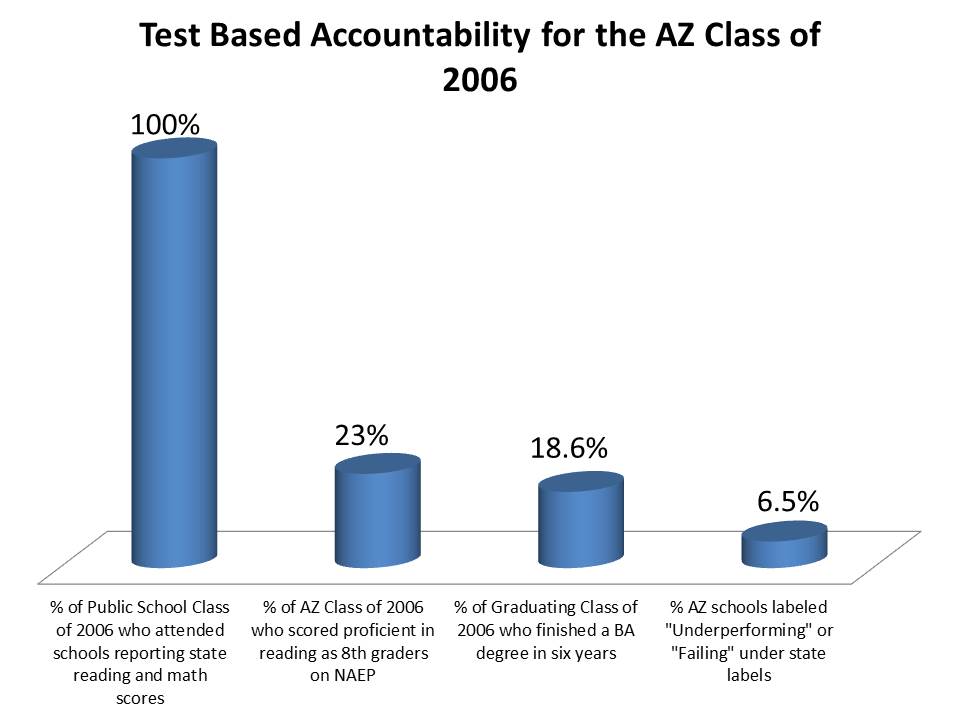
I had the chance to make a presentation on testing and private choice programs recently, and received a request to share a few slides from that presentation here on JPGB. So the first is from Arizona, circa 2006. I chose 2006 because we have a study that follows the entire public school Class of 2006 through the higher education system.

Slide6

So for those of you squinting at your Ipad- the columns read: Kids attending AZ public schools taking state math and reading tests (100%!), AZ Class of 2006 who read proficiently as 8th graders on the 2002 NAEP 8th grade reading exam (errr, 23%), Percent of Class of 2006 graduating class who went on to earn a Bachelor degree by the end of 2012 (errr 18.6%) and finally the percent of Arizona public schools who earned an “Underperforming” or “Failing” label in 2006 (*cough* 6.5%).

So who was held “accountable” in this slide. Not the Governor she was reelected by a wide margin in 2006. Oh what about the Superintendent of Public Instruction? Nope- he was reelected as well. Did Arizona have a mass culling of ineffective school superintendents in 2006? What about teachers? Nope and nope- it was business as usual.

Let’s compare the accountability for the staff at the 6.5% of schools who received a nice-so-nice label compared to that of the students. Now that it is 2015, what is the chance that any of the adults in those 6.5% of schools carry around a nine-year old label around with them as a burden, even if they remain in education and are still remain employed at the same school? Right- now what about the 81.4 percent of the Class of 2006 who either never attended college or who were among the waves of people who dropped out of college in debt with little to show for it?

The latter scenario constitutes a much harsher form of accountability than Arizona’s former “whip truly terrible schools with a wet noodle accountability.”  Sorry Class of 2006- I know that the state of Arizona gave you the equivalent of a Good Housekeeping Seal of Approval based on your results on a laughably simple AIMS test, then they kicked the can down the road on an high-school exit exam, then they labelled your school “performing” when it was actually anything but academically performing. That “performing” actually meant that it was performing its duty to employ adults and might occasionally facilitate learning if a student had a deep motivation to do it on their own. You were very foolish not to clue into this and now you will have to pay for it.

We the taxpayers and adult policymakers of Arizona feel some regret about all of this Class of 2006 for all these things, but ultimately you should have ignored the fact that the adults in your life were telling you everything was fine, and you should have studied harder especially when you were learning to read in K-3, since 77 percent of you failed to reach proficiency as 8th graders. It was really absurd so many of you thought you could do college level work, but the universities disabused you of that notion quickly didn’t they? Don’t worry the Class of 2007 temporarily filled your spots after you dropped out.

In the next life you should not be so trusting of adults and study harder. Perhaps you will take this lesson to heart as parents.  Go suffer the consequences of your actions and just think of how much worse this might have turned out if Arizona did not hold school systems accountable. The greatest trick the public school lobby ever pulled was convincing the world that the publication of scores on minimal skills math and reading tests constituted “accountability.” And like that **poof**

…meaningful accountability was gone, unless by “accountability” we mean watching helplessly as students suffer the long-term consequences for failing to acquire competitive skills.

Now as a post-script, things have improved somewhat since 2006 in Arizona. Instead of handing out “performing” labels, the state uses letter grades. Grades of C or D are closer to truth in advertising than “Performing.” The wretched AIMS test has finally received the mercy killing it so richly deserved.  Sorry I-hate-CC-with-a-purple-passion tribe, the new test aligns much closer to Arizona’s performance on NAEP so it represents an undeniable upgrade over AIMS, at least so far. Yes, it could have been accomplished by other means etc. etc. but the sad reality is that we sat around indifferently for years as the fraud described above played out.  My humble suggestion at this point would be to offer constructive and rigorous counter proposals to AZ Merit because I hope that if you’ve reached this part of the post you’ll at least acknowledge the true horror of the AIMS regime. I mean it was cooked up by a group of Arizona teachers in 1994, which makes it near sacred and all, but that can’t make up for the system being horribly mismanaged by the AZ Department of Ed and State Board of Education after that. It devolved into a cruel joke on children.

Yes Jay I get it they probably will do the same with the new test sooner or later.  How long do you expect this peace to last?

…as long as it can.

In the end, this too shall pass, so the most enduring accountability going on in Arizona today involves parental choice. Parental choice in fact represents the ultimate form of accountability that no system of aggregate test scores and school labels can ever replace.  Even at its best such accountability is an aggregate phenomenon, whereas parental choice allows parents to hold schools responsible at the individual level by voting with their feet.

Since 2006, AZ charter schools have reached a more meaningful scale. Arizona now has the highest percentage of students attending charter schools (almost 18%) of any state. Parents have used their contacts and Greatschools to figure out that even their allegedly swell schools leave much to be desired and have commenced to pounding on the doors of high quality charter operators, developing huge waiting lists.

The highest rated general enrollment school in the Arizona Board of Regents analysis of higher education outcomes Tempe Prep- was the forerunner of the Great Hearts system of schools that now has 22 campuses and mile long waiting lists. These schools did not appear in the 2006 analysis because they either had not opened yet or did not have a senior class by 2006. Stay tuned-the Board of Regents will soon have an updated analysis. Our private choice programs in the aggregate are mostly helping private schools to remain viable against the rise of charters. We need to do more on that front, and we need to help high quality charters replicate.

Meanwhile, for the first time ever, Arizona districts find their enrollment in decline in absolute terms. Before the great recession charters and choice were simply taking the edge off of district enrollment growth. In the last couple of years there has been district enrollment declines. Enrollment growth will eventually reverse this, but for now the charters are  basically absorbing all of it and more. Oh by the way, while Arizona’s NAEP scores are not high, they were higher than they have ever been in 2013. Sweet are the uses of adversity…

Arizona’s growing choice sector has created a constituency and will not be dispatched as easily as the well-meaning but ultimately failed efforts of the AIMS regime. Keep hope alive!


Comptroller Declares Victory for Capitalism and Texas over Saudis in WSJ

September 1, 2015

(Guest Post by Matthew Ladner)

Texas Comptroller of Public Accounts Glenn Hegar took to the pages of the WSJ to declare The Saudis Gambled and Texas Won:

What the Saudis and the naysayers closer to home seem to have forgotten is that the free market is the greatest incubator of technological innovation. Energy producers in this country have gauged the challenges of lower prices, are working to tackle them, and it’s paying off.

The technology behind shale production is advancing rapidly, and its costs are falling. Today the industry can tap multiple separate oil pools from a single vertical hole, drilling horizontally through miles of rock with computer-guided, steerable drill bits. Some of these “octopus” wells can feature as many as 18 horizontal shafts.

OPEC’s gamble to kill American innovation was a short-term strategy without an endgame, and no appreciation of how the strategy would spur greater efficiencies and innovation in the U.S. Call this a gentle reminder: It is never wise to bet against capitalism, especially in Texas.

George P. Mitchell continues to beat price fixers and klepto/petrocrats. This has the potential to be the biggest beat down since Herbert Dow drop kicked the European chemical cartel.