Rick Hess on Recruiting the Teachers of the Future

May 22, 2009

(Guest Post by Matthew Ladner)

The new edition of Education Next is online, and Rick Hess has a very interesting article on modernizing the teaching profession. Rick notes that we need to update bedrock assumptions-such as assuming that the dominant model of teaching recruitment should rest on recruiting 20 year olds into colleges of education and then expecting them to teach for the next 30 or 40 years. Lots of interesting suggestions on technology, compensation and alternative certification.

Great article, well worth reading.


Indiana Teacher Union Implodes like a Freddie

May 21, 2009

(Guest Post by Matthew Ladner)

AIG, Bear Stearns, Freddie, Fannie, and now….the Indiana State Teachers Association!

The National Education Association has taken over the operations of the ISTA, its’ Indiana affiliate, due to “financial distress.”  ISTA’s medical and long-term disability insurance fund is projecting a $67 million deficit and is on the brink of bankruptcy due to very questionable investment management.  For instance, in a nine month timeframe, over 4,000 investment trades were made, many of which were in high-risk equities.

Question for Leo: when do we start that LLC? The fire-sale has begun! A mere $67m to buy a controlling interest in the political overlords of Indiana K-12 policy is cheeeeeeap!!


The Daily Show on Arizona State University

May 18, 2009

(Guest Post by Matthew Ladner)

So Arizona State asked Barack Obama to deliver the commencement speech, but decided not to offer him an honorary doctorate, opining that his body of work was yet to come, and thus apparently did not merit such an honor.

The Daily Show picked up on this, and well, judge the clip for yourself. I’ve been critical of ASU for a lousy graduation rate and offering staggeringly unseemly bribes overly generous National Merit Scholarships in an effort to create the appearance of academic quality. Get the Daily Show mad at you, however, and they will drop the “Harvard of Date Rape” cluster-bomb on your village without a second thought.

It’s almost enough to make me feel sorry for ASU (once I got my breath back and dried my eyes) but when you lead with your chin, you can’t credibly complain when someone breaks your jaw. When you accept 92% of applicants and have a 28% 4-year graduation rate, it just might indicate that you are using a large number of ill-prepared students as financial cannon-fodder.

Yes, yes-it’s their choice, everyone gets an opportunity, yadda yadda yadda.  That’s all fine until you finance these six-year-beer-soaked-odysseys-of-self-discovery-resulting-in-a-graduation-about-half-the-time-vacations-from-reality with money forcibly extracted from other people. Many of the third party payers never went to college and are struggling to make ends meet.   What choice did they get?

(edited for typos)


Ed Sector’s K-12 Incoherence Week

May 15, 2009

(Guest Post by Matthew Ladner)

I’ve been out and about this week, but our pals over at Education Sector have kept me entertained. On Carey’s too-cool for-school dissing of vouchers, I can’t help but wonder: what would stop an advocate of home-schooling from dismissing Kevin’s beloved charter schools on a broadly similar basis? After all, home-schooling is legal in all 50 states, charters in only 40. Many of those 40 laws, however, are dogs that will never produce more than a rounding error number of schools. They’re not bad, they’re just drawn that way:

Precise numbers are not available, but twice as many or more students may be home-schooling than attending charter schools, and the rate of growth has been faster. High quality outcome data is hard to come by, but anecdotally universities have come to view home-school students very positively. I haven’t seen the same said for charter schools yet, nor have we seen (yet) a charter school student crush the evil Sooners like the bugs they are after winning the Heisman Trophy.

Im way too cool for you Carey, google my girlfriend

I'm too cool for you Carey, google my girlfriend...

Does it follow then that home-school supporters should be completely dismissive of charter schools? No of course not. The truth is that we don’t know what is going to take hold in K-12 reform, only that it is going to change.

Meanwhile, Andy Rotherham has delivered a brilliant column on the limitations of transparency that all but screams out at the end for a decentralized, self-regulating mechanism to hold schools accountable for results.

Ummm….you know….like parental choice.


Clive Crook on American Education and the Democrats

May 11, 2009

6837-004-ED31B9D4

 (Guest Post by Matthew Ladner)

Clive Crook doesn’t think that the alliance between education reactionaries and Democrats is going to last. I don’t either. Crook writes in the Financial Times of London:

The keys – and here comes the political challenge – are accountability and competition. However you do it, through school vouchers if you want to be radical, or the faster expansion of self-governing charter schools if you do not, the crucial thing is to give parents alternatives to failing schools. This means firing the worst teachers and shutting the worst schools. Teachers’ unions have a death grip on the system and are having none of it. In many parts of the country, sacking a teacher, however incompetent, is next to impossible. Will Mr Obama dare to face down this powerful Democratic party constituency?

There are two reasons to hope he might. One is that he understands the issue and cares about it. Plainly he feels passionately about inequality. Improving the working poor’s economic opportunities is essential, and if schools cannot be fixed, that is not going to happen.

Another reason for guarded optimism is that the politics of education is more complicated and less predictable than you might think. The Democratic party, despite the clout of the teachers’ unions, is split. Many urban activists and community organisers – the milieu from which Mr Obama sprang – are strongly in favour of greater school choice, which one might have supposed to be a Republican rallying-cry. The pressure for reform is coming from the left as well as the right.

At a meeting in Washington to launch the McKinsey report, Al Sharpton, a black community leader and all-round stirrer of controversy, was on the platform alongside more orthodox education reformers and administration officials. He called school reform the civil-rights challenge of our time. The enemy of opportunity for blacks in the US was once Jim Crow, he said; today, in a slap at the educational establishment, it was “Professor James Crow”. He is right, and the country must hope the president agrees.


More cover songs that RAWK!

May 8, 2009

(Guest Post by Matthew Ladner)

So we had fun a few weeks ago debating the relative merits of cover songs. Why not have another ball?

A little known cover of “Love is All Around” by Judy Garland:

Here’s another favorite of mine, goth-rockers Bauhaus cover Bowie’s Ziggy Stardust. The video was filmed in Austin in the mid 1980s, and I volunteered to mosh out in the body bag at the end.

Here is Pearl Jam covering Let My Love Open the Door by the Who:

U2 teams with Bjorn and Benny at a concert in Sweden to cover Dancing Queen


Rock Star Pay for Rock Star Teachers Part Trois

May 7, 2009

(Guest Post by Matthew Ladner)

A few months ago I got an angry email from an Arizona teacher claiming that her school had been terribly underfunded, and that she had 32 students in her classroom. I wrote to her:

If you have 32 children in your classroom, my first question is what is your school district doing with all of that revenue?

The JLBC put the statewide spending per pupil in Arizona at $9,399. A classroom of 32 at the statewide average would mean $300,768 in revenue from the students in your class.

Her response:

1-teacher, 1ELL teacher, 1 Special ED teacher, reading specialist, principal, janitor, secretaries, music, art, PE, computer teacher, Cafeteria workers, Para-educators, paper, textbooks, hands on science materials, Computers (this is the 21st century learning) building up keep, electricity, water, tables, chairs , etc…..

She forgot to mention administrative salaries from central command. There is one tiny little problem with all of this. According to the 2007 NAEP, 44 percent of Arizona 4th Graders scored BELOW BASIC in reading.

In other words, as Dr. Phil likes to say, how’s that hiring your average teacher from the bottom third of university students and supplementing them with crowds of others working out for you?

Shape up people!

The sad reality of American public education is that our schools have become revenue and employment maximizers that all too often are profoundly unfocused on the bottom line: student learning.  Public schools ought not to be jobs programs, but focused on their mission of equipping students with the academic skills necessary for success in life.

So, if you’ve got $300,000 in revenue from a classroom (many states have more) call me crazy, but I think you’ve got $100,000 for what research shows to be going away the most important factor for student learning gains: a high quality teacher. When I say a high quality teacher, I mean a verified high quality teacher whose student learning gains are being tracked over time by both administrators and parents on a continuous basis.

The best platforms for ongoing value added assessment are web-based data products that allow teachers to develop common assessment items based on state standards. If there are state standards for a subject, you can do value added analysis on it. When schools really get going on this, they give monthly assessments. This gives ongoing assessment data that greatly drops the amount of error (using only state tests, some of the pioneering value added models require 3 years worth of data).

Overall, it isn’t very hard to imagine a system that would improve upon the status-quo in these practices. We can no longer in good conscience socially organize our efforts to teach children to read along the lines of: let’s hire an army of people who want job security and summers off , do absolutely nothing to reward merit, and hope for the best.

This must change, and it will change.


“Can You Get this tape to him and ask him ‘WHY?!?'”

May 4, 2009

(Guest Post by Matthew Ladner)

Reason TV on DC vouchers. BOOOOOM!


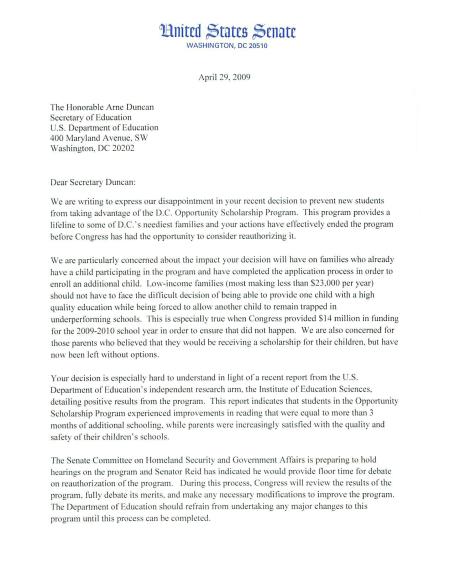
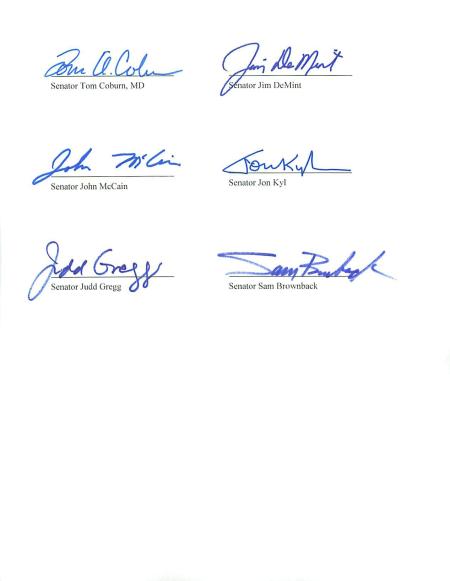
Bipartisan Senate Groups Asks Duncan to Reverse Good Friday Massacre

April 29, 2009

(Guest Post by Matthew Ladner)

duncan-letter2
duncan-letter-2
duncan-letter-31


“Forward” our Motto?

April 29, 2009

(Guest Post by Matthew Ladner)

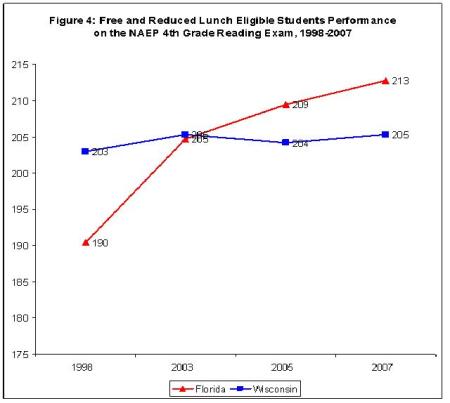
The MacIver Institute, Wisconsin’s new think-tank, released a report today by yours truly comparing the NAEP scores of Wisconsin and Florida. Let’s just say that UW-Madison would have probably fared better against the national champion Florida Gators in football last year.

wisconsin

Florida spends considerably less per student than Wisconsin and has a student profile considerably more challenging. Despite that fact, Florida surpassed Wisconsin overall on 4th grade reading (although within the margin of error) on 4th Grade Reading scores in 2007.

Most impressively, this gain was driven by much larger gains among traditionally underperforming student groups. The figure above shows the progress among Free and Reduced lunch kids in Florida and Wisconsin. In 1998, Florida’s low-income students were an average of 13 points behind their peers in Wisconsin. In 2007 however they had raced 8 points ahead.

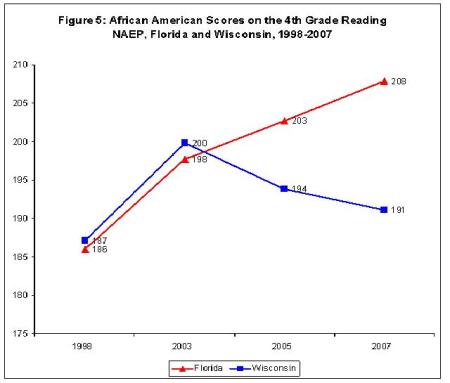
Among African American students, Florida and Wisconsin once shared space near the bottom in reading achievement. Wisconsin is still there. Florida’s African Americans students now outscore their peers in Wisconsin by 17 points.


wisconsin-african-americanOne finds the same pattern among children with disabilities. In 1998, Wisconsin students with disabilities scored 18 points higher than those in Florida. In 2007, it was 4 points lower.
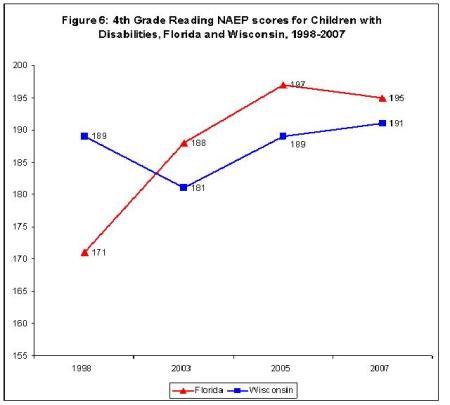
wisconsin-disabilities

The problem isn’t that Wisconsin’s scores are low, it is that they are flat.   When the Fordham Foundation found that Wisconsin had the lowest NCLB standards in the country it hinted that the state had not been vigorous in pursuit of broad K-12 reform.

Wisconsin of course was a trailblazer in parental choice with the Milwaukee Parental Choice Program. The learner has surpassed the master however with two statewide parental choice programs- one for low-income children, and one for children with disabilities. If anyone can explain why a low-income child in Milwaukee deserves an opportunity to attend a private school, but a similar child in Racine does not, I’d love to hear why. Florida also has a stronger charter school law.

Rather than sporting the lowest NCLB standards in the country, Florida doggedly pursued top-down accountability with the FCAT and grading schools A to F, and creating real consequences for school failure.

Florida embraced genuine alternative teacher certification, Wisconsin has not.

I am open to correction by my Cheesehead friends, but my distant view from the far-away desert leads me to wonder if Wisconsin may have become complacent when it comes to education reform. Coasting on their demographics, avoiding the tough calls and controversy necessary to improve public schools.

If so, perhaps inspiration can be drawn from the state song:

On, Wisconsin! On, Wisconsin!
Grand old Badger State!
We, thy loyal sons and daughters,
Hail thee, good and great.
On, Wisconsin! On, Wisconsin!
Champion of the right,
“Forward”, our motto,
God will give thee might!

Time will tell whether progressive Wisconsin will take this lying down. Will “Forward” or “comfortably stalled” be a better fitting motto for Wisconin in the next decade?