Updated Reporting on the Global Report Card

October 9, 2011

Coverage of the Global Report Card continues to roll in.  Here is a current list:

Global Report Card Results and Article

Education Next

Global Report Card Web Site

Methodological Appendix

Op-eds

Sacramento Bee

Hartford Courant

The Oklahoman

Austin American Statesman

Atlanta Journal Constitution

Interviews

Wall Street Journal (video)

Education Next (video)

Education Next (podcast)

Dallas Morning News (Q&A)

Choice Media.TV (video)

News

Dallas Morning News (subscription required, although a version can be read here)

Arkansas Democrat Gazette (subscription required)

Roll Call (article by Morton Kondracke)

Education Week

Yahoo News

Atlanta Journal Constitution

Time Magazine

KSN-TV

Richmond Times-Dispatch

United Press International

East Valley Tribune (Arizona)

TC Palm

Milwaukee Journal Sentinel

St. Pete Times

Maryland Gazette

Hawaii Reporter

Delaware News-Journal

Kansas Reporter

School Library Journal

My Fox DFW

Dallas Observer

Market Watch

Blogs

Education Next

Cato@Liberty

Joanne Jacobs

Mackinac Center

Illinois Rising

Ed is Watching 

Gotham Schools

Fordham’s Education Gadfly

Flypaper

Bacon’s Rebellion

The Locker Room

The Western Wrangler

Choice Remarks

TPE Post

Missouri Education Watchdog

Whiteboard Advisors

Jorge Werthein

The Caisson

School House Wonk

School Finance 101

Criticism

The last blog post contained some criticisms about whether the assumptions for the analysis were reasonable.  Josh McGee replied in the comment section of that post.  And NCES Commissioner, Jack Buckley, told Education Week that “The methodology in this report is highly questionable.”  This assessment is a little strange because what we did was similar to what the U.S. Department of Education has done in several past reports linking international test results to state NAEP results.  (See for example this.)  We just bring the results down to the district level.  If ours is highly questionable, then the U.S. Department of Education’s own efforts must also be questionable.

(UPDATED 12-19-11)


Steve Jobs on Education

October 6, 2011

Everyone is talking about Steve Jobs this morning.  The acknowledgement of how he improved the human condition while also making billions in profits for himself and others almost makes the Al Copeland Humanitarian Award unnecessary this year.  Steve Jobs embodied the entrepreneur as humanitarian — not because he gave away his wealth as if to cleanse himself of the sin of having earned it, but because he created and promoted consumer items that significantly improved our lives while justly generating enormous wealth for himself, his employees, and shareholders.

In addition to embodying the spirit of “The Al,” Jobs had quite a lot of smart things to say about education reform.  I’m grateful to Whitney Tilson for reminding me of this.  Here are some selected remarks from Steve Jobs on education:

[On Unions]

I’m a very big believer in equal opportunity as opposed to equal outcome. I don’t believe in equal outcome because unfortunately life’s not like that. It would be a pretty boring place if it was. But I really believe in equal opportunity. Equal opportunity to me more than anything means a great education. Maybe even more important than a great family life, but I don’t know how to do that. Nobody knows how to do that. But it pains me because we do know how to provide a great education. We really do. We could make sure that every young child in this country got a great education. We fallfar short of that…. The problem there of course is the unions. The unions are the worst thing that ever happened to education because it’s not a meritocracy. It turns into a bureaucracy, which is exactly what has happened. The teachers can’t teach and administrators run the place and nobody can be fired. It’s terrible.

[On Vouchers]

But in schools people don’t feel that they’re spending their own money. They feel like it’s free, right? No one does any comparison shopping. A matter of fact if you want to put your kid in a private school, you can’t take the forty-four hundred dollars a year out of the public school and use it, you have to come up with five or six thousand of your own money. I believe very strongly that if the country gave each parent a voucher for forty-four hundred dollars that they could only spend at any accredited school several things would happen. Number one schools would start marketing themselves like crazy to get students. Secondly, I think you’d see a lot of new schools starting. I’ve suggested as an example, if you go to Stanford Business School, they have a public policy track; they could start a school administrator track. You could get a bunch of people coming out of college tying up with someone out of the business school, they could be starting their own school. You could have twenty-five year old students out of college, very idealistic, full of energy instead of starting a Silicon Valley company, they’d start a school. I believe that they would do far better than any of our public schools would. The third thing you’d see is I believe, is the quality of schools again, just in a competitive marketplace, start to rise. Some of the schools would go broke. Alot of the public schools would go broke. There’s no question about it. It would be rather painful for the first several years

DM: But deservedly so.

SJ: But far less painful I think than the kids going through the system as it is right now.

[On Digital Learning]

The market competition model seems to indicate that where there is a need there is a lot of providers willing to tailor their products to fit that need and a lot of competition which forces them to get better and better. I used to think when I was in my twenties that technology was the solution to most of the world’s problems, but unfortunately it just ain’t so… We need to attack these things at the root, which is people and how much freedom we give people, the competition that will attract the best people. Unfortunately, there are side effects, like pushing out a lot of 46 year old teachers who lost their spirit fifteen years ago and shouldn’t be teaching anymore. I feel very strongly about this. I wish it was as simple as giving it over to the computer….

As you’ve pointed out I’ve helped with more computers in more schools than anybody else in the world and I absolutely convinced that is by no means the most important thing. The most important thing is a person. A person who incites your curiosity and feeds your curiosity; and machines cannot do that in the same way that people can. The elements of discovery are all around you. You don’t need a computer. Here – why does that fall? You know why? Nobody in the entire world knows why that falls. We can describe it pretty accurately but no one knows why. I don’t need a computer to get a kid interested in that, to spend a week playing with gravity and trying to understand that and come up with reasons why.

DM: But you do need a person.

SJ: You need a person. Especially with computers the way they are now. Computers are very reactive but they’re not proactive; they are not agents, if you will. They are very reactive. What children need is something more proactive. They need a guide. They don’t need an assistant. I think we have all the material in the world to solve this problem; it’s just being deployed in other places. I’ve been a very strong believer in that what we need to do in education is to go to the full voucher system. I know this isn’t what the interview was supposed to be about but it is what I care about a great deal.

(Source: Smithsonian Institution Oral and Video Histories)

The above interview was from 1995, but it is clear that Jobs did not significantly change his mind over time.  In 2007 he reiterated that unions and lifetime employment for teachers were at the heart of the problem.  This is from PC World:

During a joint appearance with Michael Dell that was sponsored by the Texas Public Education Reform Foundation, Jobs took on the unions by first comparing schools to small businesses, and school principals to CEOs. He then asked rhetorically: “What kind of person could you get to run a small business if you told them that when they came in, they couldn’t get rid of people that they thought weren’t any good? Not really great ones, because if you’re really smart, you go, ‘I can’t win.’ ”

He went on to say that “what is wrong with our schools in this nation is that they have become unionized in the worst possible way. This unionization and lifetime employment of K-12 teachers is off-the-charts crazy.”

After Steve Jobs made these comments I wrote an op-ed for the NY Sun, which stated:

There is a price to be paid for this kind of frank analysis and Steve Jobs knows it. “Apple just lost some business in this state, I’m sure,” Mr. Jobs said. Of course, Apple sells a large portion of its computers to public school systems. By taking a stance against school unionization, Mr. Jobs may lose some school sales for Apple.

Sharing the stage with Mr. Jobs was Michael Dell, the chief executive officer of Dell, a competing computer manufacturer. By comparison, according to the description of the event, Mr. Dell “sat quietly with his hands folded in his lap,” during Mr. Jobs’ speech while the audience at an education reform conference “applauded enthusiastically.”

Mr. Dell followed Mr. Jobs by defending the rise of unions in education: “the employer was treating his employees unfairly and that was not good. … So now you have these enterprises where they take good care of their people. The employees won, they do really well and succeed.”

Whether Mr. Jobs or Mr. Dell is right about the role unions have played in public education, one thing is perfectly clear – attacking the unions is a controversial and potentially costly choice for corporate CEOs.

The safe thing is to make bland declarations about the need to improve the quality of education without getting into any of the messy particulars that might be necessary to produce a better education. Changing the status quo in education almost certainly requires ruffling someone’s feathers, but doing that is almost certainly bad for business.

In part this is why we see highly successful entrepreneurs who survive in a world of ruthless competition abandon these business principles when they turn to education philanthropy. People who would never endorse the idea that businesses should be granted local monopolies, offer workers lifetime tenure, or pay employees based solely on seniority, embrace a status quo public system that has all of these features.

While some CEOs may sincerely believe that education is somehow different from the rest of the world in which they live, others have been cowed into submission. Teachers are a very large, well-organized, and relatively affluent consumer and political bloc….

Steve Jobs has embarked on a perilous path, but with solid evidence and persuasive arguments, he can move all of us toward higher quality schools. He should be applauded for having the courage to say out loud what scores of other business leaders are too sheepish to say.

Unfortunately, Steve Jobs will no longer be with us as we try to advance on this perilous path of education reform.


(Edited somewhat for brevity.  See Jobs’ full interview at Smithsonian Institution Oral and Video Histories)


Nominations Solicited for the 2011 Al Copeland Humanitarian Award

October 4, 2011

It is time once again for us to solicit nominations for the Al Copeland Humanitarian Award.  The criteria of the Al Copeland Humanitarian Award can be summarized by quoting our original blog post in which we sang the praises of Al Copeland and all that he did for humanity:

Al Copeland may not have done the most to benefit humanity, but he certainly did more than many people who receive such awards.  Chicago gave Bill Ayers their Citizen of the Year award in 1997.  And the Nobel Peace Prize has too often gone to a motley crew including unrepentant terrorist, Yassir Arafat, and fictional autobiography writer, Rigoberta Menchu.   Local humanitarian awards tend to go to hack politicians or community activists.  From all these award recipients you might think that a humanitarian was someone who stopped throwing bombs… or who you hoped would picket, tax, regulate, or imprison someone else.

Al Copeland never threatened to bomb, picket, tax, regulate, or imprison anyone.  By that standard alone he would be much more of a humanitarian.  But Al Copeland did even more — he gave us spicy chicken.”

Last year the winner of “The Al” was Wim Nottroth, the man who resisted Rotterdam police efforts to destroy a mural that read “Thou Shall Not Kill” following the murder of Theo van Gogh by an Islamic extremist.  He beat out  The Most Interesting Man in the World, the fictional spokesman for Dos Equis and model of masculine virtue, Stan Honey, the inventor of the yellow first down line in TV football broadcasts, Herbert Dow, the founder of Dow Chemical and subverter of a German chemicals cartel, and Marion Donovan and Victor Mills, the developers of the disposable diaper.

Another past winner of “The Al” was  Debrilla M. Ratchford, who significantly improved the human condition by inventing the rollerbag.  She beat out Steve Henson, who gave us ranch dressing,  Fasi Zaka, who ridiculed the Taliban,  Ralp Teetor, who invented cruise control, and Mary Quant, who popularized the miniskirt.

Nominations can be submitted by emailing a draft of a blog post advocating for your nominee.  If I like it, I will post it with your name attached.  Remember that the basic criteria is that we are looking for someone who significantly improved the human condition even if they made a profit in doing so.  Helping yourself does not nullify helping others.  And, like Al Copeland, nominees need not be perfect or widely recognized people.


Reporting on the Global Report Card

October 3, 2011

Coverage of the new Global Report Card (GRC) that Josh McGee and I developed is gaining steam.  The GRC allows users to compare student achievement in virtually every one of the nearly 14,000 school districts in the United States against the achievement in a set of 25 developed countries.

There are an endless number of interesting stories that could be told with this information, but the one that really stood out to us is that achievement in many of our affluent suburban public school districts barely keeps pace with that of the average student in a developed country.  People who flee from urban education ills thinking that their children will get a top world-class education in the suburbs may be disappointed.  The suburban education is usually better than in the city, but it would may not be preparing students to compete for top paying jobs in an a globalized jobs market.

Here is a current list of coverage:

Global Report Card Results and Article

Education Next

Global Report Card Web Site

Methodological Appendix

Op-eds

Sacramento Bee

Hartford Courant

The Oklahoman

Austin American Statesman

Atlanta Journal Constitution

Interviews

Wall Street Journal (video)

Education Next (video)

Education Next (podcast)

Dallas Morning News (Q&A)

Choice Media.TV (video)

News

Dallas Morning News (subscription required, although a version can be read here)

Arkansas Democrat Gazette (subscription required)

Roll Call (article by Morton Kondracke)

Education Week

Yahoo News

Atlanta Journal Constitution

Time Magazine

KSN-TV

Richmond Times-Dispatch

United Press International

East Valley Tribune (Arizona)

TC Palm

Milwaukee Journal Sentinel

St. Pete Times

Maryland Gazette

Hawaii Reporter

Delaware News-Journal

Kansas Reporter

School Library Journal

My Fox DFW

Dallas Observer

Market Watch

Blogs

Education Next

Cato@Liberty

Joanne Jacobs

Mackinac Center

Illinois Rising

Ed is Watching 

Gotham Schools

Fordham’s Education Gadfly

Flypaper

Bacon’s Rebellion

The Locker Room

The Western Wrangler

Choice Remarks

TPE Post

Missouri Education Watchdog

Whiteboard Advisors

Jorge Werthein

The Caisson

School House Wonk

School Finance 101

Criticism

The last blog post contained some criticisms about whether the assumptions for the analysis were reasonable.  Josh McGee replied in the comment section of that post.  And NCES Commissioner, Jack Buckley, told Education Week that “The methodology in this report is highly questionable.”  This assessment is a little strange because what we did was similar to what the U.S. Department of Education has done in several past reports linking international test results to state NAEP results.  (See for example this.)  We just bring the results down to the district level.  If ours is highly questionable, then the U.S. Department of Education’s own efforts must also be questionable.

(UPDATED 12-19-11)


It’s Not All About Poor Kids

September 27, 2011

Education reform has really focused on improving the quality of education for our most disadvantaged students.  This focus is not entirely without reason, since large, urban school districts serving low-income students are clearly dysfunctional.

But this nearly exclusive focus on improving the education of the poor has concealed the sub-par education being provided in many of our most affluent school districts.  As the new article Josh McGee and I wrote for Education Next shows, suburban public school districts may look good when compared against their urban neighbors, but when compared with students in 25 other developed countries many affluent suburbs barely keep pace.  That is, our best is often mediocre.

If the children of affluent suburbanites want to maintain their parents’ high standard of living, they need to be performing near the top relative to student overseas with whom they now have to compete for high-paying jobs in an increasingly globalized economy.  Doing better than the kids in big city school districts should provide suburbanites with little comfort.

But this is precisely the comparison we encourage suburbanites to make.  State accountability testing shows suburban districts doing better than the rest of the state, which consists largely of big urban districts.  Policymakers and reformers talk endlessly about the “achievement gap,” highlighting how much worse low-income and minority students are doing.  As Rick Hess recently noted, “our achievement gap mania” has stifled the innovation we need to improve education across the board.

It’s an old saying in public policy that “programs for the poor are poor programs.”  The same is true in education.  If we focus exclusively on improving the education in big cities we fail to engender the support education reform needs from suburban elites if it is to be successful.  As long as suburbanites think that education reform is something for those poor kids in large urban districts, they will never fully commit to the kind and scale of reform that is really needed to improve things in big cities as well as everywhere else.  They’re afraid to muck up what they think is a successful education system for their own children.

As our new Education Next piece shows, this suburban complacency is not well-founded.  Suburbanites need education reform for the sake of their own children and not just for the poor kids in the big cities.  If suburban elites commit to education reform for their own children,we may finally get improvement for low-income kids in the cities as well.

Student achievement in virtually every one of the nearly 14,000 public school districts in the United States compared to students overseas can be found at The Global Report Card’s interactive web site.  With the support of the George W. Bush Institute, we’ve been able to provide this information so that everyone can look up their own and other districts to see that the need for education reform is not confined to big cities.


Global Report Card Released Tomorrow

September 26, 2011

Keep your eyes out for tomorrow’s release of the Global Report Card.  This is a project conducted by Josh McGee and me in which we measure student achievement in virtually every school district in the U.S. against the performance of students in an international comparison group consisting of 25 developed countries. The project is sponsored by the George W. Bush Institute.

There will be an interactive web site containing all of the results.  And Josh and I have an article discussing some important findings from the Global Report Card that will go up on the Education Next web site tomorrow (www.educationnext.org ).

Also watch for Laura Bush on the Today Show tomorrow as part of NBC’s Education Nation .


My Testimony on National Standards before US House

September 21, 2011

As I mentioned yesterday, I testified before the US House Subcommittee on Early Education, Elementary, and Secondary Education.  Here is the written testimony I submitted:

Mr. Chairman, members of the committee, thank you for having me here to testify today.  My name is Jay P. Greene and I am the 21st Century Professor of Education Reform at the University of Arkansas.  I am also a fellow at the George W. Bush Institute located at Southern Methodist University.

I am here today to talk with you about how we can best achieve high standards and improve outcomes in education.  There is a large effort underway to change educational standards, curriculum, and assessments by centralizing the process.  This effort is based on the belief that we will get more rigorous standards and better student outcomes if standards, curriculum, and assessments are determined, or at least coordinated, at the national level.  It began with the use of Race to the Top to push states to adopt the Common Core standards, but will also require national curriculum and assessments to be fully implemented.

I believe this centralized approach is mistaken.  The best way to produce high academic standards and better student learning is by decentralizing the process of determining standards, curriculum, and assessments.  When we have choice and competition among different sets of standards, curricula, and assessments, they tend to improve in quality to better suit student needs and result in better outcomes.

One thing that should be understood with respect to nationalized approaches is that there is no evidence that countries that have nationalized systems get better results.  Advocates for nationalization will point to other countries, such as Singapore, with higher achievement that also have a nationalized system as proof that we should do the same.  But they fail to acknowledge that many countries that do worse than the United States on international tests also have nationalized systems.  Conversely, many of the countries that do better than the United States, such as Canada, Australia, and Belgium, have decentralized systems.  The research shows little or no relationship between nationalized approaches and student achievement.

In addition, there is no evidence that the Common Core standards are rigorous or will help produce better results.  The only evidence in support of Common Core consists of projects funded directly or indirectly by the Gates Foundation in which panels of selected experts are asked to offer their opinion on the quality of Common Core standards.  Not surprisingly, panels organized by the backers of Common Core believe that Common Core is good.  This is not research; this is just advocates of Common Core re-stating their support.  The few independent evaluations of Common Core that exist suggest that its standards are mediocre and represent little change from what most states already have.

If that’s true, what’s the harm in pursuing a nationalized approach?  First, nationalized approaches lack a mechanism for continual improvement.  Given how difficult it is to agree upon them, once we set national standards, curriculum, and assessments, they are nearly impossible to change.  If we discover a mistake or wish to try a new and possibly better approach, we can’t switch.  We are stuck with whatever national choices we make for a very long time.  And if we make a mistake we will impose it on the entire country.

Second, to the extent that there will be change in a nationalized system of standards, curriculum, and assessments, it will be directed by the most powerful organized interests in education, and probably not by reformers.  Making standards more rigorous and setting cut scores on assessments higher would show the education system in a more negative light, so teachers unions and other organized interests in education may attempt to steer the nationalized system in a less rigorous direction.  In general, it is unwise to build a national church if you are a minority religion.  Reformers should recognize that they are the political minority and should avoid building a nationalized system that the unions and other forces of the status quo will likely control.

Third, we are a large and diverse country.  Teaching everyone the same material at the same time and in the same way may work in small homogenous countries, like Finland, but it cannot work in the United States.  There is no single best way that would be appropriate for all students in all circumstances.

I do not mean to suggest that math is different in one place than it is in another, but the way in which we can best approach math, the age and sequence in which we introduce material, may vary significantly.  As a concrete example, California currently introduces algebra in 8th grade but Common Core calls for this to be done in 9th grade.  We don’t really know the best way for all students and it is dangerous to decide this at the national level and impose it on everyone.

I understand that there is great frustration with the weak standards, low cut-scores, and abysmal achievement in many states.  But this problem was not caused by a lack of centralization and cannot be fixed by nationalizing standards, curriculum, and assessments.  Instead, the solution to weak state results is to decentralize further so that we increase choice and competition in education.  If school systems have to earn students and the revenue they generate, they will gravitate toward more effective standards, curriculum, and assessments.

This decentralized system I am describing of choice and competition producing improvement is not purely theoretical.  It actually existed in the United States and helped build an education system that was the envy of the world.  Remember that public education was not created by the order of the national government.  Local communities built their own schools, set their own standards, devised their own curriculum, and evaluated their own efforts.  At one time there were nearly 100,000 local school districts operating almost entirely autonomously.

When people became convinced that students needed a secondary education, these districts started consolidating to be large enough to build high schools.  No one ordered them to consolidate and build high schools.  They did it because they recognized that people would be reluctant to move into their community unless it offered a secondary education.  That is, in our highly mobile society people had choices about where to live and communities had to compete for residents and tax base by offering an education system that people would want.  Standards were raised and outcomes improved through this decentralized system of choice and competition among local school districts.

The progress we were making in education, however, stalled when we started significantly centralizing education and reducing the extent of choice and competition among districts.  The policies, practices, and funding of schools has increasingly shifted to the state and national governments and greater uniformity has been imposed by unionization.  The enemy of high standards and improving outcomes is centralization.

We can see this same process of setting better standards through a decentralized system in other domains.  For example, in the video cassette industry there were competing standards: Betamax and VHS.  If we had simply imposed a national standard through the government or by a committee of experts, we almost certainly would have ended up with Betamax.  Sony, the producer of Betamax, was larger and more politically powerful than the consortium backing VHS.  And experts were enamored with the superior picture quality offered by Betamax.  But instead we had a decentralized system of determining the standard, where consumers could choose which standard they preferred rather than have it imposed by the government or a committee of experts.  As it turns out, consumers overwhelmingly preferred VHS.  It was cheaper and the tapes could play longer videos.  Consumers were willing to trade-off a reduction in picture quality for the ability to watch an entire movie without having to get up in the middle to change tapes.  Centralized standards-setters can’t know the best way and impose it on everyone.  It takes a decentralized system of choice and competition for us to learn about the better standard and gravitate toward it.

In addition, if Betamax had been imposed by a centralized authority, we almost certainly would have been stuck with that technology for a long time.  We would have stifled the innovation that produced DVDs and now Blu-Ray.  Choice and competition not only allows us to figure out the best standard for today, but leave open the possibility that new standards will be introduced that are even better and that consumers may prefer those in the future.

There is an unfortunate tendency in public policy to stifle this decentralized process of setting standards.  Policymakers are often tempted to identify the best approach, often through a panel of experts, and then impose that approach on everyone.  After all, if something is the best, why would we want to allow people to do something else?  This is a temptation I urge you to resist in education.  Even the best-intentioned experts have a hard time recognizing what the best approach would be.  And once it is set by experts, there is no mechanism like the one we get from choice and competition for improving upon that whatever “best” standards, curriculum, and assessments are identified.  Essentially, what we are talking about is the danger of central planning.  It doesn’t work in running the economy any more than it would in running our education system.

Fortunately, the nationalization effort is still in its early stages and there is time for Congress to exercise its authority and preserve a decentralized system for setting standards, curriculum, and assessments.  I should emphasize that the movement toward a nationalized system has not been voluntary on the part of the states.  It was coerced by the U.S. Department of Education as a condition for receiving Race to the Top funds and I fear that coercion may be continued with the offer of selective waivers from No Child Left Behind requirements.

I hope that you will help restore our decentralized system of setting standards, curriculum, and assessments, which is a far more effective way of producing progress in student learning.


Testimony on National Standards, Curriculum, and Assessments

September 20, 2011

I’ll be testifying tomorrow (Wednesday) at 10 am ET in front of the US House Subcommittee on Early Childhood, Elementary, and Secondary Education on national standards, curriculum, and assessments.  You can go to the Education and the Workforce Committee’s web site to watch it live-streaming.

I’ll post my written testimony later.


The Solyndra of Digital Learning

September 19, 2011

Education Secretary, Arne Duncan, and Netflix CEO, Reed Hasting, have an op-ed in today’s Wall Street Journal that starts out great but then goes dramatically downhill.  They begin by recognizing the amazing potential of digital learning:

In the past two decades, technology has revolutionized the way Americans communicate, get news, socialize and conduct business. But technology has yet to transform our classrooms. At its full potential, technology could personalize and accelerate instruction for students of all educational levels. And it could provide equitable access to a world-class education for millions of students stuck attending substandard schools in cities, remote rural regions, and tribal reservations.

But then they advocate for a federal government-backed corporation to realize digital learning’s potential:

Too often, the market for educational technology has been inefficient and fragmented. The nation’s 14,000 school districts, more than a few of which have byzantine procurement systems, have been inefficient consumers and have failed to drive consistent demand. And a robust R&D base for improving and refining educational technology has been sadly lacking.

To help remedy those gaps, the Department of Education is launching a unique public-private partnership called Digital Promise.

The last thing digital learning needs is a government funded outfit to develop it.  The government is particularly bad at picking technological winners and losers.  And if the government pours money into Digital Promise and signals to states and districts that they should adopt what Digital Promise endorses, they will stifle a developing vibrant marketplace that will experiment with different technologies and approaches to learn what work best.

If you don’t believe me that the government is particularly incapable of picking winners and losers in technology, just look at the example of Solyndra.  The government poured more than half a billion dollars of stimulus money into Solyndra’s technology for solar energy, believing that it would be the wave of the future.  As it turns out, they backed a more expensive technology that failed to win in the marketplace.  Solyndra recently declared bankruptcy, laying off more than 1,000 workers and blowing more than half a billion dollars of taxpayer money.

In addition to blowing taxpayer money by backing the wrong technology, Digital Promise is the digital learning equivalent of mandating Betamax.  If we privilege the wrong technology we will crowd out better solutions and productive innovation.

Giving taxpayer money to certain outfits also runs the risk of corruption, since political connections may well influence which company and technologies get backed.  This leads to Crony Capitalism, or crapitalism.

For the sake of digital learning, Mr. Secretary, please stop “helping” it with a government backed organization, like Digital Promise.

(Correction: Digital Promise is a Non-Profit Organization, but all the points still apply)


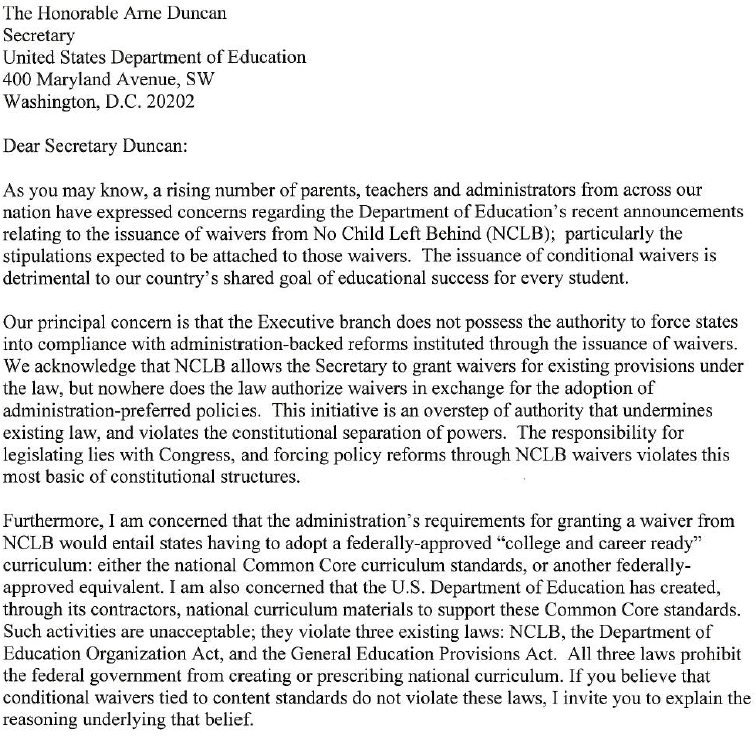
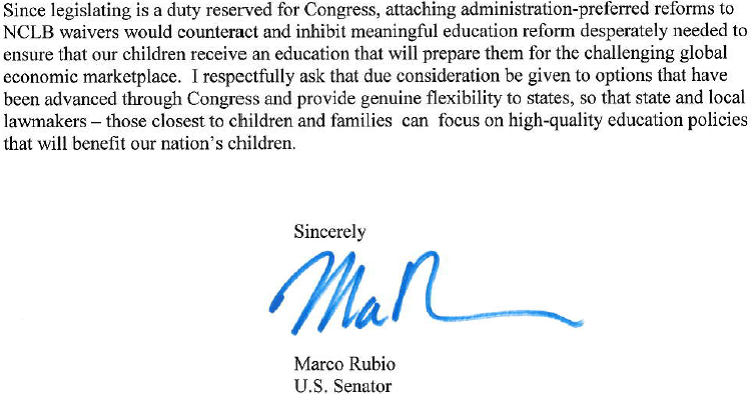
Sen. Rubio Letter to Sec. Duncan on National Standards

September 14, 2011