School Choice Researchers Unite in Ed Week

February 22, 2012

Pictured (L to R): Rick Hess, Jay Greene, Greg Forster, Mike Petrilli and Matt Ladner

(Guest post by Greg Forster)

Today, Education Week carries a joint editorial signed by nine scholars and analysists. We came together to agree that Mom and apple pie are good, Nazis and Commies are bad, and the empirical research supports the expansion of school choice:

Choice’s track record so far is promising and provides support for continuing expansion of school choice policies…Among voucher programs, random-assignment studies generally find modest improvements in reading or math scores, or both. Achievement gains are typically small in each year, but cumulative over time. Graduation rates have been studied less often, but the available evidence indicates a substantial positive impact. None of these studies has found a negative impact…Other research questions regarding voucher program participants have included student safety, parent satisfaction, racial integration, services for students with disabilities, and outcomes related to civic participation and values. Results from these studies are consistently positive…

In addition to effects on participating students, another major topic of research has been the impact of school choice on academic outcomes in the public school system…Among voucher programs, these studies consistently find that vouchers are associated with improved test scores in the affected public schools. The size of the effect in these studies varies from modest to large. No study has found a negative impact.

We have diverse viewpoints on many issues, but we share a common commitment to helping inform public decisions with such evidence as science is legitimately able to provide. We do not offer false certainty about a future none of us knows. But the early evidence is promising, and the grounds for concern have been shown to be largely baseless. The case for expanding our ongoing national experiment with school choice is strong.

This may well be the most important part:

The most important limitation on all of this evidence is that it only studies the programs we now have; it does not study the programs that we could have some day. Existing school choice programs are severely limited, providing educational options only to a targeted population of students, and those available options are highly constrained.

These limitations need to be taken seriously if policymakers wish to consider how these studies might inform their deliberations. The impact of current school choice programs does not exhaust the potential of school choice.

On the other hand, the goal of school choice should be not simply to move students from existing public schools into existing private schools, but to facilitate the emergence of new school entrants; i.e., entrepreneurs creating more effective solutions to educational challenges. This requires better-designed choice policies and the alignment of many other factors—such as human capital, private funding, and consumer-information sources—that extend beyond public policy. Public policy by itself will not fulfill the full potential of school choice.

Although I also feel particularly strongly about this:

Finally, we fear that political pressure is leading people on both sides of the issue to demand things from “science” that science is not, by its nature, able to provide. The temptation of technocracy—the idea that scientists can provide authoritative answers to public questions—is dangerous to democracy and science itself. Public debates should be based on norms, logic, and evidence drawn from beyond just the scientific sphere.

Signatories:

Kenneth Campbell is the president of the Black Alliance for Educational Options, in Washington.

Paul Diperna is the research director for the Friedman Foundation for Educational Choice, in Indianapolis.

Robert C. Enlow is the president and chief executive officer of the Friedman Foundation for Educational Choice.

Greg Forster is a senior fellow at the Friedman Foundation for Educational Choice.

Jay P. Greene is the department head and holder of the 21st-century endowed chair in education reform at the University of Arkansas, at Fayetteville, and a fellow in education policy at the George W. Bush Institute, in Dallas.

Frederick M. Hess is a resident scholar and the director of education policy studies at the American Enterprise Institute, in Washington, as well as a blogger for Education Week.

Matthew Ladner is a senior adviser for policy and research at the Foundation for Excellence in Education, in Tallahassee, Fla.

Michael J. Petrilli is the executive vice president of the Thomas B. Fordham Institute, in Washington.

Patrick J. Wolf is a professor and holder of the 21st-century endowed chair in school choice at the University of Arkansas, at Fayetteville.

Our color-coordinated mechanical lion battle chariots that join together into a giant robot are still under construction.

Defender of the empirical research universe!


Captain Hammer’s National Standards Will Save Us!

February 6, 2012

(Guest post by Greg Forster)

Michael Winerip had a doozy of a column over the weekend, exposing what look like some really seriously dumbed down state standards in New York. But don’t worry! Just like Captain Hammer, national standards are here to save us.

There’s no doubt Winerip has what looks like a pretty damning indictment of the NY English Regents exam. Here are some actual student responses that the state grading guide says should get middling or even higher scores:

  • These two Charater have very different mind Sets because they are creative in away that no one would imagen just put clay together and using leaves to create Art.
  • In the poem, the poets use of language was very depth into it.
  • Even though their is no physical conflict withen each other. Their are jealousy problems between each other that each one wish could have.
  • In life, “no two people regard the world in exactly the same way,” as J. W. von Goethe says. Everyone sees and reacts to things in different ways. Even though they may see the world in similar ways, no two people’s views will ever be exactly the same. This statement is true since everyone sees things through different viewpoints.

Bear in mind that these are not just examples pulled from student exams that actually got middling or higher scores. These are examples held up in the state scoring guide as examples of answers that should get middling or higher scores. In effect, the state is mandating low standards from the top.

But don’t worry!

They are also counting on a new set of national learning standards, known as the common core, which are currently being developed in more than 40 states. The hope is that more sophisticated standards detailing what children should know, coupled with more sophisticated curriculums and exams, will result in a more rigorous public education system.

“The D.O.E./Board of Regents position on the passing score for this exam, with attention to college and career readiness, will be re-examined in conjunction with administering a revised exam in this subject area aligned to the Common Core State Standards,” a spokesman for [New York State education commissioner] Dr. [John] King wrote.

Thank heaven! The exact same people who produced the current mandatory dumbing down are now going to produce a new set of standards. Surely that will result in a lifting of standards!


At Last, a Good Failing-Schools Voucher

February 1, 2012

(Guest post by Greg Forster)

Louisiana Governor Bobby Jindal is pushing a very ambitious education reform plan that includes a big failing-schools voucher. In general, I’m a skeptic of failing schools vouchers. This one, though, really has the potential to be transformative. It would still fall short of a universal voucher in important ways, of course, but it would fall a lot less short than previous failing schools vouchers.

The first failing schools voucher was Florida’s A+ program. It was a good program that created a lot of improvement in public schools in its first yeras. But few people appreciate what a nightmare it was on the administrative side, partly as an inevitable result of its failing-schools design, and partly because the state DOE took advantage of the opportunities that design created for mischief. That almost certainly contributed to the fall-off in its impact on public schools in later years.

I discussed these issues at length in my last study of the Florida program:

There were a number of unusual obstacles, not present in most voucher programs, that kept participation rates for A+ vouchers unusually low. A certain amount of this kind of diffi culty is inherent in the “failing schools” model of vouchers, where students’ eligibility for vouchers is determined by the academic performance of their public schools. Every year, a new set of parents need to be reached with the message of what vouchers are and that they are eligible for them; there can be no gradual building up of information about the program among a fi xed population that is always eligible. However, in the A+ program the worst obstacles were not inherent in the program design, but were imposed by the Florida Department of Education as part of its implementation…

School grades were (and still are) announced in the summer. The timing of the announcement does not follow a set schedule every year and thus is unpredictable. Once the state announced school grades, determining which schools were eligible for vouchers, parents had only two weeks to apply for the program. If they missed this fleeting application window, they could not apply later.

The extremely short two-week eligibility window was a major obstacle to participation. This difficulty was greatly compounded because parents did not know whether they were eligible until school grades came out, at which point the two-week clock began ticking. Moreover, parents did not even know when the announcement of the grades might be coming.

This combination of factors made it extremely difficult to keep parents informed. Nobody knew in advance of the application window which parents would be eligible, and nobody knew in advance when the announcement would come. And once the announcement came, there were only two weeks to get from a starting point of zero information to an ending point of parents submitting their applications for vouchers. Many—possibly even most—parents probably would not even have known that their children were eligible for the program until it was too late to apply.

Another disadvantage is the dynamic of media coverage, which is where most parents get their information about programs of this type, especially when there is no opportunity for a long-term building of knowledge in a fi xed population by word of mouth. When two schools were designated as eligible for vouchers in 1999-2000, naturally media attention focused on those two schools. This would have helped parents in those neighborhoods find out about the program. Or again, in 2002-03, when a substantial number of schools became eligible for vouchers after two straight years with no schools eligible, that was a big news story.

These two years are both instances of how a failing schools voucher program can create “shock value,” but thing about shock value is that it doesn’t stay shocking forever. In years after 2002-03, A+ vouchers were no longer the news story they were in that year. This would have made it less likely that parents would hear that they were eligible for vouchers…

These obstacles help explain why, as a previous analysis has found, the A+ voucher program is the only voucher program ever to see long-term declines in its participation rate…Since the A+ program is the only voucher program ever to see a long-term decline in participation rates, it is reasonable to attribute this decline to the unique obstacles to participation that were imposed on the program by the Florida Department of Education.

Then there’s the Ohio EdChoice program, which, like Florida’s A+, only serves a small population of schools and has a positive impact on public school performance but a modest one.

The Jindal plan, by contrast, would give a voucher to all students below a certain income in schools that get a C, D or F. That adds up to almost 400,000 eligible students, over half the state population. While changing eligibility from year to year would still be present, it would be greatly mitigated both by the lower performance bar for school eligibility (schools that change grades within the A-B range or C-F range won’t change eligibility) and also by the large amount of attention generated by such a large eligibility pool. When more than half the state’s students are eligible for choice, people will know that choice exists!

I continue to think that only universal choice will really get education out of the rut it’s in. But this would be a huge step in that direction.


Friedman Foundation Releases 2012 ABCs

January 24, 2012

HT Brandon Peat Design

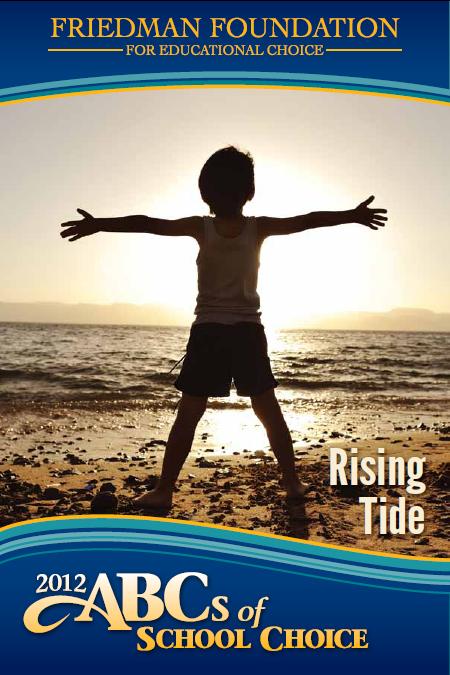
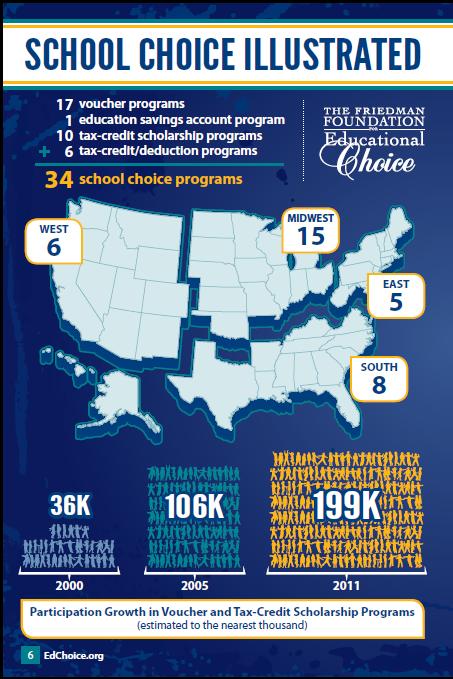
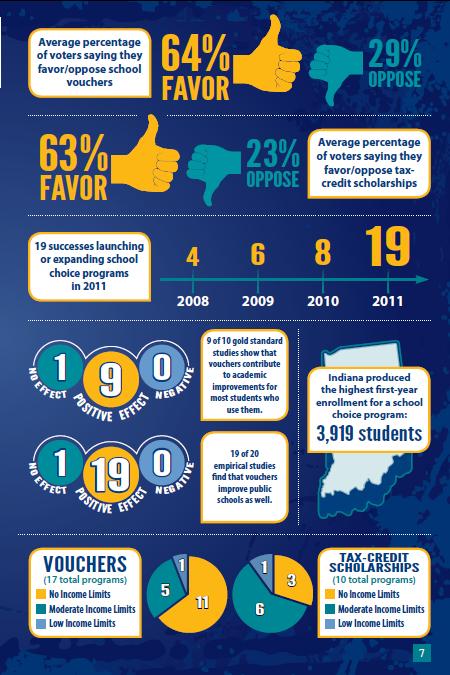
The Friedman Foundation has just released the 2012 edition of its annual publication ABCs of School Choice. It’s a busy week for releases!

There’s much to celebrate this year:

Milton and Rose D. Friedman envisioned a true revolution in American education. Their ideal was simple but powerful: give every parent the power and freedom to choose their children’s education. Unquestionably, 2011 was a breakthrough year in the quest to see that vision achieved in the United States. Thirteen states enacted school choice programs (this includes Washington, D.C., and Douglas County, Colorado). A total of 19 programs were enacted or improved—including the creation of eight new programs and the expansion of 11 existing ones.

Appropriately, this year’s report is subtitled Rising Tide. Check it out!

That’s a pretty big improvement over the plain text and little silhouettes of states it used to consist of when I edited it. Kudos!


School Choice on Learning Matters TV

January 19, 2012

(Guest post by Greg Forster)

And now, for a change of pace, JPGB is proud to present a post that doesn’t need to be shipped in a plain brown wrapper.

Learning Matters TV just posted an online forum on school choice, building on a segment they did for PBS NewsHour back in November. Eight experts got to lay down 300 words each on school choice. Your humble servant makes an appearance, as well as perennial school choice faves Andrew and Clint, plus Jay’s U.Ark. colleague Mike McShane.

I feel cleaner already.

Our new sponsor!

The Value-Add Map Is Not the Teaching Territory, But You’ll Still Get Lost without It

January 11, 2012

(Guest post by Greg Forster)

Since we’re so deep into the subject of value-added testing and the political pressures surrounding it, I thought I’d point out this recently published study tracking two and a half million students from a major urban district all the way to adulthood. (HT Whitney Tilson)

They compare teacher-specific value added on math and English scores with eventual life outcomes, and apply tests to determine whether the results are biased either by student sorting on observable variables (the life outcomes of their parents, obtained from the same life-outcome data) or unobserved variables (they use teacher switches to create a quasi-experimental approach).

Finding?

Students assigned to high-VA teachers [i.e. teachers who produce high “value added” on test scores] are more likely to attend college, attend higher- ranked colleges, earn higher salaries, live in higher SES neighborhoods, and save more for retirement. They are also less likely to have children as teenagers. Teachers have large impacts in all grades from 4 to 8.

Let’s bring that down to reality:

Replacing a teacher whose VA is in the bottom 5% with an average teacher would increase students’ lifetime income by more than $250,000 for the average classroom in our sample.

But here’s what I want to pay the most attention to. Note the careful wording of the conclusion:

We conclude that good teachers create substantial economic value and that test score impacts are helpful in identifying such teachers.

Note what they don’t say. They don’t say that increasing math and English test scores by itself leads to improved life outcomes. They say good teachers lead to improved life outcomes, and value-add is one relatively good way to identify good teachers.

You’ve heard the saying that the map is not the territory? (If not, that means you haven’t seen Ronin, in which case shame on you.) Well, it’s true. What raises life outcomes is good teaching, and good teaching can’t be reduced to test scores. (See here, here, here, here, here, here, here and here.)

But if you want to find your way around the territory, you need a map. If you want to help those kids stuck with lousy teachers who are out a quarter million, you’re going to need a tool that identifies them. Value added analysis is the best tool we’ve come up with yet – other than parental choice, of course.

And where the tests are freely selected and voluntarily adopted by schools, the tests provide helpful data for parents, so parent choice is strengthened by voluntary testing. That’s why over 90% of private schools use testing in some form. On the other hand, forcing teachers to use a test they don’t believe in is a self-defeating proposal.

But how do you get schools to want to use a test? Parent choice, of course! Choice is what creates the external standard of performance that makes assessment tools seem legitimate rather than illegitimate. So testing and choice are like chocholate and peanut butter – they’re two great tastes that taste great together.


Vaclav Havel, Hero of Freedom

December 19, 2011

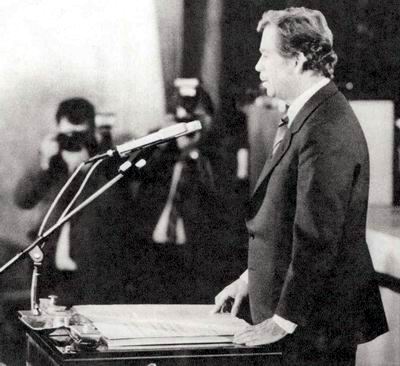
Sworn in as president of Czechoslovakia

(Guest post by Greg Forster)

It’s a busy couple days for death posts. Vaclav Havel is dead at 75.

I’ve already written my tribute to this hero of freedom – and what education reformers can learn from him – here.

If you want a great laugh and also a poinient deconstruction of the absurdity of trying to rule people by force, do yourself a huge favor and read The Memorandum. (Bonus: It’s short!)

Update: A few more links here.


Choice Is Not Chaos

December 14, 2011

(Guest post by Greg Forster)

Commenters on Jay’s outstanding post seem to be under the impression that the only alternative to national standards is chaos. If the national government doesn’t impose standards, there will be no standards at all. I think this is really what lies behind a lot of people’s support for that policy.

But, as we’ve discussed at some length here on JPGB, there are two ways to create order. One is to impose an order by raw power. The other is to allow people to organize their own orders around what they think works best (within just boundaries – your order isn’t allowed to include killing me, for example). Some forms of order need to be imposed – theives need to be locked up, not permitted to construct an alternative theiving order.

But content standards ought to follow the choice model. Currently, schools can’t create any kind of order or standards because they have to accomodate a great number of contituencies who don’t choose to be there. If every school were a school of choice, each school would have not only the freedom, but also the social support, to organize around a clear standard and impose it in every classroom. All the constituencies would be aligned.

Different schools would select different standards, of course. But that is not chaos. That is what ordered freedom looks like. The pretense that there is one clearly correct best approach to education, such that any deviation is illegitimate, looks a lot like religious fundamentalism – and that’s because it is religious fundamentalism. And it has the same dangerous tendency toward political authoriarianism that religious fundamentalism often creates.

To revisit an old post:

People need to be persuaded to adopt reform as part of their truth – something they experience as legitimate, necessary, and empowering.

“But wait!” I hear you cry. “That’s what we’ve been trying for decades, and it hasn’t worked!”

That’s right, so let’s ask why it hasn’t worked. I mean, isn’t it a little odd that 1) the system is so overwhelmingly dysfunctional that it’s destroying millions of children’s lives, 2) the people in the system are normal people, not psychotic or anything, people who by all accounts care about children’s education at least as much as the average person if not, you know, a lot more, and yet 3) the people in the system can’t be brought by any means to see reform as necessary?

What is it about the system as currently constituted that ensures reform is never embraced as something legitimate, necessary and empowering?

The system is moribund because it is a monopoly. When any institution has a captive client base, support for innovation vanishes. Reform requires people and institutions to do uncomfortable new things. Thus it won’t happen unless people are even more uncomfortable with the status quo than they are with change. So we need institutional structures that make the need for change seem plausible and legitimate. A captive client base ensures that such structures never emerge. An urgent need for change never seems really plausibile. An institution with captive clients can – or at least it will always feel like it can – continue to function, more or less as it always has, indefinitely. So why change, when change is uncomfortable, even painful?

This is why even small reforms that seem like they would be easy to implement have consistently failed to scale, and the attempt to impose such reforms through national command structures will fail even more spectacularly. Institutional culture in the existing system is hostile not just to this or that reform, but to reform as such, because it excludes the only institutional basis for making the need for change seem plausible and legitimate: the prospect of losing the client base.

This is what school choice advocates are talking about when they talk about the value of competition. “Competition” does not mean a cutthroat, ethics-free environment where individuals and institutions seek their own good at the expense of the good of others. Rather, competition is the life-giving force that drives institutions to become their best and continuously innovate, because it is the only way to hold institutions accountable for performance in a way that is both productive (because it aligns the measurement of institutional performance with people’s needs) and humane (because it creates accountability in a decentralized way rather than through a command-and-control power structure)…

This is the most important reason school choice has consistently improved educational outcomes for both the students who use it and for students in public schools. Studies of school choice programs consistently find that students using choice have better outcomes, and also that public schools improve in response to the presence of school choice. The explanation is simple: school choice puts parents back in charge of education, freeing the captive client base and creating an institutional environment in schools that makes the need for change seem plausible and legitimate.

Educators experience the urgency of the need for change when families not being served can leave for other schools – and they will never experience it any other way. Discomfort with change is also reduced for parents, because school choice restores their control over their children’s education.

HT People vs State


The Feds and Data

December 6, 2011


Look out! The feds have come to collect you!

(Guest post by Greg Forster)

 Today’s NYT features an op-ed by stand-up guy Rick Hess and pathetically failed charter school founder Linda Darling-Hammond, bemoaning federal micromanagement of schools and also suggesting four things the federal government should be doing in education. Neal replies with a step-by-step critique of the four suggestions. I’m with Neal on most of the issues, but I think Neal underestimates the legitimacy and usefulness of federal data collection.

Neal is correct that much of what Hess and Darling-Hammond ask for under the rubric of “transparency” is unrealistic. But he also writes: “There is precious little evidence Washington can force real transparency. NCLB is exhibit A.” However, he only goes on to discuss the AYP reports. NCLB also required, for the first time, every state to administer the NAEP. That was a huge transformative change. All those state-by-state comparisons everyone has been doing for the last decade, which pop up ubiquitously in education dialogue and have created a lot of real pressure for reform, come directly out of NCLB’s requirement that every state do NAEP.

Neal himself, in the same post, cites a national analysis of NAEP data to argue that NCLB hasn’t lifted scores. I agree! But it was only NCLB’s requirement that every state do NAEP that allowed Neal, myself, and others to know that.

Neal and I have already tangoed on the federalism question enough times before. Short version: I’d prefer to get the feds completely out of education, but since we can’t have that, I’m content to have them ask for basic data collection in return for the funding rather than have them not ask.

Neal is also largely right on the second point in the Hess/Darling-Hammond article; test score disparities shouldn’t be made into civil rights cases. But there are other, more legitimate ways to get at federal civil rights issues. For example, I believe that special education systems that systematically create false diagnoses are a legitimate federal civil rights issue, and if the feds were interested it would be relatively straightforward to create simple auditing systems that would discourage these abuses.

And on the last two items, Neal is bang on. Except insofar as data collection counts as research (see above), government shouldn’t fund studies. It should fund . . . data collection that allows the rest of us to do studies! And the whole competitive grant thing – well, setting up Arne Duncan, Suuuuuuuuuuuuper Geeeeeeeeeeeeenius as a one-man national legislature is just not good mojo.


True to Her Traditions – At Last

November 11, 2011

(Guest post by Greg Forster)

On Veterans Day two years ago I posted a sharp condemnation of my grad school for its contempt of the military, even in defiance of its own traditions. In the comments, I made a promise that I would be prepared to post something more cheerful for Veterans Day “when the Ivies quit spitting on the people who fight and die to preserve their right to spit on them.”

Yale is bringing back ROTC, along with Harvard and Columbia. Princeton refuses to budge. Brown is still considering its position. Cornell, Dartmouth and Penn had already brought it back before this year.

I’m not sure at what point my stated obligation to “post warm fuzzies about mom and apple pie” kicks in, and I’ll admit that I don’t think the series of events leading up to these developments generally augers well for civil/military relations. But that war is over and now is a time for reconciliation. Six of the eight Ivies now offer military training within their for-credit educational curricula. That is progress.