Conspiracy Theory Time!

October 2, 2012

(Guest post by Greg Forster)

Check out this delicious teacher-blogospheric reaction to Bill Moyers’ new ALEC story:

The education stuff starts at around the 14 minute mark, with the main example being the overthrow public education in Tennessee by a virtual school operator.

What I’ve been too lazy to determine on my own is this: is our new unelected state charter school authority based on an ALEC template? Or is that something that came out of Race to the Top? Or is there even a difference?

ALEC, President Obama’s Education Department – what’s the difference?

Not that there aren’t some real conspiracies. Thankfully, they tend to fail due to their internal contradictions and inability to control their own actors. But these people live in a world where literally everyone is out to get them and there are no other agendas besides teachers versus the world. Wonder how that mindset gets cultivated?


Mahatma Kozol Takes Cash Only

September 26, 2012

(Guest post by Greg Forster)

Over the email transom from George Mitchell comes a publicity item for Jonathan Kozol’s latest weeper. Here’s the part that really stood out to me:

We should let folks know there are signing restrictions for this event. Mr. Kozol will only personalize copies of Fire in the Ashes, and will only sign the most recent editions of four of his backlist titles that are purchased at the event.

What a selfless and noble tribune of generosity! What a titanic warrior against the greed of capitalism!

For my money (if Kozol will pardon the expression) nobody’s ever managed to top Tucker Carlson’s 1995 classic “Jonathan Kozol’s Crying Game.” One of the best things WS published even back in its glory days.

PS “Mahatma Kozol” courtesy of the Fordham Institute, during Kozol’s ridiculous “partial fast” in 2007. The image seems to have disappeared from Fordham’s site but it lives on at Alexander Russo’s blog.


Paging Mr. Nottroth, Mr. Wim Nottroth…

September 5, 2012

(Guest post by Greg Forster)

I think the JPGB post I’m most proud of is my nomination of Wim Nottroth for the Al Copeland award. I was deeply honored, of course, to have my nominee go on to win “the Al.” But I was even more honored to help more people learn about Nottroth and what he did for all of us.

Readers interested in similar threats to liberty may have been following the case now pending in Germany, where a rabbi is under criminal investigation for the “offense” of circumcising children. For those who are interested, over on the new group blog I edit called Hang Together, I offer four lessons Americans can learn from the German circumcision case as we wrestle with our own struggles on religious freedom.


Charters v. Private Schools: Urban and Suburban Differences

August 28, 2012

(Guest post by Greg Forster)

Cato has new research out from Richard Buddin, examining where charter schools draw their students from. Adam Schaeffer offers a summary, emphasizing the dangers of charter schools: “On average, charter schools may marginally improve the public education system, but in the process they are wreaking havoc on private education.”

I agree with the basic premise: charters don’t fix the underlying injustice of government monopolizing education by providing “free” (i.e. free at the point of service, paid for by taxpayers) education, driving everyone else out of the education sector. As Jay and I have argued before, vouchers make the world safe for charters; that implies you can view charters as a response by the government to protect its monopoly against the disruptive threat of voucher legislation.

But what interests me more are the urban/suburban and elementary/secondary breakdowns of these data. It appears that charters are only substantially cutting into private schools in “highly urban” areas. In the suburbs, the charter school option is framed much more in terms of boutique specialty alternatives (schools for the arts, classical education, etc.) rather than “your school sucks, here’s one that works.” If you’d asked me, I would have guessed that would also cut heavily into the private school market – it would appeal to parents of high means who are looking for something out of the ordinary for their children, and that demographic would be most likely to already be in private schools. Yet the data show otherwise; apparently the families choosing boutique suburban charters weren’t much impressed with their private school options. And what’s up with this weird distribution on the elementary/secondary axis? Apparently public middle schools really stink in urban/suburban border areas.

Discuss!


Blinding Us with Science

August 15, 2012

(Guest post by Greg Forster)

Jay’s proposed reforms to the way Gates handles science are relevant far beyond the Gates Foundation, and foundations generally. He’s helping us think about how to wrestle with a deeper problem.

Public policy arguments need an authority to which they can appeal. The percentage of the population that is both willing and able to absorb all the necessary information to make a responsible decision without relying on pretty sweeping appeals to authority is very small. And even for us wonks, you can’t reduce the role of authority to zero; life doesn’t work that way. (Economists call this “the information problem.”)

So it’s normal, natural and right for public policy arguments to make some appeals to authority. The problem is that increasingly, our culture has no widely recognized authorities other than science. When there are many potential loci of authority, there is less pressure to corrupt them. If the science doesn’t back your view, you can appeal to other sources of authority. Where there is only one authoritative platform, there’s no alternative but to seize it.

As I once wrote:

Say that you favor a given approach – in education, in politics, in culture – because it is best suited to the nature of the human person, or because it best embodies the principles and historic self-understanding of the American people, and you will struggle even to get a hearing. But if you say that “the science” supports your view, the world will fall at your feet.

Of course, this means powerful interest groups rush in to seize hold of “science,” to trumpet whatever suits their preferences, downplay its limitations, and delegitimize any contrary evidence. If they succeed – which they don’t always, but they do often enough – “the science” quickly ceasees to be science at all. That’s why “scientific” tyrannies like the Soviet Union had to put so many real scientists in jail – or in the ground.

We need other sources of wisdom and knowledge – and hence of authority, because those who are recognized as having wisdom and knowledge will be treated as sources of authority – besides science. As Jay has written:

Science has its limits.  Science cannot adjudicate among the competing values that might attract us to one educational approach over another.  Science usually tells us about outcomes for the typical or average student and cannot easily tell us about what is most effective for individual students with diverse needs.  Science is slow and uncertain, while policy and practice decisions have to be made right now whether a consensus of scientific evidence exists or not.  We should rely on science when we can but we also need to be humble about what science can and can’t address…

My fear is that the researchers, their foundation-backers, and most-importantly, the policymaker and educator consumers of the research are insensitive to these limitations of science.  I fear that the project will identify the “right” way to teach and then it will be used to enforce that right way on everyone, even though it is highly likely that there are different “right” ways for different kids…

Science can be corrupted so that it simply becomes a shield disguising the policy preferences of those in authority.  How many times have you heard a school official justify a particular policy by saying that it is supported by research when in fact no such research exists?  This (mis)use of science is a way for authority figures to tell their critics, “shut up!”

To summarize the whole point, our group of school choice researchers put it well (false humility aside) in our Education Week op-ed earlier this year:

Finally, we fear that political pressure is leading people on both sides of the issue to demand things from “science” that science is not, by its nature, able to provide. The temptation of technocracy—the idea that scientists can provide authoritative answers to public questions—is dangerous to democracy and science itself. Public debates should be based on norms, logic, and evidence drawn from beyond just the scientific sphere.

What can we do about it? Beyond building in checks and balances to ensure that science isn’t being abused, we can make a deliberate effort to appeal to non-scientific sources of wisdom. There’s nothing unscientific about relying on “norms, logic, and evidence drawn from beyond just the scientific sphere.” In Pride and Prejudice, Caroline Bingley comments that it would be more rational if there were more conversation and less dancing at balls; her brother comments that this would indeed be “much more rational, I dare say, but much less like a ball.” It might be more scientific if our civic discourse appeals to nothing but science, but it’s much less like civic discourse.

For a good example of what I mean, check out Freedom and School Choice in American Education. When it came out, I commented on how it showed the diverse values that had led the authors to support school choice:

What’s particularly valuable about this book, I think, is how it gives expression to the very different paths by which people come to hold educational freedom as an aspiration, and then connects those aspirational paths to the practical issues that face the movement in the short term. Jay comes to educational freedom with an emphasis on accountability and control; against the Amy Gutmanns of the world who want to set up educational professionals as authority figures to whom parents must defer, Jay wants to put parents back in charge of education. Matt comes to educational freedom with an emphasis on alleviating unjustified inequalities; against the aristocrats and social Darwinists of the world who aren’t bothered by the existence of unjustified inequalities, Matt wants social systems to maximize the growth of opportunities for those least likely to have access to them. And I come to educational freedom with an emphasis on the historical process of expanding human capacities, especially as embodied in America’s entrepreneurial culture; agaisnt all forms of complacency, I want America to continue leading the world in inventing ever better ways of flourishing the full capacities of humanity. And each of the other contributors has his or her own aspirational path.

Individual liberty; the lifting up of the poor and the marginalized; the American experiment in enterprise culture. These are fine things worth fighting for, and they would remain so no matter what the science says.


School Choice and Religious Freedom

August 8, 2012

(Guest post by Greg Forster)

An “interfaith” group has send a hyperventilating letter to Bobby Jindal calling Louisiana’s new school voucher program “a blatant attack on the religious freedom clauses in the United States Constitution.” And that’s one of the less painfully overwrought passages. There’s no hope of getting sound legal, moral, theological or sociological reasoning from such people, but I thought I’d take the occasion to revisit some of the reasons why school choice is a vital step forward, not backward, for religious freedom.

1) Fair play, the rule of law and equal treatment. Religious freedom requires that religious people and institutions be treated the same way everyone else is treated. I would think this would be so obvious as to be axiomatic. Yet everywhere you turn around, people think that if religious schools participate in the American education system on the same terms as other schools – which is really all school choice does – that is somehow a threat to religious freedom. What if we applied this reasoning to other sectors? If the church is burning down, don’t call the fire department! If someone sprays swastikas on the synagogue, don’t call the police! Don’t hook up the mosque to the municipal water lines! That would be a taxpayer subsidy for religion, you know.

2) Childrearing, formation and faith communities. As many people know, one of the most important Supreme Court decisions on religious freedom upheld the right of the Amish to raise their children according to Amish tradition against compulsory attendance laws. The details of the reasoning that the court used to reach that conclusion are problematic, but we don’t need to be detained by that here; the result was clearly right. A religion is not just a set of intellectual propositions one assents to. It is a total way of life, one that may be expressed differently in different individuals, but also coheres in important ways across individuals, and subsists in relationships and institutions as well as in individuals. In other words, a religion consists not only of individual belief but of a faith community. The formation and rearing of children is a necessary part of that; deny people the ability to raise their children according to the dictates of their conscience and you stamp out religious freedom. You can like this fact or hate it, but it remains a fact. As the court noted, society has a legitimate mandate to see to it that children are educated in some way, but this must not become an occasion for stamping out religious minorities whose mode of education is different. Requiring the Amish to raise their children the same way others do is not just tantamount to outlawing the Amish religion; it actually is outlawing the Amish religion. School choice extends this principle further by making American society a place where every family, not just families who prefer secular schools, has equal access to childrearing according to conscience.

3) The death of character in the common school. Pat Wolf has shown that the empirical evidence consistently finds private schools are better at teaching the civic values on which democracy rests. Charles Glenn, James Davison Hunter and others have shown why. The “common school” model, coralling families of all faiths into one school and requiring that school not to violate the religious beliefs of any of those families, compels schools to become morally neutered. Even where they try to teach moral character, they fail (Hunter has extensive data on this). The reason is simple: the inculcation of moral character requires more than scolding children to be honest, be diligent, etc. Telling edifying stories also fails. Not in every case, but in general, the reliable formation of moral character requires (Hunter again) attachment to something higher and greater than oneself, and the absorbtion at an early age of an intrinsic motivation to prioritize that higher something over the gratification of one’s own desires.

There’s much more to be said, of course, but I didn’t want to let the moment pass without at least this much of a statement of the case.


Double Standards on Special Ed Placements v. Vouchers

July 25, 2012

(Guest post by Greg Forster)

In today’s Examiner, AEI’s Michael McShane (an official JPGB super best friend) wants to know why none of the people fighting to kill the DC voucher program seem to have any objections to DC’s high rate of outplacement for special education students. Could it be because there are a lot more rich white special ed parents? McShane is here to chew gum and kick the cans of edu-hypocrites, and he’s all out of gum.

McShane doesn’t make the mistakes others have made in characterizing DC’s high rate of outplacement. Still, the stats are eye-popping, and will no doubt have many readers asking questions. McShane really doesn’t have the opportunity in a short piece like this to provide the necessary background. Thankfully, Jay wrote this a while back to bring people up to speed.


Random Pop Nationalization

July 13, 2012

“Don’t support national standards? Here is a pair of clown shoes to wear!”

(Guest post by Greg Forster)

NRO is on fire this morning. An awesome appreciation of the classic G.I. Joe series from Loren Smith (“When I get my hands on those Red October whackos, I’ll make ’em wish Karl Marx was Groucho’s brother!”) and a call to arms from Sally Lovejoy on how the Obama administration has made a lot of progress toward nationalizing education (“With the approval of two more state waivers of the NCLB Act, over half the states (26) have exchanged one set of federal mandates for another, moving us closer to a nationalized educational system.”).

Coincidence? Son, when COBRA is involved, there are no coincidences.

NOW YOU KNOW! And…

HT


The Ultimate Debate!

June 27, 2012

(Guest post by Greg Forster)

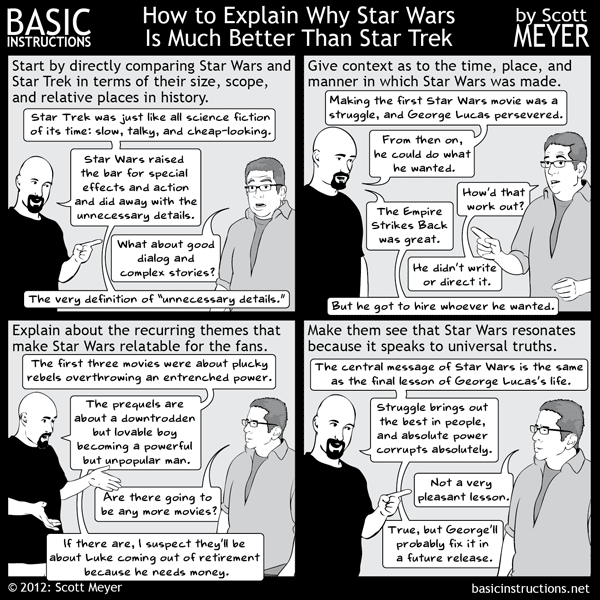
Old and Tired: Star Wars versus Star Trek – which is better?

New and Fascinating: Greg Forster versus Rich Vedder – whose evisceration of the student aid regime is more devastating?

I vote for Rich. The constraints of the WSJ debate required me to address a more narrow set of questions. Rich has marshalled a more comprehensive takedown in the new Imprimis. It’s your one stop shop for everything that’s dysfunctional and destructive about the student aid regime.

HT Basic Instructions, my favorite webcomic – see more legible versions of these comics here and here!


Pass the Popcorn: The Movie for Our Time

June 21, 2012

(Guest post by Greg Forster)

Thrice armed is he that hath his quarrel just;

And he but naked, though locked in steel,

Whose conscience is with injustice corrupted.

                                            Shakespeare’s Henry VI

You lack conviction.

                                                            Agent Coulson

Finally! I finally saw the Avengers tonight.

Greatest superhero movie ever made – yes or no? It’s a tie. Or it’s apples and oranges. This is a movie that can stand next to The Dark Knight without shame, yet the two are doing completely different things. Nolan’s Dark Knight is a movie for all times and places, becausee it’s about the struggle between good and evil in every human heart and in every human city. Whedon’s Avengers is a movie very much for our time and place specifically.

Obviously, spoilers lie in wait for you ahead!

The theme of “war” is invoked repeatedly in this movie. Where Nolan’s movie was about the struggle within hearts and within communities, this movie is about a struggle between communities – in other words, a war. Not America versus the aliens, but one America versus the other.

Yes, the culture war. But perhaps not in the way you might think.

It’s obvious that the three characters who matter in this movie are Steve Rogers, Tony Stark and Bruce Banner. Before we look at them, let’s look at why they’re the ones that mattter.

Politics wears two faces. Politics is power, and politics is justice. The great first question of political philosophy throughout the ages, the question that determines how you answer all the other questions, has been which of these is primary. Throughout history, a small minority of cynics – Thrascymacus, Machiavelli, Hobbes, Hume, Marx, Nietzsche – has said that power is primary.  Over against the cynics, the large majority of political philosophers and the nearly unanimous voice of humanity at large has insisted that justice is primary.

The other characters in this movie are about power. Thor is a warrior, obviously a man of power. Nick Fury and the Black Widow are mainly good at manipulating people, which is another form of power. And Hawkeye isn’t even a character, he’s a plot device. Smart move – nobody was ever going to care about him as a character, so Whedon didn’t even try to make him into one. They might just as well have changed his name to Agent MacGuffin.

You might have expected Thor to be about more than power because he’s a god. This is a trick of the historical lighting. From our privileged perspective as children of the mature religions, we expect that all supernatural beliefs involve a moral element. But the pagan gods were never really divine. They were just projections of ourselves, with all our flaws and our humanity, into the cosmic forces of the unseen universe. That’s exactly why they vanished from history as religion matured. You can read all about this in Plato, or in Chesterton. All pagan gods are “puny gods.”

There’s no indictment in saying these characters represent politics as power. They’re not amoral – even Black Widow has an ethic. Yet none of them is really bringing a robust vision of justice to the team. That’s why they’re not the ones who ultimately determine the fate of the world.

Steve Rogers has a vision of justice. He might seem to be about power rather than justice because he’s fighting for America. Yet his interest in America clearly has nothing to do with the structures of American power. That’s why he has no difficulty turning against Nick Fury and the Council. What he’s loyal to isn’t any particular manifestation of America, but the ideas of justice to which America is committed and which America represents. Steve Rogers has an integrity that transitions seamlessly from obeying the Council to resisting it, because the Council is not the America to which he is loyal. Because of this, his commitment to justice can’t be subverted by anyone or anything in the tangible world claiming the mantle of “America.” His commitment to justice is transcendent and therefore independent and immovable.

This fact is not unrelated to the fact that he believes in the one true God.

Tony Stark is every bit as American as Steve Rogers, and everyone knows it. From the beginning, America’s Tony Starks have had as much claim to have made this country what it is as its Steve Rogerses.  And Tony Stark is committed to a vision of justice. The Tony Starks of the world wouldn’t have nearly the influence they do if they weren’t driven by a very powerful vision of justice. Although he might never put it in these words himself, Stark believes in Romantic individualism, capital R. He worships neither gods nor God but the divine spark within, the sacred self. This can produce silly behavior, but on the whole it is not to be scoffed at. Remember that in the end Stark is willing to die to save other people. He could easily have flown away instead of pulling the missle into the portal. Romantic individualism is a creed that people have been dying for (and killing for) for centuries.

Only two things can enable a man to sacrifice his own life in cold blood: religion, or strict training in moral virtue. Tony Stark has not undergone strict training in moral virtue.

The conflict between Rogers and Stark, which manifests itself as a conflict over justice, is at bottom a religious conflict. Justice and religion flow in and out of one another in perplexing ways. People of different religions can reach moral agreement – if it weren’t so, we’d all have torn each other to pieces long ago. Yet even when our senses of justice align, the religious difference never quite goes away, never quite stops threatening to break out into a war.

Standing between these two figures is Bruce Banner. However handy Stark might be with computers, Banner is the real man of science, the Enlightenment figure. The real essence of Enlightenment ethics is rational self-restraint – to exercise rigorous control over the soul’s dark impulses because the intellect discerns it is advantageous to do so. Rogers has few discernable dark impulses because he’s surrendered himself to transcendent powers. Stark gives his dark impulses relatively free reign, wherever he can get away with it. Banner will not surrender himself to the God without (who can purge the darkness) nor to the god within (who will cultivate it). He disciplines himself, surrendering to nothing. He is always angry.

He worships neither the justice of God nor the justice of the self. He worships justice itself, for its own sake, just like the ancient Stoics, or Kant and Adam Smith.

It is not a coincidence that Banner is objectively the most powerful of the three central characters. Rational self-control is a fantastic engine of power.

Yet he ultimately does not stand on equal footing with Rogers and Stark, because his religion is narrower. Justice alone isn’t sufficient for human life. Rogers and Stark are the two great poles, the two truly ultimate visions of justice, and Banner is the man of greater power but lesser vision whose allegiance would tip the scale one way or the other, if he gave it.

Here’s why this is the movie for our time: the history of modernity is the history of great religions – Christianity, Islam, Marxism, Fascism, Romantic individualism, etc. – struggling for control of the great engines of power unleashed by the Enlightenment and the Industrial Revolution. America was the product of a great alliance between two of these religions, Christianity and Romantic individualism, against the others. It was not merely a temporary pact to share power but a real forging of deep alliances, resting on a robust sense of shared morality between the two. In spite of the differences, there really are deep undercurrents of similarity. Christianity really does celebrate the preciousness and dignity of the individual; we call it the imago Dei, the image of God in every human being. Romantic individualism really does seek to encompass both moral seriousness and an authentic sense of spiritual renewal (to see justice and mercy meet and kiss, as the psalm puts it). Yet in our time the alliance is strained. The differences between religions must always run just a little bit deeper than the similarities; otherwise they wouldn’t be different religions, they’d be different branches of the same religion. And now those differences are rising back up to the surface. The conditions that forged the original alliance have passed. Can it be reforged?

An existential threat submerges the differences and renews the alliance for a while. In the movie, it was an alien invasion. In our time, it has been 9/11. That doesn’t last, however. In the end of the movie, the heroes disperse to go their separate ways.

The closing note of the movie is Nick Fury expressing certainty that if an existential threat ever arises again, the heroes will reunite. Why does he think so? “Because we’ll need them to.” That is the optimistic scenario. I believe (for theological reasons) that there are rational grounds that logically justify a limited amount of optimism about how things go in the world. I am optimistic about renewing the old alliance that defines America. Yet there are limits, and in our time we are testing them.