Would School Choice Segregate Well-Off Students?

April 12, 2017

school-1016263_640

(Guest post by Martin Lueken)

The confirmation of Betsy DeVos as the nation’s Secretary of Education is shining a national spotlight on educational choice. It has also drawn attention from school choice skeptics and opponents and a flurry of criticisms about choice with it.

A recent report by Halley Potter of the Century Foundation claims that educational choice increases ethnic segregation. Never mind that it misinterpreted a study on Louisiana by Anna Egalite, Jonathan Mills, and Patrick Wolf (you can find Egalite’s rejoinder here).

But ethnic segregation is not the only kind of segregation about which concerns are raised. Opponents also argue that choice policies will lead to “creaming,” in which well-off students disproportionately choose to participate in choice programs, leaving public schools worse off.

These claims are making a prediction about which students and families will respond more to the offer of an ESA or voucher. Economists use the term elasticity to describe this responsiveness. In the context of school choice, for a given change in the price of private schooling (which is what ESAs and vouchers essentially do), a higher elasticity means that a larger number of students will respond by enrolling in or leaving a given school.

The analytic challenges involved in estimating elasticities of demand for private schooling are substantial because it is difficult for researchers to obtain causal estimates. Fortunately, a team of researchers conducted a study which speaks to the issue of school choice’s probably effects on this kind of segregation, and its analysis produced some interesting findings.

Susan Dynarski of the University of Michigan, Higgy winner Jonathan Gruber of the Massachusetts Institute of Technology, and Danielle Li of Harvard estimate the price elasticity of demand for private schooling. This team of researchers could observe differences in responsiveness to price among families with different backgrounds.

In a finding with huge relevance to the school choice debate, they conclude that families “with lower levels of parental education are about over four times as price elastic than other families.” In the words of the researchers:

The results indicate that vouchers would tend to increase the share of private school students who come from families with relatively low levels of parental education.

Moreover:

These results suggest that vouchers would increase the representation of low- and middle-income families at private schools.

Other model specifications “indicate that families with the highest predicted probability of private school attendance are the least sensitive to price” (p. 29).

The authors conclude:

These results suggest that a voucher program would disproportionately induce into private schools those who, along observable dimensions such as race, ethnicity, income and parental education, are dissimilar from those who currently attend private school. This is in marked contrast to the assumption made in previous studies… that the new students that vouchers would induce into private school would look demographically similar to current private school students.

…Overall, it is those families who (along observable dimensions) are least like the current population of private school customers that are most sensitive to price, suggesting that vouchers would substantially alter the socioeconomic composition of private schools.

While this study provides one useful data point for policy makers who are considering introducing or expanding educational choice in their states, policy makers should also consider information generated by studies that have already measured the impact of educational choice on segregation. The most rigorous studies available examined Louisiana’s voucher program, where researchers found that the program reduced segregation. Other studies found that school choice programs move students into less segregated schools in D.C. and Cleveland; results in Milwaukee either find no difference or suggest a positive effect. When one weighs the overall evidence about the impact of private school choice on segregation, a picture develops where findings from empirical research on school choice programs bolster the predictions suggested by Dynarski, Gruber, and Li’s findings.

These studies suggest that empowering parents to choose would change private schools. And empirical research on private school choice’s effects on segregation are largely positive. For those who value diversity and empowering parents, increasing educational options is a good thing.

Martin Lueken, Ph.D. is the Director of Education Finance and Policy at EdChoice.


Community Inclusiveness by State Charter Sector

April 12, 2017

(Guest Post by Matthew Ladner)

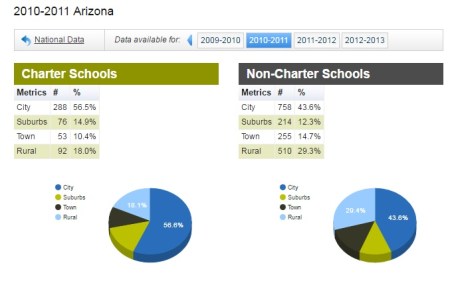
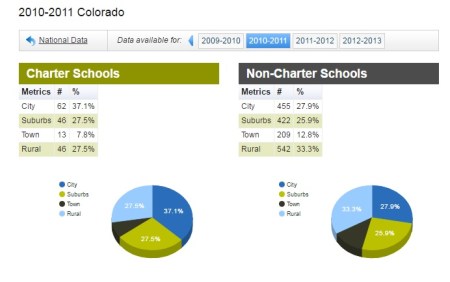
The National Alliance for Public Charter Schools dashboard has lots of cool data on state charter school sectors. I decided to take a look at the geography data by state to see how some of my favorites do on community inclusiveness. I don’t believe that we are likely to find charter sectors that precisely match the districts for a number of reasons, but large imbalances carry substantial drawbacks imo.

Bad:


Better:

Best:

Note that all three states over-represent in cities and there are practical (population density) and morally compelling (lower average performing district school options) reasons to do so. Texas however has focused on urban areas to such an extent that in communities that elect most of the state’s dominant political party (urban Texas is deep blue, with “urban” trumping “Texas” in voting preferences) schooling remains mostly a take it over leave it proposition from the districts. I heard from a CMO that operates charters in both Arizona and Texas that suburban demand for charters was even stronger than in Arizona in terms of generating wait-lists. In Arizona charter school competition is everywhere and even Scottsdale Unified needs and wants out of district transfers. Texas suburban districts meanwhile surround their new schools with trailers and keep increasing property taxes, and have limited interest in out of boundary transfers.

The “Size Does Matter” mantra again comes into play as the share of Arizona city children attending charter schools is likely considerably higher than the same share in Texas despite the fact that Arizona is more inclusive of towns, suburbs and rural areas (Texas has more urban charter schools than Arizona in absolute terms, but a much larger urban student population as well.) Thanks you again 9/33 NACSA scored charter law!


Brookings Institution finds that 82% of American families live within five miles of a private school

April 10, 2017

(Guest Post by Matthew Ladner)

Arizona lawmakers passed a broad expansion of the state’s ESA program last week, meaning that we got treated to every anti-choice talking point you can imagine during the debate, some far more dubious than others. One opponent for instance asserted that the ESA program was reminiscent of a very unfortunate history decades ago when officials kidnapped Native American children from reservation lands and forced them to attend schools in Phoenix, breaking their families up.  As you might imagine, this level of overconfident paternalism bears a scar to this day. Parental choice would of course bring this history to mind if not for the fact that it is in fact the polar freaking opposite of having some idiotic government official decide where your child was going to go to school whether you like it or not.

But I digress…

Transportation lies more in the realm of worthwhile discussion- parents can only choose between schools within transport range. Private schools engage in a variety of formal and informal transportation efforts- including carpools and buses, but the lack of tightly packed attendance boundaries presents challenges as choice schools tend to draw from large areas for students. Brookings has produced a very helpful study finding that 82% of American families live within five miles of one or more private schools.

So let’s take a real world example. A few years ago I blogged on the University of Notre Dame’s Alliance for Catholic Education program having partnered with a group of South Tucson Catholic schools. South Tucson has many low-income students and a sadly large number of low-rated public schools, but it also has a number of private schools within walking distance. Transportation is not the main issue in South Tucson- the ability of families to cover the modest tuition costs remain the main obstacle.

The complexity of the ESA program eligibility requirements were another obstacle, although one that has been overcome. This is a Powerpoint slide that ACE used to explain how they went about attempting to qualify children for Arizona choice programs under the formerly Byzantine rules of AZESA:

Having said all of this, not every child will have the same proximity to private schools as the kids in South Tucson. We can hope that additional private schools will open to meet demand, and the ESA does provide options outside of attending private schools. I am also hopeful that the Nevada ESA program will be funded this year, and we can see how including transportation as an allowable account expense works out in practice.


Governor Doug Ducey signs AZ Empowerment Scholarship Account expansion

April 7, 2017

(Guest Post by Matthew Ladner)

Arizona Governor Doug Ducey signed the expansion of the ESA program into law, becoming the first Governor to deliver on a sizable expansion of parental choice during the 2017 legislative sessions. The torch has been passed to a new generation of governors.

The other states are invited to hop on in-the water is fine!


Cerritos, California for The Higgy

April 7, 2017

(Guest Post by Michael McShane)

I’m sure that the city of Cerritos, California is a lovely place filled with charming and good hearted people. But just like William Higinbotham’s creation of the video game cannot hide the scorn of creating the Federation of American Scientists, neither can Cerritos hide its shame in trying to continue one of the most counterproductive and harmful trends in American municipal governance: Tax Increment Financing (TIF).

TIF is a tool that municipalities use to try and spur economic development within their borders. Essentially, it freezes the amount of property tax that a property owner owes on a parcel of land or building at what they owed before they improved it, allowing them to keep what would otherwise be owed in taxes as the value of their property increases. So let’s say I buy an empty lot somewhere and decide to build an IKEA on it. If I can get a TIF deal, I’ll keep paying taxes on it as if the parcel of land is still an empty lot, even though the value of the property has gone way up.

Here’s the problem: It doesn’t work. At most, it appears that TIF diverts economic activity from one part of a community to another. It doesn’t create new economic activity.  Oh, and here’s another problem, it diverts much needed tax dollars away from city, county, and state services and uses them to line developers’ pockets. Property taxes fund schools, libraries, mental health facilities, and a variety of other necessary functions of government.

But I think the worst part is how TIF, (and other forms of tax abatement, sweetheart deals cuts by civic leaders to developers, and/or outright public funding of stadiums and other facilities) promotes one of the JPGB’s mortal enemies, Petty Little Dictators. Rather than allowing people to decide where they think is best to build a new IKEA, movie theater, or office building, mayors and city councils, via tax subsidies, distort people’s behaviors to try and create their ideal little cities.  It also allows them to reward their friends and supporters with lower taxes while everyone else pays more to make up for it.

And what if you’re a business owner that doesn’t have the connections to get hooked up with TIF? Ask the sports bars around Busch stadium in St. Louis that existed before the city used tens of millions of dollars in TIF subsidies to build “Ballpark Village,” a conglomeration of food and drink options right outside of the stadium. Some saw their business fall by 50%. Great local businesses that saw through the city’s ups and downs for decades, dutifully paying their taxes all along, saw their customers go to their government-subsidized competition.

So what does Cerritos have to do with all of this? Well, California (of all places) decided to ban TIF a few years ago in response to the tremendous financial problems of the state. TIF was particularly costly to California because the state would pay back schools and libraries what local taxing jurisdiction had diverted from them.  So, they wisely got rid of it. Cerritos and several other cities are suing to try and bring TIF back.

The Higgy is given for “individuals whose arrogant delusions of shaping the world to meet their own will outweigh the positive qualities they possess.” Cerritos’s desire to use tax incentives to pick winners and losers embodies this perfectly. That’s why I think it deserves the Higgy.


BOOM! Arizona lawmakers pass broad ESA expansion

April 6, 2017

(Guest Post by Matthew Ladner)

Arizona lawmakers passed legislation tonight that will phase in near universal eligibility for ESA program. This will start with public school students in kindergarten and 1st grade, 6th grade and 9th grade in 2017-18, and then add grades from the on ramps (K,1,2 and 6,7 and 9-10 in year 2 and the next year K,1,2,3 and 6,7,8,9,10,11). The bill will also increase academic transparency and improve administration of the program.

Governor Doug Ducey’s stalwart support of expanding options proved crucial to this victory. Huge kudos to the bill sponsor Senator Lesko and Rep. Allen as well legislative leadership in both chambers and the members who took a tough vote in the face of determined opposition. Groups including the American Federation for Children, Americans for Prosperity Arizona, the Arizona Catholic Conference, the Arizona Chamber, the Center for Arizona Policy, Ed Choice, Excel in Ed and the Goldwater Institute all made vital contributions. Senator Worsley also deserves recognition as someone who played the role of honest broker in crafting a compromise that a winning coalition in each chamber supported. We’d all like to live in a world where there was no need to compromise, but that world is not the one we find ourselves in.

The Census Bureau recently announced that Maricopa County (Phoenix metro) as the fastest growing county in the nation-nudging out the Houston area. Enrollment growth is firing up again and the expanded ESA will give parents a broadening array of private educational choices to consider in what is already a robust public choice market. ESAs are an unfolding experiment in liberty, and future legislatures will debate further refinements and improvements, but this is the first big private choice victory of 2017, so…


Pay No Attention to the Research Consensus Behind the Curtain

April 6, 2017

rN8STVb.gif

(Guest post by Greg Forster)

Noah Smith dresses up a few fussy methodological quibbles and one big, really dishonest bit of fakery in order to cast aspersions on my Win-Win report and distract you from the research consensus behind the curtain.

My report reviewed over 100 empirical findings on private school choice programs, showing that there is a very strong research consensus in favor of positive effects from such programs. Smith identifies two (2) cases where he thinks I ought to have used a different method to classify the findings. I disagree, but frankly, it’s not worth quibbling about. The research consensus in favor of school choice is still clear even if we were to accept Smith’s cavails.

His statement that “vouchers have generally disappointed” is totally unsupported by the evidence – and if he read my report, he knows it.

But his big, dramatic “gotcha!” is that I allegedly omit a well-known study with a null finding. That would indeed be a serious omission.

Unfortunately for Smith, the study he dramatically accuses me of omitting is not a study of private school choice. Here is the abstract with emphasis on Smith’s dishonesty added:

School choice has become an increasingly prominent strategy for enhancing academic achievement. To evaluate the impact on participants, we exploit randomized lotteries that determine high school admission in the Chicago Public Schools. Compared to those students who lose lotteries, students who win attend high schools that are better in a number of dimensions, including peer achievement and attainment levels. Nonetheless, we find little evidence that winning a lottery provides any systematic benefit across a wide variety of traditional academic measures. Lottery winners do, however, experience improvements on a subset of nontraditional outcome measures, such as self-reported disciplinary incidents and arrest rates.

From the very first sentence, Smith explicitly frames his whole article as an article about private school choice. For him to accuse me of omitting a study on private school choice because I omitted this study is dishonest.

Smith owes me an apology and a retraction. If he refuses, Bloomberg owes me a correction.

I’ll hold my breath waiting.


Size Does Matter Visual Aid Followup

April 5, 2017

(Guest Post by Matthew Ladner)

I posed the question a couple of weeks ago as to why the National Association of Charter School Authorizers would score the charter school law of Nevada three times higher than those of Arizona and Colorado. The Arizona and Colorado charter laws after all have a delightful record of actually producing charter school seats, and both states rocked the NAEP like:

I, ah, have yet to receive anything approaching a coherent response. So I thought I would create a little visual on seat creation. The below chart shows charter schools opening in NACSA’s second rated state (NV) and also Arizona (which had a 9/33 score for most of this period) for the period Nevada has had charter schools (Arizona got a five-year head start). Just to practice my chart making skills, I inserted the flags of each state as the chart filler.

What is that you say? No Nevada is in there– it is just a little hard to spot. See that slightly different color blue smidge at the bottom of the Arizona flag? That is the Nevada flag. Here-let me give you a better look:

I think you have a good idea of what the Arizona flag looks like. This is similar to the NAEP data explorer not being able to give us academic scores for charter school students in Nevada because, well, like the visual the sector is just too small. In fact, when you examine NACSA’s top 10 ranked charter school laws, the list correlates strongly with small sectors, weakly with impressive results.

I want to make sure that my friends in the Silver State understand that I do not want to be understood to be critical of their efforts-I want nothing but the best for Nevada charters. Rather I want to not set the bar too low on defining charter school success, nor to misunderstand what actual success in charter schooling looks like. Hint: success looks a lot like Arizona and Colorado.

The comment section as always remains open if someone would like to explain why a rational person would score Nevada’s charter law three times higher than Arizona and Colorado. And by “any rational person” I mean “any rational person who supports charter schools” as obviously lots of people who do not support charters would have ample reason to rank Nevada’s law three times higher than Arizona or Colorado’s- as from that perspective delightfully contained.


Kimberlé Crenshaw for the Higgy

April 4, 2017

Image result for intersectionality

Kimberle Crenshaw is a law professor at UCLA who is best known for coining the term, “intersectionality.”  As Wikipedia describes it, intersectional theory is “the study of how overlapping or intersecting social identities, particularly minority identities, relate to systems and structures of oppression, domination, or discrimination.  There is nothing particularly harmful (or novel) about noting that people have multiple identities and that those identities overlap, sometimes in important ways.  The problem with intersectionality, which makes Crenshaw worthy of The Higgy, is that it has fueled an intellectually lazy and politically disastrous approach to virtually all social issues.

Intersectionality is intellectually lazy because it provides a single, overly-simplistic framework for understanding everything.  As Jonathan Haidt describes it, intersectionality divides the world into victims and oppressors.  In a type of re-warmed Marxism, all victims share the same struggle against the same underlying oppression, because all forms of oppression are connected.  The fight against racism cannot be won without addressing sexism, classism, ableism, etc…

Rather than having to learn about the complex circumstances and histories of different conflicts around the world, all we have to do is figure out who the victims and oppressors are.  Once we’ve forced the world into our Manichean framework, we know who should be helped and who should be stopped.  The problem is that the world is a lot more complicated than that.  People can be both oppressors and victims at the same time, depending on which issue we choose to make the focus of our attention.  And the struggle against one oppression may be completely independent of or even undermine the struggle against another oppression.

For example, the National LGBTQ Task Force decided to exclude an organization that seeks to make connections between LGBTQ communities in Israel and America from holding an event at the Task Force’s national conference in San Francisco.  Invoking the idea of intersectionality, some people convinced the Task Force that LGBTQ people in Israel could not be seen as victims (the good people) because they are oppressors of the the real victims, Palestinians.  Of course, dividing the world into oppressors and victims obscures the complex ways in which Palestinians may be oppressors of LGBTQ people or Jews at the same time that they may be victims of other types of oppression.  People are typically a mix of good and bad, which means that we might want to consider each type of grievance independently and understand it within its own context.  Instead, intersectionality encourages its adherents to label everyone as good or bad abstracted of individual circumstance or history, so we know who should be helped and who shunned (or worse).

To earn the good status of being the victim rather than the oppressor, people will compete in the who has suffered more Olympics, which is hardly a rational way to make moral or political judgements.  The people who claim to have suffered more may not be the most virtuous and those who are prospering may not be the most evil.  And encouraging people to compete for victim status discourages people from doing things that may help themselves so that they don’t risk appearing less victim-like.

In addition to being intellectually lazy, intersectionality is politically disastrous.  By connecting all issues, intersectionality prevents its adherents from agreeing with people on one issue while disagreeing on another.  If certain people are the oppressors and others victims, you can’t make common cause with the “oppressors” for the issues on which you have common interests.  You might think that linking different victims would give them a larger political coalition, but linking different oppressors drives away even more since few are the victims of every oppression.  Almost everyone can be framed as an oppressor in one way or another, all of whom are ineligible from joining your coalition against any particular injustice.

We’ve seen this type of political self-immolation in education reform, most notably at the infamous New Schools Venture Fund conference.  The more people demand that everyone in their coalition join them in opposing all injustices, the fewer people they have left to oppose any one injustice.  Some charter school people who have turned their hostility against private school choice are about to discover how lonely, small, and weak their purified coalition is about to become.  Especially given that Republicans dominate most state governments, purging mainstream Republican ideas from their version of the choice movement seems doomed to fail.  But given that intersectionality may find virtue in failure and sin in success, perhaps these folks don’t mind failing so much.

I don’t know enough about Crenshaw to say whether she has other redeeming qualities, but The Higgy does not demand that its recipients be awful people.  They only have to have done something to detract significantly from the human condition.  Introducing and promoting the concept of intersectionality certainly qualifies Crenshaw for this dishonor.


For a Lifetime Achievement Higgy: Joe Biden

April 4, 2017

untitled

(Guest post by Greg Forster)

In this golden age when Higgyworthy candidates are so numerous that last year’s Higgy convention almost failed to nominate one because the delegate was paralyzed by choice, it takes something special to stand out among the crowd. But one sure way to find the heroes whose “arrogant delusions of shaping the world to meet their own will” truly tower over the rest is to look to your elders – to those special people whose decades-long commitment to diligent and sustained blowhardism has not only accumulated a distinguished track record of inane interference and pointless posturing, but has moved the all-important “Higgyton Window” so future generations of aspiring PLDDers can sink to new depths that their elders only dreamed of.

With that in mind, I’d like to nominate recently retired Vice President Joe Biden not only for 2017 William Higginbotham Inhumanitarian of the Year but also for a Lifetime Achievement Higgy Award.

With Biden recently talking about how he totally would have won the presidency if he had run, it seems like a perfect time to recognize him with The Higgy. I submit the following achievements for the judge’s consideration:

World-Class Dispropotion of Reputation to Achievement

As Mark Hemingway pointed out when the race for the 2016 nomination was getting underway, one reason Biden had a strong incentive to run against Clinton was also a reason he might have had trouble gaining traction against her: He, like she, wanted to win the presdiency in order to secure a legacy – because he, like she, had built a strong reputation as a Very Serious Political Leader based on a long and distinguished career of accomplishing nothing in public service: “Biden spent 36 years in the Senate beginning in 1972, and if you blinked, you’d miss the highlight reel.

His Vice Presidency did little to augment this record, as The Onion constantly reminded us.

Truly Epic Mouthrunning

Joe Biden’s mouth has been a running gag for so long, it’s hard to recapture an appreciation of just how unique his talent for blowhardism is. This, mind you, is a man in a line of work where the standards for blowhardism are very high. Don’t bring your complaints about listening to you boring uncle around here, kid – in DC, that stuff doesn’t even get past the bouncer.

But in a field of top-notch blowhards, Biden is literally a blowhard’s blowhard. A while back (can’t find it now) a Weekly Standard profile opened with the observation that Biden’s tendency to blowhardism is a running gag even to Biden himself; he arrives on the scene of a speech he is to give and when the host pleads with him not to run over, he smiles and blows her off, and proceeds to run something like double his allotted time.

He Totally Helped Invent Borking But Also Totally Didn’t!

Among the many ups and downs of the American republic, there have been only a handful of really disastrous, unambiguously bad and wrong changes in our constitutional structure – like direct election of senators (bye bye, federalism). One of the worst of these was the decision to import the politics of dishonest personal destruction into judicial nominations. Now, it is important not to romanticize the political past. But the reasonably fair treatment of judicial nominees really was a bipartisan tradition that we relied on to make American democracy work. There is now no realistic path to restore it and no serious substitute.

If we were talking about Ted Kennedy’s role in the original Bork hearings, I would say there’s a case that he was more BSDD than PLDD. Kennedy destroyed the career of an innocent man by abusing power – like that notorious asterisk in the Higgy record books, David Sarnoff.

Biden’s role was Higgyworthy because he did his best to eat his cake and have it too. He tried to appease his party’s irresponsible Left while also trying, as chairman of the hearings, to look fair and respectable. He thus positioned himself for his long career run as a Very Serious Man who is not to be taken seriously.

Eww.

Just eww.

Plagarism and Lies

I’m actually inclined to give Biden a break for the infamous Kinnock incident. Biden had used the Kinnock line with attribution on multiple previous occasions; it seems clear to me that he just didn’t remember to include the attribution this one time. A mistake, but it shouldn’t be a hanging offense. This strikes me as akin to the famous Howard Dean Howl – something that wouldn’t have been a big deal except that it could be interpreted in light of a larger public predisposition toward the candidate, fair or unfair (Dean was seen as ideologically nutty, Biden as a phony).

But let’s not forget that Biden also committed plagarism in law school! And told a series of lies about his law school accomplishments:

A few days later [after the Kinnock kerfuffle], Biden’s plagiarism incident in law school came to public light. Video was also released showing that when earlier questioned by a New Hampshire resident about his grades in law school, he had stated that he had graduated in the “top half” of his class, that he had attended law school on a full scholarship, and that he had received three degrees in college, each of which was untrue or exaggerations of his actual record.

What could be more Higgyworthy, more an expression of “arrogant delusions of shaping the world to meet their own will,” than plagarism and lying about your academic accomplishments?

Medal of Freedom

No, seriously, Joe Biden totally got the Medal of Freedom:

13biden1-facebookJumbo

Tell me that alone is not Higgyworthy.

Remember, The Al got its glorious start largely as a response to Obama winning the Nobel Peace Prize. Let’s keep the tradition alive!