What all these have in common is more than just interest rates or TED spreads, even global depression; it is the entire idea of technocracy itself. Since before Plato, people have dreamed of a utopia where enlightened, dispassionate philosophers would govern and guide messy, often awful human existence toward and into “optimum” outcomes. It took until “economics” in the latter half of the 20th century for such hubris to take literal hold; there is an entire branch of the “science” dedicated through statistics just so to determining both “optimal outcomes” as well as the duty to “nudge” people toward them using the power of government if need be.
Economics is where technocracy was tried in widescale fashion first, and where it was thought at one time perhaps perfected. The Greenspan Fed, before the dot-com bust it needs to be pointed out, was believed by far too many the Socratic Ideal brought at long last to our world. So enthralling was the arrogance that it has been rationalized down by reality to what looks more like a cult than anything. Don’t believe market warnings, continue to believe The Fed Chair even though she finally confessed that economists can’t afford to keep assuming how little they know is enough. I am absolutely positive the next great psychological case will be written of the consistently imaginative dissonance leftover from When Policies Fail. It has already been started.
In this time of cynical politics it is refreshing to see something as fantastic as this floor debate in the Florida Senate. Earlier this year the sponsor of a bill to expand Florida’s ESA program for special needs children offers an amendment on the floor to rename the program after Senate President Gardiner, a special needs father and advocate and the original sponsor of the legislation. Gardiner objected and appealed to the Senator to drop his amendment, noting that he had promised to send the bill over to the Florida House without amendment. Not to be thwarted, the Senators secure a release from this promise from the Speaker of the Florida House, and then the Senate co-sponsors the amendment 39-0.
There is still some good in this world Mr. Frodo- and it is worth fighting for.
UPDATE: I am told that after all of this Senator Gardiner still refused to allow the program to be named after him, so the legislature named it after his family instead.
Japan now sells more adult diapers than baby diapers. Remember when someone from Japan bought Rockefeller Center (at an inflated price) and they were going to take over the world? Heh- here is how things really stand:
Japanese GDP and fertility rates are even further under water than those of our poor cousins across the Atlantic. Across the globe the Baby Boom generation has begun the process of entering into retirement, for which no one seems prepared, although some better than others. Watching your fertility rates collapse at the same time your society ages spells trouble.
The United States has a higher fertility rate and is an attractive destination for immigrants. What American states that might follow Japan into an adult diaper age demographic death spiral? Well if you can make it there, you’ll make it anywhere:
If you’ve never heard of Remy Munasifi (a.k.a. GoRemy), I feel sorry for you for two reasons: first, because you have until now been deprived of his comedic genius, and second, because you will get no work done for the rest of the day as you cycle through hilarious music video after even more hilarious music video.
If ever there were a year when we needed more of that, it’s 2016.
Remy is a thirty-something, Arab-American comedian who, like Weird Al, satirizes society and culture through parody music videos. His first video to go viral was his 2009 gangsta-rap parody of the lily-white “Whole Foods” culture of the D.C.-suburb, Arlington, Virginia–a video that racked up more than 300,000 views in one day and has now been seen more than 2.3 million times. His series of videos about Arab culture are even more popular–his video “Saudis in Audis” has more than 9.5 million views. However, much of Remy’s work is more explicitly political, although not partisan, particularly the videos he has produced for the libertarian ReasonTV.
For example, Remy’s “Cough Drops-The Mandate” mocks both Republicans and Democrats for the different ways in which they use government to intrude on our lives, and suggests to the viewer that perhaps we can solve many of our problems without getting the government involved.
But politicians and bureaucrats aren’t the only targets of his satire. Remy brutally mocks people who think they are saving the world on Twitter in “I Need a Hashtag!”:
Remy strikes a similar chord in “How to React to Tragedy.” In recent years, but particularly in 2016, we’ve seen a disturbing trend in the wake of tragedies as people rush to exploit them for their own political ends. Remy doesn’t spare either side:
Remy’s videos are striking not only for their clever wordplay and witty pop-culture allusions, but also for offering a taste of the highest form of social criticism. As the great political theorist Michael Walzer described in his seminal work Interpretation and Social Criticism, there are different types of social critics. The type favored in academia idealizes “radical detachment,” the social critic as “dispassionate stranger,” whose freedom from any attachment to the people whom he criticizes allows him the necessary emotional distance to speak painful but necessary truths. This form of criticism can be beneficial, but it can also lead the critic to despise the people whom he is criticizing, and they know it. That reduces the effectiveness of the critic, sometimes reducing the criticism to mere virtue signaling.
Another model is what Walzer calls the “connected critic,” who stands somewhat apart from the community and can therefore see it in ways that the masses often do not, but who is nevertheless “one of us.” As Walzer writes:
Perhaps he has traveled and studied abroad, but his appeal is to local or localized principles; if he has picked up new ideas on his travels, he tries to connect them to the local culture, building on his own intimate knowledge; he is not intellectually detached. Nor is he emotionally detached; he doesn’t wish the natives well, he seeks the success of their common enterprise.
As with blacks and Jews in America, Remy’s status as a native-born American-Arab in the post-9/11 world makes him an insider-outsider, giving him a perspective that is ripe for both comedy and social criticism. He combines them well. His comedy is biting, but not mean-spirited. His videos contain sharp indictments of the American government and society more generally, but you can sense in them a deep love for the ideals of America. He is not a Chomskyite social critic condemning America as irredeemably corrupt and founded upon the wrong values, but rather a connected critic, in the spirit of Martin Luther King, Jr., calling on America to live up to its highest ideals.
As an Arab-American, he’s also an insider-outsider in relation to Arab society and culture. His satirical takes on Arab culture–from a hip-hop paean to hummus to an ode to grape leaves set to the tune of a Nirvana classic–are humorous and even loving. However, he satirizes institutions like arranged marriage, laws against women driving, niqabs, morality police, etc.–topics that many comedians fear to touch lest they be labeled a racist or Islamophobe. Coming from someone else, these critiques may have been seen as mean-spirited and fallen on deaf ears, but Remy has a following among people with Arab heritage. He even toured with other Arab-American comedians in the “Axis of Evil” tour as his alter ego, Habib Adbul Habib, who is “Baghdad’s worst comedian.”
Whether satirizing Arab or American culture, this Arab-American’s comedy holds up a mirror that exposes our worst selves but also calls on us to be our best selves. He is the comedian and social critic that America needs and deserves right now. Remy may not need to win The Al, but he certainly deserves it.
* * * * *
BONUS MATERIAL. Here are a couple of Remy’s education-themed music videos that JayBlog readers will enjoy:
“Straight Outta Homeroom” on the absurdity of “zero tolerance” policies (think Pop Tart guns):
“Students United (Tuition Protest Song)” on clueless college students who can’t understand why the tuition at their fully loaded, theme-park campus is so expensive:
The 2016 presidential election is a reminder of just how horrible the world can be. Like Ben Shapiro, who was a star reporter at Breitbart before their pro-Trump-putsch, I used to think that tales of right-wing anti-Semites, neo-Nazis, and other backwoods fascists were largely ghost stories the Democratic party told Jews to keep them from venturing out of the party’s tent. I imagined that maybe 10% of the population adhered to these fringe beliefs on the right and perhaps another 10% believed in the left-wing version of Jew-hating conspiracy craziness.
America has a real fascism problem. So, what are we supposed to do about this? One essential weapon in the anti-fascist arsenal is humor. Charlie Chaplin mocked Hitler in The Great Dictator. Stanley Kubrick ridiculed Soviet despots as weepy drunks in Dr. Strangelove. Latin American dictators in the mold of Che Guevera and Fidel Castro were portrayed as silly madmen in Woody Allen’s Bananasand in Alan Arkin’s The In-Laws.
Part of the attraction of these dangerous despots to their crazed followers is the appearance of strength and stature. And part of the attraction of fascist movements to the stupid and weak is the illusion that they may be part of something great and powerful. Mocking fascists undermines this appeal by revealing how ridiculous they actually are.
One of Rosenberg’s most common methods for mocking the alt-right is to take internet memes they have adopted to spread their views and modify those memes so that they advocate for the opposite. For example, the alt-right has adopted “Pepe the Frog” as one of their symbols. Rosenberg turns the meme on its head by putting a Mossad t-shirt on Pepe that declares “It’s Never an Accident.”
Similarly, the alt-right has adopted images of Taylor Swift (much to her horror) as their symbol of blond-haired, blue-eyed purity and have her saying horrible neo-Nazi statements. Rosenberg modifies the meme, making Taylor a Zionist Jew:
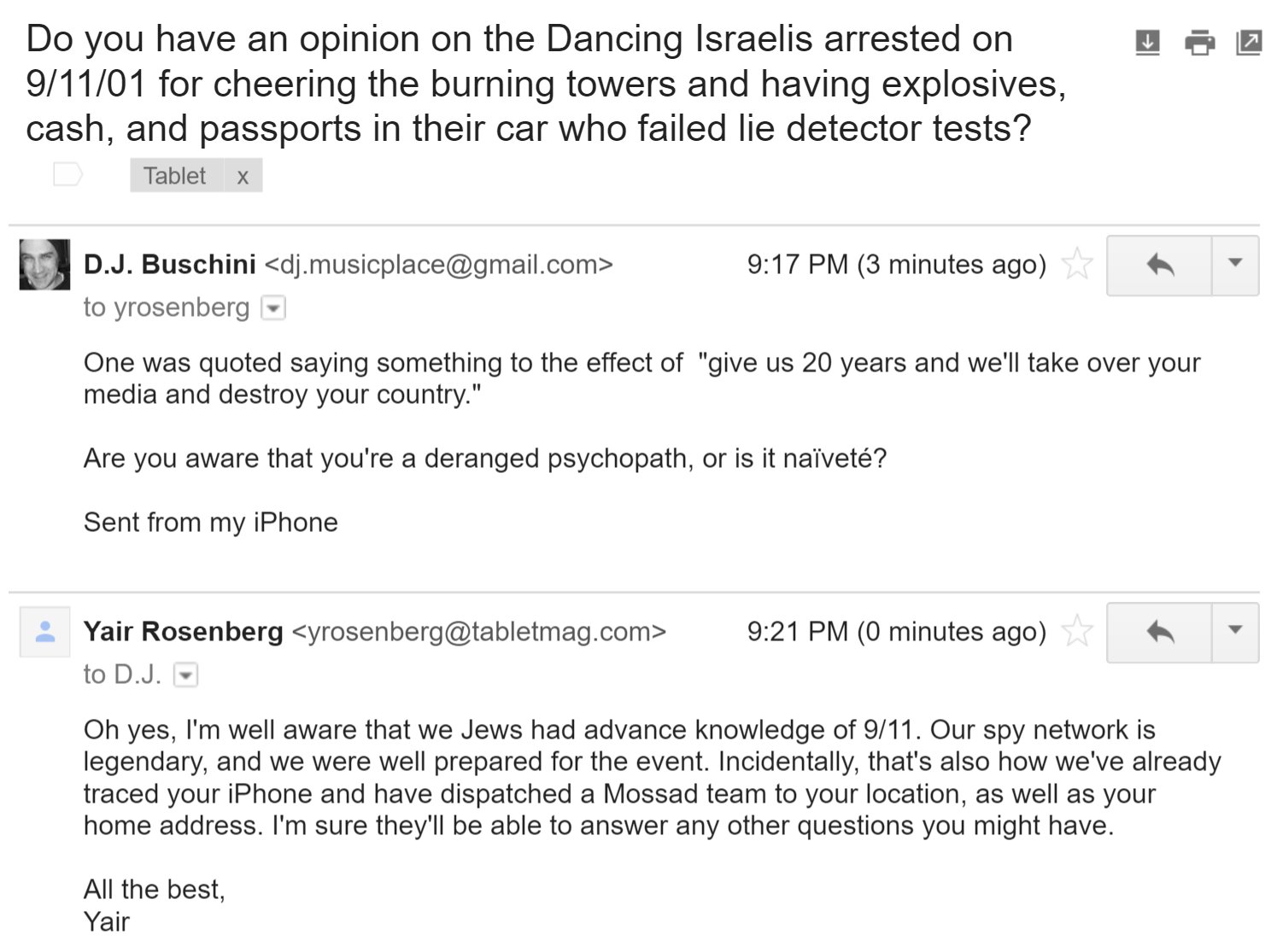
Another strategy Rosenberg has for mocking anti-Semites on Twitter is to treat their conspiracy theories seriously and suggest what the consequences might be if they were true. For example:
All these particular issues, however, underscore a basic point: Chartering has quietly revolutionized public schooling. It didn’t happen through clever, technocratic administrative fixes or a gigantic, rapidly passed omnibus legislative package. Nor did it humbly take for granted longstanding arrangements or merely tinker with the mechanics of existing programs. Instead, chartering took the long view. It trusted families and communities, carved out space for a new approach, and then allowed civil society to slowly create and change the new system. The result has been more individual empowerment, educational options, respect for pluralism, competition, civic-sector activity, innovation, and entrepreneurialism.
I also see much wisdom in the incremental gradualism that has marked the first 25 years of charter schooling, but also a ton of reasons to speed things up.
But Robert Pondiscio — the man who sparked this debate — has topped all of us with the post to end all posts on the social justice wars in ed reform. It is part of an excellent forum that Education Next has organized on the topic. Pondiscio accurately describes the angry reaction of white ed reform leaders to his original piece and their call to remedy the fact that “The leaders of reform organizations are mostly white, and mostly from backgrounds of relative privilege, creating a stark contrast with the communities, and leaders, of color that demand rapid improvements in their schools.”
The founder and leader of Education Post is Peter Cunningham, who was an assistant secretary for communication at the U.S. Department of Education under Arne Duncan, with whom he also served when Duncan ran Chicago Public Schools a decade ago. Cunningham has worked in PR, politics, and for small weekly newspapers but never, to my knowledge, as a teacher. He’s also a middle-aged white man. He is, in the argot of social justice thought, deeply privileged…. But if Education Post is serious about “elevating the voices” of the communities it serves, at some point it should be run—should it not?—by someone representative of those communities.
What about now? What about right now? What about Marilyn Anderson Rhames?
I ask this not to be mischievous, but to call the question and settle one of ed reform’s most sensitive debates. When I published my now-infamous piece earlier this year, it prompted, in addition to Rhames’ piece and others, an “open letter” signed by 170 “white education leaders” (including, not incidentally, much of the staff of Education Post) who took serious exception to my critique and lamented reform’s failure to put people of color in leadership positions.
“The education reform coalition has a problem,” the letter started. “Unlike other historical movements dedicated to the urgent betterment of social conditions, the most prominent leadership and voices of the school improvement coalition have not been representative of the communities that the effort hopes to serve. The leaders of reform organizations are mostly white, and mostly from backgrounds of relative privilege, creating a stark contrast with the communities, and leaders, of color that demand rapid improvements in their schools.”
All true, but this elides an awkward truth. Closing the achievement gap will take decades. Closing the leadership gap can be done this afternoon. All it takes is for the “white, privileged leaders” who signed the letter to recruit a person of color and step aside. The right person, like Rhames, might already be on staff, already contributing to the movement as a foot soldier or subordinate but not occupying a position of leadership or authority.
My paramount concern, almost completely unaddressed in the outsized reaction to my piece, remains that a militant leftward tilt in education reform endangers the longstanding bipartisan political support that has long fueled the movement. Neither do I believe that the only children poorly served by their schools are from families of color. But it makes little sense to bemoan “the extraordinary flaws and shortsightedness in our own leadership for letting the field become so lopsidedly white.” This is, as Teach For America likes to tell its corps members, within your locus of control. Those who signed the “open letter” may believe they are standing on principle. But if their theory of change rests on diversifying leadership, they are mostly standing in the way.
I invite those leaders to step aside for the greater good. No more open letters. No more manifestos. No more virtue signaling on Twitter. Either you are serious about the need to diversify the leadership of the reform movement, or you are not. It simply will not do to congratulate yourselves for being “brave leaders” and cluck earnestly at conferences about the need for education reform to “look like the communities it serves” year after year, while blocking exactly those people from the positions you insist they deserve.
To be clear, I continue to question whether the ed reform movement at large is properly viewed as a race-focused “social justice” movement or a broad school improvement initiative benefitting all children, thereby serving social justice ends. But let’s not quibble. If diversity of leadership is integral to your theory of change, why not practice within your organizations? And why not do it now?
Our infant nation survived George Washington relinquishing power and returning to his fields at Mount Vernon. Ed reform will survive without its current cadre of self-flagellating white leaders.
So tell me if you have ever had this experience- you find some time and think about going to a see a movie. No? Well you may have noticed that we dig movies here at JPGB so play along please…
Yes-okay so you want to see a movie, you go online to see what is playing, you look at the list of films currently screening at the movie houses you frequent and you think “blech I don’t want to see any of this” or some equivalent thereof. Just how much we are held hostage to Hollywood became even more apparent to me a few years ago when I rented a house near Zilker Park in Austin for a month. Austin at the time had five Alamo Drafthouse sites in operation, which meant that there were a consistent barrage of older, offbeat and classic films to choose between. I took the kids to see E.T. and Indiana Jones and the Last Crusade for instance, both of which were more fun than the How to Train Your Dragon 2 meh stuff that Hollywood happened to be shoveling out that summer.
The Drafthouse, with their combination of zany programming and out of the box thinking has brought something crucial back to film- soul. Authentic community is a treasure in life, and you simply can’t get much more of it out of a big-box theater. It is therefore with great pleasure that I nominate the founders of the Drafthouse, Tim and Karrie League, for the prestigious Al Copeland Humanitarian Award for showing us a path forward to redeeming cinema from the tedium of the factory farm film making.*
Like many great things in life, this story starts in Texas at Rice University, where Tim studied Art History and Mechanical Engineering, and Karrie majored in Biology and French literature. What do you do with that? How about “revolutionize the movie going experience” for starters. After Rice, the two opened their first theater, a prototype called the Tejon in California in 1994. Located on the wrong side of the tracks, the couple began to develop their carnival style in an attempt to lure people to the theater. They for instance got a live band to accompany a silent film (a later Drafthouse regular.) They brought a pig to a screening of Charlotte’s Web. Unable to obtain a liquor license for the Tejon, Tim and Karrie did what a great many sensible Californians do- packed up and moved to Austin Texas in 1997.
Tim and Karrie set up shop in a former parking garage in the Warehouse district in Austin. They got the liquor license that eluded them in California. The rest is history.
Starting as a single screen, small theatre, Austin fell deeply and passionately in love with the Drafthouse. Local directors started hosting film festivals there, followed by non-locals. Some of the non-local directors bought property and became locals.
Big box theaters noticed that the Drafthouse was earning about twice as much per person and started serving food and beer. That’s all well and good, but what makes the Drafthouse the Drafthouse is culture and programming. Examples include Master Pancake Theater (three comedians mic up on the front row and ridicule a bad movie), Hecklevision (audience text ridicule at a bad movie which appears on the screen), Midnight Blaxploitation (good grief how did this stuff get made?), Sing Alongs and Rolling Road Shows.
So sing alongs, here’s one for the ladies:
and another for Queen fans who want to put on a Freddy Mercury mustache and scream their lungs out with their favorite songs:
You of course already know about rolling road shows like Jaws on the Water:
But they’ve also gone out and about. One of my favorites was a canoe trip with a screening of Deliverance on the shore after a long day of rowing and eating pig sandwiches. They have also gone to filming locations to screen classics:
The Drafthouse is also famous for dealing with certain transgressions firmly and quickly:
Which prompted this gem (NSFW):
which was followed by a similar incident when they had to throw a Sith Lord out:
Anyhoo- thank you Tim and Karrie for making film an absolute blast. I am counting down the days until the opening of Drafthouse Phoenix.
* You may choose to infer an education analogy from this post, but I couldn’t possibly comment.
In the wake of last week’s state supreme court decision, Nevada’s ESA is mostly dead. But as Tim Keller of the Institute for Justice noted–channeling Miracle Max–being mostly dead means it is still slightly alive. As I explain over at Cato-at-Liberty, whether it fully revived depends entirely on the lawmakers who won plaudits for enacting it in the first place.
On Monday, the Nevada legislature will meet in a special session to consider subsidizing a football stadium. If they have the time to waste on subsidizing stadiums for billionaires, then surely they can find the time to fund ESAs for children who want a better education while saving the taxpayers money.
Will Gov. Sandoval and legislative leaders fix the funding issue now–while they have legislative support for the program–and thereby cement their legacies in the history of education reform? Or will they risk having the the next legislature block such efforts, leaving only a legacy of squandered opportunity?
Al Copeland may not have done the most to benefit humanity, but he certainly did more than many people who receive such awards. Chicago gave Bill Ayers their Citizen of the Year award in 1997. And the Nobel Peace Prize has too often gone to a motley crew including unrepentant terrorist, Yassir Arafat, and fictional autobiography writer, Rigoberta Menchu. Local humanitarian awards tend to go to hack politicians or community activists. From all these award recipients you might think that a humanitarian was someone who stopped throwing bombs… or who you hoped would picket, tax, regulate, or imprison someone else.
Al Copeland never threatened to bomb, picket, tax, regulate, or imprison anyone. By that standard alone he would be much more of a humanitarian. But Al Copeland did even more — he gave us spicy chicken.
Last year’s winner of “The Al” was the internet humorist, Ken M. Ken M did more to improve the human condition than just make us laugh by making idiotic comments on social media (although that would have been enough). His humor reveals the ridiculousness of people trying to change the world by arguing with people on the internet. Given how much time ed reformers waste on social media, especially the soon-to-be-sold Twitter, Ken M’s humor is a useful reminder that many of the people reading your posts are probably not much swifter or influential than the Ken M persona. Ken M beat a set of strong nominees, including Malcolm McLean, Gary Gygax, and John Lasseter.
The previous year’s winner was Peter DeComo, the inventor of the Hemolung Respiratory Assist System. To save a life DeComo had to trick border control officials to bring a model of his artificial lung machine into the US from Canada because the device had not yet been fully approved by the FDA. DeComo won over a worthy field, including Marcus Persson, the inventor of Minecraft, Ira Goldman, the developer of the “Knee Defender,” Thomas J. Barratt, the father of modern advertising, and Thibaut Scholasch and Sébastien Payen, wine-makers who improved irrigation methods.
In 2011 “The Al” went to Earle Haas, the inventor of the modern tampon. Thanks to Anna for nominating him and recognizing that advances in equal opportunity for women had as much or more to do with entrepreneurs than government mandates. Haas beat his fellow nominees: Charles Montesquieu, the political philosopher, David Einhorn, the short-seller, and Steve Wynn, the casino mogul.
The 2010 winner of “The Al” was Wim Nottroth, the man who resisted Rotterdam police efforts to destroy a mural that read “Thou Shall Not Kill” following the murder of Theo van Gogh by an Islamic extremist. He beat out The Most Interesting Man in the World, the fictional spokesman for Dos Equis and model of masculine virtue, Stan Honey, the inventor of the yellow first down line in TV football broadcasts, Herbert Dow, the founder of Dow Chemical and subverter of a German chemicals cartel, and Marion Donovan and Victor Mills, the developers of the disposable diaper.
Nominations can be submitted by emailing a draft of a blog post advocating for your nominee. If I like it, I will post it with your name attached. Remember that the basic criteria is that we are looking for someone who significantly improved the human condition even if they made a profit in doing so. Helping yourself does not nullify helping others. And, like Al Copeland, nominees need not be perfect or widely recognized people.


 Posted by matthewladner







 (((Yair Rosenberg)))






 Jay P. Greene's Blog