And the Winner of the 2016 “Al” is… Master Sergeant Roddie Edmonds

October 31, 2016

showimage

This year’s set of Al Copeland Humanitarian Award nominees was particularly strong, making selection of a winner exceptionally difficult.  As Greg noted in a comment, “this is clearly a ‘political’ year for The Al, in the sense that we’re all nominating witnesses against injustice rather than the creative entrepreneurs who usually dominate.”

Well, almost all.  Matt, as is his habit, nominated the entrepreneurs, Tim and Karrie League, who developed the Alamo Draft House chain of movie theaters.  The Alamo Draft House is one of the greatest places on earth.  The theaters carefully select movies, audience activities, food, and drink to create a completely engaging and entertaining experience.  Some people give hundreds of millions of dollars to art museums that fail to package their offerings nearly as well as Tim and Karrie League do.  And the Alamo does it without any donations while making a profit.  Improving the human condition while also making profit is a quintessential characteristic of winners of The Al.  And I almost slected Tim and Karrie League for this honor.

But as Greg said this seems like a political year in which selecting a traditional entrepreneur-type as the winner just didn’t seem right.  All of the other nominees fell in the “witnesses against injustice” category and with so much injustice all around us, I felt like I should choose one of them.  I could have chosen Jason’s excellent nominee, Remy Munasifi, whose musical parodies expose and help rebut oppression, hypocrisy, and other types of foolishness.  I could also have chosen my own nominee, Yair Rosenberg, whose trolling of neo-Nazis and other anti-Semites on Twitter deprives these bullies of the sense of power that drives much of their behavior.

Instead, I have chosen Master Sergeant Roddie Edmonds over Remy Munasifi and Yair Rosenberg because Edmonds was more than a witness to injustice.  He actively took steps, at enormous danger to himself, to promote justice in the world.  By refusing to comply with Nazi orders to separate Jewish POWs and insisting that he and all of the soldiers under his command were Jewish, Edmonds risked being shot to defy the Nazi’s hateful and murderous plans against Jews.

I hesitated for a moment in selecting Edmonds only because The Al does not typically go to people who have been widely recognized elsewhere, like Steve Jobs or John Lasseter, and Edmonds was recently honored as one of the Righteous Among the Nations at Yad Vashem, Israel’s Holocaust museum.  Unfortunately, being honored by Yad Vashem does not constitute being widely recognized, so drawing more attention to Edmonds seems important and fitting.

As much as I love Remy Munasifi and Yair Rosenberg, mocking injustice on the internet just isn’t enough.  As Ken M, last year’s winner of The Al, taught us, social media is a pretty useless forum for trying to improve the world. So, that silly video you shared on Facebook or that sly remark you made on Twitter doesn’t really do much other than amuse you.

There’s nothing wrong with some amusement. After all, that is the Prime Directive of this blog — to amuse ourselves rather than to change the world.  And being amusing is a lot better than those insufferable political rants or self-righteous internet petitions, which are all talk and no action.

If you want to fight injustice you can’t really do much with a blog, Twitter, or Facebook.  You need to find real injustices, not trumped-up (pardon the pun) minor slights like:

Image result for I am a cat not a costume

And then you need to follow the example of Master Sergeant Roddie Edmonds and take action that might even put yourself at risk.  Evil will always remain in the world, but we will suffer less from it if we have more people like Master Sergeant Roddie Edmonds.


Don’t Know or Don’t Care?

October 28, 2016

pisa-effort

When we examine the results of standardized test scores we typically think we are seeing evidence of what students know.  As it turns out, that is only partially right.  Test scores capture both what students know as well as their willingness to exert effort to show us what they know.

A new paper by my colleagues, Gema Zamarro, Collin Hitt, and Ildefonso Mendez uses multiple, novel techniques to demonstrate that between 32% and 38% of the variation in PISA test performance across countries can be explained by how much effort students are willing to exert rather than what they know.  The implications of this finding for ed reform are huge.  When we see low test score performance we are often misdiagnosing the problem as poor content instruction when it may in fact be insufficient development of student character skills.  If we focus all of our energy on the former without addressing the later, we’ll fail to make as much progress.

So, how do Gema, Collin and Ildefonso know that between 32% and 38% of variation in PISA test performance across countries is explained by effort?  They used three different methods to measure the influence of effort.  First, they took advantage of the fact that the order of questions without the PISA was randomly ordered.  They then compared how well students performed on the first set of items relative to the last.  Because the order of items was randomized the first and last questions were, on average, of equal difficulty.  The decline in getting items correct from the start to the end of the exam is therefore a function of the decline in effort students are willing to exert, not the difficulty of the items.

If you compare performance in the US and Greece (as can be seen in the figure above), students in the two countries do about as well at the beginning of the test.  That means that students in Greece and the US know about the same amount of stuff.  But students in Greece decline much more rapidly across the test, which means that those students are less willing to exert consistent effort.  When we compare PISA results from the US and Greece we wrongly conclude that content instruction in Greece must be much worse.  In reality, Greek students know as much as students in the US but simply exert a lot less effort.

A second way the paper measures effort is by examining responses students gave to a survey that was administered at the same time as the PISA.  Using novel techniques that have been validated in previous research, they measure the extent to which students skip answers (or say “don’t know”) as well as the extent to which students give careless answers as proxies for their effort.  Both skipped answers and careless answers yield very similar results to what they find from the decline across the test.

Some people have expressed skepticism about the focus on “non-cog” or character in education research because they believe that these capture personality traits that are largely inherited and immutable.  This research contradicts that claim.  Unless we think there are big and important genetic differences across countries, the variation in effort across countries has to be explained by factors that are social constructed and, at least in theory, could be changed.  In addition, great work by Gema and Albert Cheng has found that student effort can actually be changed when students are randomly assigned to different teachers who themselves possess different character skills.

The evidence is becoming clear that character matters and is subject to influence by the education system.


Where Do You Consistently Find the Highest NAEP Scores? Where Everybody Knows Your Name

October 28, 2016

(Guest Post by Matthew Ladner)

So hidden deep in the NAEP data explorer is a variable for school enrollment.  Yesterday we saw how Arizona charter schools crushed the ball on the 2015 NAEP science exams, but I was curious- would there be evidence suggesting that small schools of choice perform especially well? NAEP provides such a number in a crosstab for Arizona charter/district by school enrollment. Small district schools in Arizona performance is nothing to write home about, and are probably mostly rural. Arizona’s small charter schools-schools of choice-however, well, that is a different story. These are the 8th grade science NAEP scores for Arizona charter schools with 399 or fewer students compared to statewide averages for all students:

small-school-science

I thought that was interesting, so I checked to see how this would look in the 2015 NAEP Reading exam for 8th graders. Well-

small-school-reading

Well but the whole thing would fall apart in the math test. Except, it didn’t:

small-school-mathematics

Obviously this evidence is only suggestive, but do keep in mind that we have a large number of formal studies finding positive outcomes associated with attendance at small high schools. So perhaps high quality education involves authentic community with a shared vision of what constitutes high quality learning, and this process is facilitated by the ability of a child and parent to choose. It certainly appears to be the case out here in the Cactus Patch. Let’s call it the “Cheers theory of learning” in that you want to go where everybody knows your name. If that is you want to learn to read, figure some math, and understand science. If you prefer to fade into the background and then drop out of school- we’ve got plenty of Big Box schools to choose from as well.

So you see dare Normy....

So you see dare Normy dare used to be this big Foundation that had a great idea but then…


Arizona Charters Blow the Doors Off 2015 NAEP Science Gains

October 27, 2016

(Guest Post by Matthew Ladner)

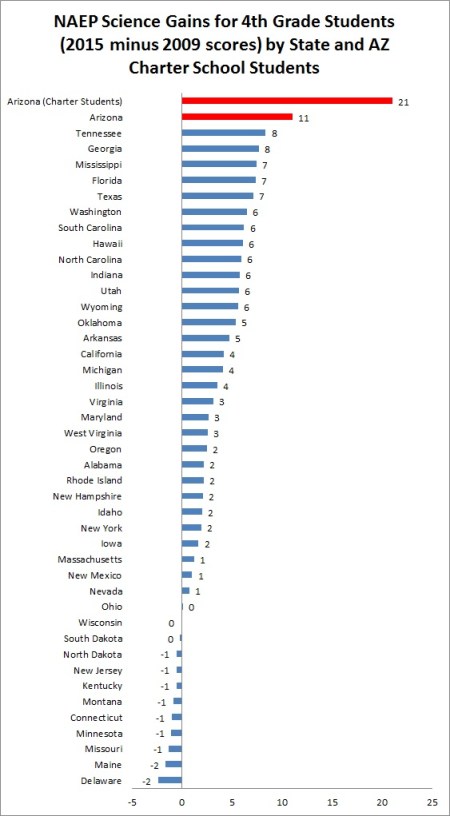
Ok sports fans, I know you are all chomping at the bit, wanting to know “but Ladner, how do Arizona charter school science gains compare to statewide averages?!?” Oh I am glad you asked, here it is for 4th grade:

4th-grade-science-gains-charter

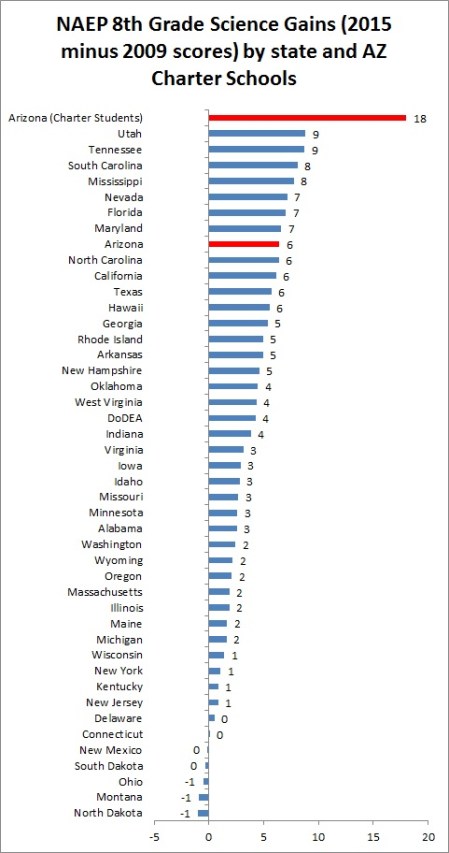
Hmmm…almost twice the gain as top ranking Arizona as a whole. Would it be running up the score to note that Arizona would not have done nearly as well without charters? I’ll just skip that part for now. Here are the NAEP 8th grade science gains:

naep-8th-grade-science-gains-charters

Well, would you look at that-twice as large as the largest state gain.  I’m crunching these out on a Prescott Library computer after taking a mountain bike ride on a “day off” but feel free to run the numbers for yourself here. I’ll breakdown subgroups later when I have more than 16 minutes left on my public computer use.

In the meantime I’m just going to go out on a limb here and say that there just might be something to this whole parental choice thing. Just maybe.


Arizona Leads the Nation in 4th Grade Science NAEP gains, Utah in 8th grade

October 27, 2016

naep-4th-grade-science-gains

(Guest Post by Matthew Ladner)

So the CeleNAEP continues…Arizona topped the nation by a wide margin in 4th grade science NAEP gains, while Utah came out on top on the statewide gains for 8th grade:

naep-8th-grade-science-gains-by-state


Arizona Charter Schools CeleNAEP release of 2015 Science Scores

October 27, 2016

2015-naep-science-az-charter
(Guest Post by Matthew Ladner)

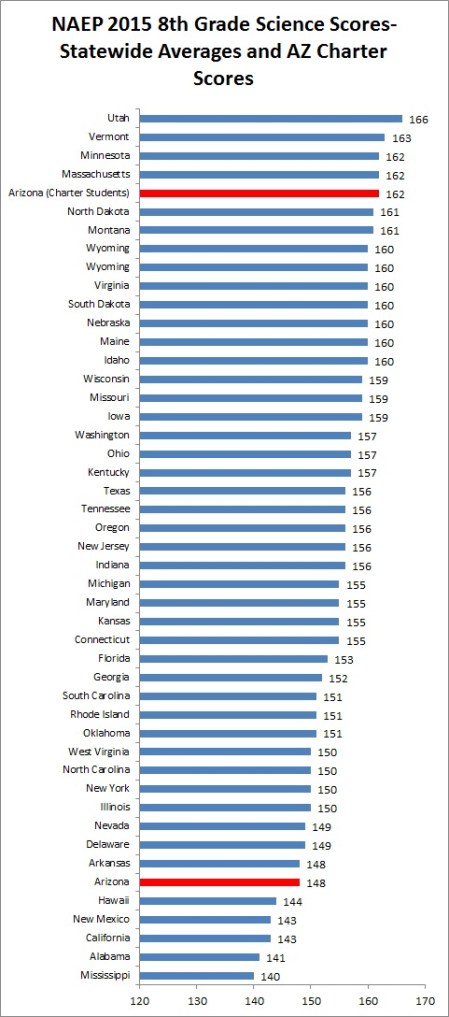
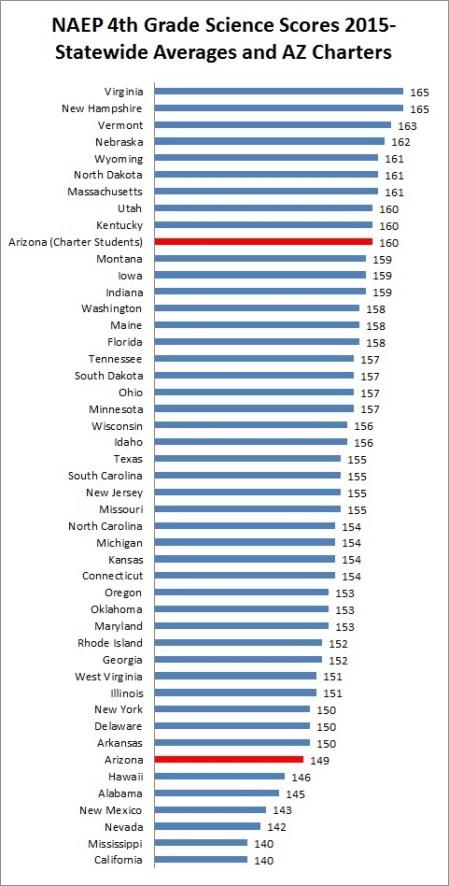
NAEP released 2015 Science results today. More results to come (I am crunching from the public library in Prescott AZ) but for both of you Arizona charter school skeptics out there, take a gander at the above chart. Just as a friendly reminder, AZ charter schools educate a majority minority student population, have very modest levels of funding compared to school systems around the country, and each NAEP exam is an entirely new sample of students, and Arizona charter students rocked all four of them (4r, 4m, 8r, 8m) so far. Now we have two more 2015 measures, and the CeleNAEP just keeps the smooth jam rolling!

Still skeptical? Well let’s check the 4th grade rankings:

az-charters-4th-grade-science-naep

More later but once again….


For the Al: Master Sergeant Roddie Edmonds

October 25, 2016

showimage

(Guest post by (((Greg Forster))))

“They cannot all be Jews!”

The Battle of the Bulge, one of the largest battles in the largest war in world history, produced thousands of prisoners. Among the prisoners in the Stalag IXA camp were about one thousand men of the U.S. 422nd Infantry Regiment, who found themselves under the command of Master Sergeant Roddie Edmonds – a non-com, but still the regiment’s most senior surviving member.

Last year, his son, Rev. Chris Edmonds, had his first full opportunity to share his father’s story with the world – by dumb luck, just a month too late for his father to participate in last year’s Al Copeland Humanitarian of the Year Award process.

But The Al has a long memory, and it will take more than a little time to make it forget Master Sergeant Roddie Edmonds.

By standing German policy, Jewish POWs were to be separated from the rest of the POW population. By this time, the largest of the death camps in the western theater were no longer in business, so most of these POWs were taken away to slave labor camps where they were, with less efficiency but no less contempt for their humanity, worked to death.

Speaking in English, the German camp commander – a Major Siegmann – approached the POWs of the 422nd. He ordered that all Jewish men were to fall out and stand in formation in front of the barracks, then went to await them.

Whereupon Master Sergeant Roddie Edmonds ordered every man under his command to fall out and stand in formation in front of the barracks.

“I would estimate that there were more than 1,000 Americans standing in wide formation in front of the barracks with Master Sergeant Roddie Edmonds standing in front, with several senior non-coms beside him, of which I was one,” recalls Lester Tanner, a Jewish member of the regiment.

Siegmann protested: “They cannot all be Jews!”

Master Sergeant Roddie Edmonds replied: “We are all Jews here.”

Siegmann drew his sidearm and held it to Edmonds’ head.

Edmonds said: “According to the Geneva Convention, we only have to give our name, rank and serial number. If you shoot me, you will have to shoot all of us, and after the war you will be tried for war crimes.”

Siegmann, having been (in the words of the Jerusalem Post) “outfaced by Edmonds,” turned and walked away.

More than 200 of the prisoners were Jewish (all the time, that is, not just when Nazis were asking). Edmonds saved them all from near-certain death.

Chris Edmonds knew his father had spent 100 days in captivity, but had no idea anything like this had happened until he read a newspaper story a couple years ago about Richard Nixon’s post-presidency search for a New York home. The article mentioned Tanner, who sold Nixon his house, and included the story about his father. Chris Edmonds began tracking down Tanner and other corroborating evidence, culminating in Master Sergeant Roddie Edmonds being named “righteous among the nations” by Yad Vashem last December. He is only the fifth American, and the first American serviceman, thus honored.

Just two weeks later, a more contemporary headline showed that the spirit of Roddie Edmonds lives on: “Muslims Protect Christians from Extremists in Kenya Bus Attack.” About a dozen heavily armed Somali terrorists captured a bus in El Wak, Kenya and demanded that the passengers disembark, with all Muslims moving to one side of the bus while Christians moved to the other side. But the Muslim passengers refused to cooperate, preventing a massacre. “These Muslims sent a very important message of the unity of purpose, that we are all Kenyans and that we are not separated by religion,” said Interior Minister Joseph Nkaissery. “Everybody can profess their own religion, but we are still one country and one people.”

Tanner recalls of Edmonds: “He did not throw his rank around. You knew he knew his stuff and he got across to you without being arrogant or inconsiderate. I admired him for his command.”

Now, so do we all.


Did Edvard Munch see the 2016 Presidential Race in Advance?

October 25, 2016

(Guest Post by Matthew Ladner)

Over the last couple of weeks we’ve learned a lot about American politics we would have preferred not to know. We can start with highly placed DNC operatives recruiting and training mentally ill homeless people to bait attacks at Republican rallies. Both of these people were caught on tape expounding monologues like a James Bond super-villain explaining their nefarious plot to ruuule ze vorld. One of them was at pains to explain just how good he was to also see to the medical and legal bills of his goons- it was very touching. The phrase “theoretical conversations” has been trotted out in an incredibly lame attempt at spin, and both men have been fired from their positions.

As the week went on, wikileaks revealed additional details like the DNC chair being provided debate questions in advance, reporters pre-clearing stories with the DNC, and more “pay for play” business from the Clinton Foundation that Bob Woodward described as not just unseemly but corrupt.  So the election is rigged right?

Wrong.

Repulsive as these things are, a Presidential election is not Ivy League football. A Presidential election alas more closely resembles SEC football, where the unofficial conference motto should be “If you a’int cheating you a’int tryin!” People age into political awareness and learn about how bad or corrupt things currently stand, and assume that things were much better in the past. Read enough history however and you’ll learn that there is nothing new under the sun. As utterly repulsive as it is to send mentally ill people into rallies in an effort to bait violence, let’s face it there are good ways to deal with this tactic, and bad ways to deal with it. Option one would be to inform the crowd that agitators are in your midst and want to lure you into attacking them, but that you should refuse to take the bait and instead alert security, who can escort them out. Option two would be to encourage people in the rally to punch these people and offer to pay their legal bills…which help me out here but lies in the same ethical neighborhood as the agitators does it not?

As far as I can tell, the election is not even remotely close. If it is remotely close the Clinton campaign team is utterly incompetent in moving large amounts of resources into a style point state like Arizona, which Romney won on his way to a decisive electoral college loss in 2012. There are some national polls that have the race close, but others have Clinton winning in a blowout. I don’t know enough about polling to discern which polls are more credible, but I do know that we elect the President in 50 separate state elections rather than in a national election and that the Clinton campaign is behaving as if the latter scenario is in play. Republicans complain of dirty tricks and MSM bias, both of which are real. Note however that the media today is far more pluralistic than in the past, and that Democrats would be happy to provide their own laundry list of perceived dirty tricks played by Republicans. Don’t complain too much Vanderbilt fan, it’s your choice to play in the SEC so pull up your big boy pants.

I found this piece by David French to be far more disturbing. There is a naive, hopeful part of me that wants to believe that what French describes in this column is another dirty trick by some goon squad black op outfit, or the Russians, or well, anyone other than a disturbingly large portion of my fellow Americans. Sadly at the moment I have no evidence that would support such a belief.

Neither party has taken Uncle Sam’s looming insolvency remotely seriously. To these eyes, one major party fought off a socialist insurgency with dirty tricks by the hair of their chinny chin chins so they could at least stick with a corrupt royalist, who would have lost in landslide if not for the folly of her opponents. The other fell under the sway of a nativist demagogue despite the obvious disaster that would ensue. Personally I’m not anxious to reenact the Spanish Civil War in American politics, and I am not falling for the “you have to support the fascists because the communists are even worse” trick.

Put me down for none of the above.


Why Charters Will Lose in Massachusetts

October 24, 2016

Image result for charters question 2

Massachusetts voters will be deciding in a few weeks whether to expand charter schools in the state. By all rights, the measure should be winning by a landslide.  Rigorous evaluations of existing Boston charters show large test score gains.  Charter supporters are spending millions to blanket the airwaves with ads. And following what appears to be the new ed reform ideal model, Massachusetts charters predominantly serve highly disadvantaged communities, so they have positioned themselves as the progressive promoters of social justice.

Despite all of this, Question 2 is trailing by double digits in recent polls and appears headed for defeat.  Why?  As I’ve written recently, ed reformers appear to have become so obsessed with social justice virtue-signaling that they’ve forgotten how politics actually works.  Narrowly targeting programs toward disadvantaged communities leaves programs politically vulnerable to harmful regulation, restriction, or repeal.  As much as disadvantaged communities desperately need education improvement, they tend to be poorly positioned to advocate for those efforts politically.

If you want to help the poor, you should design programs that include the middle and upper-middle classes.  This is the political genius of Social Security.  It is extremely effective at alleviating poverty among low-income seniors because high income seniors, who tend to be better positioned for political advocacy, also get it.  This is the political genius of many college subsidy efforts — the poor can benefit from them because wealthier families are also eligible.

I understand that Question 2 is attempting to expand charters so that they can include more middle class and upper-middle class families, but those voters are unaware of how charters might benefit them because already existing Massachusetts charters have largely failed to serve them.  And the unions and their local suburban school officials are doing a great job of scaring suburbanites about how a charter expansion might harm the relatively good arrangements they currently enjoy.

Charters in Massachusetts would have been better positioned politically if they had not previously neglected to benefit more middle and upper-middle class families.  Then more politically-advantaged families could have learned about benefits from their own experience and through networks of family and friends.  Ed reform needs to win by convincing middle and upper-middle class families that they can benefit themselves from creating and expanding ed reform programs.  Trying to obtain their support by arguing that poor and minority families who live somewhere else would benefit is a losing strategy.  Most political decisions are driven by crude calculations of self-interest, not high-minded appeals or guilt.

But ed reformers appear to have taken such a strong aversion to the rough political realities of self-interest that guilt is their dominant political message.  For example Richard Whitmire attempted to shame suburban voters, tweeting to an approving chorus of progressive reformers: “All comes down to: Will well-off suburbanites deny better schools to urban parents?”  The fact that Question 2 is trailing significantly in the polls provides the obvious answer to Whitmire’s query — of course suburbanites will deny better schools to urban parents if they think they might lose something and have little to gain.  That’s how politics works.

Until ed reformers temper this antipathy towards more advantaged families, abandon guilt-driven political appeals, and embrace the political realities of self-interest they should expect to continue suffering a series of political defeats.


A Victory for Transparency in Government

October 21, 2016

2668729037_f77e0ec2a8_b

(Guest Post by Jason Bedrick)

For decades, the Congressional Research Service has worked very hard to keep its reports to Congress hidden from public view. But now, thanks to the efforts of a group of activists and two members of Congress, the cat is not only out of the bag, but it is eating up all the spilled beans:

A guerrilla group of open-records activists struck a major blow for sunshine in government Wednesday when it posted more than 8,200 reports from the Congressional Research Service, Capitol Hill’s nonpartisan think tank whose research is usually closely guarded.

Demand Progress posted the reports at EveryCRSReport.com, giving the public an unprecedented look at the kinds of information accessible to lawmakers on nearly every subject that comes before Congress.

The reports have been available to lawmakers and thousands of staffers on Capitol Hill with access to the internal computer network, but the CRS balked at requests to broaden access, saying its mission was to report to Congress, not to the public.

“For more than 20 years, the public has clamored for Congress to systematically release CRS reports to the public,” said Daniel Schuman, a former CRS attorney who is now policy director at Demand Progress and who spearheaded the effort. “Congress must do better, and this new website points the way forward.”

He said his group has posted every publicly available report and redacted only the names, phone numbers and email addresses of the analysts who wrote them. The group also added a statement about copyrights of information in the documents, addressing one of the concerns the CRS had offered.

Congress has jealously guarded its reports, with lawmakers even voting down efforts to have CRS itself make the documents readily available.

But that has never been a unanimous stance, and some lawmakers have fought for more access.

Stymied by their colleagues, two members of Congress — one Democrat and one Republican, whom the group did not name — are providing access to the reports to Demand Progress.

They include 723 reports on constitutional issues, 211 reports on immigration policy, 592 on health policy, 18 on Indian affairs and more than 1,500 reports on Congress‘ spending powers and the programs it chooses to fund. Each of those reports is publicly available to all Capitol Hill staffers on the network.

You can find the reports at the aptly named EveryCRSreport.com. Reports of likely interest to JayBlog readers include:

  • The Law of Church and State: Public Aid to Sectarian Schools” (2011): “This report gives a brief overview of the evolution of the Court’s interpretation of the Establishment Clause in this area and analyzes the categories of aid that have been addressed by the Court. The report explains which categories have been held to be constitutionally permissible or impermissible, both at the elementary and secondary school level and at the postsecondary level.”
  • Campus-Based Student Financial Aid Programs Under the Higher Education Act” (2016): “Three Higher Education Act (HEA) student financial aid programs—the Federal Supplemental Educational Opportunity Grant (FSEOG) program, the Federal Work-Study (FWS) program, and the Federal Perkins Loan program—collectively are referred to as the campus-based programs. […] This report describes the FSEOG, FWS, and Federal Perkins Loan programs. It also presents historical information on appropriations provided for the programs and the federal student aid that has been made available to students through the programs.”
  • Charter School Programs Authorized by the Elementary and Secondary Education Act (ESEA Title V-B): A Primer” (2014): “While the charter school programs have not been reauthorized since the enactment of the No Child Left Behind Act (NCLB; P.L. 107-110) in 2002, they continue to receive funding through the annual appropriations process. In addition, since FY2010, substantive changes have been made to the programs through annual appropriations acts, including allowing or requiring the Secretary to make grants to nonprofit charter management organizations (CMOs) and other nonprofit entities for the replication and expansion of successful charter school models.”

If you find anything interesting, be sure to let us know in the comment section below.