Williamson: Evict the Rich!

August 30, 2013

(Guest post by Greg Forster)

If you’ve been waiting for the ultimate rejoinder to that ridiculous Slate article arguing that private schooling is evil, your wait is over. Kevin Williamson has a better idea: force rich white do-gooders to move to poor neighborhoods.


The Future of School Choice – Today

August 29, 2013

(Guest Post by Lindsey Burke)

Second grader Nathan is the beneficiary of the new frontier of school choice: education savings accounts. “Two years ago, before the ESA program, Nathan spoke with a lot of jargon and mixed responses,” says his mother Amanda. “Two years ago we weren’t even sure if we were ever going to have a conversation with him. The only reason this is possible is because we could find programs that meet his needs with ESA funds.”

Thanks to Arizona’s pioneering Empowerment Scholarship Account program, which began in 2011, children with special needs like Nathan, as well as children from active duty military families, foster care, and children in underperforming schools can exit the public system and have 90 percent of what the state would have spent on their education deposited into an education savings account. Funds are deposited onto a restricted-use debit card, and parents are then able to direct spending to any education-related service or provider of choice.

Parents can use ESA funds, deposited into their accounts quarterly, to pay for a variety of education services and providers, including private-school tuition, private tutoring, special education services, homeschooling expenses, textbooks, and virtual education. Parents may also roll over funds from year to year, and can use the money to invest in a college savings plan to pay for college tuition in the future.

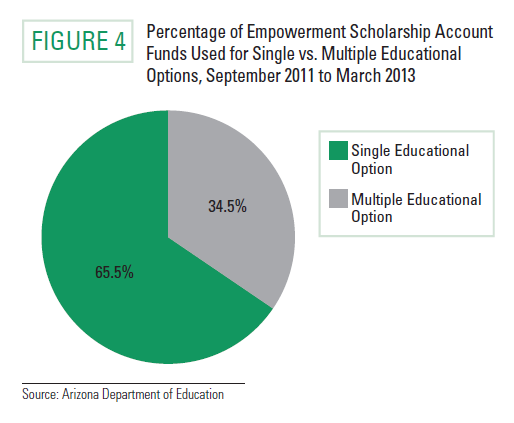
I recently evaluated Arizona’s ESA program for the Friedman Foundation to determine the extent to which parents were using their ESAs to actually customize their children’s educational experience. Using data provided by the Arizona Department of Education, I found that more than one third of families used their ESAs to tailor their child’s education, purchasing multiple services and products.

 Burke Figure 4

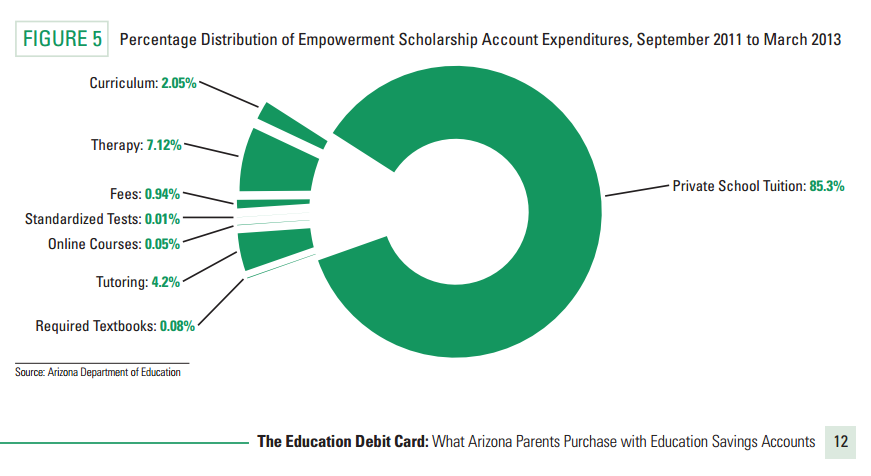
Families use their ESAs to finance a variety of education-related services from a range of providers. One family used roughly 60 percent of their ESA funds for educational therapy, 30 percent for private tutoring, and the remainder of their ESA for curricula. Another family put three-quarters of their ESA dollars toward private school tuition and invested the remaining 25 percent in a college savings fund. A third family divvied up their ESA spending on private school tuition, tutoring, curricula, and online learning.

While most families use their ESAs like a school voucher to attend a single private institution that they have chosen, approximately 34 percent use their ESAs to finance multiple education options in a given day. ESAs move beyond the worthwhile goal of choice among schools to choice among education service providers, courses, teachers, and methods—not limited to one brick-and-mortar location.

Burke Figure 5


ESAs are unique in another way: whereas traditional school vouchers must be spent in their entirety, ESAs foster demand-side pressure for education providers to offer more cost-efficient educational services by creating an incentive for parents to shop for education services based in part on cost. Parents are taking opportunity costs into account, saving ESA funds in anticipation of future education-related expenses, including college tuition. During the first quarter of the 2012-13 school year, parents rolled-over 26 percent of their ESA funds.

Burke Figure 6

Arizona has created a model that other states should consider: funding children instead of physical school buildings and allowing funds to follow children to any educational provider of choice. Jonathan Butcher and I also recently detailed how state policymakers could transition more traditional voucher and tuition tax credit programs into flexible education savings accounts. They could:

  • Create public school education savings accounts. Parents could use a public school education savings account for traditional school classes, public charter school offerings, public virtual schools such as the Florida Virtual School, community colleges, or state universities.
  • Shift existing school voucher or scholarship tax credit funds to an education savings account. States with existing voucher programs or scholarship tax credit programs should allow parents to deposit voucher or scholarship funds into an education savings account in order to gain more flexibility with their child’s funds.
  • Expand the approved expenses covered by a voucher or private school scholarship. This would include expanding the uses of a school voucher or scholarship, transitioning the program into an education savings account.

We are entering a new frontier of school choice. Education savings accounts represent an advance and refinement of Friedman’s original voucher concept. Through ESAs, Arizona is moving beyond school choice to education choice.  Kym Wilber, whose son Zach is an ESA recipient, explains:

“I use Zach’s ESA funds for other things than just tuition.  Because Zach is more on the moderate to severe functioning level [in terms of special needs], his funding can be used more broadly. I have a private tutor for Zach, and I can use the (ESA) funds for that. With the ESA, I can actually go out and buy things for our home program, such as additional speech tools.”

Providing that level of customization to every child would bring American K-12 education into the 21st century and ensure no child is relegated to the existing monopolistic system in which limited effectiveness is all too prevalent in states across the country.


It’s a Blowout: Tom Vander Ark 4, New Gates PLDD Strategy 0

August 29, 2013

The research evidence continues to pile up that the old Gates strategy of promoting small schools of choice has proven effective according to rigorous random-assignment design studies, while the new Gates PLDD strategy of building a national system of standards, assessments, and consequences has virtually no rigorous evidence to support it.

Under Tom Vander Ark’s leadership the Gates Foundation not only pursued an agenda based on a plausible theory of school improvement, but also initiated a series of high-quality studies to assess the results.  Even though Gates has largely abandoned its old strategy, those results are now pouring in.  We previously saw positive outcomes from a study by Lisa Barrow, Amy Claessens, and Diane Whitmore Schanzenbach of small schools in Chicago.  A non-Gates-funded analysis by my students, Anna Egalite and Brian Kisida, showed the same advantage for smaller schools in a national sample.  And in New York City, MDRC also demonstrated significant gains from small schools of choice.

Now MDRC has an updated analysis confirming that the benefits discovered earlier were extended and endured.  Randomly assigning students to small high schools “continue[s] to produce sustained positive effects, raising graduation rates by 9.5 percentage points.”  In addition, “more students are graduating ready for college: the [small high] schools raise by 6.8 percentage points the proportion of students scoring 75 or more on the English Regents exam, a critical measure of college readiness used by the City University of New York.”

What evidence do we have to support the new Gates PLDD strategy?  Umm, well, I’m sure Fordham can gather some of their friends together and give higher letter grades to states implementing the Gates PLDD strategy.  Over $6 million can buy some really good grades.

This is what the Gates Foundation has been reduced to — an organization that used to commission the most rigorous evaluations of their reform theory now invests overwhelmingly in the marketing and spinning of their new reform theory.  And they couldn’t even stick with the old reform theory of promoting small schools of choice long enough to see whether the rigorous evidence supported it.

Small schools?!?  That is like so 2007.  I think I’ll tweet my friends all about it, since Gates is now more interested in Twitter counts than random-assignment research.  Can Gates please put a grown-up in charge, like bringing back Tom Vander Ark?

[UPDATE — An alert reader notes that the score is actually 5-0.  I forgot this study of small schools designed as early college.  Also, note the comment I added clarifying the nature of my concern with the $6 million given by Gates to Fordham.]


DOJ Lawsuit Would Keep Black Kids in Failing Schools

August 25, 2013

(Guest Post by Yehoshua Bedrick)

In the name of civil rights, the Department of Justice is trying to prevent black families from exercising school choice.

Following on the heels of the Southern Poverty Law Center’s ridiculous lawsuit against Alabama’s new school choice law, which contends that if a law doesn’t help everyone it can’t help anyone, the U.S. Department of Justice is suing to block the state of Louisiana’s school voucher program for low-income students and students assigned to failing public schools:

The Justice Department’s primary argument is that letting students leave for vouchered private schools can disrupt the racial balance in public school systems that desegregation orders are meant to protect. Those orders almost always set rules for student transfers with the school system.

Federal analysis found that last year’s Louisiana vouchers increased racial imbalance in 34 historically segregated public schools in 13 systems. The Justice Department goes so far as to charge that in some of those schools, “the loss of students through the voucher program reversed much of the progress made toward integration.”

Segregation! That’s a serious charge. What evidence does the Department of Justice cite?

In Tangipahoa Parish, for instance, Independence Elementary School lost five white students to voucher schools, the petition states. The consequent change in the percent of enrolled white students “reinforc(ed) the racial identity of the school as a black school.”

Five students! According to the National Center for Education Statistics, there were 143 white students out of 482 students at Independence Elementary School in 2010-11 (the most recent year for which data is available). Assuming that recent enrollment and racial composition is the same and that no black students received vouchers as well, that’s a shift from 29.6 percent white to 28.9 percent white. Though the students at Independence almost certainly would not have noticed a difference, the racial bean counters at the DOJ see worsening segregation.

But the DOJ is not content merely to prevent white students from exercising school choice. The petition also cites Cecilia Primary School, which in 2012-13 “lost six black students as a result of the voucher program,” thereby “reinforcing the school’s racial identity as a white school in a predominantly black school district.” In the previous school year, the school’s racial composition was 30.1 percent black, which the DOJ notes was 16.4 percentage points lower than the black composition of the district as a whole. According to the NCES, in 2010-11 there were 205 black students out of a total enrollment of 758, so the school was 27 percent black. Assuming a constant total enrollment, the DOJ’s numbers suggest that there were 228 black students in 2011-12. The loss of six black students would mean the school’s racial composition shifted from 30.1 percent black to 29.2 percent black as a result of the voucher program. Again, imperceptible to untrained eye but a grave threat to racial harmony according to the Obama administration’s Department of Justice.

These are the only two schools cited directly in the DOJ’s petition, so presumably they represent the two cases with the largest impact. A footnote reveals that “The net loss ranged up to thirteen students per school.”

Since the vast majority of voucher students are black, it is likely that the DOJ’s lawsuit would disproportionately prevent black students from enrolling in the schools of their choice.

State Education Superintendent John White took issue with the suit’s primary argument and its characterization of the program. Almost all the students using vouchers are black, he said. Given that framework, “it’s a little ridiculous” to argue that students’ departure to voucher schools makes their home school systems less white, he said. He also thought it ironic that rules set up to combat racism were being called on to keep black students in failing schools. […]

White also pointed out that the schools in the voucher program must comply with the terms of 1975 court case, Brumfield v. Dodd, that prohibits the state from giving public money to private schools that uphold segregation or discrimination.

It’s no wonder that just a few months ago, more than one thousand people attended the Black Alliance for Educational Options rally to support the program in the face of another legal challenge.

This isn’t the first time that opponents of school choice have tried to use the specter of segregation to prevent families from exercising choice, but the evidence doesn’t support their claims. According to a literature review from the Friedman Foundation for Educational Choice, school choice programs thus far have had the salutary effect of reducingsegregation:

Eight empirical studies have examined school choice and racial segregation in schools. Of these, seven find that school choice moves students from more segregated schools into less segregated schools. One finds no net effect on segregation from school choice. No empirical study has found that choice increases racial segregation.

One of the problems with much of the discourse over segregation in education stems from the way it is defined. The Department of Justice here assumes that a school is segregated if its racial makeup varies from the population in that district. While most sane people wouldn’t consider a school that is roughly two-thirds white and one-third black or vice versa to be segregated, the Department of Justice does so long as the general population of the district is even more racially imbalanced. As the Friedman literature review notes:

[Professor Jay P.] Greene provides an instructive example that shows how this problem undermines the validity of such measures of segregation. In studies using the prevailing method, a school that is 98 percent white is considered perfectly integrated if it is in a school district that also is 98 percent white. The school receives this perfect score even if the 98-percent-white school district is right next door to another district that is 98 percent minority. Clearly, this should be considered segregation, but the prevailing method masks segregation when it occurs at the district level. Greene issues a concise verdict on what studies like this really are saying: “The schools are well integrated, given that they are horribly segregated.”

The studies included in the aforementioned Friedman Foundation literature review use more valid methods of measuring segregation, such as comparing the racial composition of a school to the racial composition of the wider metropolitan area (not just the school district), or measuring the occurrence of racial homogeneity.

School choice programs benefit most those who previously had the fewest educational options, particularly low-income families. Minority groups that are disproportionately low-income therefore benefit disproportionately from school choice. As the Friedman study notes, Milwaukee’s private schools were 75 percent white in 1994, but by 2008 they were only 35 percent white due to the city’s voucher program.

The Department of Justice’s lawsuit will hurt the very students it is intended to help. If DOJ apparatchiks want to reduce segregation in education, they should support efforts to expand school choice rather than try to block them.


Choice and Starfish

August 21, 2013

(Guest Post By Jason Bedrick)

Most people know the story of the boy who was rescuing sea stars that had washed up on a beach by throwing them back into the ocean. When a man scoffed to the boy that his efforts didn’t make a difference since he couldn’t save all of them, the boy tossed another sea star back into the ocean and replied, “It made a difference to that one.” The little-known ending to the story is that the boy was sued by the Southern Poverty Law Center for violating the Constitution’s Equal Protection clause.

 Sadly, this is only a slight exaggeration. Earlier this week, the Southern Poverty Law Center filed a federal lawsuit contending that Alabama’s new scholarship tax credit program violates the Equal Protection clause and harms the low-income students attending failing public schools whom the law is intended to help:

[SPLC] President Richard Cohen said the new Alabama Accountability Act will take millions away from public schools and will make the failing schools worse than they are now. He said the law was promoted by Republican Gov. Robert Bentley as giving students a way out of failing schools. 

“It’s a lie. Our clients do not have a way out of the failing schools that they are in,” he said.

The Montgomery-based law center sued on the opening day of classes for most public schools in Alabama. The suit focuses on a part of the law that allows families with children in Alabama’s 78 failing public schools to move them to a non-failing public school or to a private school that participates in the program. They can get a state tax credit of about $3,500 annually to help cover private school costs.

The lawsuit was filed on behalf of eight plaintiffs who say that they can’t afford to go to private schools and that the non-failing public schools are not accessible. The lawsuit raises equal protection issues.

One of the eight plaintiffs, Mariah Russaw, said she couldn’t afford the transportation costs even if her 12-year-old grandson, J.R., could leave Barbour County Junior High School in Clayton. All junior highs in the Barbour County school system are on the failing list. The nearest non-failing public school is 19 miles away in Pike County. The nearest private school is about 30 miles away, but it is not participating in the program.

The 62-year-old grandmother said it wouldn’t matter if the private school were participating. “I cannot afford to transport him to another school,” she said.

In short, SPLC argues that if the law can’t rescue every child from a failing school, then it shouldn’t be allowed to rescue any child. Not only would this line of reasoning hobble almost every government effort to incrementally address any problem, but the argument also rests on a misunderstanding of the status quo and the law’s likely impact.

The SPLC lawsuit claims that the law “creates two classes of students assigned to failing schools – those who can escape because of their parents’ income or where they live and those, like the Plaintiffs here, who cannot.” In fact, those two classes of students already exist. In our existing education system, low-income families are trapped in failing schools while wealthier families can afford either to live in districts with better public schools or to send their children to private school. The scholarship tax credit program is too limited to solve all the existing inequities, but it moves more students out of the first category and into the second. In other words, by expanding opportunities to low-income families, it makes an already unequal education system more equal.

Moreover, there is no evidence the program does harm to students who remain in public schools. The SPLC claims that the failing public schools are “likely to deteriorate further as their funding is continually diminished” as a result of students fleeing from those schools. But a mere assertion that harm is “likely” doesn’t cut it. Had the SPLC consulted the research literature instead of their fevered imaginations, they would have discovered that 22 of 23 studies of school choice programs found that they have positive impact on public school performance. The last study found no visible impact.

In other words, the increased choice and competition help both the students who participate in the program and those students who remain in their assigned public schools. Striking down the program would thus make matters worse for the litigants and other families like them, not better. Expanding the program would improve outcomes even further. If the SPLC is truly motivated by a desire to help low-income families, it should drop its lawsuit and join the effort to expand educational options. There are lots of sea stars left on the beach and they could use a hand.


In Defense of A-Rod

August 19, 2013

Alex Rodriguez is one of the highest paid athletes of all time.  He also has to be one of the most despised.  But this is precisely why the Yankees and MLB officials are getting away with a blatant effort to cheat A-Rod out of money for activities from which they benefited financially.

Yes, it is obvious that A-Rod has used performance enhancing drugs (PEDs) that are banned by baseball.  Yes, A-Rod often behaves like a jerk.  But being a jerk who cheats with drugs does not explain why the MLB is seeking much higher punishment of A-Rod than other baseball players who are also PED-using jerks.

The explanation is money.  If A-Rod is suspended for using banned substances the Yankees do not have to pay him during his suspension.  Given A-Rod’s sky-high salary, that saves the Yankees a large chunk of change.  It also lowers the Yankee’s payroll enough to avoid the “luxury tax” imposed on big spending teams.  And given that A-Rod has been injured and a sub-par player recently, losing his availability is a minor inconvenience to the Yankees relative to their enormous potential savings.  The Yankees are rooting for a big penalty.

I know that it is hard to feel bad for A-Rod.  He gets paid so much and has been such a disappointing player.  But the Yankees were dumb enough to sign a contract for his outrageous salary.  They shouldn’t be able to sneak out it by exploiting A-Rod’s unpopularity.  Justice is not achieved by cheating the disliked.  Justice requires that people get what they are owed, even if they are unpopular.

And for all those fans who despise A-Rod and other professional athletes for their high salaries, remember that the owners have even higher salaries and are making profits off of the players even after promising them enormous sums.  The professional athletes have extraordinary talents for which we, the fans, voluntarily pay large amounts of money to team owners who voluntarily offer high salaries to players.  Those players deserve every penny they are promised.  Hating talented people who earn large amounts of money is nothing but petty jealousy.

A system where team owners don’t have to pay players who are caught using PEDs unreasonably benefits the owners and encourages cheating.  Owners offer enormous salaries for higher-performing players, which provides incentives to players to use PEDs.  The owners benefit from those cheating players because of their higher performance.  If the players are caught, only the player suffers.  The owner, who benefited from the cheating, is off the hook financially and experiences no other loss from the cheating other than the loss of the availability of that player.

A better system of incentives would require owners to pay players even if they are suspended for PEDs.  This would provide a strong incentive to owners to avoid signing players who they strongly suspect to be cheating.  In turn, it would discourage players from using PEDs in the hopes of getting a better contract.  And it would encourage teams to monitor their own players more tightly to make sure they were not using PEDs.  If we want to drastically reduce the use of PEDs in baseball we can’t let the owners off the hook financially when players are caught.


Jeb Bush Drops School Choice – I Wonder Why

August 19, 2013

(Guest post by Greg Forster)

Jeb Bush’s big speech about education reform has made it onto NRO this morning. He does not include school choice as one of the four key components of education reform. I can’t imagine why Jeb would no longer view school choice as having been an important part of the Florida formula for success. Oh, wait, yes I totally can.

I am for standards. But choice must succeed before standards can succeed. By dropping school choice from his list of must-have reforms, Jeb is undermining the necessary path to success for standards.

Granted, he does turn aside at one point, under his section on digital learning, to tangentially mention school choice. But then, weirdly, he immediately feels the need to insist that “accountability is the cornerstone of reform.” Why is he suddenly going back to the subject of accountability when he’s already discussed that in a previous section? It’s a total non sequitur for him to bring it back up here – unless, that is, he shares my view that school choice is ultimately at odds with the technocratic, “trust us, we’re experts” spirit of Common Core.

He also asserts CC won’t hurt school choice – but his own defensive rush to demand that “accountability is the cornerstone of reform” after merely mentioning school choice undermines confidence in that assertion.

If anyone wants to contest my read of this speech I would request their responses to two questions: Why isn’t school choice one of Jeb’s four must-have reforms? And why does he suddenly rush to insist that “accountability is the cornerstone of reform” right after working in an anodyne mention of school choice?

One last point: We who prioritize school choice did not pick this fight. It was the CC crowd who came out with guns blazing, demanding that all schools must be judged on their yardstick (not parents’ yardsticks) and spitting on anyone who questioned their orthodoxy. We did not pick this fight. But we will not roll over just because the CC folks have all the money and power. A decade ago, the unions had all the money and power. We survived them, and we’ll survive Common Core as well, because we’re right.


The world as you knew it at the end of the 20th Century…

August 15, 2013

(Guest Post by Matthew Ladner)

Derrell Bradford hits TEDx on digital disruption, choice and education:


Enrichment Spending and Inequality

August 15, 2013

NYT(Guest Post by Matthew Ladner)

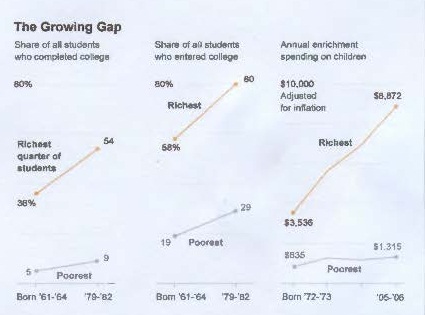
The New York Times published the above chart last December here’s a link if you would like a better look. It basically shows that both college attendance and completion and private enrichment spending have been increasing at a much faster rate among wealthier students.

I find the enrichment spending trend particularly interesting for a couple of reasons. First, like Collin’s grit measure, it seems like an example of something that has been lurking in the error term of our limited understanding of K-12 trends.  I’m not sure how the authors define “enrichment spending” but $8,900 per year for well-to-do kids is striking.  How much does this matter? I’m not sure but I think it ought to be rigorously researched. It could matter quite a bit.

Four states have average family incomes for a family of four above six figures and one cannot help but wonder how much more this trend influences academic trends than in other states. Washington DC has been gentrifying strongly and has also had a large increase in the economic achievement gap despite large gains for low-income kids.  Could this trend be partially explained by this phenomenon?

What, if anything, is to be done about this? A vast increase in K-12 spending aimed at the cultural enrichment of poor children is not in the cards given the rotten state of state and federal finances, and it is just as well given the fact that the relationship between spending and outcomes is already hazy to say the least in the public school system. Just as a reminder, in the insightful words of Paul Hill:

Money is used so loosely in public education – in ways that few understand and that lack plausible connections to student learning – that no one can say how much money, if used optimally, would be enough. Accounting systems make it impossible to track how much is spent on a particular child or school, and hide the costs of programs and teacher contracts. Districts can’t choose the most cost-effective programs because they lack evidence on costs and results.

The country is broke and even if we did raise taxes to punishing levels to fund this stuff no one should feel the least bit confident that enrichment spending would actually work if funnelled through the existing system. Jay’s idea about supplementing private summer camp attendance might be a better idea but again public finances are a total mess. This is currently in the private realm and it is necessary to keep it that way.

This would seem to leave us with at least few possibilities. Better use of technology may enhance the efforts of both public and private enrichment efforts. Khan Academy is doubtlessly one of the most powerful remedial education tools ever developed. It is free of charge and has branched out into the fine arts, and it is hardly alone. Sandra Day O’Connor has an online civics project for instance but I suspect that these efforts will require some concerted effort to realise their full potential. Putting them up online is a first crucial step, but one cannot help but to fear that their impact might be reminiscent of public libraries absent a sustained effort to get children to use them.

Fareed Zakaria summarizes the current debate on inequality, social mobility and schooling, but misses the crucial point.  The problem isn’t that we spend so little on the schooling of poor children but rather that we get so little for the massive amounts spent. American Black and Hispanic students score closer to the average score in Mexico (a nation that spends a fraction of what we do per pupil and which suffers from a much greater poverty problem) than to top performing scores. Using various policy mechanisms to increase ROI for K-12 spending runs you straight into reactionary resistance but it easily represents the most promising avenue for improving the prospects for disadvantaged children.

Oh, and by the way, as the New York Daily News kindly points out it does work.


Narcissus Redux

August 14, 2013

In the TV series Lost some of the characters believed that a set of six numbers had to be entered into a computer every 108 minutes or something terrible would happen.  At least initially, it was unclear whether this compulsion to type The Numbers really would save the world from destruction or was just a manifestation of madness.

Typing 6 numbers into a computer every 108 minutes comes to mind when I think about the role that Twitter plays in education policy debates.  Some people feel the urgent need to type fewer than 140 characters into Twitter on a very frequent basis.  Are they saving the world from something terrible or are they suffering from a form of madness?

Judging by the high status of many of these manic Tweeters you might think they are saving the world.  They include respected academics, think tank leaders, and foundation officials, so it would seem that they really must engage in these compulsive acts to prevent something terrible from happening.

Unfortunately, I think they are suffering from a form of madness.  Issuing dozens of 140 character messages every day has no real impact on making the world better.  It just encourages shallow thinking and petty sniping.  In the history of the Universe it is highly unlikely that any Tweet influenced or helped anyone.  Yes, maybe an occasional link to an interesting article was influential, but how many interesting articles can one link to each day? It is virtually certain that dozens of Tweets per day have never done anything beyond soothe the Tweeter’s manic anxiety.

Yet, we see that many seemingly respectable education policy analysts feel the compulsion to type 140 characters more frequently than every 108 minutes.  And millions of Foundation dollars are being allocated to organizations based on “metrics” that include Twitter counts.  What a remarkable waste of Foundation money, not to mention the time of highly educated individuals who could be engaged in productive tasks.  Even worse, manic Twittering has coarsened education policy discussions by substituting superficial slogans and snark for actual thought.  It has electronically lobotomized people into thinking that “tight-loose” is actually an argument.

To gauge the extent to which this madness has overtaken education policy analysts I’ve updated my Narcissus Index to see how frequently people are Tweeting.  When I published the Narcissus Index on April 2 I recorded how many Tweets people had issued as of that date.  I collected information on how many Tweets they had sent as of this morning to calculate the number of Tweets people have sent over the last 134 days.  In the table below you can see the number of Tweets issued over the last 134 days as well as the average number of Tweets per day, rounded to the closest whole number.

I also calculated how many minutes, on average, went by during every waking hour between Tweets.  I assumed that people slept 8 hours per day, so there have been 2,144 waking hours since April 2.  That works out to 128,640 waking minutes.  Dividing that number of minutes by the number of Tweets since April 2, we can see how frequently people Tweet.  Of the 81 people for whom I had information as of April 2, 3 have discontinued use of Twitter. (Good for them!)  The results for the remaining 78 are listed below.  I’m sorry I can’t easily add new people because I only have the April 2 info for these people.

Of those 78 people, 22 send out a Tweet more often, on average, than every 108 minutes.  They meet the Lost threshold for saving the world from destruction.  Larry Ferlazzo manages to Tweet every 16 minutes of every waking hour over the last 134 days.  Sara Goldrick-Rab is not far behind at one Tweet every 18 minutes.  And RiShawn Biddle manages one Tweet every 23 minutes.  Diane Ravitch may be slacking as she only Tweets every 46 minutes of every waking hour over the last four months.

Keep in mind that these people must also shower, eat, go shopping, talk with family and friends, etc…  It’s summer, so maybe they went on vacation or took a day at the beach.  Just think of the number of available minutes consumed with Tweeting.  Presumably they also have jobs.

As long as Foundations continue to allocate funds based partially on Twitter “metrics” and as long as the rest of us continue to treat this manic behavior as not only normal, but something to be admired, we will continue to encourage it.  Folks may even rightly think of it as an important part of their jobs, even though it does virtually nothing productive in the world.  Or does it save the world?

Wait, I have to type 4 8 15 16 23 42…  Phew!  Disaster averted.

Name Handle tweets in the last 134 days  tweets/day minutes between tweets
Larry Ferlazzo  @larryferlazzo 8,175 61 16
Sara Goldrick-Rab  @saragoldrickrab 6,967 52 18
RiShawn Biddle  @dropoutnation 5,538 41 23
Vicki Davis  @coolcatteacher 4,410 33 29
Randi Weingarten @rweingarten 3,901 29 33
Andy Smarick  @smarick 2,952 22 44
Morgan Polikoff  @mpolikoff 2,834 21 45
Diane Ravitch @DianeRavitch 2,797 21 46
Mickey Kaus  @kausmickey 2,713 20 47
Deborah M. McGriff  @dmmcgriff 2,692 20 48
Sherman Dorn   @shermandorn 2,411 18 53
Nancy Flanagan @nancyflanagan 2,379 18 54
Alexander Russo @alexanderrusso 2,162 16 60
Michael Petrilli @michaelpetrilli 1,933 14 67
Marc Porter Magee  @marcportermagee 1,619 12 79
Anthony Cody @anthonycody 1,560 12 82
Neal McCluskey  @NealMcCluskey 1,525 11 84
Mike Klonsky @mikeklonsky 1,486 11 87
John Bailey  @john_bailey 1,445 11 89
Tom Vander Ark @tvanderark 1,340 10 96
Allie Kimmel  @allie_kimmel 1,236 9 104
Kathleen Porter Magee  @kportermagee 1,230 9 105
The Lost Threshold
Sam Chaltain @samchaltain 1,170 9 110
Eric Lerum  @ericlerum 1,117 8 115
Patrick Riccards @Eduflack 1,011 8 127
Andrew P. Kelly  @andrewpkelly 908 7 142
The Frustrated Teacher @tfteacher 896 7 144
Bruce Baker  @schlFinance101 879 7 146
Jenna Schuette Talbot  @jennastalbot 867 6 148
Andrew Rotherham  @arotherham 784 6 164
Howard Fuller  @howardlfuller 777 6 166
Doug Levin  @douglevin 661 5 195
Gary Rubinstein  @garyrubinstein 530 4 243
Neerav Kingsland  @neeravkingsland 510 4 252
Kevin Carey  @kevincarey1 495 4 260
Michael Barber  @michaelbarber9 478 4 269
Joanne Jacobs  @joanneleejacobs 427 3 301
Justin Cohen  @juscohen 424 3 303
Ben Wildavsky  @wildavsky 395 3 326
Robert Pondiscio  @rpondiscio 393 3 327
Dana Goldstein @DanaGoldstein 387 3 332
Kevin P. Chavous  @kevinpchavous 386 3 333
Matt Williams  @mattawilliams 359 3 358
Laura Bornfreund  @laurabornfreund 358 3 359
Matt Kramer  @kramer_matt 342 3 376
Lisa Duty  @lisaduty1 339 3 379
Wendy Kopp  @wendykopp 305 2 422
Irvin Scott  @iscott4 303 2 425
Matt Chingos  @chingos 296 2 435
John Nash  @jnash 289 2 445
David DeSchryver  @ddeschryver 272 2 473
Ashley Inman  @ahsleyemillia 260 2 495
Matthew Ladner  @matthewladner 256 2 503
Jeanne Allen  @jeanneallen 227 2 567
Rachel Young  @msrachelyoung 226 2 569
Charles Barone  @charlesbarone 224 2 574
Michelle Rhee @m_rhee 209 2 616
Adam Emerson  @adamjemerson 206 2 624
Terry Stoops  @terrystoops 198 1 650
Lindsey Burke  @lindseymburke 182 1 707
Mike McShane  @MQ_McShane 163 1 789
Sara Mead   @saramead 158 1 814
Jeb Bush  @jebbush 148 1 869
Richard Lee Colvin  @R_Colvin 122 1 1054
Paul Queary  @paulqueary 107 1 1202
Alfie Kohn @alfiekohn 107 1 1202
Vicki Phillips  @drvickip 97 1 1326
Greg Richmond  @GregRichmond 84 1 1531
Ulrich Boser  @ulrichboser 63 0 2042
Jay P. Greene  @jaypgreene 49 0 2625
Heather Higgins  @TheHRH 46 0 2797
Roxanna Elden  @roxannaElden 46 0 2797
Ben Boychuk  @benboychuk 40 0 3216
Matthew K. Tabor  @matthewktabor 6 0 21440
Jamie Davies O’Leary  @jamieoleary 4 0 32160
Not Diane Ravtich  @NOTDianeRavitch 4 0 32160
Linda Perlstein  @lindaperlstein 2 0 64320

(Edited to correct typos)