Legends of the Fall

September 30, 2008

(Guest Post by Matthew Ladner)

If I live to be 120 years old, I won’t live to see a statement so brazenly and knowingly mistaken as the one uttered by Congressman Barney Frank (D-MA) regarding the current financial crisis: “The private sector got us into this mess. The government has to get us out of it.”


Say the statement out loud. Swish the sour taste in your mouth. This statement is the precise opposite of the truth. As chairman of the House Financial Services committee, Frank knows better.


It was in fact the public sector that got us into the subprime mess: specifically, government sponsored entities Fannie Mae and Freddie Mac. These “Government Sponsored Entities” engaged in social engineering in the housing market by buying up reckless mortgages. Perversely, lenders now had no incentive to consider the credit worthiness of borrowers, as they could quickly off-load even absurd mortgages to the GSE’s.


On September 30th, 1999 the New York Times reported on Congressional efforts to expand subprime lending. “Fannie Mae, the nation’s biggest underwriter of home mortgages, has been under increasing pressure from the Clinton administration to expand mortgage loans among low and moderate income people and felt pressure from stock holders to maintain phenomenal growth in profits,” the Times reported.


“Fannie Mae has expanded home ownership for millions of families in the 1990s by reducing down payment requirements,” Franklin Raines, former Clinton administration official and Fannie Mae chairman told the Times. “Yet there remain too many borrowers whose credit is just a notch below what our underwriting has required who have been relegated to paying significantly higher mortgage rates in the so-called subprime market.”


Raines made this statement as a justification for Fannie Mae easing the credit requirements on loans purchased from lenders. In other words, Fannie blew even harder into the housing bubble. “By expanding the types of loans it will buy, Fannie Mae is hoping to spur banks to make more loans to people with less-than stellar credit ratings,” the New York Times reported.


See video on unsuccessful efforts to rein in Freddie and Fannie from 2004-2005 here:


Sadly in all of this, the housing market social engineers were unable to suspend the law of unintended consequences. Bartenders became would be real estate moguls, and the lenders played along collecting fees secure in the knowledge that when it all went south, they wouldn’t be left holding the bag. Speculative bubbles thrive on someone making a quick buck, drawing others into trying to do the same. Freddie and Fannie fueled the bonfire of stupidity.


The ultimate blame lies not with the lenders, but rather with those who created the perverse incentives.


Sadly, similar economic myths have been promoted in the past, and still afflict us to this day. As a university student, I was fed the story of how the Great Depression proved the ultimate failure of free-markets, and how the administration of Franklin Roosevelt heroically saved the nation from crisis.


This version of history is also very much at odds with the truth. Research by Milton Friedman and others has firmly established that the Stock Market Crash of 1929 played only a limited role in creating and sustaining the Great Depression. Rather, a series of policy errors by Congress, the Hoover Administration (creating a global trade war), the Federal Reserve (tightening monetary policy during a contraction) and the Roosevelt Administration (too many errors to list) created a prolonged downturn.


The United States had suffered plenty of stock market crashes, and economic downturns. What stands out about the Great Depression is not that it happened, but rather that it lasted so long due to a series of tragic missteps.


This too provides a lesson for today: the main thing we should fear are not bank failures or stock market declines, but rather the rushed and foolish actions of politicians. The only thing we have to fear is not fear itself, but rather fear and reckless government mistakes.


Congressman Frank, who defended Freddie and Fannie from attempt to rein them in after scandals emerged, was even so brazen as to dismissively put this crisis “back to Ronald Reagan, when at his inauguration he said, ‘Government is not the answer to our problems; government is the problem.’”


Sorry Congressman: Reagan got it exactly right and you have it precisely wrong.


Speaking of Standards for Debate . . .

September 30, 2008

(Guest post by Greg Forster)

Since I’m on the subject of the lack of decent standards for public debate in America (see below), could supporters of the bailout please observe a moritorium on the following practices?

1. Attributing to opponents of the bailout, without citation, the position that a general economic crash or depression would be “no big deal,” or not as bad as the bailout. As far as I can see, the most common argument against the bailout seems to be that no general economic crash will occur. You may disagree; you may even have difficulty taking that position seriously. But to say that they’re cool with destroying the American economy is really a pretty obvious straw man. (Except, of course, in those rare cases where you actually do catch somebody saying that a depression would be no big deal, as here. But attributing that view to opponents of the bailout generally seems to me to be clearly false.)

2. Calling opponents of the bailout “irresponsible,” as several people did in The Corner last night. Of course, the position that a new Great Depression would be no big deal would indeed be irresponsible – if opponents of the bailout held it. But they don’t. As I understand it, they think financial markets will take a sizeable hit, as a natural result of bad investment decisions made by the major Wall Street firms under prompting from two decades of really bad housing policy in Washington, and then life will go back to normal. They further think (again, as I understand it) that the bad decisions made during the housing boom are going to have economic consequences regardless of what we do, and it’s better for those consequences to fall quickly on those who deserve them than to spread them out over all of society and have them take a long time to clear. (And that’s to say nothing of the opportunity the bailout bill offers for the authors of the old bad housing policies to enact new bad housing policies as part of the bailout.)

Let me be very clear that I have no opinion on the merits of the bailout itself, and I’m glad that it’s not my job to have one. It seems to me – and I’m no finance expert, so I welcome correction if I have this wrong – that the argument for the bailout goes roughly as follows:

1. We are in a financial panic.

2. During a financial panic, markets don’t price assets rationally in the short term (this is what I think is meant when people talk about assets being basically sound but having a “liquidity problem”).

3. If nothing is done to correct this irrationality, panics escalate into general economic crashes.

4. During a panic, the Treasury Department (or some other government entity) is able to price assets more rationally than the maket in the short term, and thus it can avert a general crash by buying the assets and then selling them off after the panic has subsided and markets are rational again.

Now, all of these are, at bottom, claims about empirical facts. And I lack the factual knowledge to say whether any of them is true or false. People whose opinion I respect are falling on both sides of the fence. And I have no pressing need to sort through all their arguments to figure it all out. So I’m content not to have an opinion.

But if I did have to choose, I’d start by looking at which side is treating the other side more fairly. It’s a pretty good rule of thumb (though not infallible) that the people who are in fact right are going to be more confident they have truth on their side, and you can tell who are really confident they have truth on their side by looking at who’s afraid of a fair exchange of ideas.


Revenge Is a Dish Best Served on Live TV

September 30, 2008

(Guest post by Greg Forster)

Joe Biden wishes Bret Stephens didn’t have such a long memory:

Debate Questions for Joe Biden

Finally, senator, something from the more distant past. In 1981, at the outset of the Reagan administration, you took the lead in cross-examining William ‘Judge’ Clark for his confirmation hearings for deputy secretary of state. Mr. Clark’s job was explicitly intended to be managerial, not policy oriented. Nevertheless, you asked him for the names of the prime ministers of South Africa and Zimbabwe, both of which were second-tier posts in presidential systems.

In the same spirit, Sen. Biden, and as a longstanding leader of the Foreign Relations Committee, can you give us the names of the prime minister of France and the president of Germany? Just to be clear here, senator, I am not referring to President Sarkozy and Chancellor Merkel.

Ouch!

Too bad we Americans never developed a tradition of real debate in politics. The only reason you’ve heard of the Lincoln/Douglas debates is because they’re unique. People might actually tune in and watch – even at 9:00 on a Friday night – if there were some prospect of interesting questions being asked. But there isn’t. And that’s why even this Thursday’s VP debate is likely to be anti-climactic.

Having picked on Joe Biden, which is too easy anyway, I’ll now show my spirit of evenhandedness (and also bring this blog post back to an educational topic) by picking on Sarah Palin.

Suppose there were some prospect of Sarah Palin being asked the following questions:

Governor Palin, during your term you have developed a working alliance with Alaska’s teacher union – throwing more money at schools even with no prospect of improvement, opposing real reforms like school choice, and shifting state funds into archaic and unaffordable “defined benefit” pension plans that you actually opposed when you ran for governor. In return, the state and national unions have praised you, and the state union stayed out of the governor’s race, effectively endorsing your candidacy.

Do you agree with Senator McCain that school choice “is a fundamental and essential right we should honor for all parents”?

If a constitutional provision such as Alaska’s bigoted Blaine Amendment (your excuse for opposing vouchers as governor) violates people’s “fundamental and essential rights,” which should prevail?

Do you agree with Senator McCain that Obama’s opposition to vouchers is “tired rhetoric” that “went over well with the teachers union” but leaves children “stuck in failing schools,” and that “no entrenched bureaucracy or union should deny parents that choice and children that opportunity”?

Do you agree with Senator McCain that it is “beyond hypocritical that many of those who would refuse to allow public school parents to choose their child’s school would never agree to force their own children into a school that did not work or was unsafe”?

Whom do you think he is talking about when he says that?

Do you think this would be a better country if we had that kind of debate?

Of course, we would need to have politicians who could give as good as they got. As in:

Biden: Mr. Stephens, I asked that question because I thought it was important. If Mr. Clark felt the question was unfair, he could have just said so. In that spirit, if I need to know the name of the prime minister of France when I’m vice president, it will probably be because I’m going to his funeral, in which case I’m sure I’ll have no trouble finding out the name before I show up.

Or:

Palin: Mr. Forster, as governor, I don’t have the privilege of rewriting the state constitution at will. I have to govern according to the laws as they are. I’m glad that bloggers like you have the freedom to call those laws into question. And I suppose being governor of the nation’s largest state is a little bit like being a blogger . . . except that I have actual responsibilities.

Think either of them would be up to that kind of answer?


Blog Security Risk

September 29, 2008

I don’t mean to alarm all of you, but I should tell you that Greg Forster, Matt Ladner, and I were all in the same place last week.  I know that this was an unacceptable breach of blog security — if something awful should have happened to us, if terrorists had struck, who would have been left to carry-on with the blog?

Normally we maintain blog security by ensuring that one of us is kept in a bunker in an undisclosed location when the other two meet.  Having us all three together was running an unreasonable risk.

We have taken concrete steps to improve blog security.  In particular, I have successfully cloned myself so that Jay Prime can go to the bunker if the three of us ever get together again.  Jay Prime has been taught all of the secrets of the Jay P. Greene Blog so that if anything should happen the blog will be able to continue.  The Blog Security color remains orange, so we will continue to be vigilant against any and all threats.


Real Longhorn Fans, Part Deux

September 27, 2008

(Guest Post by Matthew Ladner)


Reporter in Bed with School Official, Literally

September 27, 2008

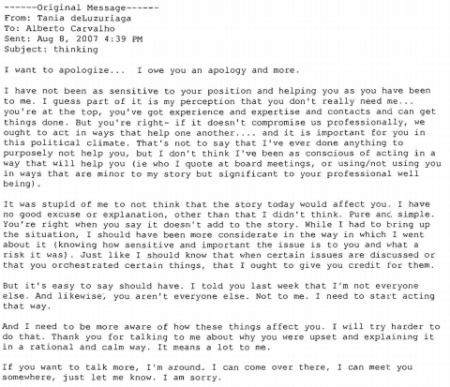
A series of e-mails between reporter, Tania deLuzuriaga, and a senor Miami-Dade school official, Alberto Carvalho, suggest an affair between the two while deLuzuriaga covered Miami schools for the Miami Herald.  deLuzuriaga has resigned from her job at the Boston Globe, where she moved last fall.  And Carvalho’s  selection as the new superintendent of Miami-Dade schools is in jeopardy.

The most alarming part of this story is not the affair itself, but how the affair distorted news coverage.  In addition to documenting the relationship, the emails detail how deLuzuriaga attempted to shape her reporting to preserve her relationship with Carvalho and how he bullied her about it.  In this exchange we see that Carvalho argued with deLuzuriaga about her coverage and she apologizes, asking for “understanding” about not quoting him more and giving him more credit:Carvalho

And in this e-mail deLuzuriaga explicitly apologizes for not helping Carvalho more and pledges that “we ought to act in ways that help one another”

Carvalho2Unfortunately, too many education reporters, especially outside of major cities, are in bed with school officials — figuratively.  They depend upon those officials for access and treat their pronouncements and views as accepted facts when they should be much more skeptical. 

If you want to see some examples of the rare investigative education reporter, check out Scott Reeder or Mike Antonucci.


Decision 2008: Greatest Bad Movie Ever

September 26, 2008

(Guest Post by Matthew Ladner)

So kids, the time has come to choose: what is the greatest really bad movie of all time? Number one seeds: Xanadu, Starship Troopers, Urban Cowboy and Point Break.


The floor is also open for nominations.


One movie I’ve had nominated, but haven’t had the chance to see yet: Congo.


Have your voice heard by voting in the comment section.


What Credit Crunch?

September 25, 2008

If there really were a credit crunch requiring a massive government bailout (even via an insurance scheme), it shouldn’t be the case that people could currently obtain mortgages, auto loans , and consumer loans at reasonable rates.  If credit were scarce, interest rates for these loans should be really high and/or impossible to get.  Neither is the case, so the claims of a crunch are false.


America Loses a Reform Titan

September 25, 2008

(Guest Post by Matthew Ladner)

J. Patrick Rooney passed away recently, leaving behind a remarkable legacy.

The Los Angeles Times once described Rooney as “a wealthy man and politically eccentric conservative who also had championed civil rights throughout his life.” An Indianapolis insurance executive, Rooney fought racial discrimination in the insurance market and launched the nation’s first privately financed school voucher program.

Rooney told the Wall Street Journal “When all families, no matter how poor, have the freedom to walk away from bad schools, competition will force the public schools to improve.”

Rooney’s privately funded programs were the precursor to the creation of scholarship tax credits, originating in Arizona. Jack and Isabel McVaugh created the Arizona School Choice Trust, inspired by Rooney’s philanthropy. In 1997, the Arizona legislature created the nation’s first scholarship tax credit program in order to augment these efforts.

Today, there are seven scholarship tax credit programs in Arizona, Florida, Georgia, Iowa, Pennsylvania, and Rhode Island helping thousands of parents to choose the best school for their child.

Rooney’s impact stretches beyond these impressive education achievements. He is also known as “the Father of Medical Savings Accounts,” the precursor to today’s Health Savings Accounts. HSAs represent the most effective heath reform option on the table today, as they uniquely address the underlying problem of out of control costs.

Rooney left the world a better place than he found it, and it falls to us to see that his great legacy of progress continues to grow.


It’s a Sign, All Right!

September 23, 2008

HT digitalius

(Guest post by Greg Forster)

When former Pinellas County teacher-union head and “national NEA activist” Doug Tuthill became president of the Florida School Choice Fund, Jay announced that dogs and cats were living together. (By coincidence, in the same week The Onion ran this, one of their best ever.)

Not so fast, says America’s Last Education Labor Reporter. “Tuthill has always been something of a union maverick,” notes ALELR in his latest communique. “He was a new unionist well before NEA President Bob Chase took up the call and made it official policy. Tuthill’s essay in the February 1997 NEA Today, headlined ‘Time to Face the Hard Truth,’ could have been written today – which might explain why Tuthill has gone over to the Dark Side.”

ALELR quotes from Tuthill’s article: “The traditional role of education unions has been to protect members from the negative effects of dysfunctional school systems. That’s not enough anymore.” As recently as 2004, Tuthill was calling for new unionism to “rise from the ashes” and was pushing for NEA involvement in charter school management, membership services for private schools, and “supporting” home schoolers.

Well, I read “Time to Face the Hard Truth,” and frankly, other than that one line about how unions should do more than protect teachers from being fired, it all looks like standard NEA boilerplate. “Today’s education unions must take on the task of transforming these systems. Our primary goal must be to create learning systems in which all adults and children achieve at high levels.” Etc. Etc. Etc. These days the NEA just has computers write this stuff for them, switching the words around so we don’t notice (e.g. “Today’s education unions must take on the goal of transforming these learning systems for all adults and children. Our primary task must be to create systems in which all achieve at high levels”). That frees up more time for them to hang out in their member-funded stadium skyboxes and go on those all-important conference trips.

So ALELR is right that the essay “could have been written today,” but not by a reformer. This kind of fluff only passes as deep thought among the “wow, man, kids need so much” crowd.

In the article, Tuthill talks about a teacher who was being fired for incompetence: ” ‘I know I haven’t done a good job,’ she said crying, ‘but I’m doing the best I can. These kids have so many problems, I just don’t know where to begin. What am I going to do?’ “

What happens? The union saves her job, and Tuthill is glad that this incompetent teacher is returned to the classroom. He sees her as a “victim” of “dysfunctional systems.” His only regret is that more effort (read: money) isn’t being spent on teacher training to help ensure that future teachers won’t be incompetent:

I was pleased that our union had helped her, but the episode bothered me. This teacher had been the victim of a series of dysfunctional systems. She was poorly trained, improperly placed, and not adequately supported. Consistent with our traditional advocacy role, we helped her, but we did nothing to change the systems that caused her problems.

Even that line about unions doing more than just protecting teachers from being fired gets it wrong. What does he say the union is protecting teachers from? “The negative effects of dysfunctional school systems.” I guess any school system that wants to fire a teacher is by definition dysfunctional.

Tuthill gets a little maverick cred simply for mentioning the fact that unions do help prevent teachers from being fired, but is that all it takes to render Tuthill’s move to the school choice movement a yawner?

With all due respect to ALELR, if Tuthill has signed on to lead the charge for school choice, it’s clear that he’s made a lot of progress since 1997. Dogs and cats are indeed living together. Now it’s just a question of how many more politicians realize that they can save the educational lives of millions of registered voters.