Questions for Jeb and Joel

June 28, 2011

(Guest post by Greg Forster)

Today’s Wall Street Journal carries my letter to the editor responding to last week’s op-ed by Jeb Bush and Joel Klein advocating national (“common”) education standards.

In my letter, I ask a few questions:

I greatly respect Jeb Bush and Joel Klein. But if Common Core is voluntary and state-driven, how do they explain the federal government repeatedly threatening states to join it or lose federal funds? Why are the testing consortia associated with this effort federally funded and controlled?

Confusingly, Messrs. Bush and Klein praise decentralization and local control for pedagogy while urging states to submit to a centralized command-and-control system for content standards. If nationalization is bad for pedagogy, why is it good for standards? Is it even possible to nationalize standards without nationalizing pedagogy?

Common Core’s standards are so mediocre that they set a “college readiness” level that is below what students need even to apply to most colleges. And they’ll get worse over time, since centralization facilitates teacher union control. What about the perpetual culture war national content standards would create? What is the upside?

Greg Forster

Foundation for Educational Choice


Confusion over National Standards

June 24, 2011

(Guest post by Greg Forster)

I greatly admire both Jeb Bush and Joel Klein, so I have mixed feelings saying that I’m confused about their op-ed this morning.

The article is entitled “The Case for Common Educational Standards.” But the article does not contain any case for common educational standards.

Quite the contrary, the article emphasizes the case against common standards. As in:

And, while education is a national priority, the answer here does not appear to be a new federal program mandating national standards. States have historically had the primary responsibility for public education, and they should continue to take the lead.

So that would be an argument against common standards.

It is the states’ responsibility to foster an education system that leads to rising student achievement. State leaders, educators, teachers and parents are empowered to ensure every student has access to the best curriculum and learning environment. Governors and lawmakers across the country are acting to adopt bold education reform policies. This is the beauty of our federal system. It provides 50 testing sites for reform and innovation.

Again, a great argument against common standards.

Bush and Klein depict the Common Core standards and the two testing consortia as products of state, not federal, initiative. As regular readers of JPGB know, there’s another reality behind that superficial appearance. If Common Core and the testing consortia are really state-driven, why has the federal government spent more than a year pushing states into them, openly and explicitly threatening loss of Title I funds to states that fail to kowtow? Why are the consortia federally funded (and therefore federally controlled)? Is it even possible for these efforts to be genuinely state-driven when the federal behemoth is openly using its funding club to threaten everyone to get on board? Bush and Klein fail to mention these issues.

However, let’s leave all that to one side. Let’s pretend – even though we know it’s false – that these efforts are really state driven. Why is it valuable for states to do these things together in a single group? If states should lead the way, if what we want is a decentralized 50-state laboratory of democracy, why not actually do that instead of rounding up all the states to all do it one way?

Bush and Klein argue that standards are being set nationally (in “common”) but pedagogy isn’t. Once again, let’s leave aside the reality that you can’t have national (common) standards while preserving freedom and diversity of pedagogy. Let’s pretend you can set national standards and then let a thousand flowers bloom on pedagogy. Why do it? Why is it valuable to set a single national (common) standard? The article’s title promises an answer to that question, but the article doesn’t deliver.

If, as Bush and Klein argue, most states have woefully inadequate standards, isn’t it likely that the central bureaucracy you’re creating will gravitate to mediocrity rather than excellence? And isn’t that just what Common Core represents, given that its standards for what count as “college ready” are actually set below what you need to even apply to, much less succeed at, most colleges?

So color me confused.


Klein’s Lessons

December 6, 2010

*** Joel Klein tells us in the pages of the WSJ what he learned as Chancellor of NYC schools.  Here’s a highlight:

First, it is wrong to assert that students’ poverty and family circumstances severely limit their educational potential. It’s now proven that a child who does poorly with one teacher could have done very well with another. Take Harlem Success Academy, a charter school with all minority, mostly high-poverty students admitted by lottery. It performs as well as our gifted and talented schools that admit kids based solely on demanding tests. We also have many new small high schools that replaced large failing ones, and are now getting outsized results for poor children.

Second, traditional proposals for improving education—more money, better curriculum, smaller classes, etc.—aren’t going to get the job done. Public education is a service-delivery challenge, and it must be operated as such.

Klein raises an excellent point.  Diane Ravitch, Sol Stern, and others who claim that they have grown frustrated with choice and other incentive-based reforms because they haven’t yet produced the miracles they expected ought to be 1,000 times more frustrated with the failure of more money, higher teacher certification requirements, curricular and pedagogical reform, etc…  We’ve tried those kinds of reforms more than 1,000 times more on a much grander scale and yet we still wait for the miracles.

To judge the effectiveness of reform strategies we can’t use miraculous improvement as the standard.  And we certainly need more fine-grained analyses than looking at whether cities or states that have tried something have improved.  And finally, we can work on various types of reforms simultaneously, so pitting incentives versus instruction is a false conflict that serves only to inflate the ego-starved reformer rather than the cause of reform.


NY Post Op-Ed on Klein

November 10, 2010

In addition to reading Matt’s post on the retirement of Joel Klein as New York City’s school chancellor, check out the op-ed I wrote with Stuart Buck that appeared in today’s New York Post.  Here’s a taste:

In 2003, when Klein became chancellor, only 21 percent of the city’s fourth-grade students were proficient in math, trailing the national average of 31 percent. By 2009, 35 percent of Gotham’s students were proficient at math, nearly catching the national average of 38 percent. New York City’s 14-percentage-point gain was twice as large as the 7-point gain nationwide.

The improvement in fourth-grade reading was similarly strong. Between 2003 and 2009 the percentage of the city’s fourth graders who were proficient at reading jumped from 22 percent to 29 percent. That 7-point gain far outstripped the national improvement, up just 2 points from 30 percent to 32 percent.

The performance of New York City’s eighth graders was less dramatic: Proficiency in the math NAEP rose from 20 percent to 26 percent, tracking the US rise from 27 percent to 33 percent. In reading, city eighth graders remained statistically unchanged, mirroring the national rate.

The large gains in fourth-grade performance and more modest improvements among eighth graders didn’t win over Klein’s fierce critics. The vitriol with which they denounced him was severe, even by New York standards.


Joel Klein Did Matter

November 9, 2010

(Guest Post by Matthew Ladner)

NYC Chancellor Joel Klein has announced his resignation to be replaced by Cathie Black of Hearst Newspapers.

I don’t know much about Ms. Black other than the fact that she apparently does not shy away from tremendous challenges. Newspapers in the age of a print death spiral and urban schools. What does one do for an encore- Middle East peace?

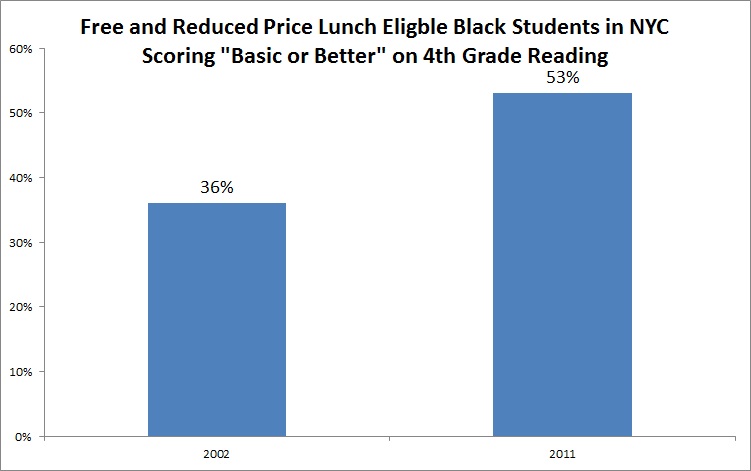
Early in the JPGB days, I wrote a post on Klein and his critics. I took a skeptical view of the Superheroic Superintendent model of reform.  I have changed my mind.  His run lasted 8 years, and NAEP scores improved by impressive margins.  Mayoral takeovers still don’t strike me as a very promising strategy, but Klein did produce results.

I wish Klein had another 8 years in him, but he leaves NYC schools significantly better than when he found them- a rare accomplishment for an urban superintendent.


Bill Gates on Teacher Pensions

July 15, 2010

(Guest Post by Matthew Ladner)

Interesting article from John Fund from the Aspen Ideas Conference.


Marcus on Tenure & Test Scores

December 2, 2009

HT Education Week

(Guest post by Greg Forster)

On NRO today, Marcus soldiers on through the endless New York test score tenure wars, reporting on a gutsball move by Mayor Bloomberg:

New York’s state legislature gave teachers a gift last year by banning the use of student test-score data in tenure decisions. Many expect the legislature to allow the law to expire next year, but Mayor Bloomberg refuses to wait. Last week, he ordered schools chancellor Joel Klein to use the data anyway, arguing that the teachers up for tenure this year were hired in 2007, and a careful reading of the law suggests it applies only to teachers hired after July 1, 2008.

I’m not a Bloomberg fan on any other issue, but on education he’s a cut above most mayors. And remember, he does this in a town with a City Council so thoroughly corrupted by the unions that legislators actually read from union cue cards during hearings.


Klein vs. Rothstein

November 5, 2009

(Guest Post by Matthew Ladner)

I was struck by Joel Klein’s statement in introducing the latest McKinsey & Company report on the impact of achievement gaps.

Klein stated:

People have said to me ‘Chancellor, we will never fix education in America until we fix poverty in America.’ Now I care about fixing poverty, but those people have got it exactly backwards folks. We are never going to fix poverty in America until we fix education in America, and this report shows that it is entirely doable.

Klein has both his theory of causality and priorities correct. It is perfectly idiotic to wallow around in helplessness claiming that education cannot radically improve in the absence of the vanguard of the proletariat seizing the commanding heights of the American economy and creating the New Jerusalem.

It should be painfully obvious even to the most ardent collectivist that this is never going to happen even if it were true, which as it happens, it isn’t. Welfare programs won’t change the fact that we recruit too few of the right people, and too many of the wrong people into teaching. It won’t change the fact that we distribute the limited supply of high quality teachers as if we are out to get poor inner city children. For that matter, it won’t change the fact we still don’t measure teacher effectiveness, and that when we do, we don’t do much of anything with the information.

Parental choice can be seen very much through this same lense. If you draw the short stick and grow up in an inner city area with terrible schools, why should anyone stand in your way of accessing a different group of educators for the same or less funding?

It is absurd to sit in the wealthiest major nation on the planet and have to listen to people claim that $10,000 a year is not enough to teach children how to read. Anyone who actually cares about the plight of the poor would do well to listen to Klein, not Rothstein.


Grading New York

November 13, 2008

(Guest post by Greg Forster)

Our old friend and colleague Marcus Winters has just released a study on New York City’s school grading program:

In 2006-07, New York City, the largest school district in the United States, decided it would follow several other school systems in adopting a progress report program. Under its program, the city grades schools from A to F according to an accumulating point system based on the weighted average of measurements of school environment, students’ performance, and students’ academic progress.

The implementation of these progress reports has not been without controversy. While many argue that they inform parents about public school quality and encourage schools to improve, others contend that grades lower morale at low-performing schools. To date there has been too little empirical information about the program’s effectiveness to settle these questions.

Schools that recieve D and F grades repeatedly are subject to takeover by the city. A previous study (Rockoff and Turner 2008) found positive results from the program but lacked student-level data. Marcus’s study has got student-level data, regression discontinuity – the whole smash. Tale of the tape:

Students in schools earning an F grade made overall improvements in math the following year, though these improvements occurred primarily among fifth-graders.

Students in F-graded schools did no better or worse in English than students in schools that were not graded F.

Whatever problems NCLB may have, school accountability does work in places where state and local government have the political will to do it seriously. Even in places where the problems seem intractible, like New York City.

EMTs are standing by in case certain people’s heads explode.


Does Joel Klein Matter?

September 18, 2008

(Guest Post by Matthew Ladner)

Literature contains any number examples of the “magic child” myth- the one with mystical abilities that will become a great leader. Paul Atreides, Luke Skywalker and Thomas “Neo” Anderson are recent examples from science fiction, but there are many others.


For some reason, we tend to buy into the messianic myth with school leaders as well.


The oddest thing (to me) about the back and forth we’ve had here and elsewhere about instructional versus incentive based reform seems to center around Joel Klein’s tenure in NYC. I think Klein will ultimately be seen as a fairly inconsequential figure.


Let me hasten to say that I briefly met Klein at a conference a few months ago, and he seemed like a good guy, so this is nothing personal. He seems to have good intentions. Some have lauded his reforms; others have indicted him for making poor instructional choices. It seems perfectly plausible to me that Klein deserves praise for some things and criticism for others.


In my book, however, there are usually only two types of urban superintendents: those that have failed, and those that will fail. Rick Hess’ Spinning Wheels made this case convincingly- school systems cycle through superintendents as pseudo-messiahs as a method for kicking the can down the road. New savior arrives, tries to implement reforms, and receives a pink slip about three years later.


The new-new savior finds a group of half implemented reforms lying around, discards them to put in his or her own new program. Repeat process indefinitely. Longtime teachers learn to ignore the flailing at the top, knowing that “this too shall pass.”


Klein obviously departs from this model. He has a legal rather than an education background, and assumed control under the auspices of Mayor Bloomberg taking over the schools. His tenure has already lasted far longer than average.


It has never been a tenet of those of us in the choice movement that a gigantic schooling system would substantially improve if only they had the right superintendent. We emphasize market mechanisms, not benevolent dictatorships. In fact, we’ve seen some celebrity superintendents in the past: Roy Roemer in Los Angeles, Mike Moses (former state Education Commissioner) in Dallas.


No revolutionary improvement there, either.


Don’t get me wrong: I’m hoping for the best with people like Rhee and Klein. One might think that, for instance, that it shouldn’t be inconceivable for Rhee to improve the governance of the DCPS, but the track record here is not awe-inspiring.


If the critique of Klein is that he received a huge windfall of money but has failed so far to produce big results, what can one say other than: why would you expect anything else? Surely hope cannot have so completely triumphed over experience.


We should be persuaded by the evidence that instructional choices are very important. Incentive based reforms are also important. If a NYC chancellor does a little bit of one and none of the other, the results are likely to be underwhelming.


In other words-this too shall pass. Wake me up if and when Klein does anything truly radical- like a Jack Welch program for firing the bottom 10% of teachers and bureaucrats each year or widespread parental choice. Until then, I’ll hope for the best but not expect too much.


Follow

Get every new post delivered to your Inbox.

Join 959 other followers