Teacher Quality Illustrated

May 21, 2008

(Guest post by Greg Forster)

No, that title does not refer to a new glossy magazine for education wonks. It’s the title I’m giving to the following totally unscientific (N=2) but really amazing story that happened to my mother last week.

My mother is a retired teacher living in a mid-size Indiana exurb, where she does volunteer work at the local museum and art center. Last week she was tapped to take a couple of third grade classes around the town and talk about the town’s history.

The first group was out of control and spent the entire trip picking up leaves and throwing them at each other. Their teacher did nothing either to address their behavior or get them to pay attention to the historical talk. She was essentially on vacation.

“This is Lincoln Park,” said my mother as they entered Lincoln Park. “Does anyone know who Lincoln was?”

Silence.

Abraham Lincoln?”

More silence.

And then, a hand goes up.

“Does he live here in [name of town]?”

My mother comes back exhausted and demoralized. She announces to the head of the art center that she’s through dealing with kids whose teachers can’t even be bothered to keep them in line on a field trip – or to teach them who Abraham Lincoln is.

“But you have another group you’re supposed to take today.”

Out my mother trudges to take the next group, which is already romping around on the lawn outside. This is another third grade class from the same school, serving the same population. The only difference is their room assignment, which is probably close to random.

Seeing my mother appraoch, the teacher claps her hands once.

The entire class falls silent, stops what they’re doing and pays attention. When asked, they organize to set out on the trip. They pay attention at every stop on the trip, and throw no leaves.

“This is Lincoln Park,” said my mother as they enetered Lincoln Park. “Does anyone know who Lincoln was?”

Not only do they know, but – with no prompting from the teacher – they begin to rattle off everything they’ve absorbed about Abraham Lincoln.

“He came through our town once on the back of a train.”

“Yeah, they say he wasn’t planning to stop, but there were so many people he stopped and made a speech.”

Then one child says:

“Every year on President’s Day, my father brings us to Lincoln Park so we can say ‘thank you’ for Abraham Lincoln because he did so much for us.”

On the way back, my mother compliments the teacher and tells her she has a real gift.

“It’s my first year,” she responds.

Taken aback, my mother can only respond that she hopes it’s the first of many.

It later transpired that it was only her first year of teaching in public school; she had two years of experience in private school before that. But under the state’s teacher-union contract, her two years in private school aren’t recognized (as is the case for some private schools in some states), so she’s paid like a first-year teacher.

I do not suggest that we can generalize anything from this story, or from any other story, or even from any number of stories (the plural of anecdote is not data). But I insist that we can, and ought to, generalize from scientific studies, especially when we have a large number of them and the findings are fairly consistent.

The studies on teacher quality find:

  1. While demographics matter for student outcomes, other things also matter – a great deal – and teacher quality is one of the most important things that matter.
  2. Years of experience, which are one of the two primary determinants of teacher pay, are not strongly associated with improved student outcomes, particularly after the first few years. (Neither are teaching credentials, the other major determinant of teacher pay.)

Yes, I know that the kid whose father takes him to Lincoln Park every year has a good family environment. But the kids in the other class have good family environments, too – this is a high-income exurb in Indiana we’re talking about.

I just thought that, in addition to being a lot of fun (“Abraham Lincoln? Does he live here in town?” Yeah, he and Tom Jefferson own the big antiques store on Main Street, right next to Billy Shakespeare’s used book shop), the story illustrated what we know from the science about teacher quality in a striking way.

Oh, and here’s another point worth making: Now that America’s public school system has apparently decided not to name schools after important civic figures any more, it’s all the more important that we hire teachers who will make sure their students know who Abraham Lincoln was. Either that, or public schools will continue to lag behind private schools in teaching students good democratic values.


Get Lost 4

May 16, 2008

(Guest post by Greg Forster)

While Jay’s travelling, I’ll be providing your weekly descent into Lost geekdom.

This may seem like a strange thing to single out, but what I liked most about this episode was the return of the real Hurley. Last week I was a little miffed when Hurley decided not to go into the cabin. That’s not the Hurley I know: the one who’s driven to find answers about the malevolent force that’s killed his grandfather and ruined his life – and who has consistently shown himself to be physically brave in his pursuit of his quest. (“I can make it. I can get out of the way. I’m spry.”) This week I felt like we saw the return of the real Hurley.

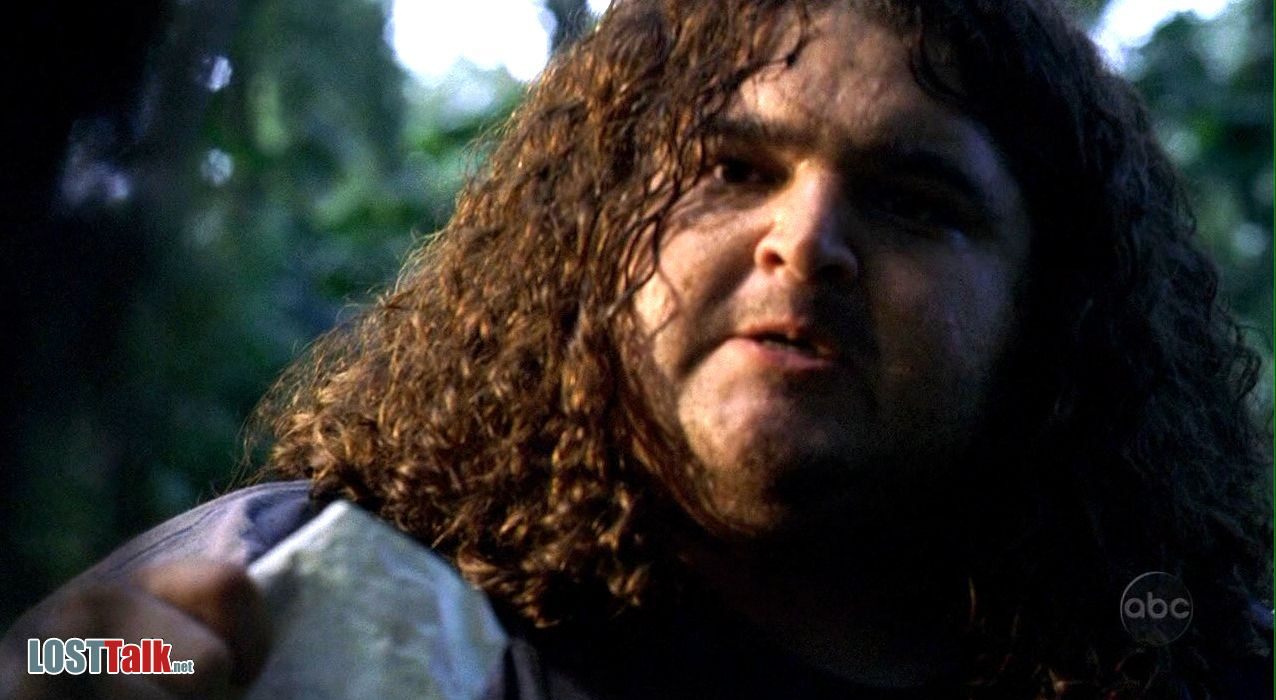
This Hurley!

Okay, that thing in the woods – maybe it’s a monster. Maybe it’s a pissed-off giraffe. I don’t know! The fact that no one is even looking for us? Yeah, that’s weird. But I just go along with it, because I’m along for the ride. Good old fun time Hurley. Well guess what?

NOW I WANT SOME FRIGGIN’ ANSWERS!

(HT LostTalk.net; you can see the original in all its glory at 6:00 here)

The really great thing about Lost is the amazing character portrayal. They’re not stereotypes. You feel like you know these people. Think about how hard that must be for the writers given the number of characters they’re juggling.

Second order of business. I believe this was the first time that the “flash backward/forward” storyline followed more than one character (or two closely related characters like Jin and Sun or Boone and Shannon – remember them?). I spent most of the episode thinking, “this isn’t working.” They were trying to do too many things, and the narrative didn’t gel.

Of course, at the end we saw why they were doing it. They were trying to set up the season finale with a feeling of epic scope – half a dozen plotlines all coming to a head at the same time and in the same place. Focusing on one character’s story would undermine the big closing montage of everyone trudging through the jungle towards The Orchid (it felt kind of like the Lost version of the “One Day More” number in Les Mis, or “Tonight” in West Side Story). So by the end I wasn’t disappointed with it, but on the other hand I don’t think they achieved what they were going for.

A side point that occurred to me: Earlier in the season, we established that the Oceanic Six cover story claims that eight people survived the crash and two never made it off the island. At the time I assumed that Claire had to be one of them, in order to explain the presence of her baby, Aaron. But now it transpires that the cover story claims Aaron is Kate’s. So now we don’t know the identities of both of the people who (according to the cover story) survived the crash but not the island.

On the other hand, the mystery of why Jack was reluctant to pursue Kate on account of Aaron has been resolved. Aaron is a constant reminder of his father’s failings, and as the show’s producers put it in a season 1 episode title, all the best cowboys have daddy issues.

Final note: the preview of the season finale claims (or perphas suggests, I don’t remember the exact words) that we will see the rescue of the Oceanic Six. Lost previews have lied many times before. But if this one’s accurate, does that imply that seasons five and six will take place in “the future,” i.e. 2005? Or will we see the rescue in a flash-forward?

See you in two weeks!


The Real Case for NCLB

May 16, 2008

(Guest post by Greg Forster)

My column on NCLB is on Pajamas Media this morning. A sample:

When you set aside all the implausible multi-year plans, toothless sanctions, easily evaded school choice requirements, and other window dressing, NCLB boils down to one simple commercial transaction: the system got a big cash payoff, in exchange for which it agreed to give standardized tests and release up-to-date information on how students are performing.

Before NCLB, many states didn’t give standardized tests at all, or didn’t release the results in a timely and publicly useable format. Now they all do. And all 50 states now participate in the Nation’s Report Card, a single national test of a representative sample of students, which allows researchers to conduct cross-state comparisons.

This transparency represents an incredible boon. The amount of empirical research done on education has been growing at a breathtaking rate. Before NCLB, education was a fringe element at best in economics, political science, and other social science disciplines. Now it’s everywhere. A lot of that research is due to the data made available by NCLB.


That “Wizardry” Teacher Firing – There’s More to the Story

May 15, 2008

(Guest post by Greg Forster)

Recently, a lot of people linked to this story:

A substitute teacher in Pasco County has lost his job after being accused of wizardry. Teacher Jim Piculas does a magic trick where a toothpick disappears and then reappears. Piculas recently did the 30-second trick in front of a classroom at Rushe Middle School in Land ‘O Lakes. Piculas said he then got a call from the supervisor of teachers, saying he’d been accused of wizardry. “I get a call the middle of the day from head of supervisor of substitute teachers. He says, ‘Jim, we have a huge issue, you can’t take any more assignments you need to come in right away,'” he said. Piculas said he did not know of any other accusations that would have led to the action. The teacher said he is concerned that the incident may prevent him from getting future jobs.

Quite a few bloggers and (especially) their commenters used this as an opportunity to bash their favorite targets: Parents are stupid, conservatives are stupid, Christians are stupid, stupid people are stupid, etc. A handful of people even managed to ask whether maybe the school officials bear just a tiny fraction of the responsibility.

Unfortunately, when describing the story, most bloggers and even most media outlets failed to include this information:

Local education officials, however, deny that Piculas was sacked for wizardry, citing a number of other complaints made against the teacher, such as not sticking to lesson plans and allowing students to use school computers.

Oops.

His dismissal form and the formal letter informing him that he would not be hired again also state that he used inappropriate language in class and put a student in charge of the class. And that reference to letting students “use school computers” turns out to mean that he allegedly let kids wander away from class and use the computers when they were supposed to be at their desks working.

Always click through those links before posting!

Nor did many people mention that the same school district that allegedly fired a substitute teacher for performing one magic trick has been hiring a professional magician to come in and perform for the kids for years, and after this story broke, they’ve reassured him that they still want him to come do his show. That tends to discredit the storyline some are peddling that Pasco County has been taken over by crazy right-wing extremists.

It’s not even clear whether any parental complaint about wizardry was actually filed. Most media reports I’ve seen have reported as fact that a parent complained to the school about wizardry, but the only evidence for this “fact” seems to be the claims of the fired substitute himself.

Tampa Channel 10 initially reported that the district claimed that the reason for the firing wasn’t “just” wizardry. That’s better than most media outlets, which didn’t report the district’s side of the story at all. But the claim that the problem wasn’t “just” wizardry didn’t come from a quote; the reporter put that word into the district’s mouth. As noted above, other outlets reported simply that that district denied wizardry was an issue. All the direct quotes and documents from the district seem to back that interpretation rather than the characterization in the initial Channel 10 report. And when Channel 10 did a follow-up report, the district said performing magic tricks is not against school policy, and the teacher’s magic trick was “insignificant.”

It is, of course, theoretically possible that there really was a parental complaint about wizardry, and that a dim-witted local school official decided to fire a substitute based on one parent’s crazy complaint, and that the district made up a bunch of accusations against the substitute after the fact in order to cover up what had happened (all of which is alleged by the fired substitute).

If so, I can only say that the schools in Pasco County are amazingly responsive to their parents. Do you suppose they have a big phone bank to call every parent at home every night and get approval for the next day’s lesson plan and lunch menu?

Kudos to Tampa Channel 10, which seems to have done the most follow-up work on this story, and to the few other media outlets doing their jobs.


Georgia Enacts Nation’s 23rd School Choice Program

May 14, 2008

(Guest post by Greg Forster)

Georgia Gov. Sonny Perdue has signed the legislation sent to him last month creating a tax-credit scholarship program in Georgia. It’s the nation’s 23rd school choice program.

I said it before, and I’ll say it again: Further proof, if further proof were necessary, that school choice is politically more successful than ever.

One thing that’s really gratifying about this program is that it has no demographic restrictions at all. Any student enrolled in Georgia public schools (K-12) is eligible for a private school scholarship. The days of limited choice are numbered.

Having swung from a win in Louisiana to a win in Georgia, all eyes now swing back to Louisiana, where a legislative vote today will determine whether a voucher bill moves forward. Gov. Bobby Jindal recently signed into law an education tax credit in the state.

Details on the new Georgia program, as they will soon appear on the Friedman Foundation’s online program guide:

GEORGIA

Tax Credits for Student Scholarship Organizations

Enacted 2008

Georgia provides a credit on both personal and corporate income taxes for donations to Student Scholarship Organizations (SSOs), privately run non-profit organizations that support private-school scholarships. Individual taxpayers contributing to SSOs may claim a dollar-for-dollar credit of up to $1,000, and married couples filing jointly may claim up to $2,500.  Corporate taxpayers may claim a dollar-for-dollar credit worth up to 75 percent of the taxpayer’s total tax liability. The program is capped at $50 million in tax credits per year.

FAST FACTS

·         All Georgia public school students eligible

·         Both individual and corporate taxpayers may donate

·         Program capped at $50 million

Scholarship or Voucher Value:

SSOs may determine the amount of each scholarship, as in most other states with tax-credit scholarship programs.

Student or School Participation:

No information on participation is available yet.

Student Eligibility:

All Georgia students enrolled in public schools are eligible to receive scholarships. SSOs may set their own eligibility guidelines. Taxpayers may not make contributions earmarked for a particular child.

Legal Status of Program:

No legal challenges have been filed against the program.

Regulations on the Program:

SSOs are required to be non-profit organizations that allocate at least 90 percent of their revenue to private-school scholarships. No more than 25 percent of an SSO’s revenue may be carried forward into the next year before it is spent. SSOs must undergo annual audits by certified public accountants, file audits and fiscal reports with the Department of Revenue, may not use a donor’s money to support that donor’s child and may not restrict their scholarships to a single school. Participating private schools must obey anti-discrimination laws.

Research on Program:

Currently no research items tied to this program.


News on Program:

Currently no news items are tied to this program.


Governing Statutes:

Georgia Code, 20-2A and 48-7-29.13.


Correction on Tax Credits

May 9, 2008

(Guest Post by Greg Forster)

In this post a while back, I wrote that the potential for enacting school choice by giving families tax credits for their education expenditures would be strictly limited “until some state enacts a refundable credit.”

George Clowes wrote me to point out that the tax credit in Minnesota is already refundable. And since I’ve already pointed out that you don’t want to get on George Clowes’s bad side, I hasten to correct my error.

This doesn’t really affect my point much, since the Minnesota credit just happens to be the only one that doesn’t include tuition (only other education expenses like books and fees are eligible) and this is an even bigger limitation than the “unrefundability” (to use a totally real and not-made-up word) of the credits in other states. Tax credits for private school families won’t provide much choice until we get one that 1) is refundable, 2) isn’t restricted to a small amount of money, and 3) includes tution.

Nonetheless, I apologize for the error, and I thank George for bringing it to my attention.


Vouchers: Evidence and Ideology

May 8, 2008

(Guest post by Greg Forster)


Lately, Robert Enlow and I at the Friedman Foundation for Educational Choice have had to spend a lot of time responding to the erroneous claims Sol Stern has been making about school choice. I honestly hate to be going up against Sol Stern right at the moment when he’s doing important work in other areas. America owes Stern a debt for doing the basic journalistic work on Bill Ayers that most journalists covering the presidential race didn’t seem interested in doing.


But what can we do? We didn’t choose this fight. If Stern is going to make a bunch of false claims about school choice, it’s our responsibility to make sure people have access to the facts and the evidence that show he’s wrong.


That’s why Enlow and I have focused primarily on using data and evidence to demonstrate that Stern’s claims are directly contrary to the known facts. It’s been interesting to see how Stern and his defenders are responding.


I’ve been saddened at how little effort Stern and his many defenders are devoting to seriously addressing the evidence we present. For example, all the studies of the effects of vouchers on public schools that were conducted outside the city of Milwaukee have been completely ignored both by Stern and by every one of his defenders I’ve seen so far. Does evidence outside Milwaukee not count for some reason? Since most of the studies on this subject have been outside Milwaukee, this arbitrary focus on Milwaukee is hard to swallow.


And what about the studies in Milwaukee? All of them had positive findings: vouchers improve public schools. Unfortunately, Stern and his critics fail to engage with these studies seriously.


Stern had argued in his original article that school choice doesn’t improve public schools, on grounds that the aggregate performance of schools in Milwaukee is still bad. His critics pointed out that a large body of high quality empirical research found that vouchers have a positive effect on public schools, both in Milwaukee and elsewhere. If Milwaukee schools are still bad, that doesn’t prove vouchers aren’t helping; and since a large body of high quality empirical research says they do help, the obvious conclusion to reach – if we are going to be guided by the data – is that other factors are dragging down Milwaukee school performance at the same time vouchers are pulling it upward.


If an asthma patient starts using medicine, and at the same time takes up smoking, his overall health may not improve. But that doesn’t mean the medicine is no good. I also think that there may be a “neighborhood effect” in Milwaukee, since eligibility for the program isn’t spread evenly over the whole city.


There’s new research forthcoming in Milwaukee that I hope will shed more light on the particular reasons the city’s aggregate performance hasn’t improved while vouchers have exerted a positive influence on it. The important point is that all the science on this subject (with one exception, in D.C., which I’ve been careful to take note of when discussing the evidence) finds in favor of vouchers.


In Stern’s follow-up defense of his original article, his “response,” if you can call it that, is to repeat his original point – that the aggregate performance of schools in Milwaukee citywide are still generally bad.


He disguises his failure to respond to his critics’ argument by making a big deal out of dates. He says that all the studies in Milwaukee are at least six years old (which is actually not very old by the standards of education research), and then provides some more recent data on the citywide aggregate performance of Milwaukee schools. But this obviously has nothing to do with the question; Stern’s critics agree that the aggregate data show Milwaukee schools are still bad. The question is whether vouchers exert a positive or negative effect. Aggregate data are irrelevant; only causal studies can address the question.


Of course it’s easy to produce more up-to-date data if you’re not going to use scientific methods to distinguish the influence of different factors and ensure the accuracy of your analysis. If you don’t care about all that science stuff, there’s no need to wait for studies to be conducted; last year’s raw data will do fine.


Weak as this is, at least it talks about the evidence. The response to our use of facts and evidence has overwhelmingly been to accuse school choice supporters of ideological closed-mindedness. Although we are appealing to facts and evidence, we are accused of being unwilling to confront the facts and evidence – accused by people who themselves do not engage with the facts and evidence to which we appeal.


Stern, for example, complains at length that “school choice had become a secular faith, requiring enforced discipline” and “unity through an enforced code of silence.” Apparently when we demonstrate that his assertions are factually false, we are enforcing silence upon him. (We’ve been so successful in silencing Stern that he is now a darling of the New York Times. If he thinks this is silence, he should get his hearing checked.)


Similarly, when Stern’s claims received uncritical coverage from Daniel Casse in the Weekly Standard, Enlow and Neal McCluskey wrote in to correct the record. Casse responded by claiming, erroneously, that Stern had already addressed their arguments in his rebuttal.


Casse also repeated, in an abbreviated form, Stern’s non-response on the subject of the empirical studies in Milwaukee – and in so doing he changed it from a non-response to an error. He erroneously claims that Stern responded to our studies by citing the “most recent studies.” But Stern cites no studies; he just cites raw data. It’s not a study until you conduct a statistical analysis to distinguish the influence of particular factors (like vouchers) from the raw aggregate results – kind of like the analyses conducted in the studies that we cite and that Stern and Casse dismiss without serious discussion.


Casse then praised Stern’s article because “it dealt with the facts on the ground” and accused school choice supporters of “reciting the school choice catechism.”


Greg Anrig, in this Washington Monthly article, actually manages to broach the subject of the scientific quality of one of the Milwaukee studies. Unfortunately, he doesn’t cite any of the other research, in Milwaukee or elsewhere, examining the effect of vouchers on public schools. So if you read his article without knowing the facts, you’ll think that one Milwaukee study is the only study that ever found that vouchers improve public schools, when in fact there’s a large body of consistently positive research on the question.


Moreover, Anrig’s analysis of the one Milwaukee study he does cite is superficial. He points out that the results in that study may be attributable to the worst students leaving the public schools. Leave aside that this is unlikely to be the case, much less that it would account for the entire positive effect the study found. The more important point is that there have been numerous other studies of this question that use methods that allow researchers to examine whether this is driving the results. Guess what they find.


Though he ignores all but one of the studies cited by school choice supporters, shuffling all the rest offstage lest his audience become aware of the large body of research with positive findings on vouchers, Anrig cites other studies that he depicts as refuting the case for vouchers. Like Stern’s citation of the raw data in Milwaukee, these other studies in fact are methodologically unable to examine the only question that counts – what was the specific impact of vouchers, as distinct from the raw aggregate results? (I’m currently putting together a full-length response to Anrig’s article that will go over the specifics on these studies, but if you follow education research you already know about them – the notoriously tarnished HLM study of NAEP scores, the even more notoriously bogus WPRI fiasco, etc.)


But Anrig, like his predecessors, is primarily interested not in the quality of the evidence but in the motives of school choice supporters. He spends most of his time tracing the sinister influence of the Bradley Foundation and painting voucher supporters as right-wing ideologues.


And these are the more respectable versions of the argument. In the comment sections here on Jay P. Greene’s Blog, Pajamas Media, and Joanne Jacobs’s site, much the same argument is put in a cruder form: you can’t trust studies that find school choice works, because after all, they’re conducted by researchers who think that school choice works.


(Some of these commenters also seem to be confused about the provenance and data sources of these studies. I linked to copies of the studies stored in the Friedman Foundation’s research database, but that doesn’t make them Friedman Foundation studies. As I stated, they were conducted at Harvard, Princeton, etc. And at one point I linked to an ELS study I did last year that also contained an extensive review of the existing research on school choice, but that doesn’t mean all the previous studies on school choice were ELS studies.)


What is one to make of all this? The more facts and evidence we provide, the more we’re accused of ignoring the facts and evidence – by people who themselves fail to address the facts and evidence we provide.


I’m tempted to say that there’s a word for that sort of behavior. And there may be some merit in that explanation, though of course I have no way of knowing. But I also think there’s something else going on as well.


One prominent blogger put it succinctly to me over e-mail. The gist of his challenge was something like: “Why don’t you just admit that all this evidence and data is just for show, and you really support school choice for ideological reasons?”


I think this expresses an idea that many people have – that there is “evidence” over here and then there is “ideology” over there, and the two exist in hermetically sealed containers and can never have any contact with one another. (Perhaps this tendency is part of the long-term damage wrought by Max Weber’s misuse of the fact/value distinction, but that’s a question for another time.)


On this view, if you know that somebody has a strong ideology, you have him “pegged” and can dismiss any evidence he brings in support of his position as a mere epiphenomenon. The evidence is a distraction from your real task, which is to identify and reveal the pernicious influence of his ideology on his thinking. Hence the widespread assumption that when a school choice supporter brings facts and evidence, there is no need to trouble yourself addressing all that stuff. Why bother? The point is that he’s an ideologue; the facts are irrelevant.


But, as I explained to the blogger who issued that challenge, evidence and ideology are not hermetically sealed. Ideology includes policy preferences, but those policy preferences are always grounded in a set of expectations about the way the world works. In fact, I would say that an “ideology” is better defined as a set of expectations about how the world works than as a set of policy preferences. (That would help explain, for example, why we still speak of differences between “liberal” and “conservative” viewpoints even on issues like immigration where there are a lot of liberals and conservatives on both sides.) And our expectations about how the world works are subject to verification or falsification by evidence.


So, for example, I hold an ideology that says (broadly speaking) that freedom makes social institutions work better. That’s one of the more important reasons I support school choice – because I want schools (all schools, public and private) to get better, and I have an expectation that when educational freedom is increased, schools will improve. My ideology is subject to empirical verification. If school choice programs do in fact make public schools better – as the empirical studies consistently show they do – then that is evidence that supports my ideology.


Even the one study that has ever shown that vouchers didn’t improve public schools, the one in D.C., also confirms my ideology. The D.C. program gives cash bribes to the public school system to compensate for lost students, thus undermining the competitive incentives that would otherwise improve public schools – so the absence of a positive voucher impact is just what my ideology would predict.


Other evidence may also be relevant to the truth or falsehood of my ideology, of course. The point is that evidence is relevant, and truth or falsehood is the issue that matters.


Now, as I’ve already sort of obliquely indicated, my view that freedom makes things work better is not the only reason I support school choice. But it is one of the more important reasons. So, if you somehow proved to me that freedom doesn’t make social institutions work better, I wouldn’t immediately disavow school choice, since there are other reasons besides that to support it. However, I would have significantly less reason to support it than I did before.


If we really think that evidence has nothing to do with ideology, I don’t see how we avoid the conclusion that people’s beliefs have nothing to do with truth or falsehood – ultimately, that all human thought is irrational. Bottom line, you aren’t entitled to ignore your opponent’s evidence, or dismiss it as tainted because it is cited by your opponent.


UPDATE: See this list of complete lists of all the empirical research on vouchers.


Edited for typos


Rejoinder to Sol Stern

May 1, 2008

(Guest post by Greg Forster)

My rejoinder to Sol Stern’s erroneous claims about school choice is on Pajamas Media this morning. A sample:

And what about the claim that vouchers are a political loser? Stern writes that “voucher programs for poor children … have hit a wall.” (emphasis added) He observes that there haven’t been new “voucher programs for poor children” (emphasis added) since the Supreme Court gave its blessing to vouchers in 2002.

If you read Stern’s article without knowing the facts, you’d think there had been only one new voucher program since 2002 — he mentions only the DC program. What Stern doesn’t tell you is that there have been no other new voucher programs “for poor children” because vouchers are now so successful that the programs enacted since 2002 are no longer restricted to poor children. They’re broader in scope.

I go on to defend the claim I made last week here on Jay P. Greene’s Blog that “school choice is politically stronger than ever,” and run down the empirical research on the effects of choice.


State Regulation of Private Schools: the Good, the Bad and the Ugly

April 30, 2008

(Guest post by Greg Forster)


Today, the Friedman Foundation for Educational Choice releases a report that evaluates how each of the 50 states regulates private schools. While all states regulate things like health and safety, most states go further and impose unreasonable and unnecessary burdens on private schools. This creates barriers to entry, hindering competition and thereby reducing the quality of both public and private schools; it also limits the freedom of parents to choose how their children will be educated. Friedman Foundation Senior Fellow Christopher Hammons graded each state based on how good a job it does of regulating private schools. Scroll down to see the grades.  


Accompanying the report, we have compiled lists of all the laws and regulations governing private schools in each of the 50 states. The lists are now available on our website.  


Our goal is to educate the public on two fronts. First, we often hear private schools described as “unregulated” by forces hostile to school choice. Private schools are in fact regulated and are accountable to the public for following a large body of laws and regulations. Second, there is wide variation from state to state in the quality of private school regulation. We hope to make the public aware of these disparities so that states with poor regulatory systems will themselves be accountable to the public.  


To help ensure the accuracy of our list of private school laws and regulations in each state, we contacted each of the 50 state departments of education, asking them to review our lists and let us know if we had anything missing or incorrect. Each state has an extremely large body of laws and regulations, so any effort to locate all the laws and regulations on a particular topic is very difficult, and we wanted to do everything possible to make sure we didn’t miss anything. As you will see below, some states were more helpful than others.

The Good

The Good #1: About one third of the states (18 ) earned a grade in the A or B range. Florida and New Jersey were tied for having the nation’s best regulatory systems for private schools, followed closely by Connecticut and Delaware.  


The Good #2: I will admit that I expected most of our e-mails to the state departments of education would be ignored. As it turned out, most of the states – 29 of them – not only got back to us but went over our lists and either said they were OK as is or offered corrections. In fact, publication of the report was delayed so that we would have time to process all the constructive input we were getting from state departments of education. So let me pour myself a big, delicious bowl of crow and apologize to the departments of education in Connecticut, Delaware, Florida, Georgia, Iowa, Illinois, Kentucky, Louisiana, Maryland, Michigan, Missouri, Nevada, New Hampshire, New Jersey, New Mexico, New York, North Carolina, Ohio, Oregon, South Carolina, South Dakota, Tennessee, Texas, Virginia, Washington, West Virginia, Wisconsin, and Wyoming. I’m sorry I doubted you, and we greatly appreciate your help.  


In addition, Arkansas and Arizona deserve recognition for getting back to us and letting us know that they were unable to help us with our request.

The Bad 

The Bad #1: Almost half the states (22) receive D or F grades for the unnecessary burdens imposed on private schools by their laws and regulations. North Dakota ranked the worst in the nation by a large margin, followed by South Dakota, Alabama, Maryland, New York and Tennessee.  


The Bad #2: The departments of education in 17 states did not respond to our attempts to contact them. California, Colorado, Hawaii, Idaho, Indiana, Kansas, Maine, Massachusetts, Minnesota, Missouri Mississippi, [oops – apologies to the DOE of Missouri and the schoolchildren of Mississippi] Montana, Nebraska, North Dakota, Oklahoma, Pennsylvania, Rhode Island, and Utah, please check whether you still have a department of education.  


Mysteriously, Alaska responded to our initial inquiry, but then didn’t respond to our follow-up communications. 

The Ugly 

Alabama’s department of education deserves special recognition for its efforts to help us. Our request was considered so important that it was ultimately handled by no less than the department’s general counsel.  


The department’s first response was to ask where we had gotten our list of Alabama’s private school laws and regulations, and how we were planning to publish it.  


I did not ask why they wanted to know, or whom they were planning to pass the information on to once I told them. Instead, I replied that we had compiled our list from the state’s publicly available laws and regulations, and that we were going to post the list on our website and publish a report looking at the laws and regulations in all 50 states.  


Their response to that was: “After continued review by appropriate persons and because of the depth of information that you have forwarded to us, it has been determined that this request needs to be reviewed by our SDE Legal Department.” They also asked for more time, which we were happy to give them, as we did for every department that asked for it.  


The next and final communication we received was this, which I reprint in its entirety:

I am the General Counsel for the State Department of Education. I have been asked by the Deputy Superintendent of Education, Dr. Eddie Johnson, to review and respond to your request. There are numerous errors contained in the four page document titled ALABAMA. I submit that a further review of our laws and regulations might be helpful. You can access our statutes at www.legislature.state.al.us. The Administrative Code for the Alabama Department of Education can be found at our website, www.alsde.edu/html/home.asp. Thank you for your interest in Alabama.


The message was signed “Larry Craven.” Really.  


I offer no speculation as to why Mr. Craven would tell us that our document contained numerous errors, but decline to specify any of them.  


If at any time he or any other party will be so kind as to specify anything in our list of laws and regulations for Alabama or any other state that’s wrong or missing, we will gladly make any necessary corrections. In a project of this size, combing through countless thousands of laws and regulations to find the ones relevant to private schools, there would be no shame in having missed some. We make a point of saying so both in the report itself and in a disclaimer that appears on each of the 50 state lists we compiled and put on our website.  


That said, this also should be said: we wouldn’t have to comb through countless thousands of laws and regulations, a process inherently subject to this kind of difficulty, if the 50 state departments of education provided this information to the public in an easily accessible format. (Some do, but most don’t.) Our only goal here is to get public-domain information actually delivered to the public. We wish we could say that goal was shared by everyone in charge of running the nation’s education system. 

Grades for State Laws and Regulations Governing Private Schools

Alabama F
Alaska B
Arizona A-
Arkansas A-
California B
Colorado B
Connecticut A
Delaware A
Florida A
Georgia A-
Hawaii C+
Idaho C+
Illinois C+
Indiana D-
Iowa D
Kansas F
Kentucky B
Louisiana D
Maine D+
Maryland F
Massachusetts C-
Michigan C-
Minnesota B+
Mississippi F
Missouri A-
Montana F
Nebraska F
Nevada F
New Hampshire C+
New Jersey A
New Mexico C+
New York F
North Carolina D
North Dakota F
Ohio C-
Oklahoma B
Oregon C+
Pennsylvania D
Rhode Island D
South Carolina F
South Dakota F
Tennessee F
Texas B-
Utah A-
Vermont D
Virginia B
Washington F
West Virginia C-
Wisconsin A-
Wyoming F

 Edited for typos


“Residential School Choice” and the Mortgage Crisis

April 28, 2008

(Guest post by Greg Forster)

What do you guys think of this op-ed in yesterday’s Washington Post linking the mortgage crisis to parents’ desire to buy homes that will get their children into better schools? I don’t know enough about the mortgage crisis to really know, but Mike Antonnuci suggests the link is overblown (see item #2 here) and I’m inclined to think that’s likely.

Still, have you noticed that in just the past few years, schools are figuring much more prominently in residential real estate marketing? MLS listings now prominetnly display not only which school district a home is located in, but the indivdiual schools it’s assigned to. Real estate advertisements and flyers are prominently listing this information as well.

Of course, I’m just speaking from my own individual observations, which as you know is a highly scientific representative sample. 🙂

Larry, you’re the financial guy around here. Any thoughts?