Command v. Choice, Part I: Truth and Power

July 26, 2011

Vaclav Klaus and Vaclav Havel

(Guest post by Greg Forster)

Jay is causing quite a stir with his two-part deconstruction of the Gates Foundation. To those who may be upset, let me say the following two things.

First: Jay’s posts will have no important impact – unless they’re true.

Second: That fact itself demonstrates why the Gates command-and-control approach to education reform is bound to fail.

As Jay points out in his two posts, the Gates effort has undermined the intellectual integrity of many people associated with it. Why? The immediate answer is simple. The Gates strategy is a power agenda. And as Jay and I have both had occasion to point out, power agendas seek to subvert “science” in order to create the impression that their policies are scientifically supported. Other knowledge systems are equally vulnerable, but in our society “science” is the only knowledge system whose validity and importance is recognized by virtually everyone; hence science is the key target for corruption.

Don’t get me wrong; power, considered simply by itself, is good. It’s better to have it than not have it. You can’t get much good done without it. But all good things come with natural temptations and dangers, and one of the natural temptations and dangers that always – always – comes with power is the constant threat to subvert knowledge.

I don’t know their hearts, but I’ll bet the Gates people are not bad people, as people go. They just aren’t awake to, and taking steps to check, this natural danger. They’re not aware of what they’re doing and don’t recognize the process of intellectual corruption for what it is even when it’s held up to their faces – because that failure of recognition is itself the natural attendant danger of power.

But this just leads us to a deeper question. Why do power agendas always display this tendency to corrupt knowledge systems? Why does Gates invest hundreds of millions of dollars in research when it’s clear they already know what they want to be true and aren’t interested in following the evidence? And why does it spend hundreds of millions more subverting the individuals and organizations who talk about education research? Why does Gates care what a bunch of bloggers think? What explains this enormous investment?

Because truth has a power of its own. People want to believe what’s true. Even wicked people who deliberately decieve others for the sake of power would not be willing to be decieved themselves for the sake of power. Every human being has a desire to know truth and live in accordance with that knowledge. To be sure, other desires compete with this desire and often win out over it. But the desire is always there and can always be harnessed as a force for social change – that is, for power. So the people who care about power always have to worry about the people who care about truth.

This dynamic is as old as time. From Plato to Paul, from Martin Luther to Martin Luther King, people who care about truth more than they care about power have been a threat to those who care more about power than they do about truth.

And the reverse is also true, as can be surmised from the response of the powerful to the four people I’ve just named. Asked what he would do to help win support from the pope for the Russian war effort against Germany, Stalin snorted, “The pope? How many divisions has he got?” In a more reflective hour, however, he spoke with more shrewdness: “Ideas are more powerful than guns. We would not let our enemies have guns, why should we let them have ideas?”

Mind you, though, the trouble is not entirely on the side of the “power people.” We “truth people” have our own, equally dangerous dysfunctions. We know that the social systems of power are a threat to the social systems of knowledge production, so our natural instinct in many cases is to fear power. We build high ivory towers and steer clear of the world of power. And by doing so we render ourselves not only irrelevant and irresponsible, but even irrational – because our isolation from “the real world” leaves us extremely vulnerable to falling for spurious ideologies that flatter our prejudices.
For example.

The natural and intrinsic dangers of the life devoted to truth are themselves just as much a threat to the process of knowledge production as the natural and intrinsic dangers of the life devoted to power.

In spite of the natural rivalry between truth and power, or perhaps because of it, people who have gone all the way to the two extremes – those who care only about power and those who care only about truth – often make alliance with one another. The power people provide subsidies that allow the truth people to spend all day in their offices thinking, computing, writing, talking, and doing everything they like to do; in exchange, the truth people anoint the power people as legitimate. Everyone gets what he wants – except for the other 99% of us, who get screwed.

The answer to this dilemma, of course, is that we have to care about both truth and power. Not to care about truth is dishonest. Not to care about power is irresponsible. Both are self-destructive. (Not to mention other-destructive!)

In reality, however, human beings are rarely so balanced. All virtues come in matched pairs of opposites (e.g. courage and moderation, candor and tact) and each person tends to care more about one necessary virtue than its opposite. That’s why people need social systems in which the legitimacy of opposing virtues is respected and processed in a way that doesn’t subordinate the one to the other.

As a little vignette to illustrate this, consider the roles played by Vaclav Havel and Vaclav Klaus in Czech liberation. Under the Czechoslovak tyranny, Havel lived underground, writing tracts and plays and organizing a network of dissident intellectuals. He had no use for the regime’s systems of power, except as targets – and slow, fat targets they were for a powerful genius like his. Havel’s greatest non-fiction work may be his book-length essay “The Power of the Powerless,” in which he argues that truth is the power of the powerless because all people desire ” to live in the truth.” Unchecked power forces people to live a lie, and the more they have to live a lie the stronger the desire to live in the truth grows. When that desire grows stronger than the desire to live quietly, the power of the powerless becomes greater than the power of the powerful.

In 1989, Havel’s circle of dissidents triggered the crisis that brought down the regime. Protestors gathered in Wenceslas Square for days, then weeks, in defiance of machine-gun toting thugs who might gun them all down at any moment. Havel addressed the crowd daily, and was in little danger because wherever he went, throngs of ordinary people spontaneously surrounded him in an effort to shield him from snipers. “You have to kill us all” was the implicit message of the protestors – and the regime broke. Havel’s game plan, Havel’s leadership, Havel’s hour.

Klaus, on the other hand, was an economist for the state bank under the Czechosolvak tyranny. He was not a supporter of the regime, but he apparently saw nothing inconsistent between that and a banking career within the system. He joined the resistance movement early during the revolution of 1989, and before long he drew a large following of support backing him as a leader – two facts that indicate, I think, that he had legitimacy as a reformer.

Havel and his circle, however, couldn’t stand him. More important, they didn’t trust him. They still don’t. To this day, Klaus is dogged by whispers about all the nasty things he must have been doing to keep his position in the state bank, while people like Havel were going to jail for the sake of truth. And it’s not like there’s not some reasonableness to that disposition.

But the bottom line was that Havel didn’t know how to run a country, and Klaus did. In 1989-1991 those two facts rapidly became clear to a large number of people. Havel and his circle had founded Civic Forum as an umbrella party for the resistance movement, and after the regime collapsed it was the “national unity party” under which the new democracy was governed. A year after the revolution, to the surprise and disgust of the Havel circle, the national party deputies elected Klaus to chair the party. Before long an anti-Klaus faction walked out of the party and founded a new one, completing the transition to a system of electoral party competition. Havel, as president of the new nation, stood formally apart from these events, but everyone knew where his sympathies lay.

With the separation of the Czech Republic from Slovakia in 1992, Klaus became its prime minister. From then until Havel’s retirement in 2003, Klaus ran the government and Havel served as head of state. And a bang-up job they both did of it, too – Klaus’ political, economic and administrative leadership brought about a peaceful and successful transition from state ownership and command-and-control to prosperity and personal freedom, while Havel articulated for his nation a renewed understanding of the political community that grounded it in the humane and civil virtues of freedom and personal responsibility. Neither of those feats could have succeeded without the other.

Havel (truth) and Klaus (power) naturally dislike and distrust each other. But the Czech resistance after 1989 and the Czech government in the two succeeding decades made room for them both – Klaus became president after Havel’s retirement from office, while Havel has continued to write and speak. As a result, the Velvet Revolution and the subsequent history of the Czech Republic stand as miraculous modern models of peace, prosperity, order and justice.

So what would an education policy that took seriously both truth and power look like? Stay tuned for Part II.

(You can tell I’m smarter than Jay because I use Roman numerals for my serialized posts.)


Testing, Cheating, Culture and Corruption

July 21, 2011

(Guest post by Greg Forster)

Matt draws our attention to some of the broader issues raised by the APS scandal. Cheating is not just about cheating.

Here’s another one of those broader issues I think we should take note of. To call this “cheating” is really inadequate. This was a whole institutional culture in which cheating had become not just acceptable, but normal. This was way beyond teachers subtly indicating the correct answers (such as through tone of voice) or deliberately seating bad students next to good ones (so they could copy). Those things happened, but much more happened.

Teachers had “cheating parties” in which they sat around erasing and remarking student answer sheets. There was one guy whose job was to open test booklets, copy the contents, reseal them (using a lighter to melt the plastic back into place) and then distribute the contents to everybody. This was a huge, pervasive, known-to-everybody cheating system.

And cheating was not just normal but mandatory. Hark ye, my bretheren, unto the Atlanta Journal-Constitution:

For teachers, a culture of fear ensured the deception would continue.

“APS is run like the mob,” one teacher told investigators, saying she cheated because she feared retaliation if she didn’t.

Cheat – or else!

What’s going on here? This is not just the undifferentiated “corruption of human nature.” This is a very specific dynamic of institutional culture. This is a system whose organizational culture responded to NCLB by systematically embracing cheating at all levels, even to the extent of viewing non-cheaters (i.e. honest teachers) as threats to the integrity of the system.

We should think carefully about how that kind of thing happens. There is one hypothesis that sticks out to me as clearly plausible: This happened because the testing requirements of NCLB were percieved as evil, tyrannical and a threat to the integrity of education. Personnel at all levels actually viewed cheating as morally virtuous because it was necessary to protect an essential good (education) from being undermined by vicious oppressors with evil agendas. And given widespread teacher cynicism about the value of standardized tests as a metric of learning, in their perception nothing valuable was lost in the process.

This is about more than cheating. This is a wakeup call to our thinking about how reform works.

I have always been in favor of the aspect of NCLB that uses tests to create transparency. Remember, before NCLB you didn’t even have all states participating in NAEP. Anyone want to go back to that? No? Well, then, let’s not throw the baby out with the bathwater.

However, it is now pretty clear that NCLB does not work as an accountability tool. Might the systemic, institutional extent of the cheating in APS help explain why? Teachers and administrators don’t percieve the tests as legitimate – they see them as inaccurate metrics being imposed by evil oppressors as tools of exploitation – and thus don’t respond to them in positive ways. (On net, that is. Bad responses cancel out good ones.)

Contrast that with the use of testing for accountability in two other contexts. Jeb Bush’s A+ accountabiliy testing system in Florida did produce positive results. Could that be because Florida had spent years at the bottom of the national listings for education and was sick of it, and had spent years trying to improve through the tried and true ideas of the unions and was sick of failing, and was thus more open to new directions? In the context of this openness, Jeb Bush’s leadership, and his partnership with the right stakeholders, framed the reforms in a way that caused them to be experienced as legitimate at the school level.

Even more impressive, consider the use of testing in innovative charter schools like KIPP. Remember that David Brooks column blasting Ravitch? Brooks identifies what he calls “a core tension,” namely: “Teaching is humane. Testing is mechanistic.”

However, in schools where the entire institutional culture has been reinvented from the ground up around personal relationships between teacher and student that are centered around leadership, mentorship and accountability, testing isn’t experienced as mechanistic at all. Where the students really see the teachers caring about them, and vice versa, standardized testing is accepted as a tool that empowers this relationship:

The schools that best represent the reform movement, like the KIPP academies or the Harlem Success schools, put tremendous emphasis on testing. But these schools are also the places where students are most likely to participate in chess and dance. They are the places where they are mostlikely to read Shakespeare and argue about philosophy and physics. In these places, tests are not the end. They are a lever to begin the process of change…

Ravitch thinks the solution is to get rid of the tests. But that way just leads to lethargy and perpetual mediocrity. The real answer is to keep the tests and the accountability but make sure every school has a clear sense of mission, an outstanding principal and an invigorating moral culture that hits you when you walk in the door.

I think this means it’s essential that the use of tests for accountability purposes must be implemented only in contexts of institutional culture where they will be experienced as legitimate – and the degree to which the tests are used must be controlled by the degree to which the institutional culture permits this experiential legitimacy.

In some cases (as with Jeb in Florida) that could be accomplished statewide. In others it can’t. Sometimes it will have to be districts, or a network of charter schools. In many contexts it won’t work at any level. It certainly won’t work nationally, since the institutional context of the federal role in education could never permit this kind of thing to develop in a way that would be seen as legitimate.

How, then, do we drive accountability? Choice and competition, obviously. And guess what? Once schools face the disruptive threat of choice, they will be more likely to start using tests for accountability voluntarily – because they want to survive and they’ll be ready to reconsider their options.

You know, it strikes me that this principle might have application to other issues besides accountability testing. In general, the higher you go up the ladder of power – from school to district, from district to state, and from state to national – the less likely you will really be implementing your reform, and the more likely you will just be playing power games, and be seen to be playing power games, and thus cause those below you on the ladder to respond by playing power games of their own. As in Atlanta.


Technology and School Choice: The False Dichotomy

July 18, 2011

(Guest post by Greg Forster)

Terry Moe has a great article in today’s Journal about how entrepreneurial innovation taking advantage of new technology is putting the teacher’s unions on the road to oblivion. It’s a great article, except that it draws one false dichotomy.

Fans of JPGB know that we do love us some high-tech transformation of schooling around here. Matt has been on this beat for a long time, and hardly a week goes by that he doesn’t update us on the latest victory of “the cool kids” over “edu-reactionaries” in the reinvention of the school. But he doesn’t own that turf entirely; I made this the theme of my contribution to Freedom and School Choice (as did Matt, of course).

The problem is that Moe insists high-tech transformation of schooling, and the destruction of union control it entails, is absolutely, positively a separate phenomenon from the wave of school reform victories this year:

This has been a horrible year for teachers unions…But the unions’ hegemony is not going to end soon. All of their big political losses have come at the hands of oversized Republican majorities. Eventually Democrats will regain control, and many of the recent reforms may be undone. The financial crisis will pass, too, taking pressure off states and giving Republicans less political cover…

Over the long haul, however, the unions are in grave trouble—for reasons that have little to do with the tribulations of this year…The first is that they are losing their grip on the Democratic base…Then there’s a crucial dynamic outside of politics: the revolution in information technology.

Really? The victories of 2011 – “the year of school choice” – aren’t in the same category with the long-term path to oblivion the unions are on? On the contrary, 2011 is the year of school choice precisely because it has become obvious that the unions are on track for oblivion, for the reasons Moe identifies.

Moe’s argument relies on the assumption that when Republicans are in power, they always make dramatic and innovative school reform policies their #1 priority.

Sorry  . . . lost my train of thought I was laughing so hard . . . let me pick myself up off the floor . . . there, now where was I? Oh, yes.

The GOP hasn’t touched real school reforms with a hundred-foot pole in years. Why did it all of a sudden embrace real reform this year?

Could it be because…

  1. …the unions are losing their grip on the Democratic base, meaning squishy Republicans don’t have to worry about being demonized as right-wing loonies simply for embracing real reform, and…
  2. …the revolution in information technology has made it obvious to MSM and other key cultural gatekeepers that the unions are the reactionaries, once again reassuring squishy Republicans they won’t be demonized for embracing real reform?

Obviously the financial crisis was also a factor here, as Moe rightly points out. But is that really an immediate-term phenomenon, bound to disappear next week? What really counts is whether the nation feels so rich it can afford to ignore ballooning school costs. Technically the recession ended two years ago and we’ve been in “recovery” for two years. How’s that feeling? Do we feel rich and luxurious again? Are we on track to restore a widespread national sense of inevitable prosperity by 2012? By 2014? By 2020?

Bottom line, the unions losing Democratic support and taking their stand in opposition to entrepreneurial change was the crucial, indispensable precondition for this year’s wave of school reform success.

Oh, and guess what? Sustaining those policies, especially school choice, will be the only way this wave of advancing technology will produce the results Moe is expecting. Only school choice can prevent the blob from neutralizing any reform you throw at it. If the techno-innovators turn their back on choice and competition, they’ll be dead meat. (For more on that topic, see the aforementioned chapter by your humble servant in Freedom and School Choice.)


School Choice Triumphant – Unions Flee in Terror

July 5, 2011

(Guest post by Greg Forster)

This morning’s Journal declares 2011 “the year of school choice.” For those of us who kept the fires of justice burning when others counseled despair, it’s a sweet moment.

The Journal also gets the big picture:

Choice by itself won’t lift U.S. K-12 education to where it needs to be…But choice is essential to driving reform because it erodes the union-dominated monopoly that assigns children to schools based on where they live. Unions defend the monopoly to protect jobs for their members, but education should above all serve students and the larger goal of a society in which everyone has an opportunity to prosper.

In totally unrelated news, Jim Geraghty provides a delctable roundup on the NEA’s unprescedented year-early endorsement of Barack Obama – a naked admission that the union no longer has any leverage beyond its mere access to cash and warm bodies, and is therefore now a captive to the movements of power politics rather than a major player in driving them. From now on, the unions do what their political masters dictate, not the other way around.

Geraghty’s political analyst breaks it down:

I can only think of one reason for this move, the Obama people are going into over drive to get as much into Obama’s coffers as possible, and thus asked for this explicitly.  These are action of a very desperate campaign…on both sides. The Obama administration obviously is not raising enough money; the NEA is losing friends on the Democrat side of the aisle (see Cuomo).

Geraghty also points to this comment on Daily Kos:

I am a building rep for the NEA.  I actually spoke personally with about 2/3 of my unionized teachers when the early endorsement – the first such in NEA history – was proposed. Out of the more than 80 teachers with whom I spoke only one supported the early endorsement. Many did not like giving up what little leverage the union had with the administration.

The comment just gets better from there – go read the whole thing. And there’s more where that came from!

In resopnse to these concerns, a team of spokespeople for the NEA released the following joint statement:

CONSTABLE: O, hell!

ORLÉANS: O Lord, the day is lost! All is lost!

DAUPHIN: Dear God! All is lost, all! Regret and everlasting shame sit on our helmets, mocking us.

[A brief blast of battle noises]

What stinking luck! Do not run away.

CONSTABLE: Our men have all broken ranks.

DAUPHIN: O, everlasting shame! Let’s fall on our swords. Are these the wretches that we threw dice for?

ORLÉANS: Is this the king we offered to ransom?

BOURBON: Shame, eternal shame, and nothing but shame! Let us die honorably. Back into the fray once again! He who will not follow me now, let him depart and stand in the doorway like a pimp, cap in hand, while some slave, no nobler than my dog, violates his daughter.

CONSTABLE: Maybe we can benefit from the same chaos that has defeated us. Let’s go offer up our lives en masse.

Looking forward to 2012!


Iowa Legislature Lines Up Another Enactment

June 30, 2011

(Guest post by Greg Forster)

Last night, Iowa’s House and Senate passed a budget that expands funding for the state’s tax-credit scholarship program. If the governor signs, as expected, that will bring us to fifteen school choice enactments and officially put us not just at, but over the benchmark for Matt’s “double down challenge”  in my bet with Jay Mathews.

And from what I hear, the next question isn’t whether we’ll get to sixteen. The question is, which state will get to fifteen first, and which will have to settle for sixteen – or seventeen, or eighteen . . .


Questions for Jeb and Joel

June 28, 2011

(Guest post by Greg Forster)

Today’s Wall Street Journal carries my letter to the editor responding to last week’s op-ed by Jeb Bush and Joel Klein advocating national (“common”) education standards.

In my letter, I ask a few questions:

I greatly respect Jeb Bush and Joel Klein. But if Common Core is voluntary and state-driven, how do they explain the federal government repeatedly threatening states to join it or lose federal funds? Why are the testing consortia associated with this effort federally funded and controlled?

Confusingly, Messrs. Bush and Klein praise decentralization and local control for pedagogy while urging states to submit to a centralized command-and-control system for content standards. If nationalization is bad for pedagogy, why is it good for standards? Is it even possible to nationalize standards without nationalizing pedagogy?

Common Core’s standards are so mediocre that they set a “college readiness” level that is below what students need even to apply to most colleges. And they’ll get worse over time, since centralization facilitates teacher union control. What about the perpetual culture war national content standards would create? What is the upside?

Greg Forster

Foundation for Educational Choice


Louisiana Doubles Down

June 28, 2011

Sorry, I couldn’t find “Louisiana Hold ‘Em”

(Guest post by Greg Forster)

Two Wisconsin enactments while I was travelling a week ago – expanding Milwaukee vouchers and creating a new voucher program in Racine – brought my ongoing humiliation of Jay Mathews to a total of 13 school choice enactments (new programs or expansions of existing programs). And that’s not even counting Oklahoma’s “expansion” of its special ed voucher program (the program was “expanded” to include students who were eligible to participate but were being illegally denied access by rogue school districts).

Governor Jindal just doubled us down by signing into law Lousiana’s expansion of its educational tax deduction, bringing us to 14 enactments on a bet that we wouldn’t reach seven.

Here’s the tally so far:

  1. UT Carson Smith expansion
  2. Douglas County, CO new voucher
  3. AZ new ESA
  4. DC voucher expansion
  5. IN new voucher
  6. IN new tax deduction
  7. IN tax-credit scholarship expansion
  8. OK new tax-credit scholarship
  9. FL tax-credit scholarship expansion
  10. FL McKay voucher expansion
  11. GA tax-credit scholarship expansion
  12. WI Milwaukee voucher expansion
  13. WI new Racine vouchers
  14. LA tax deduction expansion

Matt wants to know if there’s a mercy rule for wonk bets. As Ned Flanders once said, “Mercy is for the weak!”


Confusion over National Standards

June 24, 2011

(Guest post by Greg Forster)

I greatly admire both Jeb Bush and Joel Klein, so I have mixed feelings saying that I’m confused about their op-ed this morning.

The article is entitled “The Case for Common Educational Standards.” But the article does not contain any case for common educational standards.

Quite the contrary, the article emphasizes the case against common standards. As in:

And, while education is a national priority, the answer here does not appear to be a new federal program mandating national standards. States have historically had the primary responsibility for public education, and they should continue to take the lead.

So that would be an argument against common standards.

It is the states’ responsibility to foster an education system that leads to rising student achievement. State leaders, educators, teachers and parents are empowered to ensure every student has access to the best curriculum and learning environment. Governors and lawmakers across the country are acting to adopt bold education reform policies. This is the beauty of our federal system. It provides 50 testing sites for reform and innovation.

Again, a great argument against common standards.

Bush and Klein depict the Common Core standards and the two testing consortia as products of state, not federal, initiative. As regular readers of JPGB know, there’s another reality behind that superficial appearance. If Common Core and the testing consortia are really state-driven, why has the federal government spent more than a year pushing states into them, openly and explicitly threatening loss of Title I funds to states that fail to kowtow? Why are the consortia federally funded (and therefore federally controlled)? Is it even possible for these efforts to be genuinely state-driven when the federal behemoth is openly using its funding club to threaten everyone to get on board? Bush and Klein fail to mention these issues.

However, let’s leave all that to one side. Let’s pretend – even though we know it’s false – that these efforts are really state driven. Why is it valuable for states to do these things together in a single group? If states should lead the way, if what we want is a decentralized 50-state laboratory of democracy, why not actually do that instead of rounding up all the states to all do it one way?

Bush and Klein argue that standards are being set nationally (in “common”) but pedagogy isn’t. Once again, let’s leave aside the reality that you can’t have national (common) standards while preserving freedom and diversity of pedagogy. Let’s pretend you can set national standards and then let a thousand flowers bloom on pedagogy. Why do it? Why is it valuable to set a single national (common) standard? The article’s title promises an answer to that question, but the article doesn’t deliver.

If, as Bush and Klein argue, most states have woefully inadequate standards, isn’t it likely that the central bureaucracy you’re creating will gravitate to mediocrity rather than excellence? And isn’t that just what Common Core represents, given that its standards for what count as “college ready” are actually set below what you need to even apply to, much less succeed at, most colleges?

So color me confused.


Greg Continues to Run Up the Score on Jay Mathews

June 16, 2011

(Guest Post by Matthew Ladner)

Another day, another couple of style points for Greg. North Carolina’s legislature passed a tax credit for special needs students with an overwhelming bipartisan majority in each chamber. Down in Louisiana, lawmakers expanded the tax deduction for private school students, also by an overwhelming bipartisan margin.

Jay’s suffering is not done yet. Wisconsin is very near to expanding the size and scope of the Milwaukee program, and creating a new program in Racine, and there is more game to be played in Big-10 country.


Freedom and School Choice

June 7, 2011

(Guest post by Greg Forster)

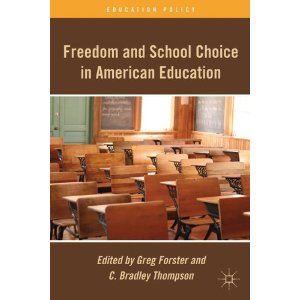
Today is the release of Freedom and School Choice in American Education, a new collection of essays on the purpose and direction of the school choice movement. Your JPGB favorites – Jay, Matt and myself – along with Andrew Coulson, George Clowes, Sheldon Richman, Pauline Dixon & James Tooley, and Brad Thompson lay out our diverse viewpoints on what we think the guiding vision for educational freedom in America ought to be, and what the school choice movement ought to do as a consequence. Paul Peterson provides the foreword.

What’s particularly valuable about this book, I think, is how it gives expression to the very different paths by which people come to hold educational freedom as an aspiration, and then connects those aspirational paths to the practical issues that face the movement in the short term. Jay comes to educational freedom with an emphasis on accountability and control; against the Amy Gutmanns of the world who want to set up educational professionals as authority figures to whom parents must defer, Jay wants to put parents back in charge of education. Matt comes to educational freedom with an emphasis on alleviating unjustified inequalities; against the aristocrats and social Darwinists of the world who aren’t bothered by the existence of unjustified inequalities, Matt wants social systems to maximize the growth of opportunities for those least likely to have access to them. And I come to educational freedom with an emphasis on the historical process of expanding human capacities, especially as embodied in America’s entrepreneurial culture; agaisnt all forms of complacency, I want America to continue leading the world in inventing ever better ways of flourishing the full capacities of humanity. And each of the other contributors has his or her own aspirational path.

This leads to an interesting constellation of agreements and disagreements about short-term tactics. Matt and I both emphasize the role of school choice in empowering entrepreneurs to invent new models. Matt emphasizes this because he knows it’s the only way to deliver better services to underserved populations; for me it’s about inventing the future for the nation as a whole. Matt wants to deliver a better education to kids now sitting in educational warehouses in Compton because he’s outraged at the injustice of a system that keeps kids in educational warehouses; my strongest motive for delivering a better education to those kids is because I want to unlock their potential to make a productive contribution to everyone.

Of course I share Matt’s outrage at injustice, and I’m sure he shares my aspiration to unlock the constructive potential of kids in Compton. Yet in important ways we end up coming down differently on tactics because we give primacy to different motives. Matt wants the school choice movement to focus on models targeted to underserved populations; he argues this is not only more just, but also has the greatest potential to demonstrate to a watching world how school choice can transform seemingly hopeless situations. But I argue agaisnt moving in that direction, preferring instead to push for more universal programs, because I’m worried school choice is getting trapped in a tiny niche that will, in the long run, undermine its ability to serve the larger goal of helping everyone flourish – not only because the programs end up being poorly designed, but because it isolates them from the mainstream of American culture.

On the other hand, Jay shares my orientation toward universal vouchers as the desirable model; he doesn’t seem to see anything special in targeted vouchers the way Matt does. Yet Jay strongly dissents from my desire to move forcefully toward universal vouchers in the short term; tactically, Jay is with Matt in that he wants to stick with narrow programs. That’s because Jay is a gradualist; he’s worried that trying to win too much too fast will do more harm than good. At the risk of some interpretive strech, I think this is ultimately because, as I’ve noted above, Jay is fundamentally worried about power. He wants to overthrow the Gutmann dictatorship, but he knows that overthrowing it rapidly would require us to become (or to make common cause with) revolutionaries. And revolutionaries are notoriously difficult to constrain. Jay doesn’t want to overthrow the Gutmann dictatorship by setting up a Forster dictatorship in its place. (Yeah, I know, it’s bizarre – but hey, it takes all kinds to make a world.)

Special thanks to the Foundation for Educational Choice and the Clemson Institute for the Study of Capitalism for co-sponsoring the conference that led to the book, and to Brad, who runs the Clemson Institute and co-edited the book with me.

If you’re going to be in Seattle for the Aug. 23-26 meeting of the State Policy Network, join us on Aug. 23 before the SPN meeting starts for a special event featuring Paul Peterson and the Freedom and School Choice contributors. It promises to be a lively time and well worth your attendance – and not just for the free food:

Kick off your SPN experience with the leading national figures in this year’s most successful policy movement – school choice and parental control of education. The Foundation for Educational Choice invites you to a half-day event on Aug. 23, with lunch provided. Featured speaker Paul Peterson of Harvard University will equip you with the latest research findings, and our panel of experts will provide up-to-the-minute discussion of political trends, innovative policy approaches, and the strategic and tactical issues every school choice advocate needs to know about. Plus, get a peek at the groundbreaking new book from Palgrave, Freedom and School Choice in American Education, co-sponsored by the Foundation for Educational Choice and the Clemson Institute for the Study of Capitalism.

The event is free – and hey, did I mention there’ll be food? (Don’t ask me how an organization founded by Milton Friedman ended up serving people a free lunch; it’s the mystery of market economics.)

The event will start at 12:00 so you have plenty of time to fly in beforehand, and we’ll be done with plenty of time to get over to SPN to register before it starts. To register for the pre-SPN event, contact Keri Hunter at keri@edchoice.org.